Gearing up for spring semester begins late in fall semester for me. That’s a practical matter–if I waited until the fall semester was over to gear up for spring, I’d be behind schedule immediately. It’s more than a practical matter, though. There comes a time in every semester, the deepest, darkest time (which in fall corresponds with shorter days and longer nights) of a semester, when it’s easier to see what’s not working rather than what is working.
One of my ongoing goals as a teacher is to return student work faster. I struggle with it for a number of reasons:
- I don’t like delivering bad news. I absolutely love sitting down with students and providing feedback on drafts and revisions, but at that point, the possibilities for success are still wide open. With a final draft, some doors are shut. I’ve wondered if switching to a portfolio system would help me here because of how much I enjoy giving feedback early in the process.
- I’m a master procrastinator when faced with unpleasant tasks.
- There isn’t a clear deadline for when student work has to be returned except in terms of when they need to turn in the next assignment, or at the very end of the semester. This is one reason I think a portfolio system might work better–I’d be grading final drafts at the end of the semester when the deadlines are very firm and real.
I’m not saying these are GOOD reasons, but they’re reasons I’ve discovered. I just realized earlier this month that I’m always slower about returning student work in spring semester & one reason for that is probably because I tend to have more problems with anxiety and depression in the spring (ironic, because I love light and love when the days begin to grow longer). I discovered it because I keep track of when student work comes in and when I return it (I call it TIR for turned-in-returned rate) on a spreadsheet & I have numbers going back several years. The good news is that overall, I’m doing much better than I used to. The bad news is that my numbers have gotten ugly the last couple of spring semesters….
Anyway, I’ve decided that I’m going to try something I’ve never tried in relation to solving this problem. (Other things I continue to do: keeping track, rewarding myself if I meet my goals at different points in the semester, reporting to someone on how I’m doing–which is what I was doing earlier this month when I discovered the WORSE IN SPRING PATTERN. I was putting my numbers in my yearly activity report.)
I’m problematizing the problem. I’m going to do research first, on feedback, and see what the research says. That’s where I am right now, and at least at the moment, my plan is to report on the research at different points in the semester.
I know it’s important–feedback is the thing that an instructor can do in a real class that an instructor can’t do in a MOOC, and however good AI gets, it still seems to me we’re a long way away from computers being able to give good feedback to writers on much beyond sentence complexity, vocabulary, spelling, and some grammar. Feedback is what makes instructors invaluable.
The first article I’m tackling is called “The Power of Feedback” and it’s by John Hattie and Helen Temperly at the University of Auckland.
One of the first quotes that struck me in the article was this one, “Feedback has no effect in a vacuum; to be powerful in its effect, there must be a learning context to which feedback is addressed.” That’s why they say “feedback is what happens second.” Instruction has to happen first. When I read this quote I thought immediately of my discomfort when a student in creative writing asks me for feedback on something they wrote before the class. I tell them it feels weird because I don’t know what they were trying for, whereas if they wrote in response to an assignment, I know what they were supposed to be trying to do.
I appreciate Hattie & Temperley’s article for their definitions & clarifications, among other things. Here’s one: “The claim is made that the main purpose of feedback is to reduce discrepancies between current understandings and performance and a goal. ” To me this emphasizes the importance of backward design–if my students and I don’t know what our goals are, I just don’t stand a chance of providing effective feedback.
These three questions seem so crucial: “Effective feedback must answer three major questions asked by a teacher and/or by a student: Where am I going? (What are the goals?), How am I going? (What progress is being made toward the goal?), and Where to next? (What activities need to be undertaken to make better progress?)”
I particularly appreciate the emphasis on the role students play in the feedback process. Here’s the good news: it’s not a passive role. Here are some things students can do. They can
- “increase their effort, particularly when the effort leads to tackling more challenging tasks or appreciating higher quality experiences rather than just doing ‘more.'”
- “develop effective error detection skills, which lead to their own self-feedback aimed at reaching a goal.”
- “seek better strategies to complete the task or be taught them, or they can obtain more information.”
So I dived into this article hoping for motivation for returning student work faster, and it does address that several pages in, and I’ll get to that as I post on the topic, but for now, it’s met a goal I didn’t even realize I had–get me pumped up about a new semester.
What can I do with this enthusiasm? Lots. “Teachers can also assist by clarifying goals, enhancing commitment or increased effort to reaching them through feedback….More generally, teachers can create a learning environment in which students develop self-regulation and error detection skills.”
I need to model self-assessment and self-regulation by setting goals, monitoring them, and then making adjustments (all processes discussed in the article, but also widely discussed any time metacognition comes up).
So my goal for returning student work in terms of promptness is this. By the end of Week 5, I want my overall average to be below 7 days, and the average for longer assignments to be below 10 days, but I want the standard deviation to be 2.0 or lower–this past fall my averages met those goals, but the standard deviation was too high (I was still keeping some longer assignments wayyyyyyy too long).
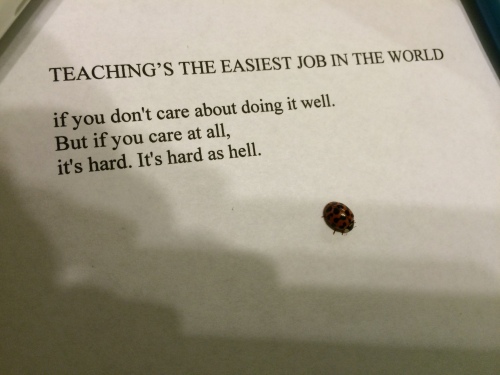
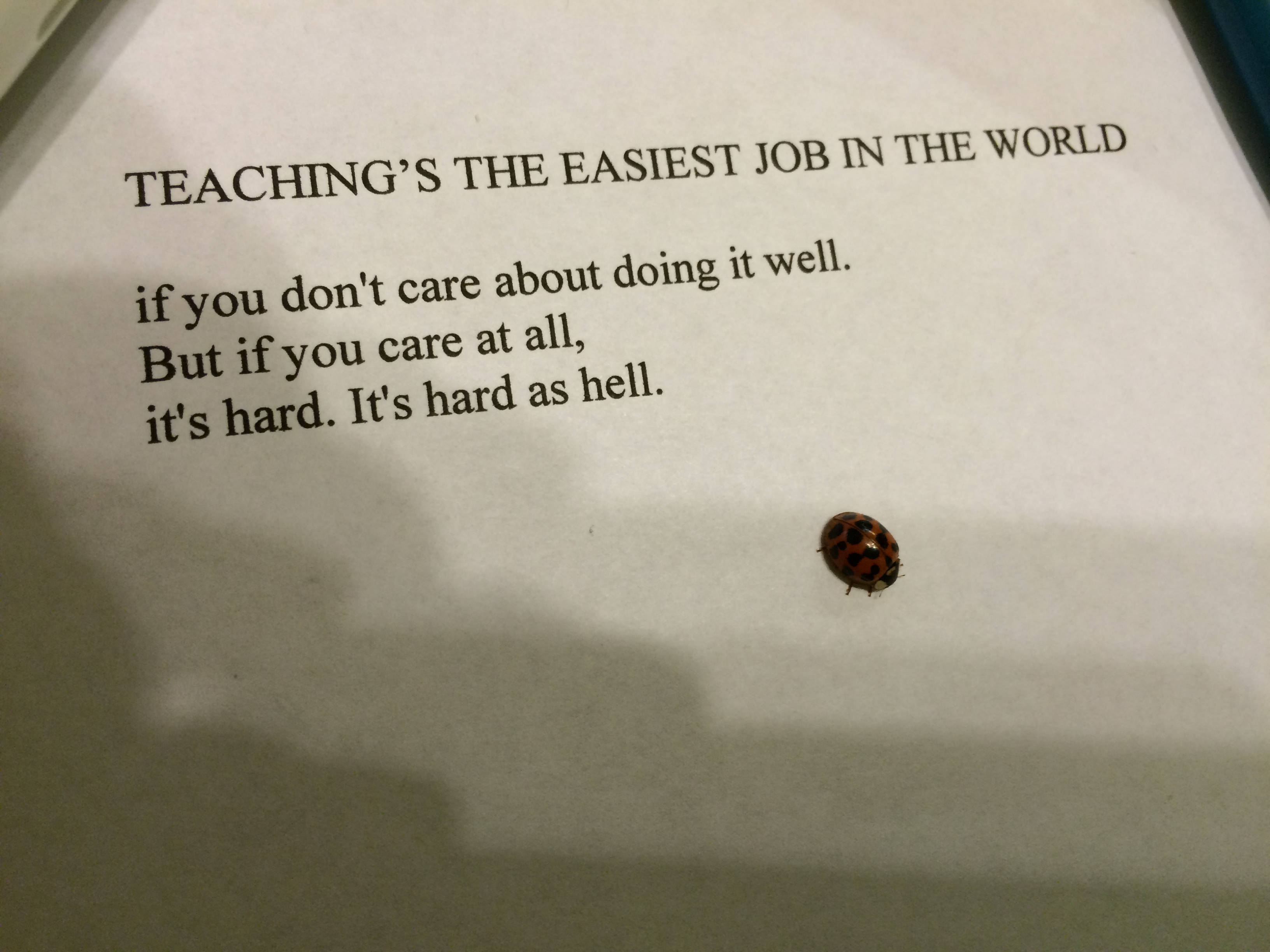
a little poem I wrote with big feelings
Beyond that, I’m setting some goals on the quality of feedback. I want to set the questions and good points from “The Power of Feedback” in front of myself as I start to communicate with students about their work, which I’m less than a week away from (classes start on Monday and the first assignments come in next Friday–sooner, since some students will want me to look at rough drafts, more than likely).
My plan is to report on my turned-in-returned rate after Week 5, or sooner, and I’ll also write more about this article & others I’ve found and will find.
Meanwhile–it’s back to finishing up syllabi & schedules for next week!



 marniere