Category Archives: Folks I Loves

I can’t not love the Cardinals

I will always be a St. Louis Cardinals fan, but I’m not as big a baseball fan as I used to be. Less time for television viewing. No cable television. No reliable free radio coverage until recently when I got a smart phone (we’ll see how next season goes).

And also, steroids.

I sometimes think the last 20 years should have a big, fat asterisk next to it. It’s hard for me to get swept away by a game when I think so many of the players are gaming the system. Thus, Albert Pujols with his bigness always made me nervous (though as far as I know, he’s not on the lists of “guys we’re pretty sure are juiced.”)

Plus I never liked Tony LaRussa’s hair. (And I never forgave him for the way George Will gave LaRussa credit for some of what Whitey Herzog did with the Cardinals.)

But I can’t not love the Cardinals, even when they’re stinking up the field the way they did Monday night against Boston. Once I start, I can’t stop watching this moment during which I am fairly certain Wainwright was jinxed.

But even if they hadn’t won last night (whoo hoo!), I’d still love them.

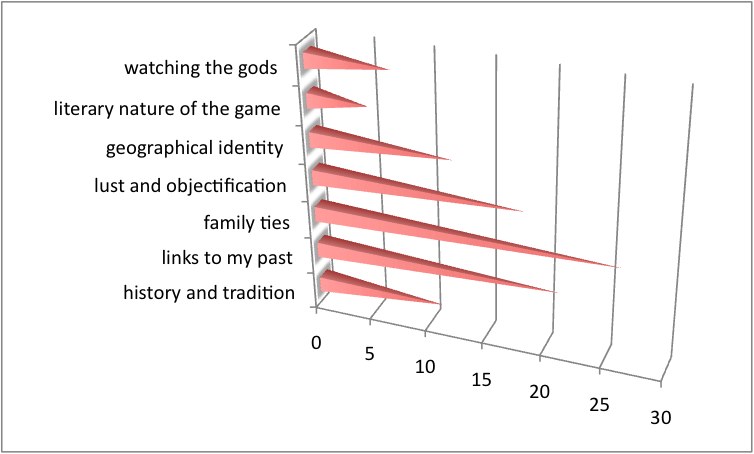
Basically, here’s why:

Seriously.

Seriously.

Watching the gods: these aren’t really normal people. We’re watching them do things we could not do.

Literary nature of the game: lots of people have written about this. It’s true. Bull Durham is my favorite movie, partly because of this.

Geographical identity: I don’t know when I’ll ever live in Southern Illinois again, but being a Cardinals fan is part of how I remind myself I’m from there.

Lust and objectification: Can I help it that I first REALLY noticed the Cardinals in 1982, when they won the Series, when I was 17, in the flush of my first waves of womanly hormone energy and girlfriends of mine pointed out things like “Tommy Herr has a great butt.” Objectification is bad, of course. But wow, are these guys fun to watch. Some more than others.

Family Ties: whatever else makes us different, the vast majority of my Southern Illinois family and I are Cardinals fans, and we can always share that. I love it that my Gran’daddy, who’s been gone for two years now, was a HUGE Yadier Molina fan. (I never told Gran’daddy my theories about Yadi waxing his eyebrows.)

Links to my past: I was such a huge fan in the late 80s. I remember sitting on the deck of one of many trailers I lived in while a grad student in Carbondale, listening to KMOX, drinking a Budweiser, sweating like crazy because birds had built a next in the a.c. and I didn’t want to bother them. I don’t want to ever forget that part of myself.

History and tradition: I never got to see Stan Musial or Lou Brock play, but I have a #6 cap and I would love, love, love to own a Brock-a-brella. St. Louis has been so dominant the last few years, it almost seems it’s cool now to hate them (NOTE:  they were NOT dominant in the late 80s and early 90s when I spent the most time actively following them), but it’s an awesome club with a rich tradition and I’m so, so happy to see them relying on their farm clubs again.

I tend to cheer for the underdogs, nonetheless. I would love to see the Cubs dominate, head to the World Series and win, win, win.  The last time the Brewers were threatening, I actually cheered for them against the Cards in the playoffs. I didn’t really mind when Boston won in 2004 (but I do feel like it’s our turn now, regardless of the arguments made by the Red Sox fan I’m married to).

But when it comes down to it, if the Cards are playing, I’m on their side. I can’t not love them.

Gentlemen in the Rain, Women in the Sun

How fitting that a play highlighting Proteus
would play on a day with various weathers,
rainy and warm then steamy and warm then pouring and warm
then breezy and cool then cool and calm then warm and calm
with the sun changing clouds into haze and then,
when Sylvia crossed the threshold from backstage,
that moment, I would swear it, did the sun
come out, full on,  and turn her blonde hair into blazing
waves of light. I still can’t see, can’t comprehend
why Valentine forgives his awful friend,
why Sylvia forgives her Valentine
for giving her to an inconstant man.
The woman seeming pitiful I get.
The man offending everyone I get.
I choose to see the Bard as having gaps,
not my heart not my brain with this big lapse.

_____


Every Thursday this semester I’m trying to do at least one big thing that reminds me I’m teaching only two courses, and have been allowed the grace and space to spend 20 hours a week on my creativity research.


Waiting for Two Gentlemen of Verona to start this morning, I was able to touch base with one of the many wonderful folks at APT who do their work offstage—at some point this fall, I’ll be doing some interviews about creativity (and especially, ironically, when they try NOT to be creative).


But it was the play itself I was most focused on today.


After all—why research creativity without enjoying the fruits of creativity that my fine little town has to offer?


Nice job, everyone—very nice to see Marcus Truschinski in another leading role, and Travis Knight right there with him (and very fun watching the high school girls at the matinee get all swoony).  I think no one does fragility mixed with strength the way Susan Shunk does—it’s like glass and steel all curving around each other. Nice job, Steve Haggard as Launce, and Will Mobley as Speed, using their terrific comic timing to sharpen the focus of the students who were, for the MOST part, dealing admirably with the distractions of rain and wind and then bright sun and heat.


And I swear, the sun really did come out right at the moment Abbey Siegworth stepped onstage in her tower.


This isn’t my favorite Shakespeare play by any stretch, but I’ve seen APT do it well two times now, and seeing it today gave me fond and bittersweet memories of the last time.  Then, it seemed to me and my friend Lee (may she rest in peace), the director emphasized every possible bit of homo-eroticism in the play (which made Valentine’s actions a little more understandable, if he’s as in love with Proteus as Julia is)

“That was hot,” Lee said to me when we chatted in the aisle right after a performance one night. As I remember it, I could only nod yes.

*


Join the Robbie Alliance!

Since I am, by my genes and by long habit, a worst-case scenario thinker, I have spent a fair bit of my child’s life (beginning when he was still in my belly) worrying  about every little thing that could go wrong.

I am trying to do less of this, this refusal to enjoy what’s going well TOO much.

Brené Brown calls it “foreboding joy” and explains it this way: “We’re trying to beat vulnerability to the punch. We don’t want to be blindsided by hurt. We don’t want to be caught off-guard, so we literally practice being devastated.”

At some point in my pregnancy, I stopped looking at the scary chapters in What to Expect. I was pregnant, after all, after finally accepting that I would not ever get pregnant, and I wanted to enjoy it.  And I did.

However, the revving up of the school year revs up a particular anxiety for me–how to help my son navigate a world that seems full of peas, peanuts,tree nuts, eggs, dairy products and sesame, all of which he is allergic to, in varying degrees.

All in all, it’ll be fine. I’m meeting with the school nurse tomorrow. I’m checking to make sure his epi pens are not expired. I may write a letter to parents of kids in his class. For me, this has to go in the category of Bad Things That Could Happen to my Kid Which I Need to Prepare for and Then Forget About.

I’m not blase about it, but it doesn’t fill my thoughts every day, so in the realm of Bad Things That Could Happen, it has way less suckitude than other things.  I need to stop reminding myself how scary he looked the one time he went into anaphylactic shock. I have to remember to take epi pens with us, and I have to read and re-read labels, but it isn’t constant vigilance.

My friends Beth and Mat, however much they are able to be joyful (and they are, actually, a VERY joyful family, way better at it than my own family), do have to practice constant vigilance because their son Robbie, the same age as my son, has Juvenile Diabetes. Here’s what Beth had to say about it today on Facebook:

I’ve been trying to limit my type 1 diabetes-related posts so that you all don’t get tired of hearing me talk about it. But know that T1D never gets tired of imposing itself on our lives. Every day we take it on and it affects everyone in the family, though obviously Robbie most of all. Just last night we had ice cream before bed and a bit later R’s blood sugar was super high. We went to sleep thinking that maybe the insulin was slow taking effect since we treated him afterwards. Then an hour or so later I woke up with a jolt and realized we’d never actually treated him. We gave him his insulin, but he continued to be high the rest of the night. I invite you to pick a day and pick a child (or yourself) and imagine having to account for every bite of food that enters the body. Imagine trying to calculate how exercise affects the blood sugar – running around a lot? Less than usual? Going swimming? Imagine calculating how excitement or nerves impacts the blood sugar level too. Imagine watching your child as he lives his life, always wondering in the back of your mind if he’s going low, risking a seizure or going high and risking all the scary long term complications. Every day is a new battle. We hang tough and the terrain grows familiar, but we pray for a cure daily. That’s why we support JDRF.

What a life motto: “we hang tough and the terrain grows familiar, but we pray for a cure daily.”

That’s so different from my worst-case-scenario worry-wart-ism. It’s almost its opposite. It’s dealing with reality and still figuring out how to enjoy ice cream when you can.

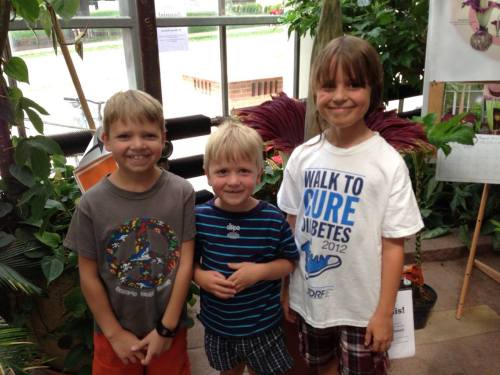
Look at their amazing boys–

Great kids! That's Robbie on the left, with the peace shirt.

Great kids! That’s Robbie on the left, with the peace shirt.

We don’t get to see this great family much any more, but in honor of how awesome they are, and what a great cause this is, I’ve contributed to the Juvenile Diabetes Research Foundation.

You can contribute to, through the Robbie Alliance. I know we can’t all say yes to all the good causes we’d like to contribute to, but I hope you can help this organization, this family, and this really terrific kid.

And also, they have a terrific logo:

robbiealliance

_____

This post is partially a thank you and a perk from my Indiegogo campaign, which I called “a shout out on my blog.”

I like to think it would have occurred to me to promote this very good cause even if Beth hadn’t contributed to my fundraiser, but it didn’t occur to me last year, even when I made a contribution to the JDRF. I am so slow sometimes….

2013 Wisconsin Professor Mindset List

On August 20, Beloit College will do what it’s been doing since 1998 and release the Mindset List for incoming college freshman. These lists are fun, especially if you don’t look every single year. So, for example, last year’s #20 “Exposed bra straps have always been a fashion statement, not a wardrobe malfunction to be corrected quietly by well-meaning friends,” amused me. I think about bras straps now and then. Other deep things I think about include trying to figure out when we’ll all decide shirts need to be shorter than the jackets they are worn under, or at least tucked in. I hope someone tells me when this happens. It took me a while to notice it was o.k. to have a shirt hanging out below a jacket.

This list is written in the spirit of “young folks live in a different world,” and to the extent that professors are old folks who are out of it, and a little more out of it each year, I think the list is helpful.

But honestly, if you’re the sort of professor who hasn’t noticed that students get their music in digital format now, a glance at this list won’t help much. And going overboard with the impression that “they often listen to it on their laptops or replace it with music downloaded onto their MP3s and iPods” (last year’s #15) might make  us miss out on an awesome opportunity to talk about the deep pleasure of listening to music on vinyl, a pretty big trend among youngsters at the moment (maybe that will be on this year’s list).

Dana Falconberry, who looks almost old enough to drink legally, had an awesome show at the Sh*tty Barn last night. She sells her song in CD, MP3 and LP format.

It turns out that spending time with young people is a really good way to learn about their mindset.

I was terribly impressed with Dana Falconberry, for example. Not only was the music awesome, her gratitude was really shiny and sweet to see. She said repeatedly how honored she was to play music in a venue where people were listening. Sitting in their chairs and listening. And totally engaged. She thanked Chris and Martha, the owners of the Sh*tty Barn, repeatedly, and followed up one of her compliments with “especially considering the state of the music industry right now.”

So, yes, I have to have it in my heart to reach out to students this fall who truly, truly, love Justin Bieber. But they don’t all love Justin Bieber (mentioned in last year’s #1).

I will check out the list when it comes out next week, remembering that it is written by guys who are older than me, who seem to be nostalgic about a world that was already gone when I started college in 1983.

Meanwhile, although I am utterly unqualified to write a list about anyone’s mindset but my own, I thought it might be fun to try to list some things that are true of me and at least one other professor (how’s that for a high standard in statistics and the logic of generalization?) I’m not the first professor to have done this–professors doing their own mindset lists may become as much of an August tradition as people passing around the Beloit list, which contains 75 items.

I don’t have the attention span or time for that many. I’m sure the fact that Sesame Street came on the air when I was four (and I thought for a while it was JUST FOR ME and was upset when I found out other kids had it in their houses, too) has something to do with my relatively recently diagnosed ADHD, the existence of which I’m sure was bemoaned in an earlier list.

1. If you’re a traditional age student, I have been teaching since before you were born.

2. If you’re a non-traditional student, first of all, you are my favorite kind of student. Seriously. Second, I am assuming you’ve been doing a lot of interesting things other than getting a college degree, and I’m looking forward to hearing about them.

3. Even though I did less of what I call “work-work” this summer than I usually do, I didn’t “have the summer off.” I did some work I got paid for (evaluating student writing samples for composition class placement) and some writing and research and class prep (which I consider “pro bono,” since I didn’t get paid for those).

4. You should know I am open to questions and complaints. This will become clear as the semester proceeds. (Or you’ll find out that I like to see myself as open but am really a bitch–I don’t think that’s true, but it’s within the realm of what’s possible. I ask for student feedback A LOT, in a variety of ways, including anonymous surveys, so I feel certain someone would have told me by now if I were pretending to be open but not really open.)

5. Even though I’m open to questions and complaints, I don’t get all happy hearing the “I paid for this class so I should be able to do what I want” argument, also known as the “student as consumer” model.

Let me assure all students and parents contributing to my students’ education (tuition now covers almost half of what it costs to run my institution–it used to be a third), and the good taxpayers of Wisconsin (state support for higher education is dwindling, but it’s still there), and taxpayers all over the country (federal financial aid, etc.) that I am determined to give good bang for the buck in and out of my classroom.

I am a well-published, award-winning, full professor in my 26th year of teaching at the college level. Moreover, I am working to improve. All the time. Every year. Every semester, actually.

But students aren’t really consumers. Even if a student of mine is paying 100% of her or his own tuition (which is rare), that isn’t half of what it costs to educate that one student. (And in a classroom of 24, it’s 1/2 of 1/24th.)

So if we stick with the consumer model, then the consumers are the ones who pay the most, and in that case, the student is a product.

Fortunately for all of us, I don’t like the consumer model much at all.

I’m getting paid a good salary to do an important job, and I’m on it. I got this.

6. However, you should also know that I don’t respond well to the “You should be available to me 24 hours a day since you make $80,000 a year” argument. Like a lot of professors my age (I’m 48), I am in the sandwich generation.  I have a son who’s eight and a half, and parents whose doctor appointments I track on Google calendar–not because I have to take them to the doctor every time, but because that’s just what they do a lot of during the week, and I’m close to my parents. I’m also married to a pretty terrific guy.

Thus, because of all my important and socially acceptable obligations, I simply cannot be available 24/7.  But honestly?  I’m not even trying.

I spend a fair bit of time on things that are only important in the sense that it’s important to enjoy life.

I just don’t think my (relatively) good salary means I should be available to students 24/7.  This applies to my colleagues as well, btw.

I don’t know how much you’d have to pay me to be that available, but it’s way more than I will ever make as a professor.

But I’m VERY available. Students praise me for it year after year in the end of term ANONYMOUS surveys the UW Colleges distribute. I’m in my office a lot and on email a lot and even available for online chats.

Also, I don’t make $80,000 a year, which leads us to the next point:

7. It’s kind of an icky time to work in the public sector in Wisconsin. It’s probably better if we don’t talk about it much.

8. I am a lifelong underachiever. My talents and my potential have almost never led to the kind of success other people anticipate for me. So I totally get skipping class, procrastinating, doing sub-par work, and generally all manner of slacking. Keep in mind, since I was born in 1965, I’m not a Baby Boomer. I’m Generation X, known across the universe for slacking.

Here’s what I don’t get:  the student who doesn’t do the work and somehow expects a grade other than what is indicated by the work that was done.

I get it if you don’t want to bring your A Game to my class. I won’t take it personally. Or I’ll try not to. But if you don’t bring your A Game, don’t be all fussy at me when your grade isn’t an A.

(And you probably ought to bring your B Game to class if you want a C, because it turns out college is often more challenging than high school. Not always. But often.)

9. If I can figure out where to get a bunch of them for free, I’m going to have a big bowl of condoms and dental dams in my office. Come by and grab a handful. (I’d buy them for y’all, but can’t really afford that, cf. #7.)  I heard on the radio last spring the rate of AIDS infection is going down except for traditional-age college students. Geez, people. Watch Philadelphia, would you? Seriously. Most of you aren’t going to get jobs with good benefits, so you won’t be able to afford all the awesome AIDS drugs we have now. And hello–what you do or do not do now can give you or keep you from getting things like cervical, anal, or mouth or throat cancer. So really, could you just try to not get any STDs? And wait just A LITTLE LONGER to get pregnant? Sheesh.

10. When I first started teaching, my group of graduate assistants was  told that part of our job was to help “thin the herd,” that SIU had admitted more freshmen than it could accommodate in sophomore classes. I can’t remember the exact percentage, but we were supposed to make sure there were at least a few Fs on our final grades, and if there weren’t, we were in danger of not being re-hired.

A snootier way to talk about this would be to say that first-year courses and instructors are “gatekeepers,” and in charge of getting rid of students who aren’t really “college material.”

It’s ridiculously easy to teach in such a way that a certain number of students are guaranteed to fail.

It’s much, much harder to try and teach in such a way that students are sufficiently supported on their way to  meeting appropriately high standards.

But that’s what I’m trying to do. If you’re in my classroom, I want you to succeed.

_____

So there you go. My 2013 Mindset List. What was on my mind when I started college? Eye shadow, apparently:
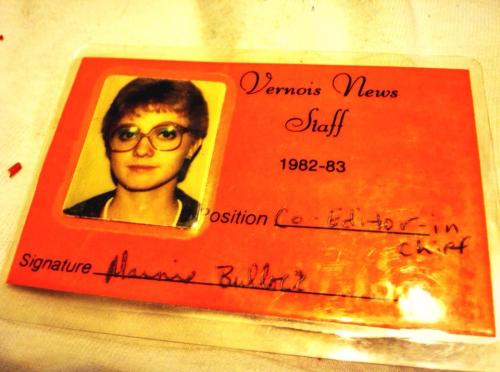
I don't know yet as much as I thought I knew then.

I don’t know yet as much as I thought I knew then.
APT’s Hamlet is Awesome. Go See It.

Q: How’s Hamlet?

rgbackdrop

The short answer, for American Players Theatre’s 2013 production is that it’s terrific and I’m still processing how terrific it is.

It took me to my APT happy place numerous times on Sunday night (a very muggy-buggy night), by which I mean I forgot I was watching a play, forgot I knew the actor playing the part, forgot I was anywhere but in the moment on the stage.

Part of me wants to stop there–to say, simply, it was great. Everyone who can get here should get here and see it.

Except this Hamlet was so freakingly brilliant–I thought about it for hours after I got home, and I’ve thought about it all day.

So at the risk of revealing my theatrical and Shakespearean ignorance (the vastness of which undiscovered country has not been mapped), here are some of those thoughts.
____

I really think John Langs, the director, is brilliant. I know a theater production is a collaborative process, so my appreciation of the unnerving, stark, gorgeous, imposing, spare set goes to Takeshi Kata and Andrew Boyce. And the way the lighting shows two Hamlets–his posture saying one thing, his face saying another?  Credit for that goes to Michael A. Peterson.

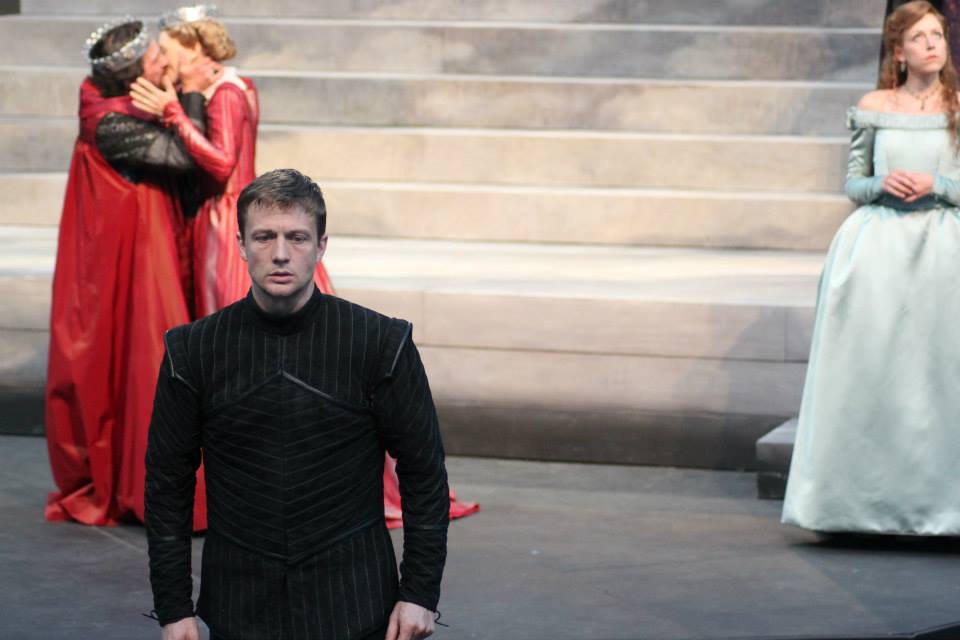
The shadow seems much surer of itself here.

The shadow seems much surer of itself here.

But over and over, each component worked with every other component. The costumes worked with the set. And the set worked with the lighting. And the lighting emphasized the performances. And the performances were awesome. That’s to the director’s credit.

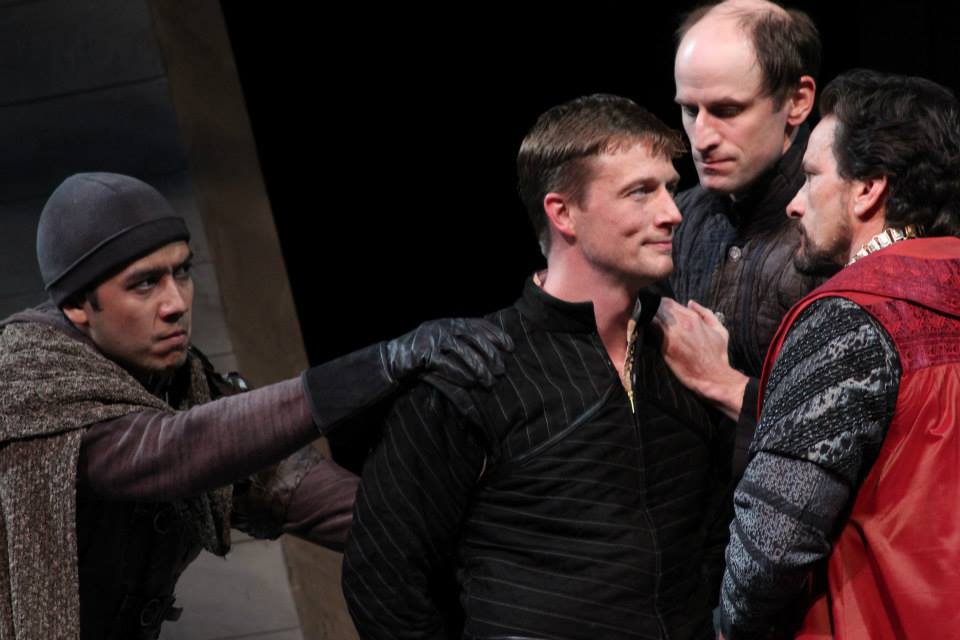
And having James Pickering–a really well-known Milwaukee actor who’s never appeared on the APT stage before–play the ghost and the player who plays the king parts and the gravedigger–that’s not just a casting idea. That’s an interpretive idea.

It made it seem like the ghost was showing up ALL THE TIME.

The child longing for the nuclear family that no longer exists.

The child longing for the nuclear family that no longer exists.

I know directors pluck from other performances (and there are a lot of Shakespeare casting traditions that would be utterly lost on me–I mean, I know about Cordelia/the fool, but that’s about it), and I know Langs directed Darragh Kennan in Hamlet in Seattle pretty recently, so I don’t know if this is the FIRST Hamlet to do that with the ghost/player/gravedigger, and I don’t know if the ghost has shown up other times when he doesn’t have lines, as he does in this performance (I won’t say where-all, because at least one of them seemed like a big risk with a big payoff), but it all went beyond “interpretive idea,” actually. It felt like vision. Genuine artistic vision.

What a counterpoint to Bassanio and Antonio from Merchant of Venice.

What a counterpoint to Bassanio and Antonio from Merchant of Venice.

Casting at APT is a complicated thing–eight plays done in repertory, core company and guest artist needs and contributions considered (who had a huge part last year, who had only supporting roles, who has one huge role this year and needs other supporting roles, who has reliable chemistry with who else)–so I can’t attribute the genius casting of this production of Hamlet to John Langs alone. Whoever had a hand in it, though–bravo.

If I’d been asked, prior to seeing this performance, to list Shakespeare’s really nasty kings, I’d have said Richard and Richard and then changed the subject, since I don’t know the histories as well as I ought. I might not have thought of Claudius at all. It’s not what I would typically think of as a meaty part.

But in Jim DeVita’s hands? Well, I hear Jim’s a fine cook, so I could say it’s like carving a chicken and understanding there’s good meat to be found places other than the drumstick and breast. Anyway, he found the meat. And chewed it up.

I mean, wow. When he says, of Fortinbras, “Holding a weak supposal of our worth,/ Or thinking by our late dear brother’s death / Our state to be disjoint and out of frame,” the delivery was so powerful I found myself wondering if Langs had somehow let Claudius deliver one of Hamlet’s speeches. (He didn’t. At least that one’s not Hamlet’s.)

“I like him not,” he says of Hamlet. And you think, “uh oh.”

I don’t mean Jim was upstaging or scene-stealing or anything bad. He just made it so clear how powerful Claudius was. How mean.

And unlike some productions, which maybe emphasize the Oedipal-incestuous-icky embraces between Hamlet and his Mom because no one can possibly imagine her really being turned on by whatever Claudius they’ve cast (the pompous guy in the Slings and Arrows production comes to mind, Season Two, Episode One, not the first season’s Claudius), De Vita and Staples have awesome onstage chemistry. One review found it “puzzling” why they were “hanging all over each other.” It didn’t puzzle me at all. Wouldn’t you, on him, were you she? And wouldn’t you, her, were you he? I, me, we would, methinks.

Gert and Claud

Gert and Claud

And then of course there’s Hamlet his own self.

Bravo, Matt Schwader. Bravo.

Mike Fischer’s review gets it right, that Matt’s “intensity adds bite and even menace to Hamlet’s encounters.” He calls him “white-hot,” and says he “handles Shakespeare’s verse as well as anyone at APT.” Yes, and yes, and yes.

I am enjoying reading and re-reading about Matt’s Hamlet process in his blog, “Bounded in a Nutshell.”

(He’s not just pretty. He’s also thinky.)

Matt’s explanation of his process helps explain one of the things that amazed me last night: the BIG ASS SPEECHES melded into the play so smoothly. They weren’t under-played, and not muted, but at no point did the production feel like this:

Druuuuuuuuummmmmmmroll: SOLILOQUY. (more stuff, more stuff, more stuff) and then
Druuuuuuummmmmroll: SOLILOQUY.

For example, leading up to the most famous of the BIG ASS SPEECHES, the “to be or not to be” one, because David Daniel’s Polonius is so strong, and Jim De Vita’s Claudius is so strong, and Christina Panfilio’s Ophelia is so strong, I found myself focused on what THEY were doing. Especially Ophelia. (I’ve never felt so pissed at Shakespeare for killing someone off as this Ophelia. She had spunk, damn it.)

Lou Grant to Mary Richards: "You've got spunk. I hate spunk."

Lou Grant to Mary Richards: “You’ve got spunk. I hate spunk.”

So when Matt came onstage and began speaking, to the audience, it took me a beat or two to realize that what he was saying was one of those speeches, even though I’d known what was coming.

In terms of speaking to the audience, as he was, part of the time, in this speech, Matt has this to say, “I’ve found that it is simply much more dramatic and engaging to watch an actor speak with another person (or group of persons, as is the case with direct address), than to be muttering to his or herself. Tremendous drama lives in the unexpected. What unexpected thing can happen to a person talking to his or her self? Not much. On the other hand, talking with an audience opens a flood of possibilities as to what might happen.”

The unexpected here is that Ophelia is listening, and she startles Hamlet, which was startling. In a good way. Because then the “get thee to a nunnery” lines seem startling, even though I knew they were coming.

Hamlet and Ophelia.

Hamlet and Ophelia.

_____

Matt did a fantastic job, which wasn’t startling. Anyone who’s watched him the last few years knew this was coming, that he’d earned it & that he could do it.

But what was startling overall was how his performance seemed utterly in service of the play.

I don’t mean I expected Matt to be selfish or show boaty. I’m just used to thinking of Hamlet as a vehicle for Hamlet (the character and the actor who plays him). This didn’t feel vehicular at all.

What a great play.

Another fantastic shot from Carissa Dixon

Another fantastic shot from Carissa Dixon

_____
(All these awesome images of the production are used with permission from the awesome Carissa Dixon.)

My Last Transition Metal for a While

The end of this month, I’ll turn 48. Inspired by Oliver Sacks, I looked up 48 on my Periodic Table of Elements place mat and found that Cadmium is element 48. It is a Transition Metal, the last I’ll experience for a while. Next up is Indium, which is grouped under “Other Metals,” (so no telling what that’ll be like), and then a couple of Nonmetals, and then, at age 54, a noble gas! Xenon. That’s something to look forward to.

More about Cadmium, from a lovely blog called GrrlScientist, which has an “element of the week” feature:

  • It’s highly toxic.
  • Used in nuclear reactors.

Cadmium also “adds fatigue resistance to many solders,” which I mis-read first as “adds fatigue resistance to many soldiers.” In any case, fatigue-resistance sounds lovely. Just what I need.

It can make strong batteries and then pollute the environment.

It makes pretty colors.

This post on cadmium yellow says that “Claude Monet (1840-1926) liked to use cadmium yellow for outdoor settings in paintings such as Autumn at Argenteuil, as he believed it would better guarantee the survival of his art. For this reason he abandoned chrome yellow pigments (with the exception of zinc chromate yellow) in the latter part of his career.”

Cadmium green, meanwhile, shows up online as all the shades of green I’ve been obsessed with lately. I may have to go to an art store soon just to get a tube of Winsor & Newton:

cadmiumgreen

So, other than being toxic and all, 48 should be an interesting year.

If you haven’t yet, you should read “The Joy of Old Age. (No Kidding.)” in which Oliver Sacks points out that his upcoming birthday, 80, is Mercury on the Periodic Table (I don’t know if he has the table on a place mat or not). It’s a lovely piece, with several notable moments. My favorite is this:

“At nearly 80, with a scattering of medical and surgical problems, none disabling, I feel glad to be alive — ‘I’m glad I’m not dead!’ sometimes bursts out of me when the weather is perfect. (This is in contrast to a story I heard from a friend who, walking with Samuel Beckett in Paris on a perfect spring morning, said to him, ‘Doesn’t a day like this make you glad to be alive?’ to which Beckett answered, ‘I wouldn’t go as far as that.’)”

I have elements of both those sentiments. Sometimes I do feel “every day is a gift,” but some days, I admit, the gift feels like a total white elephant.

Here’s hoping 48 is more Sacks than Beckett. In most ways.

Much Ado (Very, Very Much)

My anxious thoughts do woo me like Don John,
with wild tales of catastrophe, with shame,
and I play stupid Claudio each and every time.
I fall for lies. I forget everything I’ve known.
Up next the betrayed Hero inside me dies.
Not really dead, but a bad-ass swoon, or worse–
the split-second wish that everything would end
if this building, choking, chewing panic can’t.
Only Beatrice says it can. I always lose
when I argue with myself. I am a mess.
Only Benedick, in pill form, thus,
can hush me, with his little medicated kiss.

_____
That Joss Whedon. I tell you what. I loved, loved, loved his Much Ado About Nothing.

Having been swamped a bit with anxiety lately, I’ve been thinking on it, and am concluding that anxiety is a big, fat liar. But sneaky, and seductive.

Today’s wisdom, thus: if the sneaky liar is as cute as Sean Maher playing Don John, no wonder I keep falling for it.

Sean Maher  taken by Gage Skidmore

Sean Maher
taken by Gage Skidmore

And, fortunately, all’s well that ends well, right? (Because in this case, Beatrice is right–the panic never lasts. Also note: I’m so sorry to repeat the structure of Shakespeare here in my sonnet, giving Benedick the last word. I just tell myself he must be an awesome kisser in that last scene, if she stops talking entirely.)

But wouldn’t it be lovely, if my inner Claudio developed his shit-detector a wee bit more?

And if my inner Hero freaking stood up for herself instead of swooning?

Well. One does what one can to line one’s psychological ducks up*, and then one hopes the duck poop doesn’t give everyone swimmer’s itch.

_____

*including the appropriate and authorized use of anti-anxiety meds, thank you very much

(Image of Sean Maher available through Creative Commons license on Flickr.)

Driving in a David Cates Novel

“O beautiful, for spacious skies
But now those skies are threatening”
“The End of the Innocence”

Taking the secret detour, the one the natives use,
I fly down Highway T to Z,
past the Cates family farm but really,
it’s the dips and swales and curves
and hills and valleys and long slopes up
and ridge roads that feel impossibly high
for Wisconsin that let me know I’m in a zone
where fiction could happen and also perhaps
some magic but for me, partly panic–

I get agoraphobic on some of these rises
where all you can see past the crest
is the sky. It reminds me of Eastern Montana
a little (except for more trees on both sides),
where I once drove up a long brown hill for so long,
for an hour, forever, I stopped believing in Canada.
I couldn’t imagine anything north of where I was.
Nothing but a sheer drop-off to Hell, maybe,
over the top, nothingness, a crevasse, the crimp-
edge of the known world, no ditch, just–

The trip up, the torture, doesn’t last that long here.
Just when I’m wanting to pull over,
figure out how to turn around or back up,
which is impossible–the road’s too narrow,
the curve’s too sharp, the hill’s too steep–
well, there we are, around the bend
finally, a stretch of open road, another red barn.

Another falling-down house tucked in behind
a mess of blooming lilacs, under which,
if this really is a David Cates novel, someone’s having sex
RIGHT THIS MOMENT, and probably with someone they shouldn’t.

And later the woman, or maybe she’s a girl,
would take a dandelion and say “make a wish”
as she blew the white seeds everywhere at which point
the man, or maybe he’s still a boy,
would think “tampopo” but not say it, not wanting
the girl to feel bad for not knowing Japanese,
and he might also think, but not say,
some racy, clever thing using the word “blow.”
What he probably would say would be “Great.
Now there are more weeds everywhere,”
but then regret having said anything at all.

Because you have to remember, the moment you think
“Anything can happen,” that something bad could.

Just because it’s almost June and everything’s green,
every shade of green, just because the blue sky
is paint-chip sky-blue right overhead, even when
you’ve got Don Henley cranked on the radio,
you can glance in your rear view mirror and see
how the bright blue turns to pale blue and then haze
and then gray along the horizon.

You can see farms you can’t get to on Highway Z.
The people who live there are happy or sad.
But you’ll never get there. You’ll never know.

Coming home, you’ll stop at the T of Highway T and 23
and you’ll see Frank Lloyd Wright’s wind mill
and it won’t impress you this time. Not at all.
_____

I left Southern Illinois to go to graduate school in Missoula, Montana, and there met David Cates, who’d come from Spring Green, Wisconsin, where I live now.

Freaky.

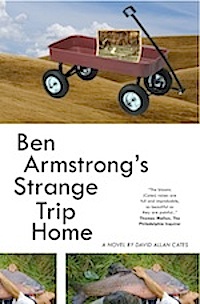
His latest book is odd and beautiful and haunting and two trips to Dodgeville recently I really have felt as though I entered some sort of parallel universe. If you read the book now, there’s probably a silver station wagon taking a curve a little too fast. I’ll be waving.

The latest novel by David Cates (wonderful to read, odd to drive in)

The latest novel by David Cates (wonderful to read, odd to drive in)

Purgatory, Kentucky

It got to where I couldn’t see a way
ahead except for dying. So I went.
So here I am. Just where, I couldn’t say.
It’s odd. Some kind of grass, or cane, all bent

this a way and that, slick at the root,
and spiky sharp half the time, black as coal,
but soft enough to lie down in, some spots.
I’d a slept more, but my dreams is full

of nasty animals and dead presidents.
I got attacked by a whole fleet of armadillos
in a river. An armada. Is that what you call it?
Abraham Lincoln himself chopping wood. “Hello

Mr. Penny Man,” I said. He spoke not a word.
But this ain’t Hell. Of that I am assured.

_____
This was a challenge poem–I wanted to write a poem JUST FOR my reading tonight at UW-Manitowoc (which was terrific–thanks, Jessica!). So the Manti folks suggested I write about Boyd Crowder’s hair, Abraham Lincoln chopping wood, and an armada or armadillos.

I’m imagining Mags Bennett’s voice here. Might write some more of these.

The Constable Bob of the Classroom

I unlock the door to class then lock it back.
As we go in I say, “This is what I do
to protect you in the event of active shooter attack.”
Students laugh. It’s early. There are only a few,

so I go on to say, “Just so you know,
that’s pretty much it. I shut the door so
no one in the hallway can kill you fast.”
In my idea of myself, I could master

a sweet little Glock 40 and holster it
and pull it out when needed. “My aim is true,”
I’d sing in my head as I blew holes clean through
my targets. But oh, my students and I, we get

an image of things going badly with me armed.
I want to be Raylan Givens, that tough, that cool.
I’d be lucky to be Constable Bob. First do no harm?
Not with this clumsy, gun-totin’ prof in the room.

_____
(I would be BEYOND lucky to be Constable Bob. “Drewbacca” indeed. And also, p.s., I can’t even pretend to begin to imagine I could ever be as cool as Ava.)