Category Archives: On Wisconsin

Getting the Pay Raise You Deserve, Part IV

Part of healing from burnout is learning to set boundaries. Making time for what’s important (yourself. family. friends. fun. community. yourself again) other than your work.

Easier said than done. Really easily said. “Set boundaries.” Unless you have a cute little hint of a lisp the way John F. Kennedy, Jr. had. Then it’s a little harder to say.

Pretty hard to do.

But those of us who’ve emerged from the Pretty Good Depression still employed find ourselves picking up the slack left behind when people were laid off, or  not replaced, or carrying a heavier load in terms of student enrollment, juggling new initiatives, etc. etc.

It is just so easy to do too much for too long and end up having your soul scrape up against your to do list like bone-on-bone-bad arthritis.

In the long run, as I mentioned to my boss’s boss’s boss last Valentine’s Day (ahem), a system that is structured to rely on people burning themselves out LIKE OURS is not sustainable. (It also doesn’t get the best work out of people, even in the relative short-run–but that’s the subject of yet another blog yet to be written. Stay tuned.)

For me, the urge  to work too much (and the actuality of working too much and the guilt of perhaps not working enough) mixes with my long-term tendencies toward depression and anxiety into a toxic burnout brew that makes me less of everything I want to be (loving, enthusiastic, effective) and more of everything I’d rather not be (chronically irritated, cynical, spastically ineffective).

I’m still learning, but I’m making progress.

If you click on “burnout” in my blog categories, you’ll see it’s something I write about a lot. (cf: fixate upon.)

In Getting the Pay Raise You Deserve, Parts I, II, and III,

I acknowledge:

It is all too easy to come across as whining, and something like “I had to spend an hour on the phone getting my insurance coverage worked out today” can come across as ingratitude, a classic First World Problem….it is a luxury to consider what changes we could make to improve our lot. But you know what? A lot of us in academia do have that luxury, especially those of us with tenure.

I assert:

You can raise your hourly wage by working fewer hours.

I celebrate myself, I sing myself:

I don’t work too hard. I work hard enough.

Here’s how good I am at setting boundaries.  I got folks pounding on one of the walls I built hollering at me  like they’re possessed by the spirit of Chico Marx: “You no work enough.”

Here’s the contested boundary of the month:

In response to Scott Walker’s 2011 budget bombs (which resulted in less take home pay for my family), I looked around to find ways to save money. We love Culver’s just as much as we always did, but we don’t go as much as we used to. INSERT LOTS AND LOTS OF OTHER EXAMPLES OF BUDGET TRIMMING HERE. And then, to save money on gas, I started working from Spring Green some Tuesdays (my teaching schedule is MWF). That enabled me to volunteer in my son’s classroom now and then. That turned into a regular gig. That turned into a commitment. Which turned into a column in the Voice of the River Valley.

I do a lot of work on Tuesdays, and I check email a lot during the day. I’m considering setting up virtual office hours to make sure students and advisees remember that I am available on Tuesdays, just not in person in my office on my campus. And as I mentioned in one of the three prior posts in this series, I average more than 40 hours a week during the 9-month contract. Since I try to take a week off between semesters, and two days off at Thanksgiving, and two or three days off during spring break, and maybe Labor Day if I’ve got my course syllabi ready, that means I typically average 45 hours during an actual teaching week.  (I don’t count how many hours I work in the summer, but it probably averages to about 20. )

I don’t see why it’s anyone’s beeswax, if I’m accessible to students, if I’m doing my job well (I have official recognition of that), and if I’m doing my share for service (and I do), WHY it matters how many of those hours are in my office or on campus or in my kitchen or at a coffee shop or wherever.

But there are people for whom dedication to campus life is measured in hours worked (more hours = more dedication) and hours on campus (more = more). I don’t agree. I hope the issue goes away. If it doesn’t–well, gracious. You won’t like me when I’m angry.

Take this one boundary skirmish as a warning, all ye who dare to dream of  work life balance. Sometimes when you set a boundary, you have to defend it. But a lot of times, people don’t even notice.

If you’re brave enough, if you’re tired enough, if you’re burned out enough, tune in next time when I share my Top List of Ways to Work Less. (Remember: if you’re on salary, you can raise your hourly wage by working fewer hours.  The hilarious irony is that the quality of your work will actually go up, and in some cases, the quantity too–because you have more energy to focus on the things you’re still doing. Shh. Don’t tell.)

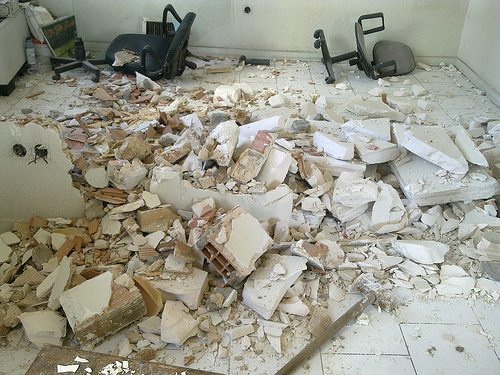
Meanwhile, Joshua blew the trumpet at Jericho and the walls came a-tumblin down.

This is what a system structured on burnout looks like. Eventually.

This is what a system structured on burnout looks like. Eventually.

_____

(photo from flickr, Creative Commons, by Babak Farrokhi, entitled “Office Under Construction.” So it’s not really about sustainable systems OR Jericho.)

Each Other’s Anodyne

I’m working today on the manuscript of a chapbook of poems about teaching and working as a professor. The working title is Each Other’s Anodyne, in which case this is the title poem.

I posted it as a note on Facebook two years ago. During Wisconsin’s Arab(esque) Spring.

The ice on our streets and sidewalks, the way the snow is crunchy, the way slush turned to gray iron–it would be so treacherous if we were protesting in Madison today. So I’m glad we’re not.

In general, the political turmoil is overall lower, and I am relieved–I felt wiped out emotionally and spiritually by that spring, and the failed recall didn’t help revive me. Other things have helped. The passage of time has helped.

Finding this poem again for the manuscript brings it all back, though, and I have to ask:

How much has changed, really?

This poem still resonates with me. (And I still need to revise the second sonnet to focus more on Firefly.)

(It’s a crown of sonnets, if you’re into form at all.)

_____
EACH OTHER’S ANODYNE

The weary teacher lays his pen aside
And rubs his eyes, says to his wife, “All right,
I’ll come to bed.” They both know he will try
To grade some more in the morning. All through the night
Another teacher wakes up anxious, mad
At everyone. She yells at her husband and son,
But it’s not their fault. It’s not the teachers’ fault.
In a dark time, our hard work shines too bright.
We’re public target practice. We’re spittoons.
For a time, a shining time, we were solid
In the middle class, rewarded for working hard
To help synapses snap and shimmer in the light.
Tempus fugit, damn it, sad but true:
The best shows all get cancelled way too soon.

The best shows all get cancelled way too soon.
Post-modernly they hooked us and we swooned
At heroes rounding all the genres up
To drove them o’er the plains. Inspire us!
The hooker with the heart of brass blew up
The patriarchy, blam! The runt did chin-ups
Until he made the winning catch, two times.
The rocket rounded earth, accompanied by chimes
At midnight, and we, we got attached too fast
To what the larger corporate sponsor failed
To see a profit in. It couldn’t last,
But we had no idea the cruise ship had sailed.
We made a snack and snuggled, and watched the show.
The nights were longer then, with deeper snow.

The nights were longer then, and deeper snow
Made driving slower. Now darker days have come
Despite the later sunsets. We didn’t know
How sweet it was—our biggest worry was some
Stupid internet scam our students fell for—
An octopus living in trees. Like always, slow
In winter—we did our jobs, shoveled some more,
And then the Packers won the Super Bowl!
For Valentine’s, our governor went nuclear.
So far he’s systematic—everything
We care about, he wants to cut. Budget despair
Has set in hard. It will not ever be spring.
Thick fog, black scabs of snow, raw time, hard earth.
But up in the gray, three sand hill cranes, flying north.

Up in the gray, three sand hill cranes, flying north.
Inexorably, the seasons change. They do.
But broken-hearted, raw, beleaguered blue—
We cannot trust the calendar. It’s death
We see when we look around—dead trees, dead grass
Below the layered shale of sooty ice.
Just like “always winter and never Christmas,”
We long for a miraculous thaw or a looking glass.
Not knowing is the worst; at least we think
It is—we’ll think that until we learn the worst.
However far we’ve learned our hopes can sink,
they’ve sunk so far, and farther, and farthest.
We thought we had a thaw, but it froze again.
The ditches are full of ice. But it is thin.

The ditches are full of ice, but it’s too thin
For skating. It makes a satisfying crunch
When you stomp it. Let’s watch the two of them—
These women hiking, sharing a picnic lunch.
One’s tiny—she can almost walk across
The ice before it breaks. Almost. Not quite.
Crashing, they are each other’s anodyne.
One lover catches another and she laughs,
“You silly thing.” And just like that, the tears
come flying out, “I’m sorry I dragged you here.
I can’t even make you my wife. This stupid state
Is stupid. I hate it. Hate, hate, hate.”
“Please don’t hate on my account. Not ever.
We’ve made a home. Your students need you here.”

We’ve made a home where students need us. Here
In the trenches, in the cold and the muck of open admission,
We’re spinning plates for students, showing where
Centrifugal becomes centripetal
With just the right transitional phrase. They take
The plates away from us, they break the glass
Bell jars and ceilings, they celebrate the figures
That animate their dreams the night they made
The quadratic formula prove itself on threat
Of death, organismic, de dicto, real.
Whatever ivory tower there ever was,
It’s gone for good, and most of us are thrilled.
We may stay—we may move on—but we are sure—
If not Wisconsin, somewhere, someone will learn.

If not Wisconsin, somewhere, someone will learn
That when you titillate the lesser devils
Of our nature, when you go all Soviet
And wish my cow would die (you ate your own),
You’re just a toddler berserker tearing down
the walls, affronted when the ceiling lands.
America seemed like such a good idea.
I guess it’s possible it might again.
Uncertain of so much save that we stand,
The union of other and each, screaming
At the snow, we can keep each other warm.
We can be each other’s anodyne,
Inventing for each other a kind of summer
When weary teachers lay their pens aside.

_____

Heroes

Heroes

This is what I remember from the protest. Unlike anti-war protests I’d been to in the past, so many of the protestors two years ago were older than me, middle class, looking for all the world like the mild-mannered sort of folk who’d never consider leaving home to protest. When I look at them now all I can think is “heroes.”

The good work goes on. Teachers are still teaching, and even though “Each Other’s Anodyne” is the title poem from my chapbook, it is not the end of the story. This is: “No One Can Stop Us.”

And even though we lost the recall, and the vast majority of the protesting is done, there are still voices out there that inspire me. Recently, Margaret Rozga accepted a Martin Luther King Jr. Award on behalf of her late husband, James Groppi. Her speech was terrific, and the video is inspiring to watch. Her poetry is terrific, and I’m so pleased for her at the attention it’s getting. But you know what else inspires me about Peggy? The years and years and years and years she taught.
_____
[Photo from flickr, Creative Commons. Taken by Richard Hurd on February 19, 2011.]

Top Ten Reasons for 21 Days of Bradley Cooper

Not that anyone needs a reason to blog about anything, really, but I do have reasons for writing about Bradley Cooper for the next 21 days. Reasons other than the fact that once it occurred to me to do it, it seemed too hilarious not to. And too impossible to have 21 posts that fit my blog and connect to him somehow. I mean–it’s not solely a fansite. He has at least one of those arready.

I have something in mind similar to the moments when the absolutely brilliant curator of “Fuck Yeah, Paul Gross” waxes thoughtful.

So it might be movie reviews, or meditations on subjects in his movies, or just any random thing I’ve noted. Plus at least one sample essay which I need to write for my ENG 102 students for their pop culture unit.

And at least one serious piece on the creative process–his relationship with Robert DeNiro is awfully interesting in terms of how creativity crosses generations.

But, o.k. sure, 21 days is a little obsessive. Let me share with you a question I have been asking for YEARS: What do people who aren’t obsessive have in their heads? Just nothing? Just air?

Don’t answer.

Here are my top ten reasons for 21 Days of Bradley Cooper:

10. He was an English major, so he may well have an opinion on the Oxford comma.

9. He lives with his mom. Who is short.

But it’s more than the fact that I’m a short English professor who loves both her son and her mother:

8. Because there are so many nominations for Silver Linings Playbook, I am going to watch EVERY MINUTE of the Oscars, and I actually care who wins. I can’t remember the last time both of these happened, and I am genuinely excited. Also, his short mother will be his Oscar date.

7. Even my therapist is a Bradley Cooper fan.

6. Good excuse to watch Bradley Cooper movies I haven’t yet seen.

5. As an English professor, part of my work is writing. As a writer, blogging is part of my work. If I research for a blog, that is work. If I write about Bradley Cooper then I turn out to be a complete workaholic. The irony alone makes this an important reason.

4. In January, I inadvertently upped my blog traffic SIGNIFICANTLY by writing about David Bowie and Jodie Foster. Since I genuinely love pop culture, I do want to write about it, and I love the idea of piggy backing on all the Googling Mr. Cooper must be generating. Craven, I know. [Here’s a little bonus tip for you Lexulous players out there–“cravens” is an acceptable word. Might be for Scrabble, too. Not sure.]

3. February is bleak in Wisconsin, in terms of scenery. The landscape is gray, and all the pretty young seasonals from American Players Theatre don’t start showing up until April and May. Thus, pics of Bradley Cooper can’t help but brighten things up:

Bradley Cooper at TriBeca in 2009.

Bradley Cooper at TriBeca in 2009.

2. I write a lot of sonnets for this blog and some of the subjects of those sonnets wouldn’t recognize a sonnet if it bit them in the ass. I suspect Mr. Cooper would. Not that he would see a sonnet here. And not that my sonnets bite.

Not in the ass, anyway.

But ultimately, the reason is

1. Silver Linings Playbook was a phenomenal movie. I haven’t been that moved by a movie in a long, long time. I find myself wanting to write about it and this way I won’t feel like I need to say it all in one post.

So, from now until the Oscars, I’m going to try to post something of substance about Bradley Cooper every day. Something every day, anyway.

(Picture of Bradley Cooper by David Shankbone from flickr–part of Creative Commons)

Pedagogy Stew in Voice of the River Valley

In the category of New Year/New Adventure, this is my favorite so far. I’m very happy to have a column in the very cool regional publication, Voice of the River Valley. The tagline on the masthead says it pretty well: “A guide to people and events that inspire, educate, and enrich life in the River Valley area.”

That covers a lot because there IS a lot here–I’ve been here for more than twenty years, and I’m still amazed. There really does seem to be some kind of vortex that draws in interesting stuff, and I’ve never lived in a prettier place. (Sure, Missoula was gorgeous, but in a way that alarmed me the whole time I was there–I’d be driving and see MOUNTAIN in my rearview mirror and my Midwestern brain kept telling me “MASSIVE THUNDERHEAD.”)

The current publisher, Sara, is picking up nicely from the founder, Mary, and I’m happy to be a part. I’ll be posting monthly some “stewing” on pedagogy–what we teach, how we teach it, why, whether it works…. This column will typically be focused on the two ends of a spectrum I’m involved in, teaching at the college level and then volunteering at the River Valley Elementary Studio School where Wendell attends. Also, parenting involves a fair bit of educating….

The February issue is available in more than 100 locations around southwest Wisconsin, and also online. The January issue contained this piece, which I’m happy to reprint here (I’ll always wait to post one until the next issue is out–and I’m making almost no changes here, except to add links or correct minor things I meant to say differently.)

ALSO NOTE: I’m happy to take requests. What should I write about as I’m stewing over pedagogy that applies to both college and our public schools?

_____

Howard Gardner’s groundbreaking book, Frames of Mind: The Theory of Multiple Intelligences, came out in 1983, the year I graduated from high school. I saw no evidence of its existence in my college or graduate school courses—as an English major, I was supposed to demonstrate what I knew through exams and essays, and I did a pretty good job of it. In creative writing classes, I was supposed to experiment, but on the page, with regular ink. I did occasionally ask professors to assess my learning in ways they hadn’t announced in the syllabus. I once wrote a poem in response to John Betjeman’s “The Conversion of St. Paul” (better than anything I was writing in creative writing) and asked if the professor would grade it instead of the essay he’d assigned, which wasn’t going well. He was a sweet man and said yes, “But try harder to write an essay next time.”

It wasn’t until I’d been teaching full time for several years that I began to hear about multiple intelligences (or their close cousin, learning styles) from two directions: my university colleagues, typically with much derision; and students, some of whom were very aware of what they were good at and how they learned best. In fact, I’ve had several students over the years tell me they were kinesthetic learners and thus not good essay-writers, and could they have an alternate assignment? (For irony, see previous paragraph.)

I’m interested in how students learn, though, so I do not meet multiple intelligences and learning styles (and I know they’re not the same thing) with the same skepticism as many of my colleagues. Asking about this recently, one common response from my colleagues ran along the lines of, “Wasn’t that all debunked?”

In a 2009 article called “Matching Teaching Style to Learning Style May Not Help Students,” author David Glenn reported on research that shows that although students may have a preferred learning style, the crucial thing, in terms of learning, is whether the teacher has designed the class to best teach whatever concept or skill is currently on the docket. To me, this is the best match-up of theory and practice.

I volunteer a couple of hours a week in my son’s second-grade classroom at River Valley Elementary Studio School, usually during literacy time. His teacher, Nicole Steigenberger, has done a terrific job of setting up a variety of activities for students to choose from, and she nudges them, gently, over the course of a week, to read to themselves, to a partner, draw in response to written descriptions, write in response to pictures with prompts, write their own stories, etc. They also take online assessments periodically, and they get a few minutes just before lunch to do literacy apps on the iPad. These students are not only learning to read and write. They’re learning to learn and demonstrate their knowledge in a variety of ways, which, given the amount of learning they have ahead of them, is almost as important as learning to read and write.

Grateful for my Crazy Life

Just this once, right now, and I wouldn’t say
It will happen again, I’m glad I have too much to do.
My crazy job is almost never boring.
I have the kind of brain that makes big plans
Involving levels and layers and long-term fun
With multiple players and organizations, and—well,
I tell you what—it makes me feel alive.
And tending to the people that I love
Takes time, but look at who I love—a full
Roster of family and friends and coworkers, a whole town
Of creative, funny people. And I LOVE Things,
More than a To Do list, more than software.
My house is messy, yes, because we choose
To read and play instead of clean. What a way
To be allowed to live. I’m grateful. At least today.

Guest Blog from my Dad! “Unseen Shadows and Unheard Echoes”

Hello, everyone! One of my big goals as I begin my second year of blogging is to host more guest bloggers. My first guest is my Dad, Everett Bullock.

Born in 1939 in Southern Illinois, he has to his credit full retirement from the U.S. Army, including time in Viet Nam during the Tet Offensive. Also to his credit: the ability to dance the Charleston on roller skates when he was a teenager (I have no video proof, but I do trust him on this).

He and my Mom will celebrate their 54th wedding anniversary on November 29th. That’s to their credit–good job, guys!

Also, he’s a terrific Dad–loving and present. I know I learned a lot of what I know as a writer and thinker from him–you’ll see why, below.

(And, just so you know, if you’re concerned after reading the poem & commentary, he’ll be surrounded by family and love on Thanksgiving AND after–it’s a huge reason I lured my parents up to Spring Green, so I can bother them ALL THE TIME at their house.)

Happy Thanksgiving everyone, and without further ado, here’s my Dad’s post:

_______

Amateur writers of prose or poetry often hesitate to put words on paper or in their computer. At times it is because of a lack of confidence in their ability, and other times we literally cannot think of anything to write. For better or worse, there are also occasions when our emotions, dreams, or nightmares reduce our ability to think clearly and write sensibly. Several years ago, members of my family departed after a Holiday visit, and I experienced a period such as this. I could not think of any cause for my feeling or any means for moving out of it. After suffering for a few hours, I started trying to write, planning to draft a poem or a paragraph or two that might clarify my problem. The attached poem was the result, finished several hours and days later. It was a relief to finish it, and I buried it with my other treasures for some time.

I must have done a poor job of burial, as the poem would come to mind every time a family member or friend would depart after a visit. I finally excavated the poem and tried to improve it. I had no success. I found that every time I read the poem, it caused me to miss those who were gone and caused me to think of how I might let them know how much I cared for them the next time they visited. While I have improved greatly, I am still less open about my caring than I should be, and I still seek out the poem to consider the empty house, empty of life, love, caring, or passion. May those who read this poem reach out to their loved ones before they depart and be sure to let them know of your love before their departure. There is no guarantee you will be able to do this at the next visit.

Everett Bullock
November 18, 2012

Unseen Shadows and Unheard Echoes

Now the house sits quietly, with feeling.
The chairs are in their places, empty.
The floors are bare and clean.
Tables are loaded with empty space.

In the dim corners, latent shadows stir,
stretch, and observe without blinking,
present, but not present,
old dust undisturbed.

The walls push faint noises from
one room to the next, pausing,
while silence catches up and passes,
leaving faint echoes.

Outside, the flowers nod with approval
as the grass straightens.
Trees hold their own conversation
with large, slow gestures.

The wind seeks familiarity,
Examining with gentle fingers,
passing with kind rejection,
continuing its search.

The fence sturdily fences out,
and fences in,
providing a beginning
and an end.

The house is still,
And waits patiently
for decay or use,
secure but empty.

Ode on a Ding Dong (a fat sonnet)

O.k. so sure there’s the fine grit of baby aspirin
Or something like it now in Oreos and Pop Tarts
And Coke has, instead of sugar, Satan’s urine,
The whole country is obese and I’m too fat,
I get that, but Jesus, let me have one day of mourning
On hearing Hostess is going out of business.
The fact they’re anti-worker makes it worse–
I can’t even make a run on Ding Dongs
Without feeling I’ve betrayed Wisconsin’s spring
Of protesting, so I ate my last one without knowing
It would be the last time I would bite
Into a chocolate layer that resisted just
A tiny bit before giving way to cake,
And then…that creamy middle. I won’t say
I’m sorry for loving Ding Dongs. I am sad.
I’m not ashamed to love something so very bad.

_____

It has made me furrow my brow, people saying things like “you know they’re bad for you” or actually listing the ingredients, in response to someone mourning the loss of Twinkies (which I personally won’t miss) or Ding Dongs (which I really will miss).

As if there’s someone out there who loved Hostess because they were under the impression that display at the end of the aisle was full of healthy treats.

One of the many, many things I loved about Kyra Sedgwick’s Brenda Leigh on The Closer was her addiction, and the way James Duff made obvious that she had unbridled love for things that were bad for her. I mean, gracious! Her going away present from her guys was a new black bag full of Ding Dongs! Or something like them, since I personally haven’t been able to find them wrapped in foil for a long time–perhaps there is a product I will come to love as much as Ding Dongs, but I suspect they were purchased and wrapped in foil by props people so that Brenda Leigh could unwrap them sensually. Foil can be sensual (at least in Sedgwick’s hands). Plastic wrap not so much.

So yes, Ding Dongs never were good for me. But I loved them and I will miss them, and you know what? You can criticize their badness all you want, but it isn’t as if now that they’re gone, the whole country will certainly get healthier.

That we’re all stress-eating, self-medicating with fat and sugar, that the country may well set off some new sort of plate tectonics by just weighing too damn much?

Don’t blame Ding Dongs.

Muncie Jones and the “Lawn Sprinkler of Hope”

It’s so easy for me to take an uncharitable view of the last 21 years and zoom in on the goals I haven’t met.

Tongue-in-crater-where-there-used-to-be-a-tooth.

A sort of obsessing that can be genuinely damaging.

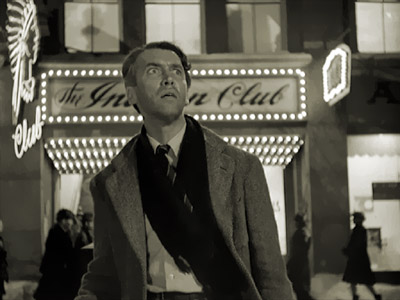
If I do it long enough, I feel like George Bailey, surveying Potterville, with the full horror of it beginning to dawn on me:

(That’s actually a pretty good depiction of how I felt at AWP in Chicago, last spring, and Unmetgoalville was pretty much why, although I also get awfully used to my little town and don’t necessarily function well in towns larger than 17,000 or so, at least not without some self-coaching. Pitiful, really, given that 17,000 is how big Mt. Vernon is, where I went to high school–if you’d told 17-year-old Marnie that 47-year-old Marnie would have a hard time feeling comfortable in Chicago, the teenager would’ve laughed, since she regularly drove in the Windy City whilst visiting her brother.)

And here I am, coming across the teaching job that doesn’t even seem to recognize me.

“But I’m a full professor,” I yell, chasing the poor ad hoc position into the bar where she faints.

“My life’s not like that,” I says to myself. “Really it’s not,” I assure myself on a cold, rainy, November afternoon. “I’m not Muncie Jones.”

Whereas, of course, I am in some ways. Indiana Jones’s sister Muncie wasn’t intentionally a play on Virginia Woolf’s Judith (Shakespeare’s sis), but that had to be lurking in my mind somewhere.

However. Now that I’ve seen Shakespeare’s Will, I can’t think of any woman in Shakespeare’s life without thinking of Tracy Michelle Arnold.

Which is where things take a turn for the better. Tracy portrayed Anne Hathaway with a phenomenal range of vulnerability and fierceness. (Now that I’m reading Brene Brown’s Daring Greatly, everything has something to do with vulnerability.)

There is fierceness in this family of women–the Jones family, the Shakespeare family, my own family.

A lot of my life, that fierceness has come out in less-than-productive ways. It may be why I liked playing with fire.

In my middle age, I am finally, finally learning to channel that fierceness into focus and grit.

One of my role models is Jenny Shank, who first caught my eye in Poets & Writers (Jan/Feb 2011), when she wrote about being a “Ham-and-Egger,” a phrase she got from Don DeLillo, which she defines in this way:

“I love that phrase, ham-and-egger. It’s how I think of myself as a writer. I’m not going to dazzle anybody with lyricism or structural ingenuity. But I put my head down and work and sometimes a story comes of it. I ham-and-egg my way through. It took me a long time to figure out that not every writer has to be brilliant.”

She also writes about sobbing during a Fellini movie because it reminded her “of my childhood dream of becoming a writer, one that I haven’t shaken for three decades, a dream that I almost gave up on a number of times, even though I still continued to write.”

And if the subject matter itself weren’t inspiring enough, she referred back to Fellini and said “Okay, so I’m not an orphaned Italian hooker in a ratty fur. But inside, aren’t we all orphaned Italian hookers in ratty furs?”

I know I am.

And I sobbed and sobbed later that spring in 2011, two different times (I don’t sob much, so I remember them). One time was taking a detour on my way to work, to go sit in the gorgeous St. Luke’s in Plain, Wisconsin and pray–this was in the midst of Wisconsin’s Arabesque Spring, when we were protesting in the snow. I felt as though the job I’d worked so hard at for 20 years was just being spit on and ground into the mud by the heel of a governor’s anti-union, anti-education Act 10.

The other sobbing happened when I got my rejection from Wisconsin Wrights. I’d submitted a revised version of Gashouse Love, a full-length play I started writing in February of 2003. I got a full typed page of comments that told me pretty thoroughly the play didn’t work. That was the bad news. But there was plenty of good news in that page–the anonymous commenter took the play very seriously, was clearly hooked by it in several ways, and very much seemed to want it to work. The sobbing came from having put in a lot of hours revising, all those hours COMING TO NAUGHT (that’s how it felt at that moment), but mostly a sense of exhaustion (see previous paragraph’s sobbing) and utter bafflement–I had almost no idea at all how to make the play better, but any little hint of how to revise carried with it a tag of THIS WILL TAKE HOURS, WEEKS, MONTHS, POSSIBLY YEARS OF WORK.

But I didn’t give up. I didn’t. I almost can’t believe it, but I didn’t.

I am sure I had the phrase “ham-and-egger” in mind.

I’d spent most of the summer of 2010 working on the poems of Speakeasy Love Hard. Gashouse Love has three generations of a family dealing with what they call “the flapper girl poems,” and I knew those poems needed to exist in full, regardless of how much showed up in the play.

The anonymous commenter for Wisconsin Wrights said the poems needed to be in the play more, and I didn’t know how to do that. I know a little more, now.

The poems from 2010, whose origin was a play begun in 2003, finally went public in the fall of 2012. It was a wonderful evening. One of the outcomes of getting to hear Sarah Day, Ashleigh LaThrop, and Nate Burger read those poems was that I felt as though a nuclear reaction had gone off in the middle of Gashouse Love.

Is the path to revision any clearer? No–but I’m excited to work on my writing plan for the rest of this semester/academic year, and will include in it “Listen to recording of Speakeasy Love Hard multiple times, with friends, taking notes and getting feedback on revising Gashouse Love.” I’m giddy with the thought of it because that play needs those poems. All of them.

Forever is how long I’ve heard you have to focus less on publication and more on enjoying revision. Could it be I’m finally there?

Not that I’m giving up on publishing. I’m not. But I am compartmentalizing and strategizing. Here again, Jenny Shank’s article was helpful: she says she invented “Johnny Business” as a way to compartmentalize the publication goals. It seems to me he lives in the same neighborhood as Michael Perry’s muse–Perry says his muse is the guy at the bank who’ll repossess his house if he doesn’t write more and get paid for it.

All of this is validated in creativity studies. In a textbook on creativity (would love to teach or take a class using this as a textbook!), Mark Runco summarizes several sources on persistence and calls it “a prerequisite for creative accomplishment,” saying that “important insights often demand a large investment of time.”

“A decade may be necessary for the person to master the knowledge necessary to understand the gaps and nuances of a field.”

[Or in my special, special case, a decade OR TWO.]

Runco quotes Arthur Cropley (one of his books charmingly has a picture of a chicken and an egg on it) who says, “In addition to possessing certain personal traits, creative individuals are characterized by their willingness to expend effort.”

Runco follows that up with a nice reiteration: “That is a good definition of persistence: The willingness to expend effort.”

Jenny Shank’s efforts are paying off–her most recent book, The Ringer, won a High Plains Literary Award. I’m so happy for her!

And Muncie Jones? Maybe she hasn’t spent as much time dodging poison darts as her hotshot brother. But she’s hanging in there. She’s been teaching four sections a year for 21 years, and sure, in one way, you could say that job has has ground her soul down to nubbins.

But you could also say it’s been really helpful ballast, and that her hot air balloon, her ship, her (whatever transportation mode requires ballast), is about to dock somewhere truly exciting.

It’s like what Jenny Shank calls “a lawn sprinkler of hope that just sprays randomly around without any direct target.” That’s not cold, gray rain on my window. That’s hope.

Genius Loci: the Sh*tty Barn

Some time-traveling incarnation of Ma Rainey possessed by Brian Eno,
serving the cooked and the raw, together, straight up—
that’s the guiding spirit of the Sh*tty Barn.

Here’s what we got going in Spring Green, Wisconsin right now: the nights are colder, the leaves are changing, a lot of the architects are heading to Arizona next week, but there are 10 days left of up-the-hill shows at APT, three and half more weeks at the Touchstone, and a full month of Sh*tty Barn sessions left to go. I can still pretend it’s summer, at least for a while.

Bessie Smith sang, “I hate to see that evening sun go down” in “St. Louis Blues.” I would sing, “I hate to see the Autumn Equinox.” Dark and getting darker, that’s where we are, so I rely on these local portkeys to take me somewhere else–somewhere midterms and winter aren’t on the way.

I can’t tell you how special the Sh*tty Barn is to me. Nowhere else did it make sense to perform something that I didn’t even know what to call. Not a poetry reading. Not a verse play. So what was it, in the end?

A special night, or, as one of my students told me today, “It was dope.” One terrific director, David Daniel, took a big schmear of narrative poems and shaped them into a narrative that worked on stage.

David working with Nate.

Three terrific actors–how lucky am I? Terrific venue, grants from the Spring Green Area Arts Coalition and the Sauk County Good Idea Grants program, all benefits of this wonderful place. The poet Honor Moore said Spring Green seemed to have some kind of special vortex going on–or maybe I said that and she agreed–in any case, this is a special place, with special people here for a good long while, or just a brief passing through. (You can see David, Sarah, and Nate a few more times yet this season at APT.)

Here’s Sarah Day, as Elizabeth, a character I wrote with her in mind–she’s reading from a book of poems called Speakeasy Love Hard:

Sarah reacting to Nate singing.

Here’s Ashleigh LaThrop as May, who is certainly the guiding spirit of Speakeasy Love Hard, but I think May’s also secretly the poet of it all:

Ashleigh’s sweet smile.

Here’s Nate Burger, just absolutely nailing a poem after the intermission. It’s called “Mobius Strip of a Man.” Did I mention he nailed it? He just nailed it.

Nate reading “Mobius Strip of a Man.”

Also on the list of my luckiness–being married to a man who can take such fantastic pictures.

After they’d finished Speakeasy Love Hard, Sarah asked if it was all right. “You’re scowling,” she said. I hope I conveyed sufficiently how wonderful it was (IT WAS WONDERFUL), that the look on my face is how I look when my mind is blown. Do playwrights ever get used to hearing their words come out of the mouths of amazing actors?

I feel as though a nuclear reaction has gone off in Gashouse Love, the play that needed Speakeasy Love Hard. No wonder the look on my face was intense, and not just blissed out (though I was feeling the bliss just as much). I have a lot of processing to do.

Will I be lucky enough to work more with these people in this place?

So grateful to the universe that it happened this one time. It was dope.

Speakeasy Love Hard: The Interview

I recently sat down with myself to ask myself some questions about the September 24th performance of Speakeasy Love Hard @ the Shitty Barn in Spring Green. We enjoyed some mocha latte in the busy dining room of our Spring Green home, as little Lego men tried to corral Jurassic Park dinosaurs and our crazy cat chased pipe cleaners.

Tell us about Speakeasy Love Hard .

Sexy. Funny. Poetry.

That’s what I’ve been saying, and that just about covers it, but in more specific terms, I’ve worked with David Daniel to come up with a lightly-, slightly-staged version of some of my narrative poetry.

The main feature is based around a set of poems called Speakeasy Love Hard, which take place in the 1920s. A young woman leaves home, makes a friend, meets a veteran of WWI, falls in love—experiences all the wildness of Prohibition St. Louis. There’s a little baseball, too—I have a poem called “Urban Shocker.”

Sarah Day and Nate Burger and possibly another mystery woman will be the performers for Speakeasy Love Hard.

After half-time, Nate Burger will be reading some other poems, also sexy, also shocking. David Daniel might even get in on the fun.

Shocking? Could you give us an example?

Well, sure—some general warnings—there’s profanity here and there, and what the ratings board would call sexual situations. No actual nudity though. That I know of. But definitely for mature audiences only.

This one’s called “Ballad of the Bad Man.” It’s sort of mildly shocking.

You take me down to the wrong side of town
At night you do, you know it.
For you, baby, I’d swallow the moon.
All that dark, and us glowing.

My whole life I’ve hated morning.
A sunny day can slay you.
The only thing between me and you
Is hours. I’m pretty good at waiting.

Report for duty at midnight, sir.
We get one shift of happiness.
Every joke and drink is work
To get us started. Make it last.

We both wake up from bad dreams at 3:00.
You hit me once without seeing
Who it was you hit.
I was crying before I felt it.

You take me down to the bad side of town.
At night you do, you know it.
I go down without a fight.
Wherever you want me, I’m going.

So, other than the appeal of a life of illicit lust, what would you say the message of the piece is?

Well, as I told Mr. Daniel, I don’t actually think too much about the message. I figure if I’m doing my job focusing on the music of the language and the flesh-and-bloodness of the characters, the message will just come out on its own.

But once he asked me that, I started thinking about it, and I think my work centers on these four things:

You have to laugh.
You could always have sex.
You rail at God.
You make it through.
(Repeat as needed.)

The poster is pretty hot. Could you talk a little about that?

I’m so lucky to be married to a multi-talented man! Nath Dresser is a singer songwriter—he performed recently at the Shitty Barn at a celebration of Townes Van Zandt. But he’s also a talented photographer, and he designed the poster. When he showed me the image, I just about swooned.

Have you worked with David Daniel or Sarah Day or Nate Burger before?

David was the director last year for my 10-minute play for 24-7 here in Spring Green. On the first read-through he said, “You’re insane,” but I assumed he meant that in the nicest possible way. I’d written a verse play overnight, with three sonnets and two sea-chanteys that had to be cut back for the performance. He did an admirable job shepherding my terrific actors through my insanity, so I thought he’d be good to work with again.

Sarah Day inspires me, generally and consistently and greatly, but she’s also done me the honor of reading my play drafts, and she’s done several dinner-table readings of them, and she participated in a reading/workshop at UW-Richland, of a play which is now called Second Blessing.

I think Sarah and David are phenomenal—I can’t really say enough about how thrilled I am to work with them again.

I haven’t worked with Nate before, but I’ve seen his work at APT, and I know he loves poetry, so I’m excited to get to work with him.

What’s your Bacon Number?

I think four, if writers count (and they might not). Because Randall Duk Kim’s number is two, so Sarah Day’s number is three (or hers might be higher—I’ll have to ask), so if writers count (and, again, they probably don’t), mine is four.

Everybody’s too busy and everybody’s broke. Why should anyone fork out $7 and three hours for Speakeasy Love Hard?

Great question. First of all, the actors are terrific. You know how people say they’d pay to hear certain actors read from the phone book? Well, these poems are at least as good as a phone book. Second, the Shitty Barn. I’ve never not had a good time at the Shitty Barn.

And finally, how many golf balls can you fit in a 747?

I have no idea. But 7:47 was when I was supposed to leave for school when I was grade school. I was a latch-key kid, so I was in charge of getting myself to school on time. Knowing me, 7:47 is not when I left. It’s probably just when I thought, “I’m supposed to leave now.”

All righty then. Anything else you want people to know?

Nope—just hope to see everyone on Monday, September 24, at 7:30 at the Shitty Barn! Buy your tickets in advance if you don’t want to wait in line!

Updates and information are available at
https://marniere.wordpress.com/speakeasy-love-hard-the-shitty-barn/

Tickets can be purchased at the door or in advance at
http://www.brownpapertickets.com/event/275278