
Category Archives: Spring Green

Muncie Jones and the “Lawn Sprinkler of Hope”

It’s so easy for me to take an uncharitable view of the last 21 years and zoom in on the goals I haven’t met.

Tongue-in-crater-where-there-used-to-be-a-tooth.

A sort of obsessing that can be genuinely damaging.

If I do it long enough, I feel like George Bailey, surveying Potterville, with the full horror of it beginning to dawn on me:
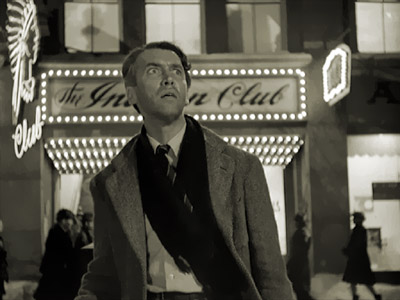
(That’s actually a pretty good depiction of how I felt at AWP in Chicago, last spring, and Unmetgoalville was pretty much why, although I also get awfully used to my little town and don’t necessarily function well in towns larger than 17,000 or so, at least not without some self-coaching. Pitiful, really, given that 17,000 is how big Mt. Vernon is, where I went to high school–if you’d told 17-year-old Marnie that 47-year-old Marnie would have a hard time feeling comfortable in Chicago, the teenager would’ve laughed, since she regularly drove in the Windy City whilst visiting her brother.)

And here I am, coming across the teaching job that doesn’t even seem to recognize me.

“But I’m a full professor,” I yell, chasing the poor ad hoc position into the bar where she faints.

“My life’s not like that,” I says to myself. “Really it’s not,” I assure myself on a cold, rainy, November afternoon. “I’m not Muncie Jones.”

Whereas, of course, I am in some ways. Indiana Jones’s sister Muncie wasn’t intentionally a play on Virginia Woolf’s Judith (Shakespeare’s sis), but that had to be lurking in my mind somewhere.

However. Now that I’ve seen Shakespeare’s Will, I can’t think of any woman in Shakespeare’s life without thinking of Tracy Michelle Arnold.

Which is where things take a turn for the better. Tracy portrayed Anne Hathaway with a phenomenal range of vulnerability and fierceness. (Now that I’m reading Brene Brown’s Daring Greatly, everything has something to do with vulnerability.)

There is fierceness in this family of women–the Jones family, the Shakespeare family, my own family.

A lot of my life, that fierceness has come out in less-than-productive ways. It may be why I liked playing with fire.

In my middle age, I am finally, finally learning to channel that fierceness into focus and grit.

One of my role models is Jenny Shank, who first caught my eye in Poets & Writers (Jan/Feb 2011), when she wrote about being a “Ham-and-Egger,” a phrase she got from Don DeLillo, which she defines in this way:

“I love that phrase, ham-and-egger. It’s how I think of myself as a writer. I’m not going to dazzle anybody with lyricism or structural ingenuity. But I put my head down and work and sometimes a story comes of it. I ham-and-egg my way through. It took me a long time to figure out that not every writer has to be brilliant.”

She also writes about sobbing during a Fellini movie because it reminded her “of my childhood dream of becoming a writer, one that I haven’t shaken for three decades, a dream that I almost gave up on a number of times, even though I still continued to write.”

And if the subject matter itself weren’t inspiring enough, she referred back to Fellini and said “Okay, so I’m not an orphaned Italian hooker in a ratty fur. But inside, aren’t we all orphaned Italian hookers in ratty furs?”

I know I am.

And I sobbed and sobbed later that spring in 2011, two different times (I don’t sob much, so I remember them). One time was taking a detour on my way to work, to go sit in the gorgeous St. Luke’s in Plain, Wisconsin and pray–this was in the midst of Wisconsin’s Arabesque Spring, when we were protesting in the snow. I felt as though the job I’d worked so hard at for 20 years was just being spit on and ground into the mud by the heel of a governor’s anti-union, anti-education Act 10.

The other sobbing happened when I got my rejection from Wisconsin Wrights. I’d submitted a revised version of Gashouse Love, a full-length play I started writing in February of 2003. I got a full typed page of comments that told me pretty thoroughly the play didn’t work. That was the bad news. But there was plenty of good news in that page–the anonymous commenter took the play very seriously, was clearly hooked by it in several ways, and very much seemed to want it to work. The sobbing came from having put in a lot of hours revising, all those hours COMING TO NAUGHT (that’s how it felt at that moment), but mostly a sense of exhaustion (see previous paragraph’s sobbing) and utter bafflement–I had almost no idea at all how to make the play better, but any little hint of how to revise carried with it a tag of THIS WILL TAKE HOURS, WEEKS, MONTHS, POSSIBLY YEARS OF WORK.

But I didn’t give up. I didn’t. I almost can’t believe it, but I didn’t.

I am sure I had the phrase “ham-and-egger” in mind.

I’d spent most of the summer of 2010 working on the poems of Speakeasy Love Hard. Gashouse Love has three generations of a family dealing with what they call “the flapper girl poems,” and I knew those poems needed to exist in full, regardless of how much showed up in the play.

The anonymous commenter for Wisconsin Wrights said the poems needed to be in the play more, and I didn’t know how to do that. I know a little more, now.

The poems from 2010, whose origin was a play begun in 2003, finally went public in the fall of 2012. It was a wonderful evening. One of the outcomes of getting to hear Sarah Day, Ashleigh LaThrop, and Nate Burger read those poems was that I felt as though a nuclear reaction had gone off in the middle of Gashouse Love.

Is the path to revision any clearer? No–but I’m excited to work on my writing plan for the rest of this semester/academic year, and will include in it “Listen to recording of Speakeasy Love Hard multiple times, with friends, taking notes and getting feedback on revising Gashouse Love.” I’m giddy with the thought of it because that play needs those poems. All of them.

Forever is how long I’ve heard you have to focus less on publication and more on enjoying revision. Could it be I’m finally there?

Not that I’m giving up on publishing. I’m not. But I am compartmentalizing and strategizing. Here again, Jenny Shank’s article was helpful: she says she invented “Johnny Business” as a way to compartmentalize the publication goals. It seems to me he lives in the same neighborhood as Michael Perry’s muse–Perry says his muse is the guy at the bank who’ll repossess his house if he doesn’t write more and get paid for it.

All of this is validated in creativity studies. In a textbook on creativity (would love to teach or take a class using this as a textbook!), Mark Runco summarizes several sources on persistence and calls it “a prerequisite for creative accomplishment,” saying that “important insights often demand a large investment of time.”

“A decade may be necessary for the person to master the knowledge necessary to understand the gaps and nuances of a field.”

[Or in my special, special case, a decade OR TWO.]

Runco quotes Arthur Cropley (one of his books charmingly has a picture of a chicken and an egg on it) who says, “In addition to possessing certain personal traits, creative individuals are characterized by their willingness to expend effort.”

Runco follows that up with a nice reiteration: “That is a good definition of persistence: The willingness to expend effort.”

Jenny Shank’s efforts are paying off–her most recent book, The Ringer, won a High Plains Literary Award. I’m so happy for her!

And Muncie Jones? Maybe she hasn’t spent as much time dodging poison darts as her hotshot brother. But she’s hanging in there. She’s been teaching four sections a year for 21 years, and sure, in one way, you could say that job has has ground her soul down to nubbins.

But you could also say it’s been really helpful ballast, and that her hot air balloon, her ship, her (whatever transportation mode requires ballast), is about to dock somewhere truly exciting.

It’s like what Jenny Shank calls “a lawn sprinkler of hope that just sprays randomly around without any direct target.” That’s not cold, gray rain on my window. That’s hope.

Genius Loci: the Sh*tty Barn

Some time-traveling incarnation of Ma Rainey possessed by Brian Eno,
serving the cooked and the raw, together, straight up—
that’s the guiding spirit of the Sh*tty Barn.

Here’s what we got going in Spring Green, Wisconsin right now: the nights are colder, the leaves are changing, a lot of the architects are heading to Arizona next week, but there are 10 days left of up-the-hill shows at APT, three and half more weeks at the Touchstone, and a full month of Sh*tty Barn sessions left to go. I can still pretend it’s summer, at least for a while.

Bessie Smith sang, “I hate to see that evening sun go down” in “St. Louis Blues.” I would sing, “I hate to see the Autumn Equinox.” Dark and getting darker, that’s where we are, so I rely on these local portkeys to take me somewhere else–somewhere midterms and winter aren’t on the way.

I can’t tell you how special the Sh*tty Barn is to me. Nowhere else did it make sense to perform something that I didn’t even know what to call. Not a poetry reading. Not a verse play. So what was it, in the end?

A special night, or, as one of my students told me today, “It was dope.” One terrific director, David Daniel, took a big schmear of narrative poems and shaped them into a narrative that worked on stage.

David working with Nate.

Three terrific actors–how lucky am I? Terrific venue, grants from the Spring Green Area Arts Coalition and the Sauk County Good Idea Grants program, all benefits of this wonderful place. The poet Honor Moore said Spring Green seemed to have some kind of special vortex going on–or maybe I said that and she agreed–in any case, this is a special place, with special people here for a good long while, or just a brief passing through. (You can see David, Sarah, and Nate a few more times yet this season at APT.)

Here’s Sarah Day, as Elizabeth, a character I wrote with her in mind–she’s reading from a book of poems called Speakeasy Love Hard:

Sarah reacting to Nate singing.

Here’s Ashleigh LaThrop as May, who is certainly the guiding spirit of Speakeasy Love Hard, but I think May’s also secretly the poet of it all:

Ashleigh’s sweet smile.

Here’s Nate Burger, just absolutely nailing a poem after the intermission. It’s called “Mobius Strip of a Man.” Did I mention he nailed it? He just nailed it.

Nate reading “Mobius Strip of a Man.”

Also on the list of my luckiness–being married to a man who can take such fantastic pictures.

After they’d finished Speakeasy Love Hard, Sarah asked if it was all right. “You’re scowling,” she said. I hope I conveyed sufficiently how wonderful it was (IT WAS WONDERFUL), that the look on my face is how I look when my mind is blown. Do playwrights ever get used to hearing their words come out of the mouths of amazing actors?

I feel as though a nuclear reaction has gone off in Gashouse Love, the play that needed Speakeasy Love Hard. No wonder the look on my face was intense, and not just blissed out (though I was feeling the bliss just as much). I have a lot of processing to do.

Will I be lucky enough to work more with these people in this place?

So grateful to the universe that it happened this one time. It was dope.

Speakeasy Love Hard: The Interview

I recently sat down with myself to ask myself some questions about the September 24th performance of Speakeasy Love Hard @ the Shitty Barn in Spring Green. We enjoyed some mocha latte in the busy dining room of our Spring Green home, as little Lego men tried to corral Jurassic Park dinosaurs and our crazy cat chased pipe cleaners.

Tell us about Speakeasy Love Hard .

Sexy. Funny. Poetry.

That’s what I’ve been saying, and that just about covers it, but in more specific terms, I’ve worked with David Daniel to come up with a lightly-, slightly-staged version of some of my narrative poetry.

The main feature is based around a set of poems called Speakeasy Love Hard, which take place in the 1920s. A young woman leaves home, makes a friend, meets a veteran of WWI, falls in love—experiences all the wildness of Prohibition St. Louis. There’s a little baseball, too—I have a poem called “Urban Shocker.”

Sarah Day and Nate Burger and possibly another mystery woman will be the performers for Speakeasy Love Hard.

After half-time, Nate Burger will be reading some other poems, also sexy, also shocking. David Daniel might even get in on the fun.

Shocking? Could you give us an example?

Well, sure—some general warnings—there’s profanity here and there, and what the ratings board would call sexual situations. No actual nudity though. That I know of. But definitely for mature audiences only.

This one’s called “Ballad of the Bad Man.” It’s sort of mildly shocking.

You take me down to the wrong side of town
At night you do, you know it.
For you, baby, I’d swallow the moon.
All that dark, and us glowing.

My whole life I’ve hated morning.
A sunny day can slay you.
The only thing between me and you
Is hours. I’m pretty good at waiting.

Report for duty at midnight, sir.
We get one shift of happiness.
Every joke and drink is work
To get us started. Make it last.

We both wake up from bad dreams at 3:00.
You hit me once without seeing
Who it was you hit.
I was crying before I felt it.

You take me down to the bad side of town.
At night you do, you know it.
I go down without a fight.
Wherever you want me, I’m going.

So, other than the appeal of a life of illicit lust, what would you say the message of the piece is?

Well, as I told Mr. Daniel, I don’t actually think too much about the message. I figure if I’m doing my job focusing on the music of the language and the flesh-and-bloodness of the characters, the message will just come out on its own.

But once he asked me that, I started thinking about it, and I think my work centers on these four things:

You have to laugh.
You could always have sex.
You rail at God.
You make it through.
(Repeat as needed.)

The poster is pretty hot. Could you talk a little about that?

I’m so lucky to be married to a multi-talented man! Nath Dresser is a singer songwriter—he performed recently at the Shitty Barn at a celebration of Townes Van Zandt. But he’s also a talented photographer, and he designed the poster. When he showed me the image, I just about swooned.

Have you worked with David Daniel or Sarah Day or Nate Burger before?

David was the director last year for my 10-minute play for 24-7 here in Spring Green. On the first read-through he said, “You’re insane,” but I assumed he meant that in the nicest possible way. I’d written a verse play overnight, with three sonnets and two sea-chanteys that had to be cut back for the performance. He did an admirable job shepherding my terrific actors through my insanity, so I thought he’d be good to work with again.

Sarah Day inspires me, generally and consistently and greatly, but she’s also done me the honor of reading my play drafts, and she’s done several dinner-table readings of them, and she participated in a reading/workshop at UW-Richland, of a play which is now called Second Blessing.

I think Sarah and David are phenomenal—I can’t really say enough about how thrilled I am to work with them again.

I haven’t worked with Nate before, but I’ve seen his work at APT, and I know he loves poetry, so I’m excited to get to work with him.

What’s your Bacon Number?

I think four, if writers count (and they might not). Because Randall Duk Kim’s number is two, so Sarah Day’s number is three (or hers might be higher—I’ll have to ask), so if writers count (and, again, they probably don’t), mine is four.

Everybody’s too busy and everybody’s broke. Why should anyone fork out $7 and three hours for Speakeasy Love Hard?

Great question. First of all, the actors are terrific. You know how people say they’d pay to hear certain actors read from the phone book? Well, these poems are at least as good as a phone book. Second, the Shitty Barn. I’ve never not had a good time at the Shitty Barn.

And finally, how many golf balls can you fit in a 747?

I have no idea. But 7:47 was when I was supposed to leave for school when I was grade school. I was a latch-key kid, so I was in charge of getting myself to school on time. Knowing me, 7:47 is not when I left. It’s probably just when I thought, “I’m supposed to leave now.”

All righty then. Anything else you want people to know?

Nope—just hope to see everyone on Monday, September 24, at 7:30 at the Shitty Barn! Buy your tickets in advance if you don’t want to wait in line!

Updates and information are available at
https://marniere.wordpress.com/speakeasy-love-hard-the-shitty-barn/

Tickets can be purchased at the door or in advance at
http://www.brownpapertickets.com/event/275278

A Knottier Wretch Post: Mary and Martha and Rest Vs. Work

Did you know that when you do an anagram of “Protestant Work Ethic,” you come up with “Procrastinate, Ewok!”

O.k., not really—it leaves a couple of letters unused and you have to throw in an extra “a.”

You do get “a thickset rotten prow” or “a sphincter totter wok” or “a thrice strew topknot,” however (all courtesy of a fun anagramming site, but you should also Google anagram). Overall, my general lack of anagramming skills is one of three or four things that would keep me from competing in an actual Scrabble tourney. But I really, really want to mess with that Protestant work ethos.

I’ve been thinking a lot about Mary and Martha this summer.

The basic story is in Luke 10: people are gathered at Mary and Martha and Lazarus’s house (L. will later be raised from the dead by Jesus), and Martha complains to Jesus that Mary isn’t helping, “Don’t you care that she’s left me to do all the work by myself?” There may well have been a lot of work—Jesus was traveling with a crowd of up to 70 disciples (not that they were all in that one house together), and this is a time and a place where hospitality was taken very seriously. And the house is identified as Martha’s in the story. She has a prominent role in the gospels. In this story she’s an antagonist, but then she’s the first, even before Peter, to identify Jesus as the Messiah.

In this particular story, instead of helping, Mary was sitting at Jesus’s feet & listening to him. Jesus apparently enjoys that, because he tells Martha she’s worried and distracted, and that (in the King James Version), “only one thing is needful.” That Mary’s listening is more important than Martha’s bustling.

A blog post I like, “Mary and Martha: A Story About God’s Radical Hospitality,” on the “Grace Rules” blog (not sure who the author is but it was written in response to a request from Julie Goss Clawson, a writer I enjoy a lot) deals with the M&M story and says, after quoting Jesus’s response to Martha, “At this point, someone usually teaches a lesson about how important it is not to get so busy that we forget to spend quiet, contemplative time with Jesus. And while I think that is a good lesson I have a feeling we may be missing the point of what Jesus is talking about.” “Grace Rules” outlines how subversive Jesus was being here, and I think that’s exactly right. He’s upending expectations about gender roles and hospitality and busy-ness and lots of other things in the mix.

I was wondering a while back who would spend more time on Facebook—Mary, Martha, or Lazarus? I said I was pretty sure Jesus would have friended all three of them. Here are some of the responses:
⋅ “I think it would have to be Lazarus, since he would get a second chance at it.”
⋅ “How much would Jesus love FB and Twitter?!”
⋅ “Mary wins out. . .her sensitive, caring, compassionate side means that she would answer even the wildest commentary the social network has to offer …. In other words, she would be a terrific online friend. Lazarus, I fear, will probably just sit at the gate of the city, dreaming of his ordeal, not wishing to share with anyone. He would not be a good friend.”

I thought Lazarus would have one of the all-time great status updates, post-resurrection, though, if he chose to post it, “I’m baaaaaaaaaaaaaaack!” or “Know how we all thought I was dead?”

We agreed that Martha would have short posts, things like “Just mopped again!” or slams, “Wish I had more time to spend on Facebook, but I have things to do, unlike some people I know.”

The thing is, of course, that sometimes, things just need to get done.

I also asked a more serious question this summer on Facebook—who’s your nominee for someone who does more than just “get a lot done,” someone who seems to get the right things done. I didn’t word it as clearly as I might have because there was a lot of confusion about whether I meant “do the right thing” as in a moral choice—but I mostly meant someone who isn’t just busy or efficient, but has real impact in important ways. I got several nominees, and I emailed those nominees to see if they could talk about HOW they do that (in my ongoing quest to figure out how to GET SHIT DONE). Three of them were nice enough to respond—

Michael Broh, a member of Spring Green’s Village Board and Production Manager at American Players Theatre, said, “I’m honored by the nomination, but I must decline. As far back as I can remember, I’ve believed myself to live in a subjective universe, one in which there is as little place for right as there is for wrong.

In terms of what drives me to make the decisions I do make, and when, I suppose it is a combination of self interest, and a feeble attempt to look beyond the immediate, and treat long term implications with equal importance.”

(I guess I’m not technically letting him decline since I’m mentioning him here—the nomination didn’t actually lead to anything other than a public compliment and a mention in an obscure blog, but it’s a sincere compliment, and he did say I could quote him.)

Melinda Van Slyke is the owner/operator of Heart of the Sky Fair Trade and a local Progressive activist. Here’s what she had to say:

“True story: One day at swimming lessons (I was probably 4 or 5 at the time) we were all lined up at the side of the pool with the instructions being to jump one by one into the arms of our awaiting swim teacher. The little boy in front of me would not jump in. He just stood there, refusing to jump in, knowing that he should, (in my little girl mind) holding up the show. I very calmly pushed him in and immediately jumped in right behind him.

So that’s the secret to my so-called success. Don’t over think it. Just jump in and do it. Don’t wait for other people to be ready and sure as hell don’t wait for permission. But I like to think that now instead of pushing people *out* of my way I push (encourage) them to get involved and do things that they haven’t done before and hopefully they realize that hey, that wasn’t so bad after all.”

This is a terrific description of her mode, except I see her more as “offering to push.” And as I was diving into collecting signatures for Walker’s recall, for example—I was grateful for the push.

The other person who answered the email was Jan Swenson, who’s so good at getting things done she made the news. Her response to the question of how she gets things done was this: “I do the right things politically when the need arises (i.e. when ‘my’ candidate needs support or when a governor needs to be recalled). Musically, I do concerts when there is a need to raise money for something I want to support or when I can help publicize community events. My last choral concert was to raise money for our local food pantries and for ‘4 Pete’s Sake.’ The concert before that was in memory of Mitch Feiner (one of our finest musicians!) and was a fundraiser for his 3 children’s college educations. As for volunteering in the community, I do that because I love APT and want to support them any way I can, and my volunteer work at the school in Arena is to help those kids continue their amazing reading program. They read so many books that the librarian can’t keep up with filing the books!”

Not one of them mentioned the sort of stillness and listening and contemplation we associate with Mary in the M&M story (because, of course, that’s not what I asked them about, and not what they were nominated for–each nominated by more than one of my Facebook friends). They all sound productive, they truly are productive in important ways, I’m pleased to be a part of the community they’re active in, pleased to benefit from the fact that they are, in KJV lingo, “cumbered with many things.” They’re inspiring, and if I can generalize, I would say that they’re describing the need for vision, courage, and responsiveness, all three of which I know I am capable of only if there’s rest and contemplation on my to do list somewhere.

The thing that I find most difficult in balancing my Mary side with my Martha side is knowing WHEN to focus on resting versus acting. In recent blogs, I’ve described my struggles with figuring out how to honor the Sabbath (“Day of Rest, My Ass”) and figuring out how to procrastinate at just the right time (but not all the time) and stay busy (but not be consumed with busy-ness) and how burning trash is one of my all-time favorite activities, apparently (“Summer Theologica”).

It’s a hard balance—knowing when to get busy, and knowing when to rest and listen.

Even Jesus struggled with it. In the later story about Mary and Martha, Jesus shows up at their house because their brother Lazarus has died. Both sisters tell him that if he’d come sooner, they know he could have healed Lazarus. This is when we get the shortest verse in the Bible, “Jesus wept.” You could say he’s weeping in disappointment because his good friends Mary and Martha don’t understand he’s capable of raising the dead (though to be fair to them, he had done that only one other time that we know of, and that was in a different gospel than the one they appear in, so they might not have heard about it). I’m sure I heard sermons like that—that his tears were tears of judgment. I don’t think so. You could also say, and these are the sermons I’ve heard most often, that he’s showing his human side and his love for his friends. That comes closer to feeling like the truth for me, but what if—what IF he’s crying not just out of sadness, but out of frustration with himself?

I have to think he was a good friend, and a good friend might well think here, “Oh my God, they’re right. So what if I can raise him from the dead? If I’d gotten here sooner, I wouldn’t have to, and they wouldn’t be so torn up….”

(It is possible that Jesus would NOT say “oh my God,” but would instead say, “Oh I’m God” or perhaps not take the Lord’s name in vain at all, since that is one of the Top Ten.)

Fortunately for me, since I’m a writer, writing about work qualifies as work, or I’d have to admit that all my time blogging is neither restful (especially not these last three posts–I kept thinking I was writing about Mary and Martha but finding I had too much to say about the points I thought were going to lead quickly to M&M) nor productive.

Even when writing feels like hard work, it doesn’t feel like work–partly because I do it pro bono most of the time.

It’s all the other things on my to do list (28 things on today’s list, 15 of which I’d hoped to have done before I hit the sack tonight, which doesn’t seem likely, although writing this blog is on the list so I can check that off at least) that feel like work that make me wonder:

If I’m allowing myself to indulge in a Mary moment, am I really resting and listening? Or am I just procrastinating the next needful Martha moment? Am I giving due diligence to the “incubation” stage of creativity? Or am I resisting every other everything that has to be achieved for successful creativity?

Let me just meditate on each moment of my answer to the above questions:

I

don’t

know.

Day of Rest, My Ass

When I say Sunday dinner I mean lunch (although on other days, “dinner” means supper—I don’t know why) and I also mean hot meat of some sort. Today it was baked chicken, real mashed potatoes (skins-on), and three-bean salad (cheated on that—it came from a can).

In an alternate universe, this meal would have been served by me, wearing an apron, after a morning spent in church.

In this particular universe, there was no apron and no morning in church.

I never remember to put on an apron, and organized religion and I are spending some time apart. I am participating in what Wendell Berry’s character Jayber Crow called “disorganized religion,” which I typically call being a Zen Baptist.

What about you? Are you resting on this day of rest?

Some of the people who take the Bible most literally, who insist that Genesis is a literal description of creation (despite the fact that there are two creation stories in Genesis and a third in Proverbs 8), are adept at ignoring Genesis 2:2-3, when God rested and created the Sabbath—something Yahweh cared enough about, apparently, to put it on his Top Ten list, (this from Exodus 20)“Remember the sabbath day, to keep it holy. Six days shalt thou labour, and do all thy work: But the seventh day is the sabbath of the LORD thy God: in it thou shalt not do any work….”

Of course, there are those who take this commandment very seriously, who won’t drive on the Sabbath, who work hard the day before to make food that can be eaten without work to prepare it. But that’s not what I grew up with, not my adult experience, although one of the reasons I love living in Spring Green is that I can function really well without driving anywhere. (Walking home from the bars is only a small part of that pleasure.)

It’s one of the more striking ironies of my life–any time I’ve belonged to a faith community, been an active participant in one, Sunday was anything BUT a day of rest.

Stretches when I’m in a wilderness time (which can be nasty and involve dehydration, or wonderful, like now), Sunday stands a much better chance of actually being a day of rest.

What do I mean by wilderness time? It’s a reference to Jesus’s time in the wilderness, first of all. Three of the four gospels tell the story of Jesus going into the desert, immediately after being baptized, to fast for 40 days and 40 nights. He’s tempted by Satan there (the best depiction of which I’ve ever seen occurs in the movie Jesus of Montreal, when the actor portraying Jesus in a suddenly-popular passion play has a lawyer telling him all the ways he could parlay this into fame and fortune).

If you focus on the gospels (as opposed to the epistles of the apostle Paul), one of the things that stands out is how often Jesus heads out on his own. My friend Tammy is the first person I recall hearing preach on this–she’s also the first person I remember pointing out to me that God pronounces he is “well pleased” with Jesus before Jesus has done anything we consider part of his work on Earth. Even after he begins that work, Jesus sneaks off a number of times, which should comfort both my slacker and my introvert friends.

I’m not saying that he was resting, exactly, as he was fasting and being tempted, but it was sort of a pause, an episode of time off the clock. His ministry won’t start until he leaves the desert, but it can’t start until he’s spent enough time in the desert.

Once his ministry starts, he somehow gets a reputation as a “wine-bibber and glutton,” which I grew up understanding was slander, that people were falsely accusing him of that. Really? I don’t know. I think Jesus had a prescription for chill pills, and knew when to take one.

Matthew 11 is a really interesting chapter. John the Baptist is in prison and sends his disciples to ask Jesus if he’s the Messiah (when John baptized Jesus, he didn’t seem to have any doubts about the matter). Jesus sends them back to John with a list of what he’s accomplished, a sort of short-form resume, “the blind receive their sight, the lame walk, the lepers are cleansed, the deaf hear, the dead are raised, and the poor have good news brought to them.” Then he adds, bizarrely coming at the end of this list, “And blessed is anyone who takes no offence at me.”

He spends some time praising John the Baptist, and then does a little comparison/contrast:

“But to what will I compare this generation? It is like children sitting in the market-places and calling to one another,
‘We played the flute for you, and you did not dance;
we wailed, and you did not mourn.’
For John came neither eating nor drinking, and they say, ‘He has a demon’; the Son of Man came eating and drinking, and they say, ‘Look, a glutton and a drunkard, a friend of tax-collectors and sinners!’ Yet wisdom is vindicated by her deeds.”

(I personally prefer “winebibber” to “drunkard,” because it sounds like so much more fun.)

It’s not literal, of course, John did eat and drink (honey and locusts, at the very least), and we don’t have Biblical evidence of Jesus eating too much or getting tipsy, but we do have evidence he appreciated good wine. Otherwise why would his first miracle be turning water into, not just wine, but wine pronounced as good wine?

The chapter ends with verses I’m pleased to take literally (and poetically, which is why I quote the King James version here): “Come unto me, all ye that labour and are heavy laden, and I will give you rest. Take my yoke upon you, and learn of me; for I am meek and lowly in heart: and ye shall find rest unto your souls. For my yoke is easy, and my burden is light.”

Never, not once, has my participation in a faith community felt easy or light. It has felt terrific, and right, and sustaining, and wonderful at times (not so great at other times). But easy? Or light? Not that I’m remembering.

So was Jesus just being ironic there?

I don’t think so, although he says things other times that contradict this (“Take up your cross daily” comes to mind—I often feel that just getting out of bed is my cross).

As someone who is nearly always teetering on the edge of burnout, I want to cling to those verses, make them real.

The title of this blog, “Day of Rest, My Ass,” is a poem written by a character in an old novel draft of mine, written during my first sabbatical, in 2004. She’s a burned-out preacher trying to find her way by working at a church camp one summer.

I understand why Jesus blesses anyone who doesn’t take offense. He did and said so many things to upset the apple quo, and advocating rest, for me a lot of days, tops the list.

The Zennoyance of M. Bullock Dresser

[Pardon me while I Prufrock a minute.]

“Nel mezzo del cammin di nostra vita
mi ritrovai dietro una vettura lenta,
perché eravamo in un no sorpasso di corsia….”

“Whether it’s pain or pleasure, through lojong practice we come to have a sense of letting our experience be as it is without trying to manipulate it, push it away, or grasp it. The pleasurable aspects of being human as well as the painful ones become the key to awakening bodhichitta.” Pema Chodron Start Where You Are

Let us go then, you and I,
While the drought sucks all the rain out of the sky,
Like a baby nursing at its mama’s breast,
Let us go through several tiny towns,
The kind with no uptown or down,
And speed traps their biggest revenue stream,
The middle class mostly a dream,
One of those nightmares where you find a room
That leads you to numberless other rooms
You never knew you had–
Oh, stop. Don’t tell me about your day.
Let’s just hit the road.

On Highway 14 the woman drove too leisurely,
In a lime-green Mercedes named Martini.

The heat wave that sharpens its teeth on a wheel,
The heat swamp that buffs its nails on a wheel,
Licked its lips along the shoulder of the road,
Turned off the cruise control at some point,
Rolled down the window to watch something congeal,
Did a three-point turn, put the pedal to the floor,
And seeing no sheriff’s car anywhere in sight,
Broke the speed of sound, and drove out of sight. But

On Highway 14 the woman drove too leisurely,
In a lime-green Mercedes named Martini.

____________________________

I might work some more on that, being as I’m middle aged, and wondering what I am not (nor was meant to be) and wondering, A LOT lately, “Do I dare” and “Do I dare?”

In the meantime, let me talk about that Mercedes. My parents and Wendell and I had set off this morning about 10 for Rockford, to see my Aunt Margie, who’s in a nursing home there. Somewhere between Spring Green and Madison, we ended up behind a lovely lime-green Mercedes convertible with the license plate “MARTINIS.”

First of all, I’m not sure I’d want to advertise I LOVE ALCOHOL SO MUCH IT’S MY PERSONALIZED PLATE, just in case I ever got pulled over.

(Not that I get pulled over a lot. Mom and I talked today about traffic tickets we’d gotten–neither of us has gotten many. But I remember being very impressed when my Gran’mommy got a speeding ticket when she was in her seventies, for going something like 60 in a 40mph zone. My cousin Jodie and I used to freak out when we watched her drive because she was old-school—she would have her right foot on the gas and her left foot poised over the brake. I particularly like to think about her as a driver because it stood in marked contrast to her basic mode as a kindly and gentle and extremely ladylike Baptist.)

Second of all, WOW that Mercedes was going slow. About 45, and it’s actually a highway, where you can go pretty much 60 and not worry at all about getting pulled over. There was some slight lane meanderage on the Mercedes’ part as well.

At the stoplight in Black Earth, the woman who was driving was fixing her hair in her fetching visor-cap and YES, the light turned green, and she kept working on her hair for a count of 1-2-3.

We couldn’t pass–Highway 14 is two-lane most of the way, and a lot of no-passing zones (or, as I like to think of them, no sorpasso di corsias) and a fair amount of traffic. It was timed exactly wrong almost the whole way.

Third of all (or is it fifth of all?), it wasn’t really “MARTINIS.” It’s the name of a popular cocktail, though. I just don’t want to go listing license plates on my blog. Except, if you make your personalized plate really easy to remember and then drive in really annoying ways in front of people, you should kind of expect to show up in a blog.

In a very dramatic moment, the minivan behind us gunned it to pass them, and barely made it back over before the passing lane ended, with oncoming traffic approaching, too. The passenger in MARTINIS flipped off the minivan, which puzzled us, until my Dad pointed out that maybe someone in the minivan had flipped them off first.

“I’m pretty sure they’re just out for a cruise,” my son said.

Finally, we were able to pass them. I thought of them briefly as we drove through Janesville later and it was raining—were the Martinis o.k.? Did they get the top up in time?

If I’d been in a hurry, I’m sure I would have been mad. My friend & UW System colleague Ryan Martin explains why we get so mad when we’re driving in this great post, “All the Rage.”

But honestly, my annoyance didn’t shift into anger today. They were so annoying it ended up being hilarious. I asked on Facebook this evening if anyone knew them, and I now know who they are. They own a bar, actually, so I’m wondering if I can turn this into a free drink somehow.

Because this is a totally flattering portrait of them, right? And of me, right?

Here’s the thing, and the reason I quoted Pema Chodron—at some point, getting annoyed at someone who’s being annoying, and then expressing that annoyance, is all just annoying. Same with obnoxious behavior. It’s hard to respond to rudeness without also being rude.

Like last night, during the performance of Skylight (PHENOMENAL—everyone should go see this play), I paid good money for a great seat in the second row, but there were three people in front of me who thought sitting in the FRONT ROW of the Touchstone Theater, a small venue, during a terrific show–they thought that was a good time to talk. It wasn’t so much that I could hear them (I have hearing aids), but they were leaning over a lot, so it was visually distracting. There were some odd dynamics going on, too—I couldn’t tell if the woman in the middle was sick, and her husband and friend were concerned, or if they chose Skylight because they were currently in a ménage a trois. I wondered about the latter because there seemed to be a lot of meaningful shoulder-rubs and knee-strokings in all kinds of variations (him on her, him on other her, her on her, her on him, other her on him). Regardless–what I really wanted to do was thump each of them on the head.

(I did once kick the seat of a woman in front of me at Sundance theater once during a Clooney movie—she was texting on a smart phone and it was REALLY BRIGHT.)

But it’s rude to thump someone on the head, and I was worried that my thumping might be an even bigger distraction to the actors I was already worried were distracted (Clooney couldn’t see me kicking the seat of the woman in front of me), or make them talk MORE, or begin to rub the sore spots for each other where they’d been thumped.

I moved to a different seat at half-time, but the three lovers (or the married couple and friend, one of whom was sick) didn’t return. Which was a little disappointing, since I’d complained about them to numerous people while eating my much-anticipated brownie, which, frankly, was a little dry (the brownies are usually amazing there).

One moral of these stories is, I don’t mind being annoyed as long as I get a story out of it.

Another part of what it comes down to is I’m not sure I have the right to be angry (or even annoyed). My Gran’mommy wouldn’t let us say “darn” or “heck” when we were little, because they were just substitutes for “damn” and “hell.” I remember asking at some point what I was supposed to say when I got mad, and she essentially said, “Don’t get mad.”

I don’t think of myself as an angry person, but maybe these lines from Justified apply (I’d love it if they did–I’d love being an Elmore Leonard character):

At the end of the pilot, Raylan has broken into the home of his ex-wife and her new husband in the middle of the night, and is then chatting with her out on the deck.

“I just never thought of myself as an angry man,” he says, after explaining why he shot a man.

And Winona says, ”Oh. Raylan, well, you do a good job of hiding it—I suppose most folks don’t see it, but honestly? You’re the angriest man I have ever known.”

What I’m hoping for is some sort of Zen Baptist process by which I can feel annoyance (read: anger) and express it without making the world a worse place, without cancelling out the benefit of however many days of meditation and Bible reading I’ve managed to string together.

This won’t be easy. The Baptist part of me remembers this verse, Matthew 7:3, “Why do you see the speck in your neighbor’s eye, but do not notice the log in your own eye?” Most of the time I complain, I feel compelled to point out my own guilt. That’s not the worst habit in the world (I find it annoying when others don’t admit their own guilt, ever), but do I really have to list all the ways I’ve annoyed people who were driving behind me before I can say, “that Mercedes was really annoying,” before I can allow myself to be annoyed?

Is the height of Zen training really to get to the point where I drive behind a car going slower than I want to go and my actual response goes something like, “it is what it is,” and I use the slower pace to be mindful about my surroundings? How different is that, really, from trying never to get angry?

Just asking. I’ll stop now before I get carried away.

The pilot of Justified ends with Raylan processing Winona’s comment, goes to the credits, and we get to hear, once again, Tone Z with Gangsta Grass:

“On this lonely road,
trying to make it home
Doing it by my lonesome-pissed off, who wants some
I see them long hard times to come.”

If I were an Elmore Leonard show, I’d be done already. Since it’s me, I’ll just say that my new life goal is to mention Timothy Olyphant every other blog entry.

And also to get a free drink from restaurant owners who drive slowly enough, for long enough, that I think they owe me something. Unless that annoys them, in which case I apologize for being annoyed.

The Merry Month of May

The hum, the lull between deep snow and mosquitoes,
Before the tourists descend en freaking masse,
Right when goldfinches go from egg yolk yawn
To neon hello, is when I love my little town
The most. The caravan of architects
Is back from Arizona, and license plates
All over town proclaim a different state.
There are faces I don’t recognize
And starting this weekend, there will be faces
I do recognize, and gestures, and gaits—
The very air changes when the actors all come back.
I know I’ll love the shows but I really love the wait,
Love knowing magic’s on its way, love art
Rumbling like thunder for my winter-dried heart.

_____

There are so many things I love about living in Spring Green, and American Players Theatre is high, high on the list. Tech folks are back in town already and since rehearsals begin next week, the actors are arriving.

Several times over the years, I’ve first seen Brian Mani back in town on the very same day, or within a day, of seeing my first bright-yellow goldfinch of the year.

(We’re lucky to have a lot of APT folk who over-winter, but often they’re off doing other jobs, so even the year-round birds aren’t in town consistently until now.)

As a professor, my semester is still in the deepest swamp–lots to grade and no indication that anything I tried this semester actually worked.

But when I glimpse, out of the corner of my eye, a certain way of gesturing, or walking, and there’s some odd sense of recognition, I realize, “Oh. That’s someone I’ve seen on stage.” (It’s odd, but a lot of times it’s the body language that pricks my brain, not always the face.)

That’s when I know that winter is truly over, and my semester will soon be over, and within a month or two, I’ll be sitting & watching and being transported to what I call my “APT happy place,” where I forget, utterly, my regular life.

And the fact that, in my regular life, I can call many of these wonderful folks my friends, that, as a writer, I’ve had the thrill of hearing some of them say my words–I feel so lucky.

Those of us in Spring Green, we are lucky, boy.

This Is Just to Say Whatever Comes to Mind

Small-town newspapers, where they still exist, are a precious treat. In Spring Green, Wisconsin, we get The Home News, “the only newspaper in the whole, wide world that cares about the River Valley area” every Wednesday. Of course, The Voice of the River Valley, a free monthly, also implicitly cares (though that’s not on its masthead). This past month The Voice had poems (in honor of National Poetry Month) and has regularly carried poems in the past. One of the things I enjoyed about the Home News’ former editor, in addition to his progressive politics and weekly editorials featuring his dog, was his willingness to publish poetry on the editorial page. He was following a long tradition. According to Mike Chasar (whose blog I like and whose book I want),

“through most of the nineteenth century and well into the twentieth…amateur poets hotly debated issues of abolition and women’s suffrage in verse form, writing their poems quickly in response not only to the day’s current events but also to the specific ideas and claims put forth in the previous day’s poems. As recently as the mid-1950s, in fact, the New York Times was in the habit of printing poems alongside letters to the editor on its opinion pages, making little or no distinction between the two.”

The fact that I am able to quote at length from Chasar’s article, entitled “Writing Good Bad Poetry,” which appeared in the November/December issue of Poets & Writers magazine in 2008, is the result of an argument I lost (am losing). “We do NOT need to keep all these,” I’ve insisted repeatedly to my husband over the years about the boxes and boxes of magazines. But my school library doesn’t subscribe to Poets & Writers, and there aren’t very many articles archived online, so when I remembered the article & looked it up in the database at school, I could have ordered a copy of the article on interlibrary loan. Or I could do what I did, come home and find it.

The willingness to wait a few more days
To get what I wanted from interlibrary loan
Would free up so much square footage in my home
That I could house a family of refugees.
But I’m married to a pack rat. I am one, too.
It’s just I used to purge more often. He won’t.
Or rather, he seldom does. We never do
Much of anything until we absolutely must.
In preparing for a visit from the appraiser this spring
We both set to work cleaning and organizing
And yes, purging. The appraiser was the amiable dad
Of a former student of mine. He and my husband had
A rambling talk. Appraised well, we locked in three percent.
We’re not an episode of “Hoarders.” At least not yet.

Chasar recounts writing poetry for Iowa City’s Press-Citizen in response to an editor’s request. The editor was wanting something “akin to what George Orwell called ‘good bad novels,’ which the author defined as fiction that doesn’t aspire to official literary greatness but that is nonetheless skillfully and admirably written for the purposes or entertainment or political effect.” He analyzes some of the poems that got printed there and discusses what they did and didn’t accomplish, what “good bad poetry” in the newspaper can and can’t accomplish in general, and concludes the article by pretty much bragging that if nothing else, publishing poems in the paper got him a free beer.

When I include poems in my blog, my pay scale is even lower than Chasar’s (he wrote them for free), because no one’s bought me a beer as yet.

(Consider this a bald plea for a Furthermore or Lake Louie.)

So why do it?

Some of it’s inexplicable: I don’t really know why I write. I don’t really know why I’m compelled to share what I write (although every other memoirist and confessional poet understands why I feel copacetic about sharing my life with strangers).

I do know why I love sonnets, through which I record the world and process the world fairly often. Bob Wrigley once called sonnets the most anal-retentive form in the English language. In one way, you might think sonnets are the anti-clutter form, since you’re limited to a certain number of beats and lines (Song of Myself or Howl being the ultimate hoarder poems). But I think of a sonnet more as a phenomenally well-designed closet. You can pack an awful lot in there. And given the existence of sonnet series, and crowns of sonnets, and George Meredith’s 15-line sonnets, it’s an ever-expandable closet.

I could say I like posting poems in blogs because they encapsulate and elevate my everyday existence.

And if that’s true, it also explains why I don’t mind that the poems I post there aren’t even trying to be my best poems. Not art, necessarily. To chronicle the everyday, I have to write every day. And post every day. (Or as close to it as I can get—can I substitute everyfewdays as a synonym? My everyfewdays existence?) Other than minor tinkering, there’s not a whole of revision that can happen in that scenario.

Ron Wallace published a terrific book with the best sonnets from his project of writing a sonnet a day for a year–but he revised a lot to get to the book, The Uses of Adversity.

In general, I think art takes revision.

This is not all merely to say that when I look back at “Metaphors: A Semester” I pretty much go “meh,” although that is pretty much what I go. I suppose in that sense the five stanzas were art imitating life because “meh” was how I was feeling about the semester at that point, but we don’t really want art imitating life in those moments, now do we.

This is just to say–wait! Where have I heard that before?

And thus the most compelling question I can think of at the moment (other than the whole “What’s cooler? Mod Squad or Starsky & Hutch?” conversation we had at supper) is this:

If all our favorite poets had blogged, what would they have posted?

For better or worse, I feel certain Robert Lowell would have posted EVERYTHING. With him in mind, let me just say that I hope some of my blog poems, eventually, could end up in my own Life Studies. Until then, you know where to find them.