Category Archives: Bloem or Pog

The Dream of Perennial Corn

1
Resource-hog sign of high summer,
high-fructose commodity seed,
short-term forest I missed sorely
in years Gran’daddy grew soybeans—

oh, corn.

Holding tight to cob-stabber handles,
letting butter invade where it will,
I demolish, row by row, kernel troops.
They leave behind mines in my teeth.

2
Fine people are already working
on sorghum and wheat
that don’t have to be plowed under,
replanted, cut down, plowed under,
and fertilized, fertilized, fertilized.

Much less practical is longing for perennial corn
but I do. I’m hot for it. Like August.
Imagine deep roots find Ogallala.
Acres jump up every year like bamboo.

We could wander and pluck at ripe goodness,
modern-day Eve, Adam, Abel, Cain.
There’s plenty enough for everyone.
More than enough for raccoons.

3
We probably won’t but we might
do the right thing, the right things
enough times in a row, enough rows
in a row, to harvest just once

without biting the hands that feed us,
without breaking our favorite jelly jar,
without zeroing out.

We might hold out our cup almost shyly
and blink, super-slow, as it fills up,
with sunshine, with sweetness, with juicy,

with corn.

___

You should check out The Land Institute if you don’t already know all about them. My husband and I have supported them for years, and in fact, my parents do, too.

(Apparently there are other people working on perennial crops, including corn, but it isn’t pretty yet. And I’m not familiar with this particular fellow.)

The Land Institute’s main site is here, and here’s an article from the Wall Street Journal which ends with a lovely little paragraph:

“‘We’ll get there,’ Mr. Jackson says, with the patient drawl of a plant breeder from Kansas. ‘But it is no instant gratification. We’re making considerable progress, but this is not for the conventional mind.'”

As always, I’m pleased not to have a conventional mind.

___
388108_10101425678827198_1617838374_n

The problem isn’t teachers.

for Heather, and so, so many more

The gritty nasty easy complaints take root
even when we try to weed them out.
The problem isn’t teachers. It isn’t you,

not if you’re teaching, it’s sure not.
We know what it’s all about
when gritty nasty easy complaints take root

in public discourse. Money is the root,
the square root, when we hear how
the problem is teachers. It isn’t you,

no, not you, rich man, you tell the truth
about those lazy public employees. Shout
those gritty nasty easy complaints! The root

is poverty, and unearned self-esteem, and too,
too much testing and less learning, but
the problem isn’t teachers. It isn’t you

my friend, my hero, my diligent compatriot.
Teaching well is about telling the truth.
Gritty nasty easy complaints may take root,
but the problem isn’t teachers. It isn’t you.

If I'd made one bale every semester I taught....

If I’d made one bale every semester I taught….

Gentlemen in the Rain, Women in the Sun

How fitting that a play highlighting Proteus
would play on a day with various weathers,
rainy and warm then steamy and warm then pouring and warm
then breezy and cool then cool and calm then warm and calm
with the sun changing clouds into haze and then,
when Sylvia crossed the threshold from backstage,
that moment, I would swear it, did the sun
come out, full on,  and turn her blonde hair into blazing
waves of light. I still can’t see, can’t comprehend
why Valentine forgives his awful friend,
why Sylvia forgives her Valentine
for giving her to an inconstant man.
The woman seeming pitiful I get.
The man offending everyone I get.
I choose to see the Bard as having gaps,
not my heart not my brain with this big lapse.

_____


Every Thursday this semester I’m trying to do at least one big thing that reminds me I’m teaching only two courses, and have been allowed the grace and space to spend 20 hours a week on my creativity research.


Waiting for Two Gentlemen of Verona to start this morning, I was able to touch base with one of the many wonderful folks at APT who do their work offstage—at some point this fall, I’ll be doing some interviews about creativity (and especially, ironically, when they try NOT to be creative).


But it was the play itself I was most focused on today.


After all—why research creativity without enjoying the fruits of creativity that my fine little town has to offer?


Nice job, everyone—very nice to see Marcus Truschinski in another leading role, and Travis Knight right there with him (and very fun watching the high school girls at the matinee get all swoony).  I think no one does fragility mixed with strength the way Susan Shunk does—it’s like glass and steel all curving around each other. Nice job, Steve Haggard as Launce, and Will Mobley as Speed, using their terrific comic timing to sharpen the focus of the students who were, for the MOST part, dealing admirably with the distractions of rain and wind and then bright sun and heat.


And I swear, the sun really did come out right at the moment Abbey Siegworth stepped onstage in her tower.


This isn’t my favorite Shakespeare play by any stretch, but I’ve seen APT do it well two times now, and seeing it today gave me fond and bittersweet memories of the last time.  Then, it seemed to me and my friend Lee (may she rest in peace), the director emphasized every possible bit of homo-eroticism in the play (which made Valentine’s actions a little more understandable, if he’s as in love with Proteus as Julia is)

“That was hot,” Lee said to me when we chatted in the aisle right after a performance one night. As I remember it, I could only nod yes.

*


Shark Week poem entry

They say you have to keep moving or else you die.
So I haul my cartilage from surfer to seal,
wall-eyed and hungry, fighting stereotypes.
Call it “feeding frenzy,” but what I feel
Is exuberance, or joy, to say it plainer.
For me, it’s blood in the water. For someone else,
A luggage sale at Boston Store. (But hell–
When is there not a luggage sale there?)
I’m like the rooster who won’t pay child support,
The tom whose kittens are not safe from him,
Can’t stick around. Safer outside the fort.
It doesn’t pay to stop until I cash it in.
But in the ocean, even when you’re dead,
You don’t stop moving. Waves rock your bed.

The Word Made Flesh is Sylvia

And tremblingly, we’ve all partook.
The only question’s whether
we’re cannibals or communicants.
Either way, we eat her

grave cave crisp papery skin,
we suck her red homunculus
right off our own chapped lips.
We do it again and again.

The only way to know
if, instead of gruesome, all is holy,
(but all is both), is when we’re done,
we can’t be, she can’t be,
not one single living word can be
diminished. None.

_____
So, once again, I agree with Chuck Rybak. We do suck Sylvia. 🙂

Much Ado (Very, Very Much)

My anxious thoughts do woo me like Don John,
with wild tales of catastrophe, with shame,
and I play stupid Claudio each and every time.
I fall for lies. I forget everything I’ve known.
Up next the betrayed Hero inside me dies.
Not really dead, but a bad-ass swoon, or worse–
the split-second wish that everything would end
if this building, choking, chewing panic can’t.
Only Beatrice says it can. I always lose
when I argue with myself. I am a mess.
Only Benedick, in pill form, thus,
can hush me, with his little medicated kiss.

_____
That Joss Whedon. I tell you what. I loved, loved, loved his Much Ado About Nothing.

Having been swamped a bit with anxiety lately, I’ve been thinking on it, and am concluding that anxiety is a big, fat liar. But sneaky, and seductive.

Today’s wisdom, thus: if the sneaky liar is as cute as Sean Maher playing Don John, no wonder I keep falling for it.

Sean Maher  taken by Gage Skidmore

Sean Maher
taken by Gage Skidmore

And, fortunately, all’s well that ends well, right? (Because in this case, Beatrice is right–the panic never lasts. Also note: I’m so sorry to repeat the structure of Shakespeare here in my sonnet, giving Benedick the last word. I just tell myself he must be an awesome kisser in that last scene, if she stops talking entirely.)

But wouldn’t it be lovely, if my inner Claudio developed his shit-detector a wee bit more?

And if my inner Hero freaking stood up for herself instead of swooning?

Well. One does what one can to line one’s psychological ducks up*, and then one hopes the duck poop doesn’t give everyone swimmer’s itch.

_____

*including the appropriate and authorized use of anti-anxiety meds, thank you very much

(Image of Sean Maher available through Creative Commons license on Flickr.)

Pedagogy Stew: April 2013

Objects in Motion

I’m so glad dance is part of my son’s education.
Sometimes, sure, an object at rest remains at rest,
But tonight an object in motion continued in motion—

A whole school of molecules kept dancing,
From slow solid to wavy liquid to hyper gas.
I’m so glad dance is part of my son’s education,

unlike mine. When I dance I’m like a squirrel on the ocean.
My grade school almost never danced—toomany Baptists.
Just like the law that keeps all those objects in motion,

he’ll continue to feel what he’s learned, not just emotion—
it’s embodied learning at its cellular best.
I’m so glad dance is part of my son’s education,

not just text and audio, not just construction
paper, more than dioramas, more than tests.
The law says an object in motion continues in motion,

and here’s proof. Still dancing, past bedtime, way past.
Those filthy feet look like a month of dirt amassed.
I’m so glad dance is part of my son’s education.
An object in motion continues in motion.

At least every quarter, the River Valley Elementary Studio Schoolin Spring Green has what is called a “culminating event,” where students display what they’ve learned in the previous unit. We’ve seen art galleries, tableaux, singing and now dance. Students worked with local professional dancers, along with their regular teachers, to choreograph the states of matter and the laws of motion, and at the end of February, we got to see them dance to “Solid Liquid Gas” by the band They Might Be Giants (as well as more classical works).It’s not just what you learn—it’s how you learn it, where you learn it, and how you demonstrate it. All of it matters.

Or, as one of my former students said recently, “You don’t break with your arms. You break with your butt.” He had just executed the most authoritative break I have ever seen. The pool table in the UW-Richland student center always has a mix of some of our most and least diligent students. This particular student has not had the most straightforward path through our traditionally-takes-two-years Associates Degree, but he has some solid momentum going now. It has been interesting, and encouraging, to watch him at rest, in motion, and exerting force—not necessarily in that order.

There are so many ways, and so many places, to learn the laws of motion.

Something Beyond Cynicism

On the other side of burnout
there is rest, there is a place
where even my incompetence
has a bucket it fits into.

As I compost all my bitterness,
my misplaced hopefulness,
my misspent hours,
I watch the steam

rise up from what’s rotten.

A wisp of a moist gray ghost,
a sign of moving on,
a sweet portent

there and gone.

What’s done
is done.

Driving in a David Cates Novel

“O beautiful, for spacious skies
But now those skies are threatening”
“The End of the Innocence”

Taking the secret detour, the one the natives use,
I fly down Highway T to Z,
past the Cates family farm but really,
it’s the dips and swales and curves
and hills and valleys and long slopes up
and ridge roads that feel impossibly high
for Wisconsin that let me know I’m in a zone
where fiction could happen and also perhaps
some magic but for me, partly panic–

I get agoraphobic on some of these rises
where all you can see past the crest
is the sky. It reminds me of Eastern Montana
a little (except for more trees on both sides),
where I once drove up a long brown hill for so long,
for an hour, forever, I stopped believing in Canada.
I couldn’t imagine anything north of where I was.
Nothing but a sheer drop-off to Hell, maybe,
over the top, nothingness, a crevasse, the crimp-
edge of the known world, no ditch, just–

The trip up, the torture, doesn’t last that long here.
Just when I’m wanting to pull over,
figure out how to turn around or back up,
which is impossible–the road’s too narrow,
the curve’s too sharp, the hill’s too steep–
well, there we are, around the bend
finally, a stretch of open road, another red barn.

Another falling-down house tucked in behind
a mess of blooming lilacs, under which,
if this really is a David Cates novel, someone’s having sex
RIGHT THIS MOMENT, and probably with someone they shouldn’t.

And later the woman, or maybe she’s a girl,
would take a dandelion and say “make a wish”
as she blew the white seeds everywhere at which point
the man, or maybe he’s still a boy,
would think “tampopo” but not say it, not wanting
the girl to feel bad for not knowing Japanese,
and he might also think, but not say,
some racy, clever thing using the word “blow.”
What he probably would say would be “Great.
Now there are more weeds everywhere,”
but then regret having said anything at all.

Because you have to remember, the moment you think
“Anything can happen,” that something bad could.

Just because it’s almost June and everything’s green,
every shade of green, just because the blue sky
is paint-chip sky-blue right overhead, even when
you’ve got Don Henley cranked on the radio,
you can glance in your rear view mirror and see
how the bright blue turns to pale blue and then haze
and then gray along the horizon.

You can see farms you can’t get to on Highway Z.
The people who live there are happy or sad.
But you’ll never get there. You’ll never know.

Coming home, you’ll stop at the T of Highway T and 23
and you’ll see Frank Lloyd Wright’s wind mill
and it won’t impress you this time. Not at all.
_____

I left Southern Illinois to go to graduate school in Missoula, Montana, and there met David Cates, who’d come from Spring Green, Wisconsin, where I live now.

Freaky.

His latest book is odd and beautiful and haunting and two trips to Dodgeville recently I really have felt as though I entered some sort of parallel universe. If you read the book now, there’s probably a silver station wagon taking a curve a little too fast. I’ll be waving.

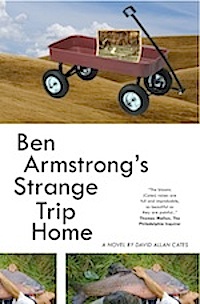
The latest novel by David Cates (wonderful to read, odd to drive in)

The latest novel by David Cates (wonderful to read, odd to drive in)

Hamlet’s Back at Devil’s Lake

The actor playing him this summer’s there,
I mean to say. He likes to memorize
while hiking, where the purple quartzite shines
and the T-Rex headed vultures soar.
The rock he’s on is so much older than
the play he’s in. They’re metamorphic mirrors–
hard things from Shakespeare and tectonic shifting–
still shiny, still showing us us after years
and years, hundreds, and millions, a billion years.
It is time and timelessness. And time is time,
not out of joint, not yet, still gracious here.

He is morphing, but the actor is still Matt,
and this Prince of Denmark loves his dog.

(If only poor Ophelia’d had a cat.)

_____
Oh! I can’t wait to see Hamlet this summer–great fun to be had and heartache to be felt and always, always interesting to see a new actor take on the old speeches and give them to us new.

Which reminds me–I need to get all my tickets figured out! To the box office with me, anon!

If you haven’t already made your own plans, you really oughta go to American Players Theatre.

_____

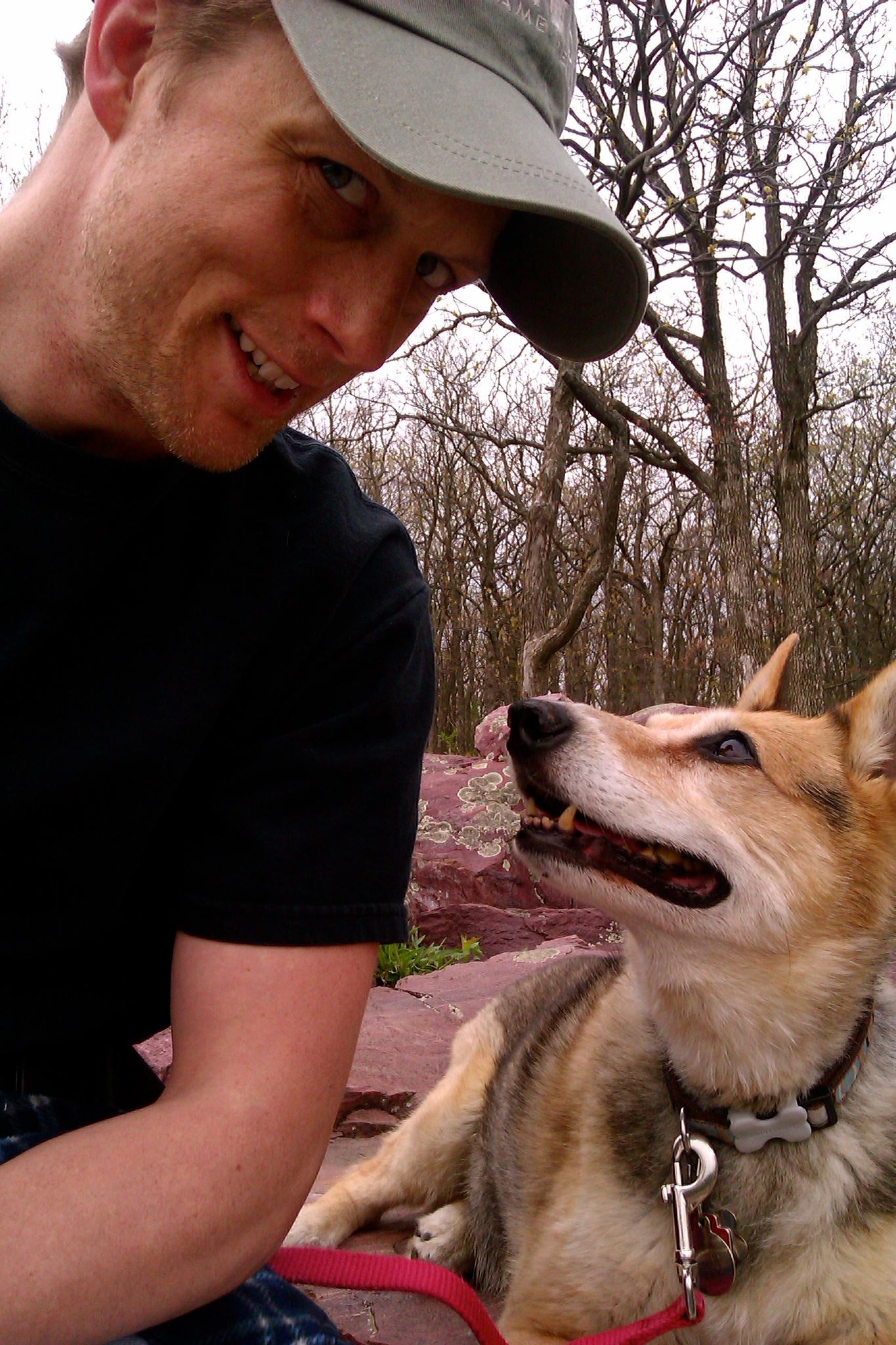
(Apologies for the sprung rhyme scheme above. Once I’d thought of “If only poor Ophelia’d had a cat,” I couldn’t let it go. Fortunately “cat” rhymes with “Matt.” But “dog” is just hanging out there, not rhyming with anything. Yet. I might revise. In any case, I know Matt will take care of his dog. And dogs mostly don’t care about rhymes. Thanks, Matt, for letting me share the pics–especially the puppy one. How could anyone look at that picture and not smile?)

____
462639_10151595624175155_1127254500_o

Matt Schwader, appearing this summer in Hamlet.

Matt Schwader, appearing this summer in Hamlet.