Category Archives: Southern Illinois

Purgatory, Kentucky (done?)

It got to where I couldn’t see a way
ahead except for dying. So I went.
Or, so I came. Just where, I couldn’t say.
It’s odd. Some kind of grass, or cane, all bent
this way and that, slick at the root,
and spiky sharp half the time, black as coal,
but soft enough to lie down in, some spots.
I’d have slept more, but my dreams are full
of nasty animals and dead presidents.
I got attacked by a whole fleet of armadillos
in a river. An armada. Is that what you call it?
Abraham Lincoln himself chopping wood. “Hello
Mr. Penny Man,” I said. He spoke not a word.
But this ain’t Hell. Of that I am assured.

This ain’t hell. Of that I am assured.
Would there be moderately cold beer or
would they let me keep my truck if torture
was on the agenda for now and ever after?
You might say yes, but I think not. No way.
I will admit that I have odd dreams.
But nothing scary, really. Nothing mean.
Just weird. Like a really long nap in the middle of the day.
There’s not much else to do. I could reflect
on all my trials and tribulations, the error
of my ways, but where would be the profit in that?
The wicked queen’s mistake was looking in the mirror.
She couldn’t rest in her own head and let
the young ones be the ones to stew and fret.

The young ones are the ones who stew and fret,
yes, even here they do. I tell them to relax,
but I do recall what it was like, to be fraught
with longing for a certain someone’s kiss,
the way a particular set of hard calluses
could raise a wave of shivers on my skin,
then one touch later heat me up fast,
so hot for more, I would do anything….
There is no profit in that kind of thought.
The man whose hands I speak of is not here.
I’ve grown restless all the sudden, not
full of life, I wouldn’t say, just bored.
Turns out I dislike it, this world without end.
The ferry’s here. I guess I’ll drive on in.

The ferry’s here. I guess I’ll drive on in.
I tell you if I’d known I’d have my truck
on this side of, well, whatever side I’m on,
I’d have done myself in sooner. Just my luck
the ignition switch is still a fussy thing
which I guess means this isn’t heaven.
I never really minded when it wouldn’t start,
just took the time to admire my good old Ford,
Bought it new in ’72, Grabber Blue,
What was there me and my girl couldn’t do?
My favorite thing I ever hauled? An outhouse
that my Mama did NOT want me to take away.
“When your crazy cousin Vernon visits,
I like to have a quiet place to pray.”

I like to have a quiet place to pray,
and sitting, waiting, in my truck, well that’s
about as quiet as it ever gets
because the radio died in ’88.
When a radio dies where does its music go?
They say sound waves never really go away.
I don’t understand everything I know
about that. I guess I believe that sound’s a wave.
I guess I believe there are tiny bones in my ear,
a hammer and an anvil and a horseshoe? Is that right?
I wonder if they’ll be taking questions there.
I wonder if it’s always kind of twilight.
There’s the ferry now—I guess it’s time
I got myself in gear and got in line.

I got myself in gear and got in line
but wow, this line’s not moving. Not at all.
Then suddenly I’m hearing “Begin the Beguine”
a song I didn’t even know I knew. There’s a swell
of trumpets and what is that? An oboe? I don’t know.
And now a woman in a cape has stopped
by my truck. She’s a nun. So I guess it’s not a cape.
She says she’s a Beguine. Go with the flow
is what I’m thinking. There. We’re moving some.
The nun is in my truck. She sings along
to “Smoke Gets in Your Eyes.” I only hum.
I never could remember all the words to a song.
And now we’re going slow again, so slow
we might be backing up. I just don’t know.

We might be backing up. I just don’t know
if I’m alive or dead, asleep, awake–
but then, my whole life (a hundred years ago)
has been like that, blurry on the day-to-day
and sharp, in focus, only now and then.
Is that depression? Or is it being dumb
about what matters? I kind of drift along
a lot. My favorite thing was being at home,
just doing nothing, which is why my house is a mess.
Or was a mess. I’m sure it’s still a mess.
I’m the only one who ever cleaned.
But if I’m dead, what’s home? That’s what I mean.
There’s really nothing left to do but pray.
It’s gotten to where I cannot see the way.

_____

I began writing this crown of sonnets in April of 2013, as part of National Poetry Month, and NaPoWriMo.  I’m slow.  I would remember it every now and then and add a sonnet to it.

It’s a curious project–it began as a challenge sonnet when I was on my way to Manitowoc to do a reading.  I can’t remember all the parts of the challenge, though I think Abraham Lincoln was in it, and I definitely remember my friend Becky asking that I include Boyd Crowder’s hair.

Walton_Goggins_March_19,_2014_(cropped)

This is Walton Goggins, who played Boyd Crowder on Justified. On the show, I think Boyd used more hair product. (Image from Wikimedia Commons)

Because I loved Justified so much, putting Boyd in the poem opened all sorts of possibilities. I immediately heard the voice of Mags Bennett, played by the amazing Margo Martindale (one of the best villains with one of the best story arcs in all of tv land, ever). That’s why it was Purgatory, Kentucky.

But as I wrote it, I was less and less sure of Mags’ voice in the poem, or the need to have her narrate, so I’ve revised a lot of that out of it.

It doesn’t have much to do with Kentucky at this point, so I’ll probably change the title. It could be Purgatory, Illinois.  The outhouse portion happened in Southern Illinois, which is itself sort of a blurry place, not entirely southern, not entirely midwestern…  I actually like the sound of Purgatory, Illinois.

In any case, I believe the draft is done, and that means that I’ve now written four crowns–“Mothering God” was the first, and then “Each Other’s Anodyne,” and then “Mobius Strip of a Man,” and then this one.  I’m now working on a heroic crown of sonnets about my back surgery at the Shriner’s Hospital for Crippled Children (it’s not called that anymore).  I actually have this vague memory of writing another crown of sonnets, but surely I’d remember it clearly if I done it, right?
And also I look like Bernie Sanders

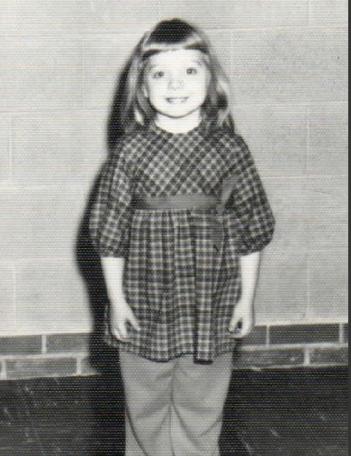
Even with my super-short, super-straight bangs, I was an adorable child:

393489_2101279191124_155254841_n

Kindergarten Cute

Whatever body-image issues I’ve developed since then, there’s no question in my mind I was cute then.  When I was a baby, one or two of my uncles (depends on who’s telling the story) said there should be a “Marnie Doll” because I was cuter than a Kewpie Doll.

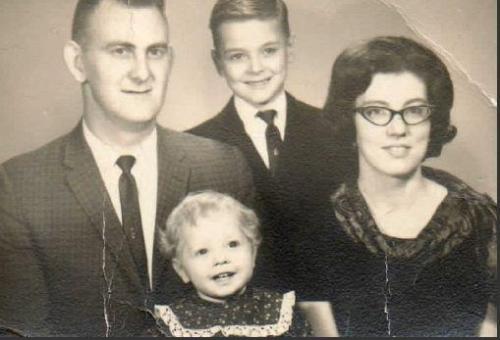
When I was a baby, my parents and brother and I got one of the two good pictures of the four of us we’ve ever managed to get:

384749_2101265950793_1949350502_n

There’s also a picture of us in the 80s that’s pretty good. But in general, the four of us don’t photograph well together.

Recently, my Great-Uncle Logan passed away, and my cousin Jewell is going through his photo albums to divide up the pictures. She’ll give the originals to my mother, but she scanned this one and sent it to me:

1689697_10102386058738158_1728250219445087742_n

This is generally how it goes when the four of us have our picture taken. The looking in different directions. The some of us all swanky and others not so much. In this one, the squinting. Still, I’m loving this picture. First, my mother looks remarkably like one of my younger cousins & I always find those resemblance moments compelling.

And also I look like Bernie Sanders. When I posted this on Facebook, a few people tried to tell me I was actually cute, but I said, no, no–I was a cute child, but this is not a cute picture of me.

Thus, my thoughts when I saw it were “I look like Bernie Sanders” and “Mom looks like Jamie” and also “Mom looks so cool!”

When my Mom saw the picture, she was trying to figure out what year it was.

When my brother saw the picture, he agreed that I looked like Bernie Sanders, but pointed out it was before Dad went to Vietnam–he knew because Dad didn’t have much of  a tan.

Dad agreed it was before Vietnam because he came back from that war with a higher rank and medals.

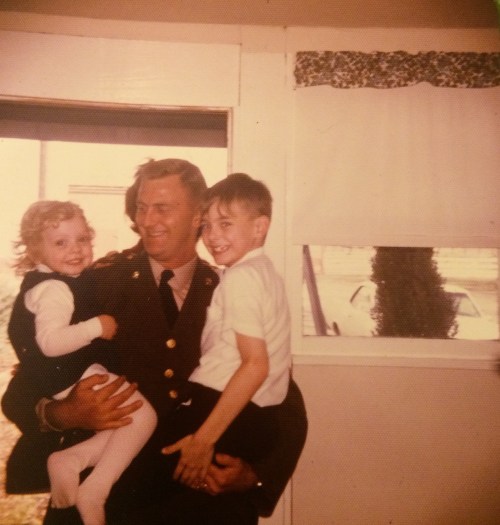
The Bernie Sanders pic made us all remember the following picture, the first one of all of us when Dad came back from Vietnam (Mom’s standing behind Dad–you can see her hair a little–again, challenging to get a good pic of all four of us).

FullSizeRender-3

I don’t know if the four of us were ever happier than we were in that picture. In that moment.

After that, we would have two adolescences and career challenges and the ordinary life stresses of keeping it all together as adults and then weathering deaths in the family and now my father’s memory is so spotty that he’s confabulating–remembering things that didn’t happen. When he saw the Bernie Sanders pic, he talked about remembering seeing it before, but Mom and I are pretty sure we never saw it. That Uncle Logan snapped it, and it went in their photo albums, and we’re just now seeing it.

That’s the thing about confabulation–it’s hard to know if I should play along (at which point I almost feel like I’m gaslighting myself) or challenge Dad (which is troubling, since the confabulated memory seems as real to him as any other). And in this case, does it really matter? Probably not.

But if we skip to the end of the war and focus on the picture of Dad holding Brian and me, Mom right behind, that white car in the drive–we’re on Gran’mommy and Gran’daddy’s back porch, in their old house on the farm (before the new house, before they had to sell the farm).

If we focus on that picture, well, it’s just pure bliss. I’m sure of it.

Tin Whiskers

“Tin whiskers are easy to miss, thinner than a human hair. They look like metal fuzz. They grow — for reasons scientists don’t understand — from plated tin surfaces, millimeter by millimeter. And if they bridge two closely spaced circuits, tin whiskers can cause a short.” Todd C. Frankel, “A Carbondale professor, runaway Toyotas and the hunt for ‘tin whiskers'”

1 (a found poem, from the same article)
“None of this happens if David Gilbert keeps his Ford
F-150 truck. Not the threats to his job
as a professor at Southern Illinois University Carbondale.
Not the corporate intimidation. He never would have
testified before Congress. And he never would have met
those NASA scientists, the ones who ended up
naming an electrical effect after him. As a gift,
they gave him the black NASA coffee mug
sitting on his desk — the one he’s sipping from
right now. The mug reads, ‘If it’s not safe, say so.’”

2
But he traded in his truck for a Toyota.
This is when they were crashing, speeding up,
Toyotas were, getting recalled. He was a curious,
and tenured professor, and had an automotive
lab, so he hooked his truck up to a machine
(it looks like steam punk in my brain, with gears
and cogs and whistles and clocks) and caused an error
the truck’s computer missed, again and again.
Here’s the movie he’s the hero of—
Big bad Toyota tried to trash his name.
My alma mater tried to stop his work.
He just kept telling the truth. It’s almost like
some people have tin whiskers inside of them.
Inside of him, a regard for truth, almost like love.

_____

I like to read the online versions of newspapers from places I’ve lived in the past, or places I’m interested in. Thus, on any given day, I might check out The Missoulian (oh! those years in Montana!) or The Southern Illinoisan (the place names alone are worth it), and though I never lived in St. Louis, I spent a fair bit of time there. The article referenced above was in the St. Louis Post Dispatch online, written by Todd C. Frankel, who now writes for the Washington Post.

It’s a well-written article, a complex and compelling story.

It speaks to so many things, including the enduring value of tenure.

So, bravo, Mr. Frankel, and yay for Professor Gilbert, who really does strike me as a hero.

All the Ramones are dead and I am old.

All the Ramones are dead and I am old.
Can you guess which of those two items made the news?
My bottle rocket’s grounded, ashed over and cold,

not hot like when I aimed it at a friend,
both of us drunk, young wildness on the loose.
All the Ramones are dead and I am old

enough to have liked them before they were old,
when they were hot, when they were cool,
not like a bottle rocket on the ground, ashed over and cold,

but cool like benzodiazepines. All my bold
endeavors seem dangerous now. I’m blue.
All the Ramones are dead and I am old.

One time a friend dressed up as Joey Ramone,
but he looked like Emo Phillips, to tell the truth.
My bottle rocket’s grounded, ashed over and cold,

but I might have a little firepower left in my head.
I’m anxious to figure out what I can do
because the Ramones are dead and I am old,
with only a bottle rocket, ashed over and cold.

The Dream of Perennial Corn

1
Resource-hog sign of high summer,
high-fructose commodity seed,
short-term forest I missed sorely
in years Gran’daddy grew soybeans—

oh, corn.

Holding tight to cob-stabber handles,
letting butter invade where it will,
I demolish, row by row, kernel troops.
They leave behind mines in my teeth.

2
Fine people are already working
on sorghum and wheat
that don’t have to be plowed under,
replanted, cut down, plowed under,
and fertilized, fertilized, fertilized.

Much less practical is longing for perennial corn
but I do. I’m hot for it. Like August.
Imagine deep roots find Ogallala.
Acres jump up every year like bamboo.

We could wander and pluck at ripe goodness,
modern-day Eve, Adam, Abel, Cain.
There’s plenty enough for everyone.
More than enough for raccoons.

3
We probably won’t but we might
do the right thing, the right things
enough times in a row, enough rows
in a row, to harvest just once

without biting the hands that feed us,
without breaking our favorite jelly jar,
without zeroing out.

We might hold out our cup almost shyly
and blink, super-slow, as it fills up,
with sunshine, with sweetness, with juicy,

with corn.

___

You should check out The Land Institute if you don’t already know all about them. My husband and I have supported them for years, and in fact, my parents do, too.

(Apparently there are other people working on perennial crops, including corn, but it isn’t pretty yet. And I’m not familiar with this particular fellow.)

The Land Institute’s main site is here, and here’s an article from the Wall Street Journal which ends with a lovely little paragraph:

“‘We’ll get there,’ Mr. Jackson says, with the patient drawl of a plant breeder from Kansas. ‘But it is no instant gratification. We’re making considerable progress, but this is not for the conventional mind.'”

As always, I’m pleased not to have a conventional mind.

___
388108_10101425678827198_1617838374_n

Pedagogy Stew: November 2013

Gracious but I was a pill sometimes.

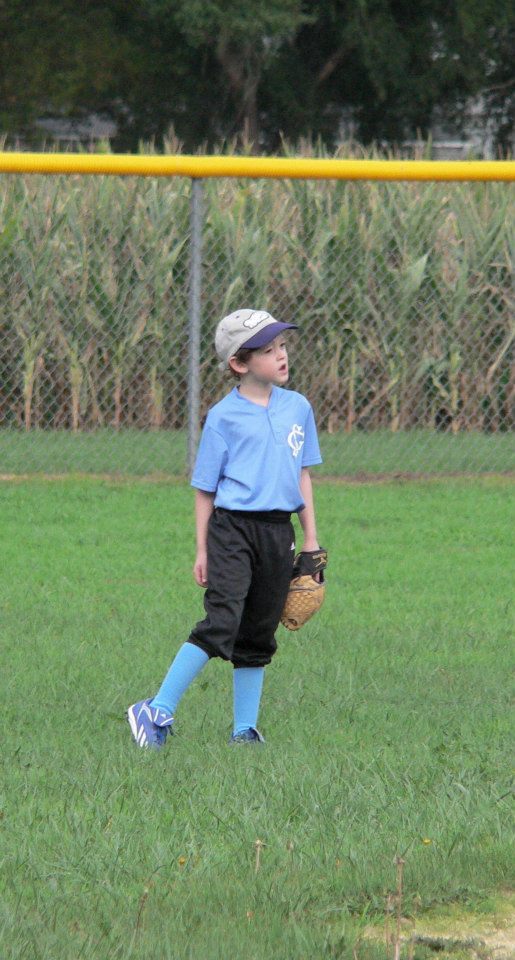
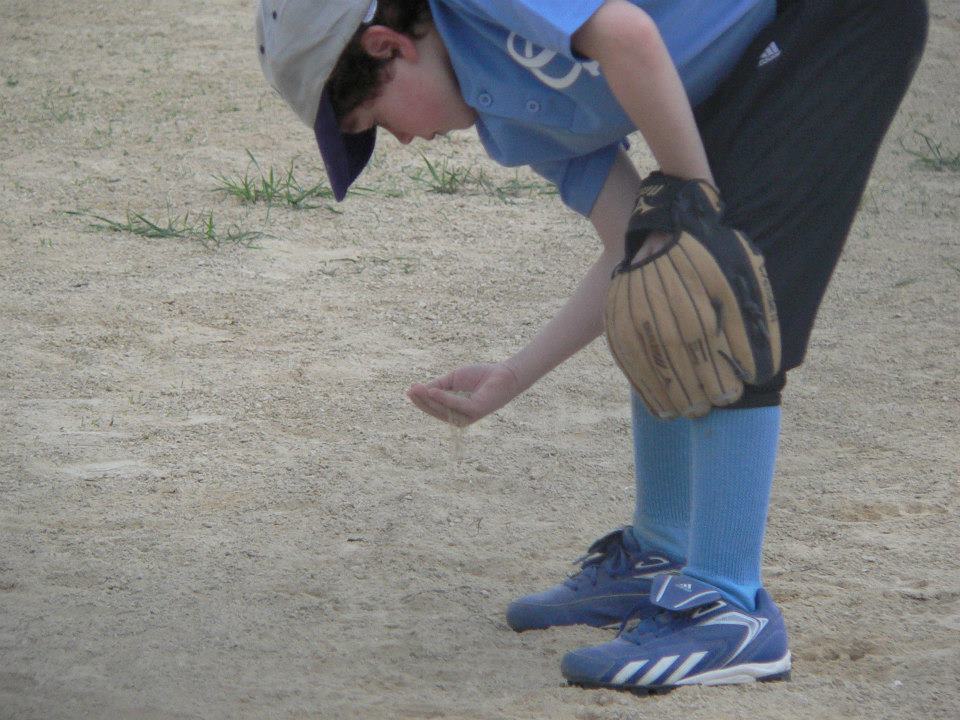
He's better about watching the ball year by year. But sometimes the dirt is so interesting....

He’s better about watching the ball year by year. But sometimes the dirt is so interesting….

I watch my son’s squirrely-ness in the outfield in the context of how I played right field as a child. One time I got so bored, I just walked home.

Living kitty-cornered to the school came in handy. I’ve recently verified with grade school friends that yes, at least once, when I raised my hand to ask to go to the bathroom, I went home to use that bathroom. And watch a little TV.

“No one could find you,” my lifelong friend Cindy said.  “Finally someone called your house.”

“And I answered the phone?” Apparently I did, and then casually went back to school.

I don’t recall getting in trouble for that, and here’s probably why.  When I was in the sixth grade, I had spinal surgery, fusion for severe scoliosis. I wore a neck-to-hips cast for three months, then a slightly smaller cast for another three months, then what was called a Milwaukee brace for six months.

Overall, I was a very well-behaved child, and remember my glory moments of audacious youth fondly because they were few and far between. And because when I got caught, I didn’t get in trouble much.

Allowances were made.

Paul Tough’s terrific book, How Children Succeed, discusses a study and method of measuring childhood stress and trauma called ACE, for Adverse Childhood Experiences. The more adversity, the more likely a child is to struggle in school. One major factor that helps such a child thrive in spite of adversity (whether it’s violence or poverty, or, I would guess, major surgery), is good, solid, attachment parenting.  Which I got.

Thus my son’s traumatic trips to the emergency room because of severe food allergy reactions—we can buffer those experiences so he’s not doomed.

And when I’m volunteering at his school, and one of his classmates is just being a total pill, I have to acknowledge that I don’t know their home situation. I don’t know what they had to maneuver as they made it to bed the night before, or whether someone was there to feed them in the morning, or, even if they have all the material goods they could ever wish for, someone is consistently mean to them.

Viewing people with compassion—that really is what it’s all about.

I don’t do it perfectly, but it’s something I tend to do well as a professor.

I tell my students that our time together as members of the class is such a small fraction of our lives. If it’s all we know about each other, it’s really not much.

I picture them as icebergs, not because I’m a ship and they’re dangerous obstacles, but because I’m seeing just the tip of who they are and what they’re capable of.

I do try, year after year, to maintain appropriately high standards, but ultimately I’m  more interested in clarity of instruction and high levels of support.

In other words, I make allowances.

(This column originally appeared in Voice of the River Valley.)

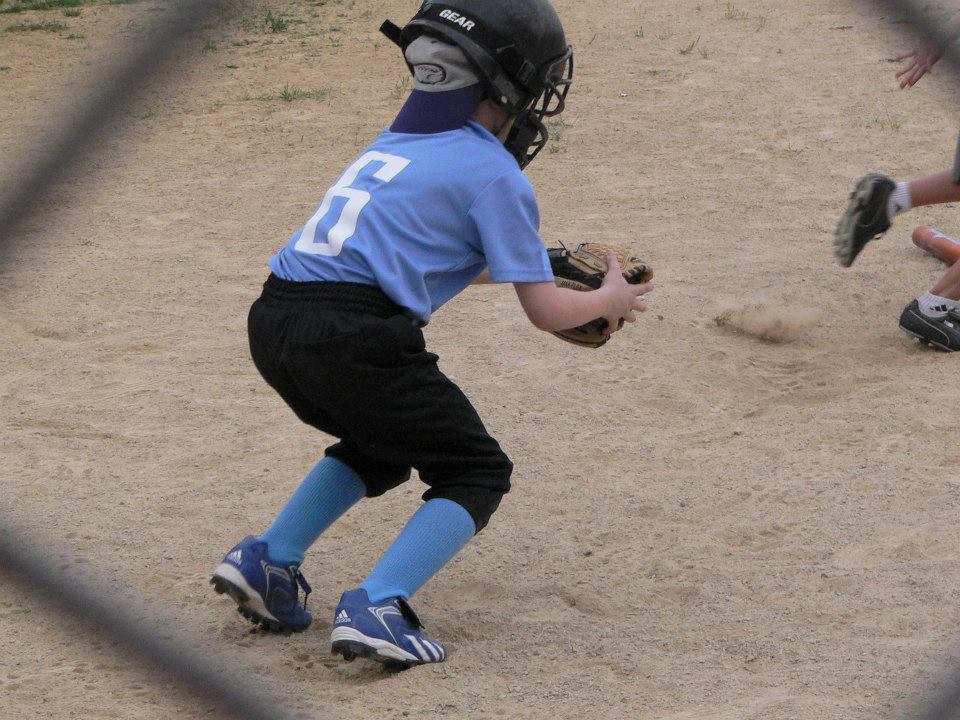
Here he's 100% in the game.

Here he’s 100% in the game.

Pedagogy Stew: October 2013

Picture an eighth-grade boy in the late 1970s. Sort of a cross between Richie Cunningham and Shaun Cassidy. Watch him as he jams a little nubbin of a pencil so far into an electric pencil sharpener that it runs continuously, leaving the not-too-bright teacher to puzzle over the mystery of it all.

Don’t worry about that boy. He’ll grow up to be an aeronautics engineer.

The teacher? He’ll get fired. He had so little control in the classroom, we looked like one of those inspiring hero-teacher movies BEFORE the hero shows up.

That’s the closest I ever came to being homeschooled, when this teacher was in the process of being fired. My Dad was on the school board, and when the teacher accused me of crying to my parents about how mean he was (I complained, but I don’t remember crying), they pulled me out of school. But it wasn’t really homeschooling. I just sat in a lawn chair in the corner of my Grandma Roane’s lawn (which was kitty-cornered to the school) and waved at everyone when they were at recess. Soon enough a hunky-hero teacher showed up and I went back to school.

I was lucky enough to spend an evening with many of my eighth grade friends in early August this past summer, and it was terrific seeing all these folks again. What we went through in grade school bonds us in deep ways.

We caught up on all kinds of things. We agreed the hunky-hero teacher still looks pretty great, thirty-plus years on.

We chose to get together this summer.

But the time we spent together back then wasn’t out of choice. Not ours, and not our parents’.

We went to school where we went to school because there wasn’t an alternative.

Since most of us were from staunch Baptist or Methodist or Pentecostal families, the Catholic school in the next town would never have seemed like an alternative, though it occurs to me now that it was.

I don’t think any of us had ever heard of homeschooling.

Homeschooling is but one of many, many alternatives now. School choice in Wisconsin means my husband and I can send our son to any local elementary school, including our choice, the Studio School, which is a public school/charter school/school within a school. Next year, there may be a STEM school (focusing on Science, Technology, Engineering and Mathematics) in Arena we could send him to. School vouchers in Wisconsin mean we could send him to a private school and get some state money for it (wait—really? That can’t be right. Maybe I dreamed that).

Our two main criteria for deciding how to school our son are these: is he happy? Is he learning?

I’m glad to have alternatives. I’m glad we get to have criteria beyond “if the teacher is horrible, we’ll try to get him fired.”

But it’s not just nostalgia when I miss the simplicity of how I went to school.

(This column originally appeared in Voice of the River Valley.)

Pedagogy Stew: September 2013

My brain has a timekeeping section that operates like a not-very-creative grade school teacher’s bulletin board. There’s a snowflake for January and a heart for February and a kite for March. For September, of course, there’s a little red schoolhouse. Or perhaps a pencil, since almost no school looks like a little red schoolhouse any more.

I remember the one-room schoolhouse from my hometown primarily as a huge blaze—they burned it to give the volunteer fire department practice. No one had been a student there for more than thirty years. I started school in a red brick square that’s still being used as a school, but not for long. Taxpayers in my hometown passed a referendum to build a much bigger new school.

Back to school.

It’s an evocative phrase, isn’t it? See the bleary-eyed children—some of them not transitioning well at all from the summer sleeping schedule, some of them suffering so much from ragweed allergies they’re already longing for snow.  Listen to the bells and announcements and the roar of recess. Feel the amazing fast stops and starts and really particular squeaks of new gym shoes. Smell the glue. (Don’t tell me if you can taste the paste.)

O school supplies, how I love thee!

Even when we were homeschooling my son, we went out and bought school supplies at the end of summer. We accumulated such a stash, in fact, that I now scour the writing implement drawer for brand new pencils instead of buying them.

If you haven’t seen a school supply list for a while, they’ve changed some. For one, most schools (around here, anyway) put most supplies in big containers for everyone to use. When I buy a box of crayons, it’s not my son’s box to keep in his desk. The crayons get taken out of the box completely.

Each family is asked to contribute an absurdly high number of glue sticks. The burden of “who pays for this stuff” gets shifted more and more to families. I don’t look forward to the fees I’m hearing about from middle school and high school parents (of kids in public schools, mind you). Still, teachers end up buying a lot of supplies from their own pockets.

At the college level, at least on my campus, students are reminded to budget for their “printing account,” so they can print from campus printers during the semester. A lot of what we used to Xerox “for free” for students is now available online, and they have to print it themselves. It was never free, of course. It was paid for by departments out of “supplies and expenses” budgets that have shrunk in recent years.

Regardless of who pays for what, though, it’s the end of summer, the beginning of autumn, a time of harvest and bounty. The printing accounts are full, the pencils still have their original erasers, and there are reams upon reams of paper just waiting to see what our students have to say.

(This column appeared originally in Voice of the River Valley.)

Pedagogy Stew: August 2013

I’m headed to my 30th high school reunion this month, which causes me to reflect on many things, including my overwhelming urge to find a copy of The Preppy Handbook (pretty sure there were no Southern Illinois locations mentioned in it, also pretty sure I didn’t catch that it was satire when I got it for Christmas, circa 1981, along with some knock-off Topsiders and a belt with little ducks on it).

I was ranked 5th out of a graduating class of about 400. I remember that because I’d been tied for first until my junior year, when I flaked out and could muster only a B in Advanced Algebra/Trig, the same in Chemistry. This coincided with the onset of that whole “imagine this graph/molecule in 3-D inside your head,” which I pretty much totally sucked at.

But overall, those pretty-good-but-not-excellent marks were just further manifestation of my lifelong urge to avoid certain sorts of difficulty.  I’m drawn to some challenges, primarily those of my own devising. Stepping off the valedictorian track involved a rejection of mastering the challenges of classes someone else chose for me. I refused to take calculus my senior year, and as I remember it, my Dad called the man who would’ve taught it (who had taught algebra to my Dad at a local community college) and they grieved together.

I can’t help wondering what kind of challenge students anticipate when they sign up for a MOOC.

MOOC is short for Massively Open Online Course, and they’re all the rage in higher education. They are available online, usually for free, from some terrific universities and professors.

The good part is having free access to lectures, assignments, and tests from some superstar professors.

The bad part is, typically, having zero access to that professor, or to feedback that isn’t automated.

The good part is how easy it is to sign up and participate.

The bad part is the incredibly high dropout rate.

The good part is that a highly motivated student can learn a lot, for free.

The bad part is that a student who is motivated to avoid the challenge of sitting in a traditional college classroom, or taking what now seems like a “traditional” online college course…this student may not be up for the challenge of learning in a less structured, less obligation-driven environment.

In general, as a college student, I’d have crashed and burned in a MOOC, especially if I were taking it to speed through requirements I didn’t see the point of.

But what if taking a MOOC were my own idea? And not required?

It might be like my sophomore English class, at that point. I insisted on doing my book reports on the silliest books—a biography of Colonel Sanders and one I still remember the title of, Sherlock Bones—Pet Detective.  But I was reading Shakespeare’s Venus and Adonis and Kazantzakis’s The Last Temptation of Christ on my own. A challenge of my own devising.

(This column appeared originally in Voice of the River Valley.)

I can’t not love the Cardinals

I will always be a St. Louis Cardinals fan, but I’m not as big a baseball fan as I used to be. Less time for television viewing. No cable television. No reliable free radio coverage until recently when I got a smart phone (we’ll see how next season goes).

And also, steroids.

I sometimes think the last 20 years should have a big, fat asterisk next to it. It’s hard for me to get swept away by a game when I think so many of the players are gaming the system. Thus, Albert Pujols with his bigness always made me nervous (though as far as I know, he’s not on the lists of “guys we’re pretty sure are juiced.”)

Plus I never liked Tony LaRussa’s hair. (And I never forgave him for the way George Will gave LaRussa credit for some of what Whitey Herzog did with the Cardinals.)

But I can’t not love the Cardinals, even when they’re stinking up the field the way they did Monday night against Boston. Once I start, I can’t stop watching this moment during which I am fairly certain Wainwright was jinxed.

But even if they hadn’t won last night (whoo hoo!), I’d still love them.

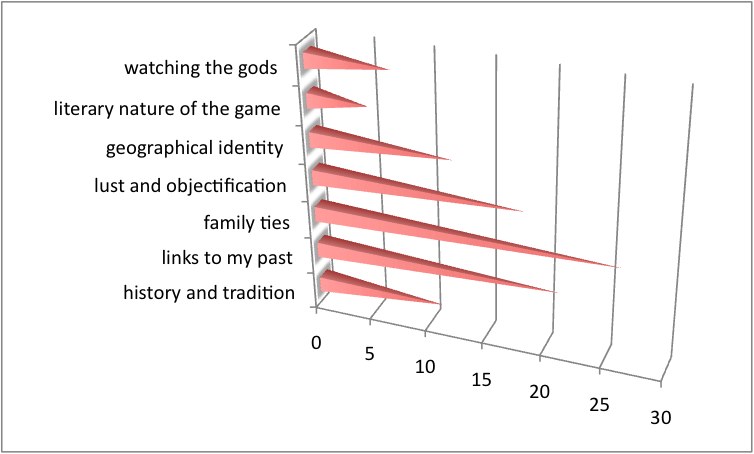
Basically, here’s why:

Seriously.

Seriously.

Watching the gods: these aren’t really normal people. We’re watching them do things we could not do.

Literary nature of the game: lots of people have written about this. It’s true. Bull Durham is my favorite movie, partly because of this.

Geographical identity: I don’t know when I’ll ever live in Southern Illinois again, but being a Cardinals fan is part of how I remind myself I’m from there.

Lust and objectification: Can I help it that I first REALLY noticed the Cardinals in 1982, when they won the Series, when I was 17, in the flush of my first waves of womanly hormone energy and girlfriends of mine pointed out things like “Tommy Herr has a great butt.” Objectification is bad, of course. But wow, are these guys fun to watch. Some more than others.

Family Ties: whatever else makes us different, the vast majority of my Southern Illinois family and I are Cardinals fans, and we can always share that. I love it that my Gran’daddy, who’s been gone for two years now, was a HUGE Yadier Molina fan. (I never told Gran’daddy my theories about Yadi waxing his eyebrows.)

Links to my past: I was such a huge fan in the late 80s. I remember sitting on the deck of one of many trailers I lived in while a grad student in Carbondale, listening to KMOX, drinking a Budweiser, sweating like crazy because birds had built a next in the a.c. and I didn’t want to bother them. I don’t want to ever forget that part of myself.

History and tradition: I never got to see Stan Musial or Lou Brock play, but I have a #6 cap and I would love, love, love to own a Brock-a-brella. St. Louis has been so dominant the last few years, it almost seems it’s cool now to hate them (NOTE:  they were NOT dominant in the late 80s and early 90s when I spent the most time actively following them), but it’s an awesome club with a rich tradition and I’m so, so happy to see them relying on their farm clubs again.

I tend to cheer for the underdogs, nonetheless. I would love to see the Cubs dominate, head to the World Series and win, win, win.  The last time the Brewers were threatening, I actually cheered for them against the Cards in the playoffs. I didn’t really mind when Boston won in 2004 (but I do feel like it’s our turn now, regardless of the arguments made by the Red Sox fan I’m married to).

But when it comes down to it, if the Cards are playing, I’m on their side. I can’t not love them.