Category Archives: Southern Illinois

If God’s going to all the trouble of sending a tornado after you….

When I was little, I wasn’t scared of tornadoes.

My Dad always said, “If God’s going to go to all the trouble of sending a tornado after you…” and I actually don’t remember the exact words of what came after that, but the idea was, just give up. If God wants you to die in a tornado and you survive that tornado, he’ll send another tornado. Or a car wreck. Or a brown recluse spider.

I found that profoundly comforting when I was a child and beyond, but I’m sure my Dad’s calm helped, too. (Note to self: try not to freak out ENTIRELY as you’re fleeing your own home, your child in tow, to your parents’ basement across town. When I said, “Get in the car right now!” I’m pretty sure I had the same intonation & volume as “You can’t handle the truth!”)

Back in the 70s, there were watches and warnings pretty much all the time, it seemed, from March through September. We ignored watches entirely, and only grew concerned about warnings if the sky turned green.

Dad and I used to stand in our garage and watch sheets of rain come across the open field northeast of our house. He was probably smoking a pipe. I was probably petting Wooly and Daisy (the best dogs ever in the history of the world).

Regardless.

I now note several problems with Dad’s tornado wisdom.

1. Even if my belief in God had not changed, OH MY GOD. Really? I’m a good Baptist girl and God might just, out of pretty much fucking nowhere, send a tornado to kill me? And I can’t get away no matter what?

2. My belief in God has changed. I have a kind of wacked-out sort of X-Files Mulder/Scully hybrid of beliefs. As in:
a. I want to believe.
b. Maybe God could steer tornadoes in a pinch, but tends not to.

3. The basically impossibly huge question of how a loving God could allow horrible things to happen. (I’m not going to solve that here. Sorry if you’re disappointed.)

When I lived in the second of a series of three trailers I called home as a graduate student at Southern Illinois University, I began to have a recurring nightmare about tornadoes. In it, I would wake up in the middle of a horrible storm, feel the trailer begin to shake, watch the walls suck inward, watch the roof blow away, and then try to hold onto my bed to keep from getting sucked into the sky. Then I would wake up.

I suspect this had to do with being in miscellaneous precarious emotional situations in those years. And also living in a trailer. “God’s bowling alleys,” my brother always called trailer parks.

(So, o.k. What is it with men in my family and tornadoes?)

But during one actual tornado warning, I stayed in Trailer #1 and announced to God, “I’ll just die here with my cats, thank you.” Very green sky. Large branches flying by the window. Trailer rocking in real life, not the dream world. (Oh, that girl. I could just smack my 21-year-old self!)

I think, over the years, I’ve just grown less and less fatalistic. Certainly less suicidal! It is also possible my frontal lobe has developed some.

And then having a husband I love and I son I am OVER THE MOON ABOUT makes storms really stressful.

We’ve had a wacky weather week in Wisconsin. More storms coming.

Is it possible, in what I now called the land of “Zen Baptist” on my faith journey, to take wise precautions and yet be at peace about whatever comes?

Sure hope so.

Because what comforted me as a child, comforts me not at all right now.

_____
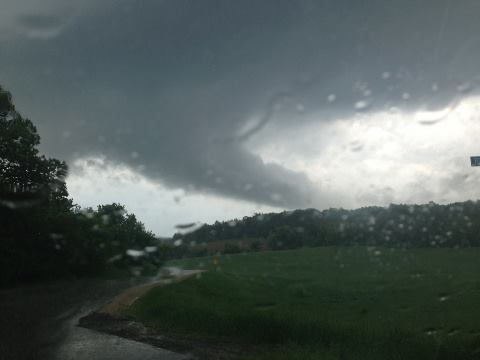
Here’s what fun about social media. Someone named Kevin posted this on Channel 3000’s Facebook page. The comments are hilarious. Including: “it’s sunny in beloit” and a whole thread of “don’t take pictures while you’re driving” and “it’s not a tornado.”

So. Probably not a tornado. (No one actually said it was.) And also not my picture. But gracious. I wouldn’t mind some boring weather.

Not a tornado.

Not a tornado.

I Want to Be the One: Class of ’83

I want to be the one who doesn’t spend
one minute worried about how fat I am,
how fat or bald you are, if that’s Botox
smoothing out your smile. Are those boobs real?
No—none of that. I want to hug old friends—
yes, OLD, or old enough. It’s only time
that’s passed. We’re so lucky if our clocks
are still ticking. Ten years from how we’ll feel
more grief than we’ve felt yet. The 50s are hard
to live through–heart attacks, cancer, car wrecks–
we’ve already lost a few–who’s next?
At our 40th, we’ll just be glad we’re not dead.
I want to be the one who gets that now.
I want to really get it, the blessing of right now.
_____

I’m looking forward to the 30th high school reunion this summer, partly based on how much fun I had at my 20th.

Lines that didn’t make this particular sonnet:

I want to be the one you want to see.

(cut: too needy.)

I want to be the one who asks you how
you really are, who waits to hear you say

(nice idea, just didn’t fit)

And besides, if it’s like the 20th, what I’ll be asking is, “Hey, have you seen my husband?” And I hope the answer is, again, “Yeah! He’s out in the parking lot drinking homemade wine out of Mark’s trunk.”

(IF I have enough to drink myself, I might ask the guy who keeps posting Bible verses on our reunion Facebook page, “What the fuck?” But we’ll have to wait to see about that. I feel as though I deserve some sort of massive bonus karma points for not posting that as a comment on f.b. already, although, of course, this whole paragraph pretty much zeroes out any gain in karma points.)

But in memory of those we’ve already lost, and with high hopes for good times in August, here’s to the class of ’83!

We've already lost some great folks.

We’ve already lost some great folks.


UPDATE: let me clarify, because I don’t want people to get offended for the wrong reasons: I think it’s perfectly fine to post a Bible verse on the reunion page. The verses posted thus far, though, seemed kind of random to me & the fellow didn’t post any context.   Verses that would seem less random might be “Wine is a mocker and beer is a brawler.” Bonus points if you can name chapter and verse WITHOUT Google or a concordance. (Honestly, I just know it’s in Proverbs somewhere, but given my Baptist heritage, I shouldn’t even get partial points for that.)

Tiger-Beat-Teeny-Bopper-Fan-Fan-Fan, Stop

I was eight when I learned that Rick Springfield slept in the nude at B&B Hobby Shop in Mt. Vernon, Illinois.
_____

Every Sunday after church, my family  would stop at B&B Hobby, next to the Granada Theater in downtown Mt. Vernon, at a time in history when small-town downtowns everywhere were still thriving.

The store was so much deeper than it was wide—in my memory, there were sections and sections toward the back of the store, very dark, high shelves so teeming they were close to toppling. Back there, the paths in the linoleum weren’t nearly as worn. Head shop? Porn section? Just a little girl’s imagination? I never, never went all the way back.

Dad looked at the selection of pipes and tobacco. “The better it smells, the worse it tastes,” he always said about pipe tobacco.

My brother looked at balsa wood dowels and possibly-huffable glue and model paint. Among his other creations was a working guillotine that he threatened to use on my Ken doll.

Mom and I looked at magazines, right in the front of the store, next to one of the big floor-to-ceiling pane-glass windows. I was absolutely focused on Tiger Beat and Teen Beat and 16 Magazine. (I was 8 or 9 when I read 16, 13 or 14 when I read Seventeen, and then at 17, began reading Andy Warhol’s Interview.)

Once we’d loaded up the counter with that week’s purchases, which always included the St. Louis Post Dispatch, we piled in the car and headed toward Opdyke, about a 20 minute drive.

I always read on the way home. I always got a headache. But I could never wait.

_____

So of course, what I did was read “Why Rick Springfield Sleeps in the Nude” at B&B Hobby Shop when I was 8. Because I read it there, because it was SO TITILLATING, when I think of Rick Springfield, yes, I think of General Hospital, yes I think of “Jesse’s Girl,” but mostly, I think of that headline on the cover of Tiger Beat and I am SMACK RIGHT THERE in B&B Hobby. With a little bit of a sick car-headache to go with it.

And why did he sleep in the nude? As I remember it, he told a story about waking up when he was a boy with both legs somehow in one leg of his pajamas, and being terrified that he’d somehow lost a leg, and ever after slept in the nude.

One wonders now at the probability of any single part of the story being true (very low) and also the probability that the editors were making a joke about a different sort of leg getting stuck in his pajamas (very high).

Oh! Those early 70s! What a time. It was also Donny Osmond I was nuts for (I had an Osmond’s lunch box I wish I’d kept, like this one)

In what I now understand as the beginning of the end of my pre-pubescent teeny-bopper phase, there was once an article on Shaun Cassidy, where he was asked what kind of music he listened to. I only remember one band from his list, Led Zeppelin, but I came away understanding he was the same age as my brother and listened to the same kind of music. My brother hated what I listened to. I used to torture him by singing, “Make the world go away,” in my best Marie Osmond impersonation.

I wasn’t done being a teeny-bopper, but a layer of sweetness had been stripped away. In its place, a dawning awareness of the chasm that yawned between what I thought I knew and what was true.

Being a teeny-bopper fan was hard work then. You had to wait for magazines to come out, you had to pay to belong to fan clubs, and you had to watch TV pretty much all the time just in case someone showed up somewhere.

Now? Pshaw. Easy as pie. Set up a Google alert and you learn more than you even really want to.

And thus we encounter the middle-aged teeny-bopper phase. I don’t put the posters on my wall any more, but I still get that little frisson, “new picture!” or “new detail!” or “new movie!”

On Monday’s show, Katie Couric asks Bradley Cooper about his dating life, and mentions how the media seems absolutely obsessed. He does a nice collapse on the couch, and then comments that he partly finds it pretty interesting and partly finds it pretty disheartening.

There’s also a video of him on Howard Stern’s show, from 2011, when Stern is not just praising Renee Zellweger (who was Cooper’s girlfriend at the time), but Stern is also trying to figure out if he’d had a shot of sleeping with her one time back when, when they were having their hair done in adjacent chairs…. The look on Cooper’s face is hard to interpret, except that there’s nothing in it that is saying, “I’m enjoying this part of the conversation, Howard, please say more.”  If you track the timeline of media coverage of his love life, Cooper & Zellweger broke up just days after that show.

[Finding out Bradley Cooper is a huge fan of Howard Stern is somewhere on the same emotional planet as finding out Shaun Cassidy liked Led Zeppelin. Interesting.]

I’m not as nice as Katie Couric (seems to be) and not as crude as Howard Stern (seems to be).

I wish I were so different from either of them that I could interview someone like Bradley Cooper and not bring up dating at all.

Ultimately, in the pie chart of “What I Find Interesting About Bradley Cooper” (tune in tomorrow for the full chart!), “Whom He’s Dating” is a mighty-slim sliver.

But I wish it weren’t a part of the pie at all.

If My Teaching Career Were Keats, It Would Be Dead

T minus 10 days and Spring Semester 2013 officially begins for me (I know many people have started already, and no, I don’t know why our classes begin on a Friday this year).  When I turned in grades for Fall 2012, I officially completed my 25th year of teaching at the college level.  When I started in 1987 at age 22, I was not particularly good at my job, but I was enthusiastic. My skills are solider now, and my enthusiasm…well, it’s pretty solid for the part of my job that takes place in the classroom.

As I approach the beginning of my 26th year of teaching, I find myself wondering about metaphors for semesters.

Of course, it might be better not to have a metaphor for a semester at all. It might be more productive to be the Kings and Queens of Denotation (say what?) and simply proceed, understanding that a semester is a unit of time. But that’s not how I roll.

The rooms we teach in affect how we teach: Nancy Van Note Chism notes “social constructivists point out that the social setting greatly influences learning. Picture the limitations of the standard classroom or study carrel in terms of these ideas. The decor is sterile and unstimulating; the seating arrangements rarely allow for peer-to-peer exchange; and the technology does not allow individual access to information as needed. Rather, the room supports a transmission theory whose built pedagogy says that one person will ‘transfer’ information to others who will ‘take it in’ at the same rate by focusing on the person at the front of the room.”

I think metaphors affect us in much the same way. If our metaphors don’t match our pedagogy, we will find ourselves asking students to balance buckets of water on their heads whilst also spinning on a merry-go-round (one of those old-school ones that are really dangerous and hard to find) without even realizing the impossibility of what we’re asking.

(But wow—wouldn’t that be hilarious? Everyone would just be soaked and dizzy and puking and miserable and laughing like crazy.)

Here are some metaphors I’ve been mulling:

  • Train trip
  • Garden
  • Party
  • Game
  • Business meeting
  • Battle
  • Swimming pool
photo by stingberd on Flickr (available through Creative Commons license)

photo by stingberd on Flickr (available through Creative Commons license)

Pros and cons:

  • Train trip

+ Destination clear. Class schedule much like itinerary. Professor as engineer and conductor.

– Rigidity. Students are simply passengers (passive unless they take over the train, which feels like a bad western).

  • Garden

+Aesthetically pleasing. Students as gardeners. Learning outcomes as harvest

-SLOW. I always plant more than I can manage. Weeds.

  • Party

+Fun

-Learning not always fun

  • Game

+Clear objectives. Fun.

-Competition is stressful.

  • Business meeting

+Businesslike.

-Businesslike.

  • Battle

+Goals, outcome and timeline clear (if Colin Powell is in charge).

-Someone has to lose (die).

  • Swimming pool

+Professor as swimming instructor, coach, and lifeguard.  Fun. Immersion implied (the Baptist in me loves that part). Stakes are high.

-Some people show up with rocks in their pockets and WILL NOT FLOAT.

Think metaphors don’t matter? What about this:  One of my grad school professors said once, while erasing the board from a previous class, “Not erasing a board when you leave a class is as bad as not flushing the toilet when you leave the bathroom.”  It’s hard to get that out of your head, and it’s made me awfully sensitive to this particular sort of professor-etiquette (or lack of it).  But, yuck, for the image, and YUCK to saying what we write on the board is POOP in need of flushing.

As I’m working on syllabi for the spring (notice how I imply the work has already begun), I’m mulling the garden and game metaphors most.

Perhaps croquet the way we used to play at Gran’mommy and Gran’daddy’s… We must have used several sets, because I remember way more than six or eight players. And there was no standard set-up. We put the wickets in the trickiest places–one favorite was on the edge of a steep slope from the yard down to the road. If you missed that one, you were in the road, trying to hit your way back up. And I remember my Dad and my Uncle Ferrell just WHACKING (pardon me, I mean ROQUETING) each other all the way across the road, into the corn fields…

Or maybe not.  Would we actually get to the appropriate learning outcomes in a game like that?

See? That’s why I struggle, every goddam semester I’ve ever taught, with making it all the way through the semester using the week-to-week schedule I pass out on the first day. I have the best intentions of hitting each train station on the appointed day and time, but I’m just not very good at it.

I want to explore what it means to balance train-like, business-assed precision with game-like, adventuring fun.

Meanwhile, what’s your favorite metaphor for a semester? For any other unit of time? For any other job?

It wasn’t real. It was absolutely wonderful.

A snow globe, a Hallmark special, our own sitcom,
A Christmas card by Norman Rockwell–well,
It’s true. We had perfect holidays back home.
Our schedules, our stockings, our hearts—full, full, full.
We always had to eat before we opened presents,
We ate too much, and THEN distributed the loot.
We took our turns opening, youngest to oldest, we oohed
And ahhed and made jokes. Gran’mommy’s perennials:
“Boxes can fool you,” and “Pretty paper,” (which she saved).
Everyone played nice. It was nice. And it stayed that way
Because the grownups held their breath. I am grateful
For the effort I didn’t see when I was a child. I do grieve
It wasn’t sustainable. We didn’t sustain it. I won’t say
It wasn’t real. It was absolutely wonderful.

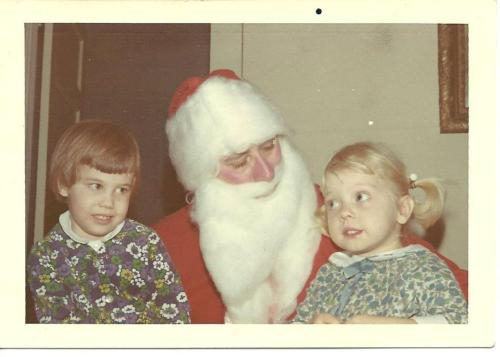
Jodie and me talking to Santa. Jode's not too sure about this guy....I'm probably being really specific about what I want.

Jodie and me talking to Santa. Jode’s not too sure about this guy….I’m probably being really specific about what I want.

_____

We were so lucky. It wasn’t perfect–of course not. Not one person involved was perfect, so the gathering couldn’t have been. But it sure seems perfect in my memory.

Santa visited a lot of years when there were youngsters. This appears to be a Les Hutchison year, and I’m somewhere around three, so it predates my cousin Rob. I was the youngest, so I’d have opened my presents first. Poor Jodie–she had one year to go first, but as long as she remembered, someone else went sooner. (She probably didn’t mind too much.) Then Rob was the youngest for a very long time, 10 or 12 years, anyway. (My mom and her next youngest sister had their children very young; my Mom’s baby sister had her babies much later, right when my brother’s daughter was born, in the early 80s–so the late 60s and all the 70s, Jodie and Rob and I were the kids. My brother is six years older than me, so I’m sure he wouldn’t mind not being listed in this particular lucky cluster, though he’d have opened his presents right after Jodie.)

I remember the food(Aunt Wessie’s cinnamon bread), I remember the decorations (a creepy Santa like this one, I think)il_170x135.388388796_hm64

I remember the bad, bad jokes, and I remember the laughter. We laughed A LOT.

I remarked to a friend once that I never, ever laughed harder than when I was with my family (by which I mean this branch of the family, my Mom’s branch, the Roane/Marlow branch).

This friend had an insightful response, “Well, yeah, laughter breaks up tension pretty well.” Or something along those lines. And that’s partly true. As I got older, I had a stronger and stronger sense of everyone holding their breath, which I’m not nearly as good at (though I’m better at it than I want to be).

Keeping secrets and keeping up appearances. Pretty standard family stuff.

So, sure, there was tension. There still is.

But the truth is, I come from funny people. I just do. Some of it’s corny, some of it’s mean, but it is a constant, and it’s varied, and it’s smart, and it’s just a huge part of who we were. And are.

So whatever else there was, there was humor, and there was love, and there was phenomenally good luck.

We had an extraordinary run of people staying pretty healthy and grownups being mostly employed and marriages working relatively well. No one drank at these family gatherings (that I knew of), and no one fought (that I noticed), and everyone seemed to have a great time, and typically left to go home (we almost all lived in a one-mile radius) only when we’d planned our next gathering (which was never very far away).

On Christmas, that meant making plans for Gran’daddy’s birthday on December 26. If he were still with us, he’d be celebrating his 97th today. By the late 70s, we’d gotten in the tradition of someone giving him fancy collections of sausage and cheese for Christmas, and we’d gather for his birthday the next day and eat them. The numbers and varieties of cheese and sausage grew over the years, and we’d pass them around and around, shouting back and forth about which ones were best, spiciest, etc.

And in those pre-Google years, we nearly always had these two conversations: What is Boxing Day? And does “second cousin” mean the same as “first cousin, once removed?” I actually don’t ever want to look those things up–it was always too fun confusing each other with our answers.

There is no more one-mile radius. We have health problems in all manner of stripes and stages. We’re no longer exempt to national averages on marriage and employment.

Gran’daddy has been gone a year and a half and Gran’mommy seven more years than that.

So much is gone. Over. Done.

But what we had was real. And it was absolutely wonderful.

Tripping on Christmas

for Michael Higgins, my Zen Baptist Brother in Christ

Some churches hang the Christmas greens, a big deal,
But I don’t think First Baptist did. Instead,
Miss Iris’ shiny metal tree is what we had—
White, not silver, and oh! The color wheel!

Little kindergartners tripping out
In Sunday School. The tea party saucer became
The stone for Jacob’s pillow. We took turns being him,
And we saw angels climb a ladder to the clouds.

And then at the end of the season, some churches burn
The trees and garlands—the incense of which must bring
To mind the smell of other burning greens—
A safe and sanctioned mode of getting stoned.

Your message this morning recommended Marley—
A sweet gift for Advent. Grace. Mind? Altered.

From the Vermont Country Store online!

Guest Blog from my Dad! “Unseen Shadows and Unheard Echoes”

Hello, everyone! One of my big goals as I begin my second year of blogging is to host more guest bloggers. My first guest is my Dad, Everett Bullock.

Born in 1939 in Southern Illinois, he has to his credit full retirement from the U.S. Army, including time in Viet Nam during the Tet Offensive. Also to his credit: the ability to dance the Charleston on roller skates when he was a teenager (I have no video proof, but I do trust him on this).

He and my Mom will celebrate their 54th wedding anniversary on November 29th. That’s to their credit–good job, guys!

Also, he’s a terrific Dad–loving and present. I know I learned a lot of what I know as a writer and thinker from him–you’ll see why, below.

(And, just so you know, if you’re concerned after reading the poem & commentary, he’ll be surrounded by family and love on Thanksgiving AND after–it’s a huge reason I lured my parents up to Spring Green, so I can bother them ALL THE TIME at their house.)

Happy Thanksgiving everyone, and without further ado, here’s my Dad’s post:

_______

Amateur writers of prose or poetry often hesitate to put words on paper or in their computer. At times it is because of a lack of confidence in their ability, and other times we literally cannot think of anything to write. For better or worse, there are also occasions when our emotions, dreams, or nightmares reduce our ability to think clearly and write sensibly. Several years ago, members of my family departed after a Holiday visit, and I experienced a period such as this. I could not think of any cause for my feeling or any means for moving out of it. After suffering for a few hours, I started trying to write, planning to draft a poem or a paragraph or two that might clarify my problem. The attached poem was the result, finished several hours and days later. It was a relief to finish it, and I buried it with my other treasures for some time.

I must have done a poor job of burial, as the poem would come to mind every time a family member or friend would depart after a visit. I finally excavated the poem and tried to improve it. I had no success. I found that every time I read the poem, it caused me to miss those who were gone and caused me to think of how I might let them know how much I cared for them the next time they visited. While I have improved greatly, I am still less open about my caring than I should be, and I still seek out the poem to consider the empty house, empty of life, love, caring, or passion. May those who read this poem reach out to their loved ones before they depart and be sure to let them know of your love before their departure. There is no guarantee you will be able to do this at the next visit.

Everett Bullock
November 18, 2012

Unseen Shadows and Unheard Echoes

Now the house sits quietly, with feeling.
The chairs are in their places, empty.
The floors are bare and clean.
Tables are loaded with empty space.

In the dim corners, latent shadows stir,
stretch, and observe without blinking,
present, but not present,
old dust undisturbed.

The walls push faint noises from
one room to the next, pausing,
while silence catches up and passes,
leaving faint echoes.

Outside, the flowers nod with approval
as the grass straightens.
Trees hold their own conversation
with large, slow gestures.

The wind seeks familiarity,
Examining with gentle fingers,
passing with kind rejection,
continuing its search.

The fence sturdily fences out,
and fences in,
providing a beginning
and an end.

The house is still,
And waits patiently
for decay or use,
secure but empty.

Muncie Jones and the “Lawn Sprinkler of Hope”

It’s so easy for me to take an uncharitable view of the last 21 years and zoom in on the goals I haven’t met.

Tongue-in-crater-where-there-used-to-be-a-tooth.

A sort of obsessing that can be genuinely damaging.

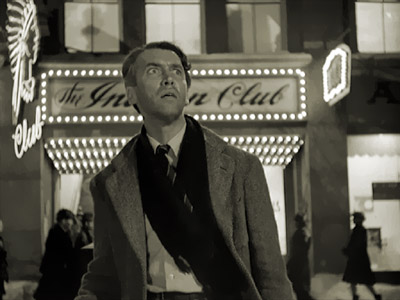
If I do it long enough, I feel like George Bailey, surveying Potterville, with the full horror of it beginning to dawn on me:

(That’s actually a pretty good depiction of how I felt at AWP in Chicago, last spring, and Unmetgoalville was pretty much why, although I also get awfully used to my little town and don’t necessarily function well in towns larger than 17,000 or so, at least not without some self-coaching. Pitiful, really, given that 17,000 is how big Mt. Vernon is, where I went to high school–if you’d told 17-year-old Marnie that 47-year-old Marnie would have a hard time feeling comfortable in Chicago, the teenager would’ve laughed, since she regularly drove in the Windy City whilst visiting her brother.)

And here I am, coming across the teaching job that doesn’t even seem to recognize me.

“But I’m a full professor,” I yell, chasing the poor ad hoc position into the bar where she faints.

“My life’s not like that,” I says to myself. “Really it’s not,” I assure myself on a cold, rainy, November afternoon. “I’m not Muncie Jones.”

Whereas, of course, I am in some ways. Indiana Jones’s sister Muncie wasn’t intentionally a play on Virginia Woolf’s Judith (Shakespeare’s sis), but that had to be lurking in my mind somewhere.

However. Now that I’ve seen Shakespeare’s Will, I can’t think of any woman in Shakespeare’s life without thinking of Tracy Michelle Arnold.

Which is where things take a turn for the better. Tracy portrayed Anne Hathaway with a phenomenal range of vulnerability and fierceness. (Now that I’m reading Brene Brown’s Daring Greatly, everything has something to do with vulnerability.)

There is fierceness in this family of women–the Jones family, the Shakespeare family, my own family.

A lot of my life, that fierceness has come out in less-than-productive ways. It may be why I liked playing with fire.

In my middle age, I am finally, finally learning to channel that fierceness into focus and grit.

One of my role models is Jenny Shank, who first caught my eye in Poets & Writers (Jan/Feb 2011), when she wrote about being a “Ham-and-Egger,” a phrase she got from Don DeLillo, which she defines in this way:

“I love that phrase, ham-and-egger. It’s how I think of myself as a writer. I’m not going to dazzle anybody with lyricism or structural ingenuity. But I put my head down and work and sometimes a story comes of it. I ham-and-egg my way through. It took me a long time to figure out that not every writer has to be brilliant.”

She also writes about sobbing during a Fellini movie because it reminded her “of my childhood dream of becoming a writer, one that I haven’t shaken for three decades, a dream that I almost gave up on a number of times, even though I still continued to write.”

And if the subject matter itself weren’t inspiring enough, she referred back to Fellini and said “Okay, so I’m not an orphaned Italian hooker in a ratty fur. But inside, aren’t we all orphaned Italian hookers in ratty furs?”

I know I am.

And I sobbed and sobbed later that spring in 2011, two different times (I don’t sob much, so I remember them). One time was taking a detour on my way to work, to go sit in the gorgeous St. Luke’s in Plain, Wisconsin and pray–this was in the midst of Wisconsin’s Arabesque Spring, when we were protesting in the snow. I felt as though the job I’d worked so hard at for 20 years was just being spit on and ground into the mud by the heel of a governor’s anti-union, anti-education Act 10.

The other sobbing happened when I got my rejection from Wisconsin Wrights. I’d submitted a revised version of Gashouse Love, a full-length play I started writing in February of 2003. I got a full typed page of comments that told me pretty thoroughly the play didn’t work. That was the bad news. But there was plenty of good news in that page–the anonymous commenter took the play very seriously, was clearly hooked by it in several ways, and very much seemed to want it to work. The sobbing came from having put in a lot of hours revising, all those hours COMING TO NAUGHT (that’s how it felt at that moment), but mostly a sense of exhaustion (see previous paragraph’s sobbing) and utter bafflement–I had almost no idea at all how to make the play better, but any little hint of how to revise carried with it a tag of THIS WILL TAKE HOURS, WEEKS, MONTHS, POSSIBLY YEARS OF WORK.

But I didn’t give up. I didn’t. I almost can’t believe it, but I didn’t.

I am sure I had the phrase “ham-and-egger” in mind.

I’d spent most of the summer of 2010 working on the poems of Speakeasy Love Hard. Gashouse Love has three generations of a family dealing with what they call “the flapper girl poems,” and I knew those poems needed to exist in full, regardless of how much showed up in the play.

The anonymous commenter for Wisconsin Wrights said the poems needed to be in the play more, and I didn’t know how to do that. I know a little more, now.

The poems from 2010, whose origin was a play begun in 2003, finally went public in the fall of 2012. It was a wonderful evening. One of the outcomes of getting to hear Sarah Day, Ashleigh LaThrop, and Nate Burger read those poems was that I felt as though a nuclear reaction had gone off in the middle of Gashouse Love.

Is the path to revision any clearer? No–but I’m excited to work on my writing plan for the rest of this semester/academic year, and will include in it “Listen to recording of Speakeasy Love Hard multiple times, with friends, taking notes and getting feedback on revising Gashouse Love.” I’m giddy with the thought of it because that play needs those poems. All of them.

Forever is how long I’ve heard you have to focus less on publication and more on enjoying revision. Could it be I’m finally there?

Not that I’m giving up on publishing. I’m not. But I am compartmentalizing and strategizing. Here again, Jenny Shank’s article was helpful: she says she invented “Johnny Business” as a way to compartmentalize the publication goals. It seems to me he lives in the same neighborhood as Michael Perry’s muse–Perry says his muse is the guy at the bank who’ll repossess his house if he doesn’t write more and get paid for it.

All of this is validated in creativity studies. In a textbook on creativity (would love to teach or take a class using this as a textbook!), Mark Runco summarizes several sources on persistence and calls it “a prerequisite for creative accomplishment,” saying that “important insights often demand a large investment of time.”

“A decade may be necessary for the person to master the knowledge necessary to understand the gaps and nuances of a field.”

[Or in my special, special case, a decade OR TWO.]

Runco quotes Arthur Cropley (one of his books charmingly has a picture of a chicken and an egg on it) who says, “In addition to possessing certain personal traits, creative individuals are characterized by their willingness to expend effort.”

Runco follows that up with a nice reiteration: “That is a good definition of persistence: The willingness to expend effort.”

Jenny Shank’s efforts are paying off–her most recent book, The Ringer, won a High Plains Literary Award. I’m so happy for her!

And Muncie Jones? Maybe she hasn’t spent as much time dodging poison darts as her hotshot brother. But she’s hanging in there. She’s been teaching four sections a year for 21 years, and sure, in one way, you could say that job has has ground her soul down to nubbins.

But you could also say it’s been really helpful ballast, and that her hot air balloon, her ship, her (whatever transportation mode requires ballast), is about to dock somewhere truly exciting.

It’s like what Jenny Shank calls “a lawn sprinkler of hope that just sprays randomly around without any direct target.” That’s not cold, gray rain on my window. That’s hope.

The Heart of the Farm

for Joy

The woman, the wife, of course, could be the heart,

The husband could, or the children, doing their part

To keep machinery humming—the chore machine,

The pet machine, the house-barn-garden machine.

They grow up fast on farms, those children do.

Maybe the heart of the farm is the land. It’s true

Each generation adds their hard-earned sweat

To the soil, but it’s the land sustaining it.

I think the heart of the farm is made of wood,

Or maybe metal and enamel, handed down

When someone in the family could buy new

Or someone died. The kitchen table holds

Conversations, accounts payable, and food–

It’s so alive it almost makes a sound.

Playing with Fire, Opdyke-Style

Two innocent-looking girls take the shade off a bedroom lamp, up-end a coffee can on it, and melt crayons in the shallow tray they’d created. It’s difficult work. The balance is precarious. It’s way too easy for the waxy mess to slop onto the carpet where it will stay, a clump one girl tries to cover with furniture or dirty clothes the rest of her childhood. Neither of them got burned.

But they did catch fire, having their own little moment of alchemy when the gold crayon swirled itself into the other colors.

They will graduate to ruining plastic pitchers with their experiments. What happens when you mix nail polish remover with nail polish? This cleaner with that one?

Both of them owned Easy Bake Ovens. Neither of them owned a chemistry set.

What happens when one of the girls pours just a little nail polish remover in a shower stall and lights it on fire? She had the hand sprayer ready and the water already running, and she watched the wall of blue flame for a count of two, maybe three, before she doused it.

Don’t believe in miracles? How about dumb luck? The fact that I escaped my childhood alive, without massive burn scars, the fact that my childhood home didn’t burn to the ground—-I have to believe in one or the other. Though I will say, in our own pre-adolescent way, my friend and I were methodical in our experiments. The hand sprayer was good to go, after all.

I never set off firecrackers or wired a birdhouse to explode, the way my brother did (birds never moved in, fortunately, smart birds). But my brother and I were both dangerously creative.

We particularly enjoyed burning trash. Out in the country where we grew up, on the edge of a tiny town called Opdyke, there was no trash pickup, so you burned what you could and dumped or buried the rest. Any other chore, we’d fight to weasel out of. Burning trash, we fought to see who got to do it. Our special favorite was finding anything labeled CAUTION, FLAMMABLE, or especially, DO NOT INCINERATE. At least we had the good sense to stand back. Sometimes there was a whoosh of flame or an interesting shade of smoke or if we were really lucky, BAM! An explosion when an aerosol can slammed against the side of the burning barrel.

One of my brother’s friends was badly burned when he used gasoline to burn his family’s trash faster. All we learned from that, apparently, was DON’T USE ACCELERANTS. (Which is actually a really good thing to learn.)

An analysis of this could reveal boredom, misdirected intellectual curiosity, some variety of pathology, or a combination of all three. But we also were being true to our Opdyke heritage and our family heritage, whether we knew it or not.

On our father’s side of the family, we were only one, maybe two generations removed from people who had stills in the hills. My father’s childhood home burned to the ground, twice I think. I have a vague memory that it was my grandfather’s fault, but I’m not sure about that.

On our mother’s side, we had our solidly creative Gran’daddy, who could solve pretty much any intractable problem by sleeping on it. He regularly dreamed the solution. He could also find water by dowsing—I’ve always been afraid to try. I don’t want to know if I have that particular gift.

When it came to fire, Gran’daddy worked as a volunteer firefighter and I remember being part of a crowd watching them set the old one-room schoolhouse on fire so the volunteers had something to practice on. (I also remember one odd little boy flashing his penis to everyone that day. At least we didn’t have that pathology in my family.)

In terms of creativity and fire, I have to think of Gran’daddy’s work with Sparky, a welder and inventor in our little town.

On the main street, which now has a name but didn’t when I lived there, Opdyke had a post office, ½ of a building that also housed an old-fashioned store with a wood-burning stove. We waited for the bus inside on cold days. (At this point my memory blurs with an episode of the Waltons–I can’t believe I was so lucky and that this was the early 70s, not the 30s.) Next building down was a two-story, red-brick garage where Sparky had his shop. That was pretty much all there was, business-wise.

I know Sparky and Gran’daddy worked together to make parts for various farm machines, but I also remember fabulous inventions, like the rotation hot-dog roaster for camp fires.

It never once occurred to me to ask to visit that shop, and no one ever offered.

Had my son’s school existed at that time, in that place, there probably would have been a field trip there, or we’d have had Sparky come to class to demonstrate.

At least I like to think so, and I like to think River Valley Elementary Studio School is in the process of living up to part of its initial purpose, to give kids space to be creative as part of their education.

It’s not just that I want my son to also escape his childhood without burn scars. It’s not just that I want him not to burn our house down.

I want him to be able to play with fire and learn even more from it than I did.

On reflection, I am utterly baffled that I took Chemistry I in high school but not Chemistry II, where the students regularly made explosives behind the teacher’s back. (Well, other than being completely burned out by my senior year and also hitting a very solid three-dimensional brick wall when I tried to imagine molecules in 3-D.)

In my creativity research, I am trying to learn how to encourage and assess students’ creativity. I’m struck by these quotes from Arthur Cropley, in his book, Creativity in Education and Learning: A Guide for Teachers and Educators. He points out that

“Surveys have shown that in theory at least teachers overwhelmingly support creativity as something that should be fostered in the classroom….However, in actual classroom practice they often frown upon traits associated with creativity or even actively dislike characteristics such as boldness, desire for novelty or originality.” I don’t know how much I exhibited those traits in the classroom, but I can definitely see my obsession with fire as a bold “desire for novelty” (something other than another rerun of Gilligan’s Island) and I don’t know of any other children who set their shower stalls on fire, though a lot of people may be like I was until this moment, sensibly keeping things like that a secret. Cropley has a list of things to do to make creativity possible in the classroom, and it’s striking to me how most of those apply to my brother’s and my trash burning processes. Cropley says we should

• “encourage students to learn independently
• have a co-operative, socially integrative style of teaching
• do not neglect mastery of factual knowledge
• tolerate sensible or bold errors
• promote self-evaluation
• take questions seriously
• offer opportunities to work with varied materials under different conditions
• help students learn to cope with frustration and failure
• reward courage as much as being right.”

We did “neglect factual knowledge” for the most part, and I don’t remember much self-evaluation. I don’t remember frustration or failure, but I think the wall of flame in the shower stall scared me enough I went back to burning trash as my main experimental mode, where you could “reward courage” with an occasional but deeply satisfying explosion. We were hell-bent on making our own “opportunities to work with varied materials under different conditions.” My 8th grade demonstration speech involved dripping candle wax into a pie-pan of water. “What’s it for?” the teacher asked when I was done. It hadn’t occurred to me I needed a purpose–it was just really fun to do. But what I said was, “If you use scented candles, these can be put anywhere to make things smell nice.” I don’t remember being punished or rewarded for that project.

I want to officially and publicly and sincerely apologize to my parents who are learning about most of this for the first time along with everyone else reading right now. (I explained and apologized long ago for the mouse bones the repairman found in the dishwasher when it broke down.)

“Sin boldly,” Martin Luther said, which is what I think of when I read “bold errors.” I wonder, as a teacher, if I make any room at all for that in my students.

It scares me to death to imagine what kind of experiments my already creative son will think up. I mostly hope it’s in a classroom with safety goggles and fire extinguishers available, but I think it’s part of my job to let him experiment at home as well.

Because playing with fire? Having a sweet face that will mislead some people into thinking he doesn’t have a dark side? He comes by that naturally. So did I.