Category Archives: Sustainable Chaos

how do you like your blueeyed boy Mister Weinstein

As we close out 21 Days of Bradley Cooper, I am so happy that Silver Linings Playbook won SOMETHING last night at the Oscars, and I’m pretty crazy about Jennifer Lawrence, even without watching these videos, in which she gushes over and then is kind of annoyed by Jack Nicholson “Is he back? I need a rear view mirror.”  And also expresses actual authentic reactions to media-ishy questions, post-Win.

I loved Winter’s Bone, too. And in Silver Linings Playbook, her character Tiffany had my favorite line from the movie:

“I was a slut. There will always be a part of me that is dirty and sloppy, but I like that, just like all the other parts of myself. I can forgive. Can you say the same for yourself, fucker? Can you forgive? Are you capable of that?”

To me this is one of the signature lines of the movie, not just because of the brashness and crassness, but because it’s about integration, moving beyond shame, and redeeming your own self, from the inside out.  Jennifer Lawrence’s Tiffany teaches Bradley Cooper’s Pat how to do that.

Which reminds me, this was never 21 Days of Jennifer Lawrence (maybe that’s next! probably not).  It was 21 Days of Bradley Cooper.

He didn’t win. It is entirely possible that only his mother thought he really had a chance to. As much as I’ve enjoyed my little foray into Bradley Cooperstown, I have to admit that I agree with the “brutally honest director” who did a think-aloud of his Oscar ballot, who said, “For Bradley Cooper, the nomination is his award.”

One wonders about direction after the Oscars–I think if Mr. Cooper had won, people would have remembered him as the guy who stole it from Abe Lincoln, not as the guy who took huge strides in the role of Pat Solitano.

I was hopeful Silver Linings Playbook would win more, though–the movie hit me at just the right time, and I really, really wanted the Academy to give more love to a smart comedy with a happy ending.

(I’m sure I should want to see Amour. I do not want to.)

The “brutally honest director” said this about David O. Russell’s chances for Best Director, that  “it took David O. Russell to figure out that Bradley Cooper is a great actor,” and Nate Silver had the movie trending a little for Best Picture, so I was hopeful.

Nonetheless, the Oscars are over, and I find that I still have not answered my friend Jen’s question, “So there is a movie in which Bradley Cooper’s character is not a psychopath?”

His character, Pat, in Silver Linings Playbook, begins the movie figuring out how to manage his bipolar disorder. So, not a psychopath. Previously delusional and violent, but no, not a psychopath. And in the movie, appealingly upbeat, hopeful, earnest, vulnerable, and relentless.

There is corroboration for the psychopath idea, though, here: “The Creepiness of Bradley Cooper,” in which the author says she sees “something of the psychopath about him,” but is ultimately not troubled by it: “Dark times call for dark celebrities, and these times are dark.”

Amen.

That article featured his turn in Limitless, which I see as essentially an ambivalent fable about Adderall.

All my Google searches and alerts had not turned up that article, though–it was referenced in this one in the New Republic Article, “Bradley Cooper: Beefcake Thespian How the “Silver Linings Playbook” star became a serious actor.”

This article is pretty heavy on the snark, emphasizing Mr. Cooper’s tendency to play characters you wouldn’t necessarily trust. Or like.

And it seems to have multiple axes it wants to grind. Curious.

My favorite Bradley Cooper article is this one from Esquire, “Dinner with Bradley,” post-Limitless, pre-Silver Linings Playbook, which likens him to a young Senatorial Jack Kennedy. It’s smart writing, and seems to give Mr. Cooper credit for some of the same things the New Republic article criticizes him for (pushing himself to be serious, being ambitious). It does this thing where I wondered if the author was trying to imply SOMETHING HAPPENED, (“Eleven o’clock on a Saturday morning and Bradley Cooper is sleeping. Russell Crowe is Robin Hood on the television and there has been another day of Limitless publicity in between and Cooper is tired. Five days earlier, Entertainment Weekly declared that ‘A Serious Movie Star Is Born.’ He is on his side and unshaven and not snoring and smiling.”) but is otherwise pretty interesting.

I’m sort of exhibit A of how nominations can bolster a movie–it definitely caught my attention because of the Oscar talk, and I’m pretty sure that’s why it showed at Sundance (and when I go see a movie, I typically would HOPE it would be showing at Sundance).

It’s been a fun ride for me. But Bradley Cooper had WAY more fun as evidenced in this Happy Hugger slideshow.

Full disclosure: in regards to my plan three weeks ago in which I imagined myself posting something about Bradley Cooper every day until the Oscars. That didn’t happen because
1. I got bored.
2. I got busy.
3. My calculated and cynical attempt to bolster blog traffic by blogging about a hot commodity was not successful. I think I’m still getting all those David Bowie hits because there weren’t that many people blogging about his new single. Whereas there are approximately (number approaching infinity) people blogging about Bradley Cooper.

One of my blogs, though, wondered about all Harvey Weinstein’s machinations on behalf of Silver Linings Playbook, thus the title.

"Stop looking at me, Bradley Cooper."

“Stop looking at me, Bradley Cooper.”

(photo by wrestlingentropy on flickr, Creative Commons)

“How do I do that? How do I become a person who says no to things?”

(If you’re keeping score at home, this is also “How to Get the Pay Raise You Deserve, Part V”)

Here’s one of my favorite drums to pound:

You can raise your hourly wage by working fewer hours.

(You have to be on salary for the math to work.)

How? Here’s how to do less:

10. Take people at their word. Take them up on their offers. For example, when I get an email from someone who says, “Would you like to do X, or do you need me to do it?” I mostly say, “That would be great if you would do it! Thanks!” Because what are the possibilities there?

a. It was a passive-aggressive way of asking me to do it.

b. It was a genuine offer to do X.

c. It was a way to try to shame me into doing it, hoping I wouldn’t admit to “needing” anything.

So, for a. my response is that I might sometimes accede to passive-aggressive bullshit without realizing what I’m doing, but when I see it, I like to mess with it, and play dumb, and pretend like I’m dealing with someone who says what they mean. (Because they totally should say what they mean, or at least stop talking to me.)

For b., my response is THANKS! Then I try to make the offer back  when I can. (I’m not a selfish jerk. I’m just trying to stay relatively sane.)

For c., I would, if I were forced to name names, say call 1-800-Shame Resilience and ask to talk to Brené Brown. She’ll give you the what-for. And I have many, many needs about which I have so little shame that I’m happy to let someone else feel needed.

My need to admit I have needs and someone else’s need to feel needed = pie and ice cream.

This is how great it feels to be needed.

This is how great it feels to be needed.

9. Ask for help. Don’t even wait for someone drive their passive-aggressive sedan by you so slowly that it’s easy-peasy for you to grab the bumper and ride your skateboard along in their fumes for a while. Just ask for help.  You’re a good person. You’re helpful. When someone who isn’t ALWAYS asking for  help asks you for help, do you think that person is horrible?  (Don’t tell me if you do.)
8. Pretend you’re someone you’re not. Would the Mansplainer say yes to everything asked of him? He would not. If you were a rock star, would your personal assistant field this request to you? He would not.
7. Wait to say yes. Lots of people have talked about this, so I won’t say much. But it’s pure gold in terms of effectiveness. It’s hard to say no in the moment of social pressure ACK ACK ONE OF THOSE BAD DREAMS WHERE I CAN’T SPEAK, but it’s way easier half a day later to email and say, “I’m sorry. I just looked at my to do list and my calendar and I just can’t.”

6. Don’t LIE and say you looked at your to do list and your calendar. Actually do it. And try to make it a really accurate to do list and a calendar on which you’ve sketched out when you’re going to do what’s on the list. (Please allow me once again to recommend Things and “Sunday Meeting” by Kerry Rock-My-World.)

5.Stop thinking up new things to do that no one even asked you to come up with.

4. Don’t wait until your wicked-burnout ways land you in a health or relationship crisis (they will, eventually). Get that calendar back out and imagine you’ve been warned that approximately two weeks from now, there will be a one to two-day crisis that you absolutely have to deal with.

Or, if that feels icky, imagine that the grandmother of a former student wants to give your campus a check for $100,000 dollars and because that student spoke so fondly of you, you have to accept the check in person. Two weeks from now. It will take two days.

What would you do? Cancel some stuff? Ask people to cover for you? Reschedule some stuff? Imagine blocking out two whole days. Make a plan.

Then follow through.  Or, if that feels too indulgent, do it for one day. Or an hour.

If you really can’t do it just for yourself, to get caught up, or catch a movie, or take a nap, or work on your favorite part of your job that you never get to work on, or go on a date, or WHATEVER, then schedule an appointment with a healthcare professional and use sick leave. That is what sick leave is for. It is for when you have a health problem. If you can’t make time for what is important, you have a problem.

3. Find that one thing on your to do list that you haven’t done yet, that you don’t want to do, that you keep putting off, for whatever reason. Cross it off your list. If someone else needs to know you’re done with it, email them and say, “I’m so sorry, but I said yes to too many things this semester/month/week/year/time on the planet. I am not going to do this. I am very, very sorry.”

This is not the BEST way to be a people pleaser, but you know what? Ms. People wasn’t pleased at how long it was taking you to do whatever. At least now Ms. People can make other plans.

And even though it wasn’t taking up your time because you weren’t doing it, it was taking up a lot of psychological energy hanging around on your to do list. Kind of like that creepy guy that kept asking you what kind of batteries he should buy with his special massage implement when you worked at Spencer’s Gifts.

2. Check in with people who know you & will tell you the truth (their truth, anyway) who can fulfill these roles (these might or might not be people you actually work with, and these may be the only useful roles the fun house mirrors play in your life):

MIRROR: person who sees things pretty much as you see them in terms of philosophy, values, work-life balance, who respects you and cares for you. Ask the MIRROR person: am I working too much? am I working enough? Jussssssssst right? Make adjustments as needed, in consultation with that person.

FUN HOUSE MIRROR SKINNY WORKAHOLIC VERSION: ask someone who lives to work and works to live the same questions. If that person EVER, EVER, EVER says something along the lines of “You’re working an awful lot lately,” you know it’s crisis time (see #4 above).

(Don’t wait for that person to say “You’re working too much.” They don’t believe that is possible.)

FUN HOUSE MIRROR LOVE-HANDLED BELUSHI-BOY: if you say to this terrific guy, who’s probably wearing a Hawaiian shirt & shorts with 700 pockets, “hey, am I working enough?” and he says, “No, you’ve been super mellow and ready to play pool a lot lately” go back and double-check with your MIRROR and then make a plan if you need to. Could be you’re making time for a precious friend or it could be you got TOO GOOD at setting boundaries. Don’t worry if that happened, because

Here’s what there will always be plenty of: people asking you to do stuff. You will never lack for opportunities to do a little back-fill if you realize you were slacking. Which you probably weren’t.

1. Do whatever you can to be the kind of person who operates from a base of worth and plenty rather than inadequacy and scarcity.

I still struggle with this, but I’m trying to listen less to the voice in me that wants everyone to like me all the time, especially the people I don’t like. I’m trying to listen more to the voice that says I am enough, and that I get to be picky about who rides on the bus with me. People who bring me down can’t get on my bus. Or they at least can’t sit in the back where we’re singing “One Tin Soldier.”

This isn’t possible for all of us, I know, at least maybe not now, not this year, not this week, not with this boss, not in this job, not in this economy–I get it. I feel it. I feel gobsmacked by it sometimes. But when and where it’s possible, we need to listen to Nancy Reagan’s quavery, moneyed, seat-of-power voice:

JUST SAY NO.

Getting the Pay Raise You Deserve, Part IV

Part of healing from burnout is learning to set boundaries. Making time for what’s important (yourself. family. friends. fun. community. yourself again) other than your work.

Easier said than done. Really easily said. “Set boundaries.” Unless you have a cute little hint of a lisp the way John F. Kennedy, Jr. had. Then it’s a little harder to say.

Pretty hard to do.

But those of us who’ve emerged from the Pretty Good Depression still employed find ourselves picking up the slack left behind when people were laid off, or  not replaced, or carrying a heavier load in terms of student enrollment, juggling new initiatives, etc. etc.

It is just so easy to do too much for too long and end up having your soul scrape up against your to do list like bone-on-bone-bad arthritis.

In the long run, as I mentioned to my boss’s boss’s boss last Valentine’s Day (ahem), a system that is structured to rely on people burning themselves out LIKE OURS is not sustainable. (It also doesn’t get the best work out of people, even in the relative short-run–but that’s the subject of yet another blog yet to be written. Stay tuned.)

For me, the urge  to work too much (and the actuality of working too much and the guilt of perhaps not working enough) mixes with my long-term tendencies toward depression and anxiety into a toxic burnout brew that makes me less of everything I want to be (loving, enthusiastic, effective) and more of everything I’d rather not be (chronically irritated, cynical, spastically ineffective).

I’m still learning, but I’m making progress.

If you click on “burnout” in my blog categories, you’ll see it’s something I write about a lot. (cf: fixate upon.)

In Getting the Pay Raise You Deserve, Parts I, II, and III,

I acknowledge:

It is all too easy to come across as whining, and something like “I had to spend an hour on the phone getting my insurance coverage worked out today” can come across as ingratitude, a classic First World Problem….it is a luxury to consider what changes we could make to improve our lot. But you know what? A lot of us in academia do have that luxury, especially those of us with tenure.

I assert:

You can raise your hourly wage by working fewer hours.

I celebrate myself, I sing myself:

I don’t work too hard. I work hard enough.

Here’s how good I am at setting boundaries.  I got folks pounding on one of the walls I built hollering at me  like they’re possessed by the spirit of Chico Marx: “You no work enough.”

Here’s the contested boundary of the month:

In response to Scott Walker’s 2011 budget bombs (which resulted in less take home pay for my family), I looked around to find ways to save money. We love Culver’s just as much as we always did, but we don’t go as much as we used to. INSERT LOTS AND LOTS OF OTHER EXAMPLES OF BUDGET TRIMMING HERE. And then, to save money on gas, I started working from Spring Green some Tuesdays (my teaching schedule is MWF). That enabled me to volunteer in my son’s classroom now and then. That turned into a regular gig. That turned into a commitment. Which turned into a column in the Voice of the River Valley.

I do a lot of work on Tuesdays, and I check email a lot during the day. I’m considering setting up virtual office hours to make sure students and advisees remember that I am available on Tuesdays, just not in person in my office on my campus. And as I mentioned in one of the three prior posts in this series, I average more than 40 hours a week during the 9-month contract. Since I try to take a week off between semesters, and two days off at Thanksgiving, and two or three days off during spring break, and maybe Labor Day if I’ve got my course syllabi ready, that means I typically average 45 hours during an actual teaching week.  (I don’t count how many hours I work in the summer, but it probably averages to about 20. )

I don’t see why it’s anyone’s beeswax, if I’m accessible to students, if I’m doing my job well (I have official recognition of that), and if I’m doing my share for service (and I do), WHY it matters how many of those hours are in my office or on campus or in my kitchen or at a coffee shop or wherever.

But there are people for whom dedication to campus life is measured in hours worked (more hours = more dedication) and hours on campus (more = more). I don’t agree. I hope the issue goes away. If it doesn’t–well, gracious. You won’t like me when I’m angry.

Take this one boundary skirmish as a warning, all ye who dare to dream of  work life balance. Sometimes when you set a boundary, you have to defend it. But a lot of times, people don’t even notice.

If you’re brave enough, if you’re tired enough, if you’re burned out enough, tune in next time when I share my Top List of Ways to Work Less. (Remember: if you’re on salary, you can raise your hourly wage by working fewer hours.  The hilarious irony is that the quality of your work will actually go up, and in some cases, the quantity too–because you have more energy to focus on the things you’re still doing. Shh. Don’t tell.)

Meanwhile, Joshua blew the trumpet at Jericho and the walls came a-tumblin down.

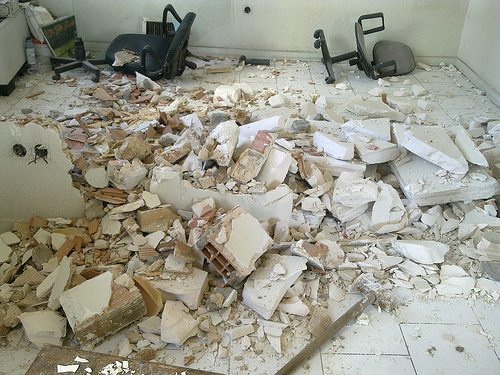
This is what a system structured on burnout looks like. Eventually.

This is what a system structured on burnout looks like. Eventually.

_____

(photo from flickr, Creative Commons, by Babak Farrokhi, entitled “Office Under Construction.” So it’s not really about sustainable systems OR Jericho.)

Little Shot of Sunshine A.S.A.F.P.

I have a serious case of the Februaries (as my friend Jessica calls them). Tired of winter. Tired of dark. Tired of tired of tired of tired.

So you know how we sometimes say someone or something is a force of nature?

Well–the sun is THE force of nature, right?

So let’s MacGyver our moods, shall we? Borrow our myopic buddy’s glasses and make a prism to focus what little sun there is on whatever target needs it most.

BOOM! Fire! Explosion! And we’re free.

(That’s how it works on TV anyhow.)

Seriously. Give someone a compliment. Say thanks. Apologize. Tell a joke. Randomly shoot a thumbs-up when you see someone doing anything remotely thumbs-uppable. Do it now. Or As Soon As Freaking Possible.

I know I need it. I know I’m not alone.

And lest anyone mistake this for a Pollyanna moment (or, as someone near and dear to me is capable of, a Nucleanna moment)–I think there’s a poopload of bleakness and bad news around.

But a little shot of sunshine now and then, that makes the poop more bearable.

At least in theory.

My favorite color.

My favorite color.

Cheers!

{photo from flickr, Creative Commons, by Beau B–no real name given because he is apparently a high school student. Usage of this photo should not be construed as an endorsement of underage drinking, drinking to excess, or drinking in the workplace. It’s just pretty. And a pun.n Plus, if you know me, you know the acrylic nails just crack me up.]

Each Other’s Anodyne

I’m working today on the manuscript of a chapbook of poems about teaching and working as a professor. The working title is Each Other’s Anodyne, in which case this is the title poem.

I posted it as a note on Facebook two years ago. During Wisconsin’s Arab(esque) Spring.

The ice on our streets and sidewalks, the way the snow is crunchy, the way slush turned to gray iron–it would be so treacherous if we were protesting in Madison today. So I’m glad we’re not.

In general, the political turmoil is overall lower, and I am relieved–I felt wiped out emotionally and spiritually by that spring, and the failed recall didn’t help revive me. Other things have helped. The passage of time has helped.

Finding this poem again for the manuscript brings it all back, though, and I have to ask:

How much has changed, really?

This poem still resonates with me. (And I still need to revise the second sonnet to focus more on Firefly.)

(It’s a crown of sonnets, if you’re into form at all.)

_____
EACH OTHER’S ANODYNE

The weary teacher lays his pen aside
And rubs his eyes, says to his wife, “All right,
I’ll come to bed.” They both know he will try
To grade some more in the morning. All through the night
Another teacher wakes up anxious, mad
At everyone. She yells at her husband and son,
But it’s not their fault. It’s not the teachers’ fault.
In a dark time, our hard work shines too bright.
We’re public target practice. We’re spittoons.
For a time, a shining time, we were solid
In the middle class, rewarded for working hard
To help synapses snap and shimmer in the light.
Tempus fugit, damn it, sad but true:
The best shows all get cancelled way too soon.

The best shows all get cancelled way too soon.
Post-modernly they hooked us and we swooned
At heroes rounding all the genres up
To drove them o’er the plains. Inspire us!
The hooker with the heart of brass blew up
The patriarchy, blam! The runt did chin-ups
Until he made the winning catch, two times.
The rocket rounded earth, accompanied by chimes
At midnight, and we, we got attached too fast
To what the larger corporate sponsor failed
To see a profit in. It couldn’t last,
But we had no idea the cruise ship had sailed.
We made a snack and snuggled, and watched the show.
The nights were longer then, with deeper snow.

The nights were longer then, and deeper snow
Made driving slower. Now darker days have come
Despite the later sunsets. We didn’t know
How sweet it was—our biggest worry was some
Stupid internet scam our students fell for—
An octopus living in trees. Like always, slow
In winter—we did our jobs, shoveled some more,
And then the Packers won the Super Bowl!
For Valentine’s, our governor went nuclear.
So far he’s systematic—everything
We care about, he wants to cut. Budget despair
Has set in hard. It will not ever be spring.
Thick fog, black scabs of snow, raw time, hard earth.
But up in the gray, three sand hill cranes, flying north.

Up in the gray, three sand hill cranes, flying north.
Inexorably, the seasons change. They do.
But broken-hearted, raw, beleaguered blue—
We cannot trust the calendar. It’s death
We see when we look around—dead trees, dead grass
Below the layered shale of sooty ice.
Just like “always winter and never Christmas,”
We long for a miraculous thaw or a looking glass.
Not knowing is the worst; at least we think
It is—we’ll think that until we learn the worst.
However far we’ve learned our hopes can sink,
they’ve sunk so far, and farther, and farthest.
We thought we had a thaw, but it froze again.
The ditches are full of ice. But it is thin.

The ditches are full of ice, but it’s too thin
For skating. It makes a satisfying crunch
When you stomp it. Let’s watch the two of them—
These women hiking, sharing a picnic lunch.
One’s tiny—she can almost walk across
The ice before it breaks. Almost. Not quite.
Crashing, they are each other’s anodyne.
One lover catches another and she laughs,
“You silly thing.” And just like that, the tears
come flying out, “I’m sorry I dragged you here.
I can’t even make you my wife. This stupid state
Is stupid. I hate it. Hate, hate, hate.”
“Please don’t hate on my account. Not ever.
We’ve made a home. Your students need you here.”

We’ve made a home where students need us. Here
In the trenches, in the cold and the muck of open admission,
We’re spinning plates for students, showing where
Centrifugal becomes centripetal
With just the right transitional phrase. They take
The plates away from us, they break the glass
Bell jars and ceilings, they celebrate the figures
That animate their dreams the night they made
The quadratic formula prove itself on threat
Of death, organismic, de dicto, real.
Whatever ivory tower there ever was,
It’s gone for good, and most of us are thrilled.
We may stay—we may move on—but we are sure—
If not Wisconsin, somewhere, someone will learn.

If not Wisconsin, somewhere, someone will learn
That when you titillate the lesser devils
Of our nature, when you go all Soviet
And wish my cow would die (you ate your own),
You’re just a toddler berserker tearing down
the walls, affronted when the ceiling lands.
America seemed like such a good idea.
I guess it’s possible it might again.
Uncertain of so much save that we stand,
The union of other and each, screaming
At the snow, we can keep each other warm.
We can be each other’s anodyne,
Inventing for each other a kind of summer
When weary teachers lay their pens aside.

_____

Heroes

Heroes

This is what I remember from the protest. Unlike anti-war protests I’d been to in the past, so many of the protestors two years ago were older than me, middle class, looking for all the world like the mild-mannered sort of folk who’d never consider leaving home to protest. When I look at them now all I can think is “heroes.”

The good work goes on. Teachers are still teaching, and even though “Each Other’s Anodyne” is the title poem from my chapbook, it is not the end of the story. This is: “No One Can Stop Us.”

And even though we lost the recall, and the vast majority of the protesting is done, there are still voices out there that inspire me. Recently, Margaret Rozga accepted a Martin Luther King Jr. Award on behalf of her late husband, James Groppi. Her speech was terrific, and the video is inspiring to watch. Her poetry is terrific, and I’m so pleased for her at the attention it’s getting. But you know what else inspires me about Peggy? The years and years and years and years she taught.
_____
[Photo from flickr, Creative Commons. Taken by Richard Hurd on February 19, 2011.]

Pretty Bleak

UPDATE! ENG 203 students helped me revise.  We put in “bleeding” instead of “blue-gray” in line five, AND we’re contemplating using a verb/gerund in the last line, something along the lines of dancing/prancing like a gas (based on the heaving and skipping preceding it).

_____

for Alayne

PRETTY BLEAK

Unremittingly gray and beige and white,

The forecast should have called for headache weather.

This must be what arthritis looks like

From inside the land of pain. Frozen virus showers.

Bleeding  pewter, slate, graphite, gray.

Dirty snow. Even pine trees look more black than green.

Oh, February. Oh, Wisconsin. Oh.

I would flush this bleakness like shit if I could.

Another month at least of scraping the windshield.

Of all plans depending on what the weather pretties say.

I almost don’t believe in hot and humid,

In a day when there is zero percent chance of snow.

And yet, just that fast, the snow’s subliming,

Heaving from solid, skipping liquid, free as a gas.

______

Snow in Italy (NASA Goddard Photo and Video NASA Goddard Space Flight Center)

Snow in Italy (NASA Goddard Photo and Video NASA Goddard Space Flight Center)

We know it snows in Italy.  Here’s proof.

But that’s not what we think of when we think of Italy. Here’s to a sunny day, sitting on a stone veranda, drinking a chewy wine out of one of those little water glasses.  Cheers!

_____

(photo from Flickr, Creative Commons)

Being Strategic About Lent

Convergence of the universe, February 10, 2013 example:

We’re heading into a week with Mardi Gras and Lent, and then Valentine’s Day, which will feature a visit to my campus from the UW Colleges Chancellor and Provost.

Really feels like the universe got its dates mixed up. Shouldn’t it be Mardi Gras, Valentine’s, and THEN Lent? I would say, in general, prolonged contact with administrators makes me feel Lenten. (I mean that in the sweetest possible way, of course.)

So take that week of big dates and mash it up with a book I’m reading, The Generals, by Thomas Ricks (“One of Ricks’s strengths is that his judgments are nuanced” says one reviewer. I’ll say. I bought two copies of the book as a “family book club” selection–my parents and my husband and I are making our way through it.)

So then take that book and those dates and layer them on top of my recent attempts to make good use of Things and a Sunday meeting, and here’s what we get:

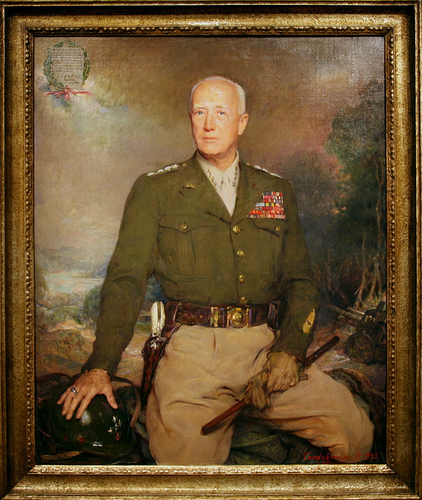
I’m feeling the need to be my own General Patton, my own Ike, my own General George C. Marshall, and be strategic about how I’m spending my time, supremely allying my short-term goals with my long-term goals and the available hours.

Here are the quotes I’m finding stunning this morning:

According to Ricks, “Marshall understood that Eisenhower had a talent for implementing strategy. And that job, Marshall believed, was more difficult than designing it. ‘There’s nothing so profound in the logic of the thing….But the execution of it, that’s another matter.'”

Interestingly, until I typed it, I was misreading this as “nothing so profound AS the logic of the thing,” which is telling, since I LOVE, love, love designing plans, so of course I’d be biased in their favor.

When Marshall met with Eisenhower right after Pearl Harbor , he gave him a test, saying, “Look, there are two things we have got to do. We have to to do our best in the Pacific and we’ve got to win this whole war. Now, how are we going to do it? Now, that is going to be your problem.” Ricks presents the next part in an understated way that emphasizes the drama:

“‘Give me a few hours,’ Eisenhower requested.”

Can you imagine? Mind-blowing.

Ricks quotes Eisenhower repeatedly from Ike’s memoirs (which I now very much want to read), here matching a quote from Ike to the incredible test above, “I loved to do that kind of work” Ike wrote. “Practical problems have always been my equivalent of crossword puzzles.”

According to Ricks, the thing Ike was amazingly good at was prioritizing.

Which is something I’m amazingly bad at sometimes. So I want to learn from this:

“Prioritizing tends to be a forgotten aspect of strategy. The art of strategy is foremost not about how to do something but about what to do. In other words, the first problem is to determine what the real problem is. There are many aspects to any given problem, the strategist must sort through them and determine its essence, for there lies the key to its solution. Eisenhower clearly understood the need to separate the essential from the merely important.”

Wowie, zowie. That’s my task: separating the essential from the merely important. To some extent, this echoes other works I’ve read, such as Steven Covey’s Seven Habits of Highly Effective People, which I read as a birthday present TO my father one year. I was broke since his birthday is in September (and academics don’t get their first paycheck until October–it took me a lot of years to figure out how NOT to be broke in September), so I pledged to read books he’d been recommending.  I was pleasantly surprised by Covey’s book.

But somehow reading about these things in the context of WWII seems really compelling to me right now, and wow–I had no idea how HUGE George Marshall was in effecting our success.

I enjoyed the chapter on Patton, about whom Ricks says, “The blustery Patton behaved in ways that would have gotten other officers relieved, but he was kept on because he was seen, accurately, as a man of unusual flaws and exceptional strengths.”  And I’m now on the chapter about Mark Clark, who, according to Ricks, “was perhaps, never quite bad enough to relieve but not quite good enough to admire.” That’s damning.

So I’m summoning my inner General Marshall to appoint my inner Ike to implement my plan and keep my inner Patton under control.

General Patton, from Flickr Creative Commons, attr. to clif1066

General Patton, from Flickr Creative Commons, attr. to clif1066

Forward, march!

Party on Mardi Gras.  Express love on Valentine’s Day. Give nothing up for Lent; instead add IN supreme focus on prioritizing.

Left-right-left-right-left-right (doo wah diddy diddy dum diddy doo).

“I am not the Sexiest Man Alive! I am an actor! I am the Elephant Man!”

Bradley Cooper isn’t old enough, or hasn’t aged enough, to have the sort of moment Jude Law is apparently having, where he can talk about being less pretty so he can be taken more seriously. The original Jude Law article has some terrific pictures, and yes, the man has aged in some interesting ways.  But Gawker has a snarky-fun take on it, saying that Law, in that article, has participated in “the ancient ritual of the Aging Male Beauty interview, declaring his utter relief to have finally slid into human levels of attractiveness….The Aging Male Beauty interview is a beloved rite of passage, typically performed in the colder Oscar months….” The only reason I don’t mind the snark much in this case is that, really, Jude Law is still a fine looking man.

But even with the scars on his face, Mr. Cooper is still awfully pretty. What to do, what to do.

Well, what he did a long time ago was fall in love with David Lynch’s Elephant Man. [He wasn’t quite as young as my friends Beckie and Roy’s son Wickham, who went as the Elephant Man for Halloween when he was 4, and instead of saying “Trick-or-treat” said, “I am not an animal.”]

What Mr. Cooper did when he was in the MFA program at the Actor’s Studio was convince people his thesis should be him in the lead of Bernard Pomerance’s Elephant Man.  On Fresh Air yesterday, he told Terry Gross that several people at the school tried to talk him out of it.

What he’s done recently is perform it in Massachusetts, to good local reviews (they allowed only local media). Here’s an article with pictures.

And what he’ll be doing soon is bringing it to Broadway.

How strikingly different that is from the way most of us navigate the world of inner beauty/outer beauty. How strange to be so beautiful and be so attracted to a play about a man whose inner beauty was masked by outer deformity.

And really, what a nice counterpoint to being People‘s Sexiest Man Alive, even more effective than what Mr. Cooper has done in more than one interview, which is to point out that when he was selected as the Sexiest Man Alive, the choice was actually protested.

Having your selection as the Sexiest Man Alive protested is funny, and probably humbling (though really, that’s kind of humble-bragging, isn’t it?).

But being the sort of actor who has a long relationship with a movie and a play about Joseph Merrick–that takes the 2D People cover and gives it real depth and texture.

Looking for Wow

First Baptist Church in Madison, Wisconsin (where I no longer officially belong but will always, in some way, BELONG) once hired a youth minister who had a nose ring, so, I liked her immediately. Then also she has a son the same age as mine. And then she quoted Anne Lamott in a sermon and called her the writer of the fifth gospel. BOOM! That’s one of the ways I know I’m in the same tribe as someone—massive respect and affection for Anne Lamott.

I read her latest, Help, Thanks, Wow, on the iPad, with the Kindle app, and I liked the book a lot. (Also liked reading digitally–If my son hadn’t essentially taken over the iPad, I might be reading more books that way. )

I like her definition of prayer:
“It is communication from the heart to that which surpasses understanding.”

I am charmed that this might annoy, unnerve, or offend any number of people I care about, who see prayer differently than I see it–all across the spectrum from pretty conservative-evangelical-fundamentalist Christians who’d be bothered not to see God in a definition of prayer (if they haven’t hidden me entirely on our social-media-in-common sites) to my atheist friends, who politely avert their eyes when I get going on the Jesus talk.

I particularly like this paragraph:
“Prayer can be motion and stillness and energy—all at the same time. It begins with stopping in our tracks, or with our backs against the wall, or when we are going under the waves, or when we are just so sick and tired of being psychically sick and tired that we surrender, or at least we finally stop running away and at long last walk or lurch or crawl toward something. Or maybe miraculously, we just release our grip slightly.”

Oh, does that resonate with me–both the need to release my grip AND the way that prayer helps me do that.

Her categories of prayer are helpful, though of course she’s not the first to come up with these. There’s “help,” for which we have the formal name of “intercessory prayer.” And then “thanks,” which some would call “prayers of thanksgiving,” and then “wow,” which I would probably call praise, but seems to be the official category of “adoration.”

Or is it?

This article, “Prayer and Subjective Well-Being: An Examination of Six Different Types of Prayer” lists these: “adoration, confession, thanksgiving, supplication, reception, and obligatory.”

Here’s how Whittington and Scher define prayers of adoration: “prayers focused on the worship of God, without any reference to circumstances, needs, or desires.” This is partly what Lamott means by “wow,” and it also coordinates with my new favorite song “Bring Your Praise,” by Trin-i-tee 5:7 (and if the fact that I love this song isn’t proof the Lord works in mysterious ways, well then….)

“If you want to see amazing, all you got to do is praise Him,” they sing. And also, “he can do anything, but he wants you to praise him.” (Which makes God sound a little needy and high-maintenance, frankly, which makes the Gnostic idea that Christianity’s creator-God has some issues. I always figure he was a second son, based on his dismissiveness about primogeniture in Genesis….)

Here’s the definition Whittington and Scher use for a prayer of “reception.” They quote another researcher, who says reception is “characterized by a contemplative attitude of openness, receptivity, and surrender, resulting in experiences ranging from peaceful/quiet to rapture/ecstasy.”

Sounds more like WOW, doesn’t it?

So I’ve been singing that song, “if you wanna see amazin’, all you gotta do is praise him” and essentially looking for wow.

I wrote one “help” prayer and posted it recently: “Prayer for a New Semester.” And of course there have already been school shootings, so immediately there’s the issue of “when God says no” and the question of whether my lack of faith is why my requests don’t get granted 100% of the time. (I found this sermon very comforting–I’ve long made the connection of “if faith is a gift, it’s not my fault I don’t have it.”)

I followed that up with a “thanks” prayer, “Grateful for my Crazy Life.”

Here are a couple of stabs at wow:

Stopping in Lone Rock

If I lived in L.A. traffic would drive me nuts,
And I don’t like Chicago’s bus-to-bus-to-el routes,
But yesterday’s commute sucked big-time, massive
Sucking—whereas usually my rural drive
Is lovely—how many eagles this week? A pileated?—
Yesterday it was snow-slick on the way in
And on the way home I nearly went snow-blind.
Today I worked from home, fever-breathing with a cold.

At one point I thought, “So this is zen driving” because
Really, I was guessing where the road was.
In the distance, there simply was no road in sight.
Up close, you could hazard a hypothesis.
I had to stop in Lone Rock to buy sunglasses—
My eyes were exhausted from staring at white on white on white.
____

All right, so it’s also a prayer of complaint (not a problem–there are whole Psalms that do that, right?), but the last six lines I was trying to convey the wow I felt, even though it wasn’t a very blissy wow.

I’m not such a fan of winter.

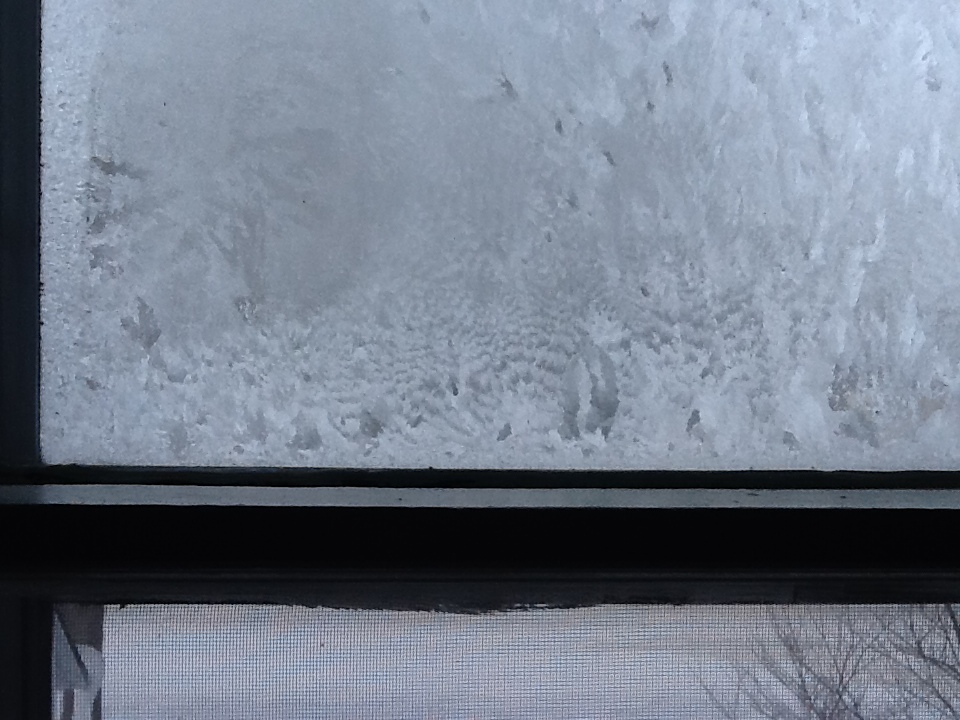
But I do use these cold days and nights (it’s supposed to get down to -11 tonight) to practice wow. One of the ways I do it is looking at frost on windows and seeing how many images are there that start with the letter “f.” Feather, flame, fire, fractal….By the time spring gets here, the list is usually pretty long. It’s not gratitude. Gratitude, from me, about winter–almost never going to happen. (MINUS ELEVEN.) But I can, occasionally, get to wow about it.

Frost in my bedroom window

Frost in my bedroom window

Grateful for my Crazy Life

Just this once, right now, and I wouldn’t say
It will happen again, I’m glad I have too much to do.
My crazy job is almost never boring.
I have the kind of brain that makes big plans
Involving levels and layers and long-term fun
With multiple players and organizations, and—well,
I tell you what—it makes me feel alive.
And tending to the people that I love
Takes time, but look at who I love—a full
Roster of family and friends and coworkers, a whole town
Of creative, funny people. And I LOVE Things,
More than a To Do list, more than software.
My house is messy, yes, because we choose
To read and play instead of clean. What a way
To be allowed to live. I’m grateful. At least today.