Category Archives: Sustainable Chaos

Once Again The Wire Explains My Life to Me


Yes, once again The Wire has helped me figure out my life. WHY WHY WHY have I seen an uptick in essays that have a gorgeous structure—intro/thesis, clear transitions, academic style, good introductions of sources, clear citations AND YET almost entirely random quotes that DO NOT MATCH the general statements that precede them?

I’m just guessing on account of teaching to the test.


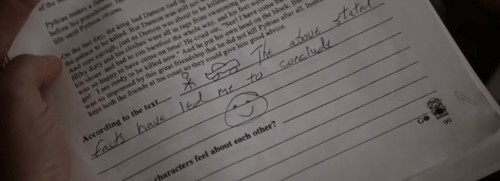
Screen Shot 2016-05-26 at 8.44.47 PM

The Wire Season 4, Episode 9, “Know Your Place”

In this episode of The Wire (NO SPOILERS! I’m only on Season 4 for chrissakes) Pryzbylewski is lamenting having to teach students to begin and end each answer in a formulaic way, and somehow KAZAAM! everything was clear to me.

I have clever students who are (as Ken Bain would point out) strategic enough to do what they need to do to get the grade they want, so they learn the format, and the tone, and YET:

It looks something like this (totally made up, not based on a particular student paper):

General statement: Even though girls are thought of as being cleaner and neater than boys, that’s not always true.

Quote used: “RQ1: How do male college students’ self-reported hand washing behaviors compare to perceptions of hand washing prevalence in the population of male students on campus?”

Or, even, “In a scholarly, peer-reviewed article called ‘Testing the Effects of Social Norms and Behavioral Privacy on Hand Washing: A Field Experiment,’ Lapinski et al. ask “how do male college students’ self-reported hand washing behaviors compare to perceptions of hand washing prevalence in the population of male students on campus?”‘(Lapinski et al. 341)*,

p.s. I’ve lost track of the whole single quote/double quote thing.

p.p.s. *I totally made up that page number

THE POINT IS, if you’re just skimming, the way I’m sure I would if I were an AP exam reader (and the way in which I’m sure actual AP readers don’t skim, right?), it sounds fine. But if you actually read for content, for substance, for MEANING, Jaysus, it don’t work at all. I mean, Jeebus.

Which reminds me of a Bible verse: 2 Timothy Chapter3, verses  (written, as we like to say, by the Apostle Paul to the lovely young Timothy):

“3 But mark this: There will be terrible times in the last days. People will [all kinds of stuff Paul is bothered by, some of which I am bothered by, some not so much] having a form of godliness but denying its power. Have nothing to do with such people.”

A form of godliness, but denying its power. That so much applies to churches, and “godly” folks, but also language, to quote scripture: “The word of god is seldom, and  tremblingly partook.”

Did Paul get exhausted? This exhausts me. Have nothing to do with such  people.


Dear Jodie Foster: I got it (and it wouldn’t matter if I didn’t)

Update:  An article today  in The New York Times confirms–Jodie Foster’s REALLY FAMOUS 2013 Golden Globes speech was a scripted speech.  I was right that it felt intentionally structured.  I was right.  Did I mention I was right? Original post below:

_____

It’s been a long time since I watched an award show, but my husband was getting our son to bed last night, so I got to turn on the Golden Globes, which has long been my favorite awards show because it never seems to take itself too seriously, and just enough big stars always show up to make it fun.

I missed the beginning, so I missed some good Fey-Poehler moments, but thank-you universe, I got to see George Clooney canoodling Amy Poehler during the best actress in a comedy category moment.

And I got to watch all of Jodie Foster’s speech. Live.

And it made me cry. In a good way. Because it’s 2013, I said something on Facebook almost immediately, and then read a comment and HOLY CRAP–that speech was an instant controversy in a way something can be instant controversy only now, with all our immediate access and RESPOND RESPOND RESPOND modes.  I’m glad I wasn’t looking at f.b. or Twitter when she was speaking, because the people complaining might have colored the speech for me.

It’s a pretty Rorschachy cultural moment, apparently. People who watched the same speech I did thought it was incoherent, fragmented, confusing, and inappropriate. On Twitter and Facebook, people have said she was drunk. On drugs. Unhinged. Or sad. Perhaps in need of professional help.

So far, the only article I’ve read that gets it right (from my perspective) is this one from Salon, “Jodie Foster Comes Out, Gritting Her Teeth,” and even there–I thought she was having more fun than that.

In an attempt to figure out why people are responding so differently, I’ve watched the speech several times and analyzed the transcript. Here’s what I think–it was the tone and the pace and the lack of transitions that made people holler “incoherent!” If you watch the speech again, knowing what’s coming, or look at the transcript, it doesn’t seem so wacky. Or even very disorganized or fragmented.

Some caveats for my analysis: I love Jodie Foster. She could pretty much do or say whatever and I would be fine.

Caveat #2: the speech did feel zoomy to me, sort of flight-of-fancy-paced, but HELLO. I like that kind of zooming, that kind of doesn’t-feel-structured-but-it-is feeling.

What did we expect her to do? I suppose we would have expected a brief “thank you, this town has been very good to me, etc.” speech. Something like her Oscar speech, when she won for The Accused in 1988, a 141-word snippet in which she also thanks her mother. She said, “There are very few things: there’s love and work and family. And this movie is so special to us because it was all three of those things. And I’d like to thank all of my families, the tribes that I come from.”

In contrast, last night’s speech was more than 1,100 words. Nearly ten times as long. Lots of time to do lots more.

And I do know from incoherence. I’ve been teaching first and second-year college students for 25 years now. There’s incoherence (no main point, supporting points that don’t match main point, supporting points that don’t connect to each other), and then there’s subtlety.  I also teach creative writing, including creative nonfiction. There are ways to express ourselves that meander, that don’t add up to incoherence. I think Jodie Foster is more akin to Mary Paumier Jone’s “Meander” than a first-year disorganized essay, or a “bizarre” or “incoherent rant,” as many people are labeling the speech.

What she did, as I outline it, is the following:

  • Start with an insider joke (“Well, for all of you ‘SNL’ fans, I’m 50! I’m 50!”)
  • Thank the person who introduced her (“I want to thank you for everything: for your bat-crazed, rapid-fire brain, the sweet intro. I love you and Susan and I am so grateful that you continually talk me off the ledge when I go on and foam at the mouth and say, ‘I’m done with acting, I’m done with acting, I’m really done, I’m done, I’m done.’” MORE ON THIS LATER. IT IS KEY.)
  • Comment on winning a Lifetime Achievement Award (““Trust me, 47 years in the film business is a long time….”)
  • Announce that she is going to pull a rabbit out of a hat (“So while I’m here being all confessional, I guess I have a sudden urge to say something that I’ve never really been able to air in public.”)
  • Thwart our expectations (“I’m single!”)
  • Explain why she’s thwarting our expectations (After a weird moment without audio–I thought it was my TV, but the ABC transcript says “audio went out,” she picks up with “…be a big coming-out speech tonight because I already did my coming out about a thousand years ago back in the Stone Age….”)
  • Comment on culture in a joking way (“But now I’m told, apparently, that every celebrity is expected to honor the details of their private life with a press conference, a fragrance and a prime-time reality show. You know, you guys might be surprised, but I am not Honey Boo Boo Child. No, I’m sorry, that’s just not me….)
  • Comment on culture in a serious way (““But seriously, if you had been a public figure from the time that you were a toddler, if you’d had to fight for a life that felt real and honest and normal against all odds, then maybe you too might value privacy above all else. Privacy.”  That BUT SERIOUSLY does count as a transition, btw.)
  • Impart some wisdom (“There are a few secrets to keeping your psyche intact over such a long career. The first, love people and stay beside them.”)
  • Thank people who have helped her (“That table over there, 222, way out in Idaho, Paris, Stockholm, that one, next to the bathroom with all the unfamous faces, the very same faces for all these years.”)
  • Conclude (“I will continue to tell stories, to move people by being moved, the greatest job in the world. It’s just that from now on, I may be holding a different talking stick. And maybe it won’t be as sparkly, maybe it won’t open on 3,000 screens, maybe it will be so quiet and delicate that only dogs can hear it whistle. But it will be my writing on the wall. Jodie Foster was here, I still am, and I want to be seen, to be understood deeply and to be not so very lonely. Thank you, all of you, for the company. Here’s to the next 50 years.”)

What’s so fragmented about that? Just because she didn’t say, “Next, I would like to comment on culture in a joking way.”  Really? We needed that? “And finally I would like to conclude.”

I always tell students that transitions are for readers. They’re kind. They’re considerate. Jodie Foster wasn’t being so terribly kind and considerate, I suppose–maybe that’s why people actually seem offended by the PERCEIVED lack of coherence. We thought she was nice! We thought she loved us and wanted us along!

One reason I think this seemed incoherent is not because she was incoherent; I think it’s because she is so freaking smart. Who the hell tries to comment on culture and impart wisdom at the Golden Globes? Jode.

I don’t know that we’ll ever know if this was ad-libbed or totally planned or partly ad-libbed and partly planned or how sober she was. We just heard her thoughts on privacy, after all.  But it stands up pretty well to analysis.

And it’s hilarious in some ways, even though people were mostly NOT laughing at the right places (not at the Golden Globes and judging from Twitter, not in a lot of homes).  If we go with the notion that the biggest component of humor is surprise, we can see she was going for it again and again–starting with “I’m 50!” and tossing out the almost Schecky Green style of “my fellow actors out there, we’ve giggled through love scenes, we’ve punched and cried and spit and vomited and blown snot all over one another — and those are just the costars I liked.” (Someone should have done a rim-shot. Maybe if she’d slowed down and said, “bah dum bum” we’d have gotten it, but no, she was ZOOMING.)

Then she moved on  “I’m single” and then with “I’m not Honey Boo Boo,” which, if she’d allowed us to linger, could have taken us to layers upon layers of serious hilarity. Jodie Foster, beautiful, in a shiny dress that matched her great blue eyes, fit, strong, brilliant, no she is not Honey Boo Boo. But wow. If she did have a reality show….But we didn’t get time to picture it and giggle to ourselves because she went zooming on to “I’d have to spank Daniel Craig’s bottom just to stay on the air” (which he did laugh at–another reason to love him).

Then there’s all the deep irony of 1)coming out by thanking your longtime lover when HEY!  You just told us you weren’t coming out!  WAIT A MINUTE!  and 2)sending a message to your mother who apparently has dementia and is close to death, which is a pretty goddam intimate thing to do when you were just lecturing us on PRIVACY, 3)and also, there were your sons, which paparazzi are pretty crappy at grabbing snaps of, beautiful boys, right there at your table when you were just lecturing us on PRIVACY….

[And this actually wasn’t the first time she “came out” in public. I’m looking for the link, but she thanked Cydney publicly at least once before and called her her wife–and if her being a lesbian were a secret at all, it was a pretty open secret. I know some people have been angry at her for years for not “coming out” in a big way, but obviously, she wanted to do it her way.]

Caveat #3: I love Robert Downey Jr’s performance in Home for the Holidays, and Foster’s commentary on the DVD of that movie makes it sound like he ad-libbed almost constantly, and that she loved it.

So maybe I wasn’t as startled at the pace and lack of transitions in the speech because Robert Downey Jr. introduced her. He set the tone, and he set the pace. He was ironic almost all the way through, and silly, and almost no one laughed, it seemed, when he praised her for her philanthropy and the Jodie Foster Aquatic Pavilion, which he followed up quickly with a picture of her face photo-shopped onto Bo Derek’s famous “10” shot, with the caption, “Let’s Get Wet!”

He didn’t pause to let any of his jokes sink in. He just plowed on through.

And when she thanked him, she specifically mentioned his “bat-crazed, rapid-fire brain,” and “the sweet intro.”  You know what? The intro wasn’t sweet. It was, I trust, sweetly intended, since they’re friends, but it was mostly for her I think, an individualized, Robert Downey Jr.-ized chunk of what she would find funny.

She just picked up that baton and ran with it, and if we couldn’t keep up, well–we don’t get to hang out with them, do we? We’re not in their league.

Mel Gibson did look a little lost. I’d rather not be in his category of lost-ness.

But it says something, doesn’t it, that the two actors she chose to have at her table are not known for their clear-headedness and decorum? I take from this that she is loyal as the day is long and she has a fondness for the crazy. Both traits I happen to share.

I did feel dizzy at the end of her speech, no doubt, and the “I may never be on stage again” was a very weird moment, but we got a lot of Jodie Foster last night, more than I ever thought we’d get. Just looking at who was at her table–that was a lot, by itself.

She’s been in the public so publicly, so long, I’m not going to say “we got the real Jodie Foster!” There are layers upon layers upon layers there.

But in a room where she feels at home, where she can take whatever tone she wants and zoom however fast she wants, she ended with good news, “I will continue to tell stories, to move people by being moved,” and what I took to be the storyteller’s basic credo: “Jodie Foster was here, I still am, and I want to be seen, to be understood deeply and to be not so very lonely.”

She finished with “Thank you, all of you, for the company. Here’s to the next 50 years.”

That’s why it matters, right, why it was bothering me for people to react to the speech so differently than I did? Because I was, very distantly, keeping her company. I’m 47. Beginning with her picture on the Coppertone bottle (and I could write a whole blog about Coppertone, the very name working as a transporter, and if I ever smell it–wow, I’m gone), she has been a part of my life.

She was never not there.

I wish her well and I loved, loved, loved that speech.

Zoom zoom!

_____

UPDATE: Here’s a story from 2007 when Jodie Foster thanked Cydney Bernard. She isn’t quoted as having said “wife,” so I’m either remembering a different story, or remembering this one wrong, but this is from five years ago.

And also I look like Bernie Sanders

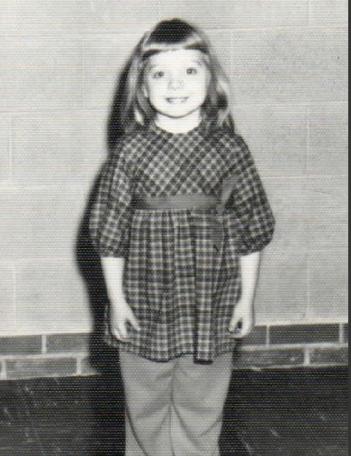
Even with my super-short, super-straight bangs, I was an adorable child:

393489_2101279191124_155254841_n

Kindergarten Cute

Whatever body-image issues I’ve developed since then, there’s no question in my mind I was cute then.  When I was a baby, one or two of my uncles (depends on who’s telling the story) said there should be a “Marnie Doll” because I was cuter than a Kewpie Doll.

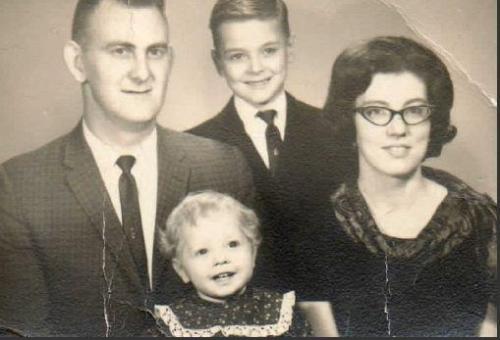
When I was a baby, my parents and brother and I got one of the two good pictures of the four of us we’ve ever managed to get:

384749_2101265950793_1949350502_n

There’s also a picture of us in the 80s that’s pretty good. But in general, the four of us don’t photograph well together.

Recently, my Great-Uncle Logan passed away, and my cousin Jewell is going through his photo albums to divide up the pictures. She’ll give the originals to my mother, but she scanned this one and sent it to me:

1689697_10102386058738158_1728250219445087742_n

This is generally how it goes when the four of us have our picture taken. The looking in different directions. The some of us all swanky and others not so much. In this one, the squinting. Still, I’m loving this picture. First, my mother looks remarkably like one of my younger cousins & I always find those resemblance moments compelling.

And also I look like Bernie Sanders. When I posted this on Facebook, a few people tried to tell me I was actually cute, but I said, no, no–I was a cute child, but this is not a cute picture of me.

Thus, my thoughts when I saw it were “I look like Bernie Sanders” and “Mom looks like Jamie” and also “Mom looks so cool!”

When my Mom saw the picture, she was trying to figure out what year it was.

When my brother saw the picture, he agreed that I looked like Bernie Sanders, but pointed out it was before Dad went to Vietnam–he knew because Dad didn’t have much of  a tan.

Dad agreed it was before Vietnam because he came back from that war with a higher rank and medals.

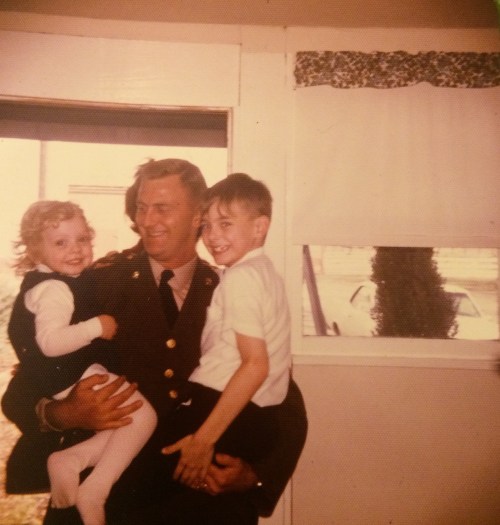
The Bernie Sanders pic made us all remember the following picture, the first one of all of us when Dad came back from Vietnam (Mom’s standing behind Dad–you can see her hair a little–again, challenging to get a good pic of all four of us).

FullSizeRender-3

I don’t know if the four of us were ever happier than we were in that picture. In that moment.

After that, we would have two adolescences and career challenges and the ordinary life stresses of keeping it all together as adults and then weathering deaths in the family and now my father’s memory is so spotty that he’s confabulating–remembering things that didn’t happen. When he saw the Bernie Sanders pic, he talked about remembering seeing it before, but Mom and I are pretty sure we never saw it. That Uncle Logan snapped it, and it went in their photo albums, and we’re just now seeing it.

That’s the thing about confabulation–it’s hard to know if I should play along (at which point I almost feel like I’m gaslighting myself) or challenge Dad (which is troubling, since the confabulated memory seems as real to him as any other). And in this case, does it really matter? Probably not.

But if we skip to the end of the war and focus on the picture of Dad holding Brian and me, Mom right behind, that white car in the drive–we’re on Gran’mommy and Gran’daddy’s back porch, in their old house on the farm (before the new house, before they had to sell the farm).

If we focus on that picture, well, it’s just pure bliss. I’m sure of it.

What’s Waiting on the Other Side of Turmoil?

–a Thanksgiving poem in a difficult time,
ending with a paraphrase of Julian of Norwich
which also contains a reference to Husker Du


What’s waiting on the other side of turmoil?
We can hope, but the ugly truth is we don’t know
if all will be well and every everything will be well.

We’re partial to our own peculiar ordeal.
Our depth of field’s so shallow it can’t show
what’s waiting on the other side of turmoil.

It’s hard to line up the practical with the theological.
Would Julian say, if she got her car stuck in the snow,
“all shall be well and all manner of thing shall be well?”

I bet she sometimes just muttered “oh well.”
I bet she had her doubts a mothering God controlled
what’s waiting on the other side of turmoil,

the gruesome news, the shit at work, the hell
through which we make each other go and go and go.
If all will be well and every everything will be well,

the obvious question is when? Does anyone know?
Could one tiny seed of calm actually grow?
What’s waiting on the other side of turmoil?
When will all be well? Will every everything be well?

_____

It does seem to me the setting on turmoil is turned way up lately.  But this Thanksgiving I am trying to nurture little seeds of calm where I can.

vanessa20130506-0650

Vanessa Quivertail when she was a baby kitteh.


Translated into Chinese!!!!!!

I was wrong about which blog post it was, but I’m STILL freaking excited that my colleague at UW-Richland, Faye Peng, translated some of my writing into Chinese!

It’s the post previous to this, “Here’s What It’s Like” (which is, as of this moment, up to 228 views).

She didn’t translate the whole thing so I’ll just say that I know budget cuts aren’t really like the things I described. Oh–also–not sure how the movie references play in translation–there are references to The Titanic (which I’ve never actually seen), Seven (which I have seen), and Sophie’s Choice (which I’ve seen a LOT).

Here’s how I was wrong. I first thought that my found poem using all direct quotes from the amazing TV show The Wire), “Contemplating the Declining Percentage of Investment in Higher Education and in Particular Legislators and Governors who Nevertheless Cheer Hard for their Sports Teams, While Also Mulling the Curious Maneuvers of University Leadership that May or May Not Yield Good Results for Those of Us in the Trenches, So to Speak,”  had been translated into Chinese.

_____


威斯康星大学预算削减的痛

这种疼就像,
他举起手,
你以为他要说“停下”,
但是他挥拳打向你;

对终身教授,
这种痛就像,
你坐在救生艇上,
你看着其他人被淹没,
你可以紧闭双眼,
你可以捂住你的双耳,
可是他们正在被淹没;

这种痛就像,
你抱着孩子逃离火车,
可是你不得不决定,
你救哪一个孩子,
放弃哪一个孩子;

这种痛就像,
你面对系列杀人犯,
他让你决定从你身上的哪一个部位切下血肉
[发怒][发怒][发怒][大哭][大哭][大哭]

Here’s What It’s Like: UW System Cuts

Here’s what it’s like. You thought he was raising his hand to say “stop” but he hit you instead.

Here’s what it’s like to be a tenured UW System faculty member right now. You’re in a lifeboat. Other people are drowning. You can close your eyes. You can cover your ears. But they’re still drowning.

Here’s what it’s like. You get off the train holding your children’s hands. You’re forced to choose which one lives and which one dies.

Here’s what it’s like. A serial killer makes you choose which pound of flesh you will cut out of yourself.

It’s not really like that, of course. No one’s dying. There’s not physical violence.

Moreover, I don’t know what it’s like to lose a child or be left alive when someone else drowns (though I read Ordinary People about six hundred times when I was 13).   I do know what it’s like to be hit–one time I thought a man was raising his hand to motion “shush,” but he punched me instead (Carbondale, Halloween). I have no experience with serial killers.  So–sorry if I’m seeming melodramatic.

But the proposed cuts to the UW System?  And my institution’s range of possible responses?

It feels awful.

Here’s what it’s really like.

The street in front of my house is torn up right now because the village is putting in storm drains and widening the street a bit. Trees were cut down last fall. It’s ugly right now, and it will never again be as pretty as it was, with the canopy of mature sugar maples making the entrance to downtown Spring Green the very picture of “small-town tree-lined street.” If that’s part of what you loved about the Spring Green Art Fair—sorry. No more. At least not on my end of the street. I’m skeptical whether all the trees really needed to come down, because the people in charge of projects like this don’t seem to have the same feelings and beliefs I do when I comes to trees. Nonetheless, we’ve been told the replacement trees will be native (smallish—not full-sized sugar maples, but still native—and especially NOT suburban-looking ornamental pseudo-trees). Overall, I’m o.k. with what’s going on. Storm drains will be FANTASTIC. No more navigating lakes and frozen lakes and partially frozen lakes to get the mail or get in and out of a car at the curb.

But what if I found out all the destruction, all the tree demolition, was for no good reason? What if the trees were needed only because someone had a jones to show off their wood chipper? What if I found out that there’s no longer a plan to re-pave it all?  Or there’s a plan to pave it lightly, right on top, with no foundation below? What if the whole street were getting demolished simply to provide dirt for a big hole somewhere else?

I would feel like I feel right now about the UW System.

Angry. Distraught. Relatively hopeless and helpless.

The UW Colleges is facing cuts that I think we cannot survive.

Here’s the worst part at the moment—our institution is going implement massive changes soon because we can’t afford not to, just in case the cuts are as bad as Governor Walker’s budget requested. Or, even if they’re not THAT bad, even if they’re half as bad. We’re still implementing cuts.

The specifics of it are not firm yet, but it will be ugly and awful and bad no matter what.

And once you’ve cut those trees down, well–it will never be the same.

I have a lot of respect for local legislators. Howard Marklein and Ed Brooks came to my campus and listened to us, and I know they’re trying to do what they can.  I was impressed with both of them.

There’s talk of holding the UW Colleges harmless in the cuts, and while that might mean we actually live to fight another day, it also feels awful. (I mean—we kind of all know that Jan died, too. And this feels so much like Scott Walker’s tried-and-true method of divide and conquer—we’re like rats in a tub fighting over baubles and moldered scraps.)

I just don't want to be the very last rat on the sinking ship.

I just don’t want to be the very last rat on the sinking ship.

But however much respect I have for my local legislators–that budget hole they’re filling? Their party created it. They’re fine with tax breaks the state couldn’t afford. They’re fine with refusing to take federal money for Medicaid. They won’t do what Minnesota has done.

Here’s what it’s like. Have you ever had a nightmare where someone bad is chasing you and you’re so freaked out you just fall down and think “just kill me. Kill me now.”

It’s not like that, not really. I’m awake, for one thing. But part of me wants to fall down and say “Just do it. Close my campus now.”

We’re supposed to feel good, apparently, about the fact that closing a campus isn’t on the table or in the plans.

But if you were to cut down trees and tear up a street and dig giant holes and abandon any pretense of putting in pipes or repaving it at some point—who would want to drive there? Who would want to live there? Who would hold an art fair there, if there were any other street available?

And if you cut my campus so much that it’s just a shell, who would want to go to school there? Who would want to work there?
_____

For an ongoingly good voice about all this, check out Chuck Rybak’s blog.

_____
Posting this while I eat lunch, btw. It’s a really good lunch.

_____

Maybe I’m wrong about how awful it’ll be.

I don't want to look.

I don’t want to look.

Daylight Savings and Loan

They say you get the hour back in the fall
but it’s so old by then you’ll hardly know
it’s yours. Remember when your postpartum ghost
convinced you that you’d been sent home, arms full
of someone else’s baby? That wasn’t true.
Come fall, don’t fret that time. Just sleep right through.
But what if we got to pick which hour to lose?
The wasted hour? The bad phone call? (To choose–
as if we could control the clock–but wait–we do.)
What interest would that time have then accrued?
Would we regret the moment and the choice?
Would we learn how badly our intentions screw things up?
Yes, and yet–we want to scream it–Cease! Desist!
to our mistakes, to family, friends, and also, yes,
to the officer who shot to kill and not to stop.

—–
I feel the need to say this very carefully.

Another young black man has been shot and killed by the police. There are peaceful protests planned.

I am praying today for the family and for the city of Madison.

I can say, carefully and logically, that I am not anti-police, that I truly appreciate how they put themselves in harm’s way so many times to protect the people they serve.  I understand, logically, and legally, that a police officer can have just cause for shooting. But as much as I believe those sentences, I also know I  write them from a position of middle-class white privilege, so I almost wanted not to write this paragraph at all.

What is more important to say, for me to say, is that the reason police keep NOT getting the benefit of the doubt is because of persistent racism.  That’s what they just found in studying Ferguson.  And there are ongoing conversations about the problems in Madison related to race.  This latest round of talks was sparked by a special editorial by Rev. Alex Gee in the Cap Times called “Justified Anger.”

I find that editorial thoughtful and disturbing. It should disturb me. It should move me to act, but I don’t always know how to act. Or when.

I might not know what to do, but I did know one thing not to do.

I’ve been thinking about Daylight Saving Time, which I hate, and I’m working on some flash fiction about it, and the first two lines of the above poem occurred to me yesterday, and as I began writing it, I wanted it to to be a mildly thoughtful but mostly silly poem about the urge to mess with time, to stop time, to take things out of time.

But what would that mean, to write a mostly silly poem when once again another young black man is dead at the hands of the police, and this time, really close to home? I couldn’t do it.

It’s not much, but I made this poem and this post not totally about me and my silly thoughts.

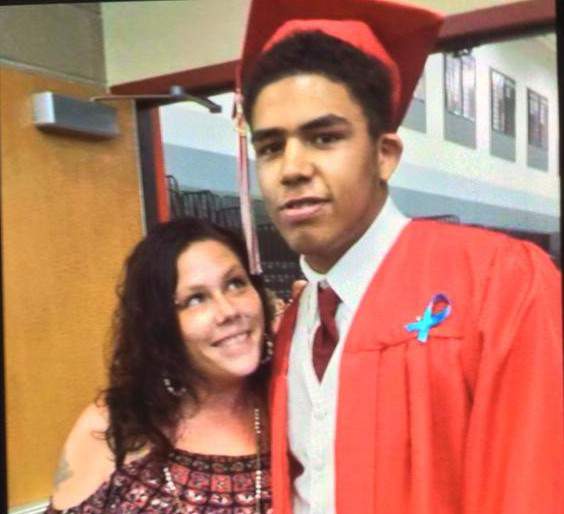
Of all the recent hours I’d like to lose, I’d like to lose the one where Anthony Robinson died.

Tony Robinson, in a picture from his mother's phone.

Tony Robinson, in a picture from his mother’s phone.

“Feedback is what happens second” Part I

Gearing up for spring semester begins late in fall semester for me. That’s a practical matter–if I waited until the fall semester was over to gear up for spring, I’d be behind schedule immediately. It’s more than a practical matter, though. There comes a time in every semester, the deepest, darkest time (which in fall corresponds with shorter days and longer nights) of a semester, when it’s easier to see what’s not working rather than what is working.

One of my ongoing goals as a teacher is to return student work faster. I struggle with it for a number of reasons:

  • I don’t like delivering bad news. I absolutely love sitting down with students and providing feedback on drafts and revisions, but at that point, the possibilities for success are still wide open. With a final draft, some doors are shut. I’ve wondered if switching to a portfolio system would help me here because of how much I enjoy giving feedback early in the process.
  • I’m a master procrastinator when faced with unpleasant tasks.
  • There isn’t a clear deadline for when student work has to be returned except in terms of when they need to turn in the next assignment, or at the very end of the semester. This is one reason I think a portfolio system might work better–I’d be grading final drafts at the end of the semester when the deadlines are very firm and real.

I’m not saying these are GOOD reasons, but they’re reasons I’ve discovered.  I just realized earlier this month that I’m always slower about returning student work in spring semester & one reason for that is probably because I tend to have more problems with anxiety and depression in the spring (ironic, because I love light and love when the days begin to grow longer). I discovered it because I keep track of when student work comes in and when I return it (I call it TIR for turned-in-returned rate) on a spreadsheet & I have numbers going back several years. The good news is that overall, I’m doing much better than I used to. The bad news is that my numbers have gotten ugly the last couple of spring semesters….

Anyway, I’ve decided that I’m going to try something I’ve never tried in relation to solving this problem. (Other things I continue to do: keeping track, rewarding myself if I meet my goals at different points in the semester, reporting to someone on how I’m doing–which is what I was doing earlier this month when I discovered the WORSE IN SPRING PATTERN.  I was putting my numbers in my yearly activity report.)

I’m problematizing the problem. I’m going to do research first, on feedback, and see what the research says.  That’s where I am right now, and at least at the moment, my plan is to report on the research at different points in the semester.

I know it’s important–feedback is the thing that an instructor can do in a real class that an instructor can’t do in a MOOC, and however good AI gets, it still seems to me we’re a long way away from computers being able to give good feedback to writers on much beyond sentence complexity, vocabulary, spelling, and some grammar. Feedback is what makes instructors invaluable.

The first article I’m tackling is called “The Power of Feedback” and it’s by John Hattie and Helen Temperly at the University of Auckland.

One of the first quotes that struck me in the article was this one, “Feedback has no effect in a vacuum; to be powerful in its effect, there must be a learning context to which feedback is addressed.”  That’s why they say “feedback is what happens second.”  Instruction has to happen first.  When I read this quote I thought immediately of my discomfort when a student in creative writing asks me for feedback on something they wrote before the class.  I tell them it feels weird because I don’t know what they were trying for, whereas if they wrote in response to an assignment, I know what they were supposed to be trying to do.

I appreciate Hattie & Temperley’s article for their definitions & clarifications, among other things.  Here’s one:  “The claim is made that the main purpose of feedback is to reduce discrepancies between current understandings and performance and a goal. ” To me this emphasizes the importance of backward design–if my students and I don’t know what our goals are, I just don’t stand a chance of providing effective feedback.

These three questions seem so crucial: “Effective feedback must answer three major questions asked by a teacher and/or by a student: Where am I going? (What are the goals?), How am I going? (What progress is being made toward the goal?), and Where to next? (What activities need to be undertaken to make better progress?)”

I particularly appreciate the emphasis on the role students play in the feedback process. Here’s the good news:  it’s not a passive role. Here are some things students can do. They can

  • “increase their effort, particularly when the effort leads to tackling more challenging tasks or appreciating higher quality experiences rather than just doing ‘more.'”
  • “develop effective error detection skills, which lead to their own self-feedback aimed at reaching a goal.”
  • “seek better strategies to complete the task or be taught them, or they can obtain more information.”

So I dived into this article hoping for motivation for returning student work faster, and it does address that several pages in, and I’ll get to that as I post on the topic, but for now, it’s met a goal I didn’t even realize I had–get me pumped up about a new semester.

What can I do with this enthusiasm? Lots.  “Teachers can also assist by clarifying goals, enhancing commitment or increased effort to reaching them through feedback….More generally, teachers can create a learning environment in which students develop self-regulation and error detection skills.”

I need to model self-assessment and self-regulation by setting goals, monitoring them, and then making adjustments (all processes discussed in the article, but also widely discussed any time metacognition comes up).

So my goal for returning student work in terms of promptness is this.  By the end of Week 5, I want my overall average to be below 7 days, and the average for longer assignments to be below 10 days, but I want the standard deviation to be 2.0 or lower–this past fall my averages met those goals, but the standard deviation was too high (I was still keeping some longer assignments wayyyyyyy too long).

a little poem I wrote with big feelings

a little poem I wrote with big feelings

Beyond that, I’m setting some goals on the quality of feedback. I want to set the questions and good points from “The Power of Feedback” in front of myself as I start to communicate with students about their work, which I’m less than a week away from (classes start on Monday and the first assignments come in next Friday–sooner, since some students will want me to look at rough drafts, more than likely).

My plan is to report on my turned-in-returned rate after Week 5, or sooner, and I’ll also write more about this article & others I’ve found and will find.

Meanwhile–it’s back to finishing up syllabi & schedules for next week!


Deadline: Epiphany

“Traditionally it is bad luck to keep your Christmas Decorations up beyond Twelfth Night – the last of the 12 Days of Christmas.” Plymouth Herald

Some years I can’t wait for the tree
to come down. I want it up
the day after Thanksgiving and then
everything put away before New Year’s.

My friend Bellamy left hers up
through Valentine’s. Probably more than once.
A real tree—brown by the time
she got it out to the curb.

But this year I’ve wanted Christmas
to last a little longer, for the event
part of Advent not to be here quite yet.
I’m not sure why. I had good holidays,

a nearly perfect mix of quiet and fun.
Maybe that’s why. Of course that’s why.
I’ve brought out other candles to use
because it’s still dark so early in the day.

It’s still cold. I’m still longing
for something to happen and yet not
wanting anything to change.
Waiting for the wise gifts to come.

Just a few of the non-holiday candles I've dug out.  On a clean stove!

Just a few of the non-holiday candles I’ve dug out. On a clean stove!

(I actually also think one of the reasons I’m not ready to be done with the season is that I love, love, love Aimee Mann’s One More Drifter in the Snow. I’m not ready to stop listening to it. So I won’t.)

Gathering it up to put it away. NOTE THE HOLY BLATZ TRAY we use for the advent candles.

Gathering it up to put it away. NOTE THE HOLY BLATZ TRAY we use for the advent candles.

Tin Whiskers

“Tin whiskers are easy to miss, thinner than a human hair. They look like metal fuzz. They grow — for reasons scientists don’t understand — from plated tin surfaces, millimeter by millimeter. And if they bridge two closely spaced circuits, tin whiskers can cause a short.” Todd C. Frankel, “A Carbondale professor, runaway Toyotas and the hunt for ‘tin whiskers'”

1 (a found poem, from the same article)
“None of this happens if David Gilbert keeps his Ford
F-150 truck. Not the threats to his job
as a professor at Southern Illinois University Carbondale.
Not the corporate intimidation. He never would have
testified before Congress. And he never would have met
those NASA scientists, the ones who ended up
naming an electrical effect after him. As a gift,
they gave him the black NASA coffee mug
sitting on his desk — the one he’s sipping from
right now. The mug reads, ‘If it’s not safe, say so.’”

2
But he traded in his truck for a Toyota.
This is when they were crashing, speeding up,
Toyotas were, getting recalled. He was a curious,
and tenured professor, and had an automotive
lab, so he hooked his truck up to a machine
(it looks like steam punk in my brain, with gears
and cogs and whistles and clocks) and caused an error
the truck’s computer missed, again and again.
Here’s the movie he’s the hero of—
Big bad Toyota tried to trash his name.
My alma mater tried to stop his work.
He just kept telling the truth. It’s almost like
some people have tin whiskers inside of them.
Inside of him, a regard for truth, almost like love.

_____

I like to read the online versions of newspapers from places I’ve lived in the past, or places I’m interested in. Thus, on any given day, I might check out The Missoulian (oh! those years in Montana!) or The Southern Illinoisan (the place names alone are worth it), and though I never lived in St. Louis, I spent a fair bit of time there. The article referenced above was in the St. Louis Post Dispatch online, written by Todd C. Frankel, who now writes for the Washington Post.

It’s a well-written article, a complex and compelling story.

It speaks to so many things, including the enduring value of tenure.

So, bravo, Mr. Frankel, and yay for Professor Gilbert, who really does strike me as a hero.