Category Archives: Searching

“Feedback is what happens second” Part I

Gearing up for spring semester begins late in fall semester for me. That’s a practical matter–if I waited until the fall semester was over to gear up for spring, I’d be behind schedule immediately. It’s more than a practical matter, though. There comes a time in every semester, the deepest, darkest time (which in fall corresponds with shorter days and longer nights) of a semester, when it’s easier to see what’s not working rather than what is working.

One of my ongoing goals as a teacher is to return student work faster. I struggle with it for a number of reasons:

  • I don’t like delivering bad news. I absolutely love sitting down with students and providing feedback on drafts and revisions, but at that point, the possibilities for success are still wide open. With a final draft, some doors are shut. I’ve wondered if switching to a portfolio system would help me here because of how much I enjoy giving feedback early in the process.
  • I’m a master procrastinator when faced with unpleasant tasks.
  • There isn’t a clear deadline for when student work has to be returned except in terms of when they need to turn in the next assignment, or at the very end of the semester. This is one reason I think a portfolio system might work better–I’d be grading final drafts at the end of the semester when the deadlines are very firm and real.

I’m not saying these are GOOD reasons, but they’re reasons I’ve discovered.  I just realized earlier this month that I’m always slower about returning student work in spring semester & one reason for that is probably because I tend to have more problems with anxiety and depression in the spring (ironic, because I love light and love when the days begin to grow longer). I discovered it because I keep track of when student work comes in and when I return it (I call it TIR for turned-in-returned rate) on a spreadsheet & I have numbers going back several years. The good news is that overall, I’m doing much better than I used to. The bad news is that my numbers have gotten ugly the last couple of spring semesters….

Anyway, I’ve decided that I’m going to try something I’ve never tried in relation to solving this problem. (Other things I continue to do: keeping track, rewarding myself if I meet my goals at different points in the semester, reporting to someone on how I’m doing–which is what I was doing earlier this month when I discovered the WORSE IN SPRING PATTERN.  I was putting my numbers in my yearly activity report.)

I’m problematizing the problem. I’m going to do research first, on feedback, and see what the research says.  That’s where I am right now, and at least at the moment, my plan is to report on the research at different points in the semester.

I know it’s important–feedback is the thing that an instructor can do in a real class that an instructor can’t do in a MOOC, and however good AI gets, it still seems to me we’re a long way away from computers being able to give good feedback to writers on much beyond sentence complexity, vocabulary, spelling, and some grammar. Feedback is what makes instructors invaluable.

The first article I’m tackling is called “The Power of Feedback” and it’s by John Hattie and Helen Temperly at the University of Auckland.

One of the first quotes that struck me in the article was this one, “Feedback has no effect in a vacuum; to be powerful in its effect, there must be a learning context to which feedback is addressed.”  That’s why they say “feedback is what happens second.”  Instruction has to happen first.  When I read this quote I thought immediately of my discomfort when a student in creative writing asks me for feedback on something they wrote before the class.  I tell them it feels weird because I don’t know what they were trying for, whereas if they wrote in response to an assignment, I know what they were supposed to be trying to do.

I appreciate Hattie & Temperley’s article for their definitions & clarifications, among other things.  Here’s one:  “The claim is made that the main purpose of feedback is to reduce discrepancies between current understandings and performance and a goal. ” To me this emphasizes the importance of backward design–if my students and I don’t know what our goals are, I just don’t stand a chance of providing effective feedback.

These three questions seem so crucial: “Effective feedback must answer three major questions asked by a teacher and/or by a student: Where am I going? (What are the goals?), How am I going? (What progress is being made toward the goal?), and Where to next? (What activities need to be undertaken to make better progress?)”

I particularly appreciate the emphasis on the role students play in the feedback process. Here’s the good news:  it’s not a passive role. Here are some things students can do. They can

  • “increase their effort, particularly when the effort leads to tackling more challenging tasks or appreciating higher quality experiences rather than just doing ‘more.'”
  • “develop effective error detection skills, which lead to their own self-feedback aimed at reaching a goal.”
  • “seek better strategies to complete the task or be taught them, or they can obtain more information.”

So I dived into this article hoping for motivation for returning student work faster, and it does address that several pages in, and I’ll get to that as I post on the topic, but for now, it’s met a goal I didn’t even realize I had–get me pumped up about a new semester.

What can I do with this enthusiasm? Lots.  “Teachers can also assist by clarifying goals, enhancing commitment or increased effort to reaching them through feedback….More generally, teachers can create a learning environment in which students develop self-regulation and error detection skills.”

I need to model self-assessment and self-regulation by setting goals, monitoring them, and then making adjustments (all processes discussed in the article, but also widely discussed any time metacognition comes up).

So my goal for returning student work in terms of promptness is this.  By the end of Week 5, I want my overall average to be below 7 days, and the average for longer assignments to be below 10 days, but I want the standard deviation to be 2.0 or lower–this past fall my averages met those goals, but the standard deviation was too high (I was still keeping some longer assignments wayyyyyyy too long).
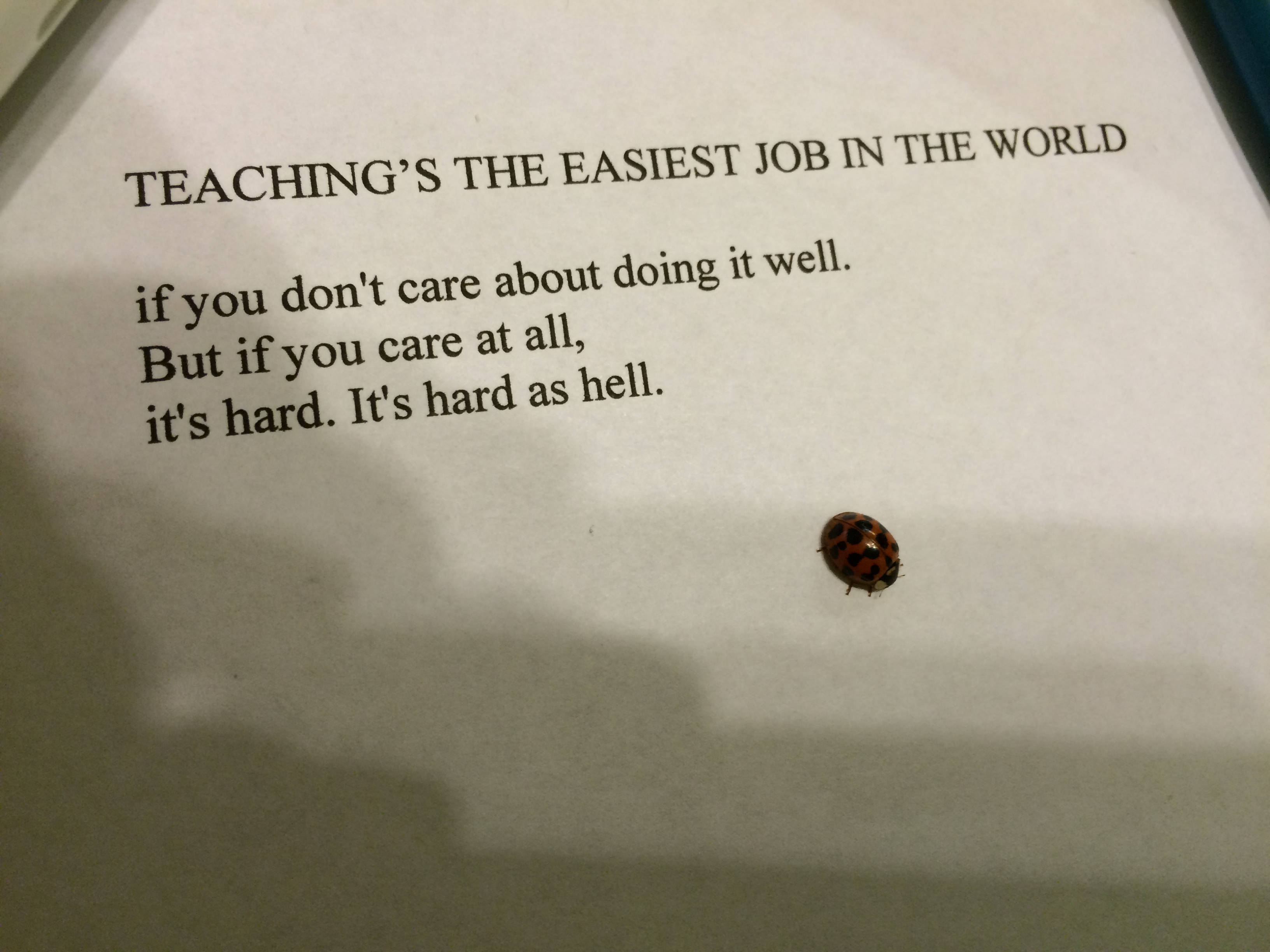
a little poem I wrote with big feelings

a little poem I wrote with big feelings

Beyond that, I’m setting some goals on the quality of feedback. I want to set the questions and good points from “The Power of Feedback” in front of myself as I start to communicate with students about their work, which I’m less than a week away from (classes start on Monday and the first assignments come in next Friday–sooner, since some students will want me to look at rough drafts, more than likely).

My plan is to report on my turned-in-returned rate after Week 5, or sooner, and I’ll also write more about this article & others I’ve found and will find.

Meanwhile–it’s back to finishing up syllabi & schedules for next week!


Deadline: Epiphany

“Traditionally it is bad luck to keep your Christmas Decorations up beyond Twelfth Night – the last of the 12 Days of Christmas.” Plymouth Herald

Some years I can’t wait for the tree
to come down. I want it up
the day after Thanksgiving and then
everything put away before New Year’s.

My friend Bellamy left hers up
through Valentine’s. Probably more than once.
A real tree—brown by the time
she got it out to the curb.

But this year I’ve wanted Christmas
to last a little longer, for the event
part of Advent not to be here quite yet.
I’m not sure why. I had good holidays,

a nearly perfect mix of quiet and fun.
Maybe that’s why. Of course that’s why.
I’ve brought out other candles to use
because it’s still dark so early in the day.

It’s still cold. I’m still longing
for something to happen and yet not
wanting anything to change.
Waiting for the wise gifts to come.

Just a few of the non-holiday candles I've dug out.  On a clean stove!

Just a few of the non-holiday candles I’ve dug out. On a clean stove!

(I actually also think one of the reasons I’m not ready to be done with the season is that I love, love, love Aimee Mann’s One More Drifter in the Snow. I’m not ready to stop listening to it. So I won’t.)

Gathering it up to put it away. NOTE THE HOLY BLATZ TRAY we use for the advent candles.

Gathering it up to put it away. NOTE THE HOLY BLATZ TRAY we use for the advent candles.

All the Ramones are dead and I am old.

All the Ramones are dead and I am old.
Can you guess which of those two items made the news?
My bottle rocket’s grounded, ashed over and cold,

not hot like when I aimed it at a friend,
both of us drunk, young wildness on the loose.
All the Ramones are dead and I am old

enough to have liked them before they were old,
when they were hot, when they were cool,
not like a bottle rocket on the ground, ashed over and cold,

but cool like benzodiazepines. All my bold
endeavors seem dangerous now. I’m blue.
All the Ramones are dead and I am old.

One time a friend dressed up as Joey Ramone,
but he looked like Emo Phillips, to tell the truth.
My bottle rocket’s grounded, ashed over and cold,

but I might have a little firepower left in my head.
I’m anxious to figure out what I can do
because the Ramones are dead and I am old,
with only a bottle rocket, ashed over and cold.

The Noble Gases (continued)

1
No wonder I can never remember all eight—
there are only six. I have a place mat
with the periodic table of the elements on it—
I guess it’s time to get it out again.
The ones I never forget are neon
and radon—bar signs and killers in the basement.
I usually remember Superman’s Achille’s heel,
thus krypton, and if I think of Jason, I might
think of Argonauts and thus argon, but
usually I don’t. Almost never will
I think of helium, the most famous one,
the silly voice, the birthday balloon,
the one that can overfill your lungs
and kill you, leeching all your oxygen.

2
There are so many things I can’t remember
all at once. Did I lock the door or not?
Trying to cover up for a name I forgot,
I always introduced myself to my friend’s mother.
I wanted her to say her name back to me.
She never did, but one time said through her teeth,
“I know who you are, god damn it.”
I know her name now, but she’s dead. I don’t need it.
I forget whole poems I’ve written. And other names,
of course, of people I ought to know, and students,
within weeks (or days) of turning in final grades.
I forgot how to start the Lord’s Prayer more than once.
My father’s early Alzheimer’s makes this shit
fraught so I try to console myself with lists.

3
The boys sat in the back, playing chess in their heads.
My friend Beckie and I decided we had too many plots
of Gilligan’s Island in our bright enough heads
to do what they did, several turns in before someone forgot
where some piece was and they argued and then they were done.
I rear-ended a Jeep that same trip, having forgotten
to keep far enough back, forgetting to count
one thousand one, one thousand—ouch.

The noble gases are noble because they’re inert,
unchanging, unlike those brains with the tangles and plaques.
And which noble gas is it inside a laser can fix your eyesight?
Which one makes the IMAX movies so bright?
It’s xenon, which, until a friend pointed it out,
I’d forgotten. I can never remember what all I lack.

With thanks to Max Garland,

and Beckie Hendrick,

and John Heasley (who did remember xenon)

photo (1)

How I Learned to Stop Worrying and Not-Hate Mother’s Day

Mother’s Day, Part 1: I Have Issues

“Rejoice with them that do rejoice, and weep
with them that weep” has been so hard for me
on Mother’s Day, just starting with myself
because I always felt both the yin and yang
of the day—deep gratitude for my amazing son
and mother and grandmother and so many others,
but not that by itself, because I also felt
trace elements of the grief from all the years
we were trying to get pregnant and could not.
Then so much hurt for the motherless, the ones
who never got pregnant who wanted to, the ones
who had mothers who hurt them or children who died.
And this word: miscarriage. Or this one: miscarriages.
And then so many who are childless by choice are told
so many times that choice is the one invalid one
of all our choices. And so I hated Mother’s Day
the first few years I was one and I still
would just as soon ignore it but I won’t.
_____

On Hating Mother’s Day (and other days)

I posted, on Facebook, for two or three years running, this diatribe against Mother’s Day by Anne Lamott. It always got such a strong response, positive and negative. The positive is relatively easy for me to understand and explain—there are a lot of us for whom Mother’s Day is not all sunshine brunch and flowers, for a lot of different reasons, and until Lamott’s piece, I don’t remember someone writing about “I hate Mother’s Day.”

In that, Mother’s Day is different from other holidays people tend to hate. Someone ambivalent about Christmas? Or angry about it? We might not agree, but we’ve seen repeated complaints about the commercialism of it, they way people who practice other faiths feel excluded, the way the war-on-Christmas-craziness asks us to pretend “happy holidays” is bad (when wishing someone a holy-day is pretty religious actually).

If someone were to write about being the adult child of an alcoholic and how Christmas was always tense when they were a child because maybe Dad would be drunk and abusive or maybe he’d just be gone, and either way, it was a relief when the day was over, we’d be sympathetic.

I think most of us are open to complaints about Christmas, even as we put up our tree and fa la la through the season.

Same with Valentine’s. If your romantic life is anything other than where you want it to be, this is probably not a great day, and we all get that.

Here are some holidays it would be harder to complain about and get general sympathy:

I imagine that if you’re a certain sort of conservative Christian who thinks demons are real, Halloween pretty much sucks. I also imagine that if you’re a pacifist, Veteran’s Day is difficult. Thanksgiving is all football and family and feasting, right? Unless you are a Native American. Or even if you’re just thinking about the way Native Americans might view the first Thanksgiving and what came pretty soon after.

In my experience Mother’s Day is more in this second group—just not something people are terribly open to hearing complaints about (especially from someone like me, with a living mother I adore, and a 9-year-old son who’s just awesome).

So that explains the positive responses—people who have ISSUES with Mother’s Day but have antipathy that dare not speak its name (a small version of saying “Voldemort” out loud).

And it explains some of the negative responses—people who just can’t imagine why someone could possibly hate such a lovely day that honors women who’ve blah blah blah.

The other negative responses have to do with the fact that Lamott is being pretty crabby and diatribey and not terribly logical (which she mostly never is, not terribly). My friend Jenny explains that well in her latest post.

She says Lamott’s  “vitriol is off-putting, and I disagree passionately with parts. By the end, I feel like I’ve been served what might have been a lovely soup were it not peppered with flies.”

Rejoicing With Them That Do Rejoice Or Not

“Rejoice with them that do rejoice, and weep with them that weep” is from Paul’s letter to the Romans. Ambivalent as I am about the man, I have to admit he just nailed it sometimes (am I remembering right that someone theorized he was short and ugly or did I just imagine that? I picture him that way, regardless).

Here’s why that verse is hard:

Times I’ve been unhappy with whatever portion of my life, I haven’t always done well rejoicing with those who were getting what I wanted but didn’t have.

And, I have to say, those who have so much aren’t always awesome about being sensitive to those who have less.

It’s not just a matter of holidays, either—it can be any random status update, or even that terrific practice of expressing gratitude regularly (some do it daily)—if someone’s expressing gratitude for something terrific, and I have something less than terrific, it’s hard not to snark inside my own head “well of course you’re grateful. I would be, too.”

I’m guilty of both sides of that—I don’t rejoice sometimes for those who are rejoicing.

And then sometimes when I’m rejoicing, I forget (entirely, utterly, blithely) to weep with those who weep. Or even that there are people weeping.

It’s something I’m trying to get better at, and I guess I’m writing this only to ask that we all remember both sides of Mother’s Day—that it’s wonderful and awful both.

Let’s weep with those who weep.

But also rejoice with those who rejoice.

(How can we do that all at once, every moment? I haven’t got a clue—for me it’s just the awareness and the attempt.)

_____

On Hating Mother’s Day Less

Meanwhile, I’ve realized that part of my own ISSUE with Mother’s Day stemmed from a long list of “shoulds.”

  • Since I struggled to get pregnant, but finally did, I should feel nothing but grateful on Mother’s Day.
  • Since my mother’s alive and wonderful, I should feel nothing but lucky on Mother’s Day.
  • Since my husband does laundry and dishes all the time, I should feel nothing but grateful on Mother’s Day.
  • Since my son routinely makes me laugh and smile, I should feel nothing but lucky on Mother’s Day.

Never mind that early May is always exhausting—the end of a semester, the end of an academic year.

Never mind that every role I love (mother, daughter, wife, sibling, aunt, cousin, gardener, professor, friend, writer, colleague, community member) is a role that also conflicts at least once every freaking day with every other role I love. Sometimes I feel like the guy in Too Many Hats when the monkeys start giving him shit.

I actually enjoyed Mother’s Day last year. As I remember, it was because I told people ahead of time precisely how I wanted to spend the day, and they let me do it the way I wanted, and I went into it with very low expectations—the first few years I think I wanted the day to look like a commercial put out by Hallmark if they sold both cards AND coffee—perky and happy and everyone smiling WHICH IS NOT EVER HOW THE DAY TURNED OUT.

(When my son was still in diapers, for example, he almost never wet through—I think we had to change sheets maybe twice his whole diaper-hood from a leaky diaper. But one of those times was EARLY Mother’s Day morning.)

So my plan is again to tell people precisely how I want to spend the day, and spend it that way, and acknowledge that I will likely feel lucky and grateful and exhausted and conflicted in varying measures and times through the day, the way I do most every day.

And I will be trying, on Mother’s Day and other days, to rejoice with them that do rejoice and weep with them that weep.

_____

Mother’s Day, Part 2: What I Want

To sleep a little later than I usually do.
To sit and watch my mother’s freckled hands
as they tremor just a little holding a cup
of coffee we’ve gone out for, just us two.
To snuggle with my son and watch TV.
To have someone else decide what we’re going to eat.
And then fix it or bring it or take me somewhere.
And then I want to go to bed and read.
And then I want the day to end. Amen.
 

_____
cropped-wr-tulip-gun-7509.jpg

Jesus Weasels and the Rusty Balloon

Those people who love Paul as much as Jesus—
shall we agree to call them the Paulines?
The schematics of sin, the counting of beans,
fault-finding, blame-placing weasels
not just ignoring the big guy’s red letters, but
also forgetting Shorty’s juicy bits
“Better to marry than burn” must have meant
the epistler burned like an old mattress,
like an oil lamp that never empties,
an abandoned refinery post-apocalypse.
But I get it, I really, really do. Without
a clear sense of rules, how the hell do you
know how to pop the rusty balloon
of anxiety in your chest, let alone actually pop it.

______

I wrote this sonnet in tweets, a couple of lines at a time, starting on Friday, finishing today. Made me look at the sonnet differently–I may try again sometime. Tweeting the lines makes me want to make them more stand-alone. Hm.

Desperate for Silliness (Be There Now)

And so I take these online quizzes all the time
I’m every awesome everyone except
when inexplicably I’m Reagan or a ham
cured by local artisans. These I accept:
I’m Sherlock and Muttley and living in Paris.

So long as I’m not me, not being where here is.

And now I see I’ve failed to impress
you in your social media seriousness
“be authentic” is your web address.

They are made of pathos, these straws I’m grabbing for.
I’m plunging down and down in shallow water
with you with me, ending up we don’t know where.

___
A good friend complained on the Book of Face yesterday that he was tired of seeing everyone’s Buzzfeed quiz results.

I sympathize totally in one way–as these things go on social media, I participated early on, got tired of it, went back when it caught my eye again, got tired of it again…. And it is interesting to me, and curious, how eager we all are to answer questions about ourselves online and see what a random quiz tells us about what character or place or random object is a good match.

But I can’t frown too hard in the direction of people who are still quizzing themselves relentlessly because they may well be tired of how often they’re notified that I’m playing Candy Crush (though I will say I try very, very hard not to inadvertently click on “invite your friends to play Candy Crush,” but the game sneaks that into its long list of “click to send this person extra moves,” which I’m happy to do if I know that person is actually playing Candy Crush. Unless they emerged from Level 181 sooner than I did in which case why do they need extra moves? Harrumph.)

Another friend said last week she wanted to see more of our own pictures, not silly pictures we were sharing that someone we didn’t even know had posted.

And yes, let’s do that–let’s share some more of our authentic selves with each other.

And yet, is there a spot on our social media that could be an authentic medium for authenticity?

These are lines I cut from the sonnet:

You could eat a salad at McDonald’s, true,
but once you’re there, honestly, why would you?

Paris by Rui Ornelas  on Flickr

Paris by Rui Ornelas
on Flickr

The Dream of Perennial Corn

1
Resource-hog sign of high summer,
high-fructose commodity seed,
short-term forest I missed sorely
in years Gran’daddy grew soybeans—

oh, corn.

Holding tight to cob-stabber handles,
letting butter invade where it will,
I demolish, row by row, kernel troops.
They leave behind mines in my teeth.

2
Fine people are already working
on sorghum and wheat
that don’t have to be plowed under,
replanted, cut down, plowed under,
and fertilized, fertilized, fertilized.

Much less practical is longing for perennial corn
but I do. I’m hot for it. Like August.
Imagine deep roots find Ogallala.
Acres jump up every year like bamboo.

We could wander and pluck at ripe goodness,
modern-day Eve, Adam, Abel, Cain.
There’s plenty enough for everyone.
More than enough for raccoons.

3
We probably won’t but we might
do the right thing, the right things
enough times in a row, enough rows
in a row, to harvest just once

without biting the hands that feed us,
without breaking our favorite jelly jar,
without zeroing out.

We might hold out our cup almost shyly
and blink, super-slow, as it fills up,
with sunshine, with sweetness, with juicy,

with corn.

___

You should check out The Land Institute if you don’t already know all about them. My husband and I have supported them for years, and in fact, my parents do, too.

(Apparently there are other people working on perennial crops, including corn, but it isn’t pretty yet. And I’m not familiar with this particular fellow.)

The Land Institute’s main site is here, and here’s an article from the Wall Street Journal which ends with a lovely little paragraph:

“‘We’ll get there,’ Mr. Jackson says, with the patient drawl of a plant breeder from Kansas. ‘But it is no instant gratification. We’re making considerable progress, but this is not for the conventional mind.'”

As always, I’m pleased not to have a conventional mind.

___
388108_10101425678827198_1617838374_n

Pedagogy Stew: October 2013

Picture an eighth-grade boy in the late 1970s. Sort of a cross between Richie Cunningham and Shaun Cassidy. Watch him as he jams a little nubbin of a pencil so far into an electric pencil sharpener that it runs continuously, leaving the not-too-bright teacher to puzzle over the mystery of it all.

Don’t worry about that boy. He’ll grow up to be an aeronautics engineer.

The teacher? He’ll get fired. He had so little control in the classroom, we looked like one of those inspiring hero-teacher movies BEFORE the hero shows up.

That’s the closest I ever came to being homeschooled, when this teacher was in the process of being fired. My Dad was on the school board, and when the teacher accused me of crying to my parents about how mean he was (I complained, but I don’t remember crying), they pulled me out of school. But it wasn’t really homeschooling. I just sat in a lawn chair in the corner of my Grandma Roane’s lawn (which was kitty-cornered to the school) and waved at everyone when they were at recess. Soon enough a hunky-hero teacher showed up and I went back to school.

I was lucky enough to spend an evening with many of my eighth grade friends in early August this past summer, and it was terrific seeing all these folks again. What we went through in grade school bonds us in deep ways.

We caught up on all kinds of things. We agreed the hunky-hero teacher still looks pretty great, thirty-plus years on.

We chose to get together this summer.

But the time we spent together back then wasn’t out of choice. Not ours, and not our parents’.

We went to school where we went to school because there wasn’t an alternative.

Since most of us were from staunch Baptist or Methodist or Pentecostal families, the Catholic school in the next town would never have seemed like an alternative, though it occurs to me now that it was.

I don’t think any of us had ever heard of homeschooling.

Homeschooling is but one of many, many alternatives now. School choice in Wisconsin means my husband and I can send our son to any local elementary school, including our choice, the Studio School, which is a public school/charter school/school within a school. Next year, there may be a STEM school (focusing on Science, Technology, Engineering and Mathematics) in Arena we could send him to. School vouchers in Wisconsin mean we could send him to a private school and get some state money for it (wait—really? That can’t be right. Maybe I dreamed that).

Our two main criteria for deciding how to school our son are these: is he happy? Is he learning?

I’m glad to have alternatives. I’m glad we get to have criteria beyond “if the teacher is horrible, we’ll try to get him fired.”

But it’s not just nostalgia when I miss the simplicity of how I went to school.

(This column originally appeared in Voice of the River Valley.)

Pedagogy Stew: July 2013

As I write this, my husband and son are in the living room, reading Harry Potter and the Half Blood Prince.  We’ve spent a lot of 2013 so far reading those books, just plowing through them.  (I almost said “burning through them,” but that sounds bad.) With summer here, the pace has increased, well, apace.

In one way, I’m jealous of my son. Remember how long we had to wait between each book? But in another way, I’m sad for him. How amazing it must have been to be a child when the first one came out, and then grow up with Harry, with a book coming along every year or so, just when you thought you couldn’t possibly wait any longer.

On the third hand, wow do I love to binge through TV and book series.

Late May and June were Maisie Dobbs weeks for me this year. I read all ten of Jacqueline Winspear’s mysteries featuring the “psychologist and investigator,” quickly, not exactly in order, but saving the 10th for last.

Leaving Everything Most Loved is in some ways a summary of the previous novels, mentioning their plots and characters, and serving as something of a “final accounting” for the whole series (though it doesn’t seem to be final—I’ve scoured the interwebs, and there’s no word of this being “THE LAST Maisie Dobbs novel.” Whew).

What is a “final accounting?”   Winspear defines it as what Maisie does as she makes “the essential visits to places and people encountered,” and calls it “a task that brought work on a particular investigation to a more settled close.” It’s more nuanced than our clichéd use of “closure.” When Maisie has wrapped up each case, she prepares a report for whomever hired her and then returns to locations crucial to solving whatever mystery there was.

It’s easy enough to end a semester as a professor by turning in grades, cleaning up my office, making a to do list for the summer, and no more.

But I’ve long tried to spend some time reflecting—what went well? Not so well? Why? And what can I do differently? I keep track of how promptly (or molasses-slowly) I return student work in an Excel spreadsheet, and I give students grading feedback on Excel, so I can run reports that way, too. Looking at the data for multiple years if sometimes almost a revelation.

This time, in addition to all the reflecting I typically do, I think I will visit each classroom I taught in, and my son’s classroom, where I volunteered, and see, like Maisie Dobbs, what each room has to say to me.

It also can’t hurt to think of all my semesters as mysteries, most of them solved (a few cold cases, I have to admit, still lingering).

What about you? What season has just ended for you? What case have you just solved? How will you do your final accounting?

(This column originally appeared in Voice of the River Valley.)