Category Archives: Pedagogy Stew

Pedagogy Stew #2

The following can be found in the February 2013 Voice of the River Valley.  The March edition is available online in the archives (I will post it when the April edition comes out).

I appreciate everyone’s feedback on the column when I’m out and about–glad to know it’s hitting the spot (at least for some folks!)

Any requests? I’m about done with the April column, but what should I write about next?

[And here’s a curious thing–I’ve just now realized I mentioned my bad handwriting in February’s column AND March’s. Both in the context of teaching–this time in terms of writing on the board, in March in context of commenting on student papers. So, two things:  I should perhaps re-read previous columns right before I send off the brand new ones, and 2)perhaps I need to write a whole blog post on the handwriting thing. Apparently it’s heavy on my mind.]

_____

Even though most college faculty no longer see themselves as “the sage on the stage,”

Look! A sage on the stage!

Look! A sage on the stage!

lecturing for full class periods, filling up the empty vessels of our students’ minds, the lecture-style classrooms we teach in are typically set up for someone to come in, and, sage-like, to stand at the front of the room and begin talking to students who sit with their desks facing forward. Now that a lot of us rely on PowerPoint slides for lectures (I like them because they keep me on track, and students can read them, unlike my handwriting, which is largely illegible—worst grade I ever got was a C in fourth grade for penmanship), even when we can move the desks around, we don’t, because we want students to keep their eyes on the slides.

I realized how attached I was to what I saw as the “default” setup for the basic humanities/social science college classroom last fall, when a fellow professor regularly had her students sitting in a circle—and often left the chairs in a circle when they left. I was annoyed at having to rearrange chairs, but I tried not to grumble—after all, “fusty don” is not the teaching persona I’m going for. (I do have students work in small groups in the course of most class periods, and 200-level classes more often have discussions in which they sit in a circle.)
I think my time volunteering at my son’s school makes me highly conscious of these matters. In a chapter from a book called Learning Spaces, Nancy Van Note Chism points out that “[s]pace can have a powerful impact on learning; we cannot overlook space in our attempts to accomplish our goals.” The teachers at the River Valley Elementary Studio School make an ongoing effort to support learning by shaping the space.
A couple of Saturdays ago, I went in to help one of the kindergarten teachers begin work on an igloo made of milk jugs. What lucky students! Lessons in physical science, social science, math, environmental conservation, creativity—all right there in their room in a way they can see and touch. My son’s teacher, that same Saturday, was rearranging furniture she’d brought in so that their classroom now has a living room. On a recent morning she met with students individually on the sofa, to go over their most recent reading test scores (while I worked with the rest of the class as they did individualized literacy work). In the afternoons, students read to themselves in the living room if they want.
Van Note Chism finishes her piece with this quote: “No longer can we assume that any old furniture and any old room arrangement will do—we know better. Like all academicians, we should ensure that current knowledge informs practice.” For a variety of reasons, professors tend to tolerate “any old,” but we could learn a lot from the emphasis K-12 teachers place on space.
—–
(Picture from flickr, Creative Commons. Tulane Public Relations, “student in class.”)

Getting the Pay Raise You Deserve, Part IV

Part of healing from burnout is learning to set boundaries. Making time for what’s important (yourself. family. friends. fun. community. yourself again) other than your work.

Easier said than done. Really easily said. “Set boundaries.” Unless you have a cute little hint of a lisp the way John F. Kennedy, Jr. had. Then it’s a little harder to say.

Pretty hard to do.

But those of us who’ve emerged from the Pretty Good Depression still employed find ourselves picking up the slack left behind when people were laid off, or  not replaced, or carrying a heavier load in terms of student enrollment, juggling new initiatives, etc. etc.

It is just so easy to do too much for too long and end up having your soul scrape up against your to do list like bone-on-bone-bad arthritis.

In the long run, as I mentioned to my boss’s boss’s boss last Valentine’s Day (ahem), a system that is structured to rely on people burning themselves out LIKE OURS is not sustainable. (It also doesn’t get the best work out of people, even in the relative short-run–but that’s the subject of yet another blog yet to be written. Stay tuned.)

For me, the urge  to work too much (and the actuality of working too much and the guilt of perhaps not working enough) mixes with my long-term tendencies toward depression and anxiety into a toxic burnout brew that makes me less of everything I want to be (loving, enthusiastic, effective) and more of everything I’d rather not be (chronically irritated, cynical, spastically ineffective).

I’m still learning, but I’m making progress.

If you click on “burnout” in my blog categories, you’ll see it’s something I write about a lot. (cf: fixate upon.)

In Getting the Pay Raise You Deserve, Parts I, II, and III,

I acknowledge:

It is all too easy to come across as whining, and something like “I had to spend an hour on the phone getting my insurance coverage worked out today” can come across as ingratitude, a classic First World Problem….it is a luxury to consider what changes we could make to improve our lot. But you know what? A lot of us in academia do have that luxury, especially those of us with tenure.

I assert:

You can raise your hourly wage by working fewer hours.

I celebrate myself, I sing myself:

I don’t work too hard. I work hard enough.

Here’s how good I am at setting boundaries.  I got folks pounding on one of the walls I built hollering at me  like they’re possessed by the spirit of Chico Marx: “You no work enough.”

Here’s the contested boundary of the month:

In response to Scott Walker’s 2011 budget bombs (which resulted in less take home pay for my family), I looked around to find ways to save money. We love Culver’s just as much as we always did, but we don’t go as much as we used to. INSERT LOTS AND LOTS OF OTHER EXAMPLES OF BUDGET TRIMMING HERE. And then, to save money on gas, I started working from Spring Green some Tuesdays (my teaching schedule is MWF). That enabled me to volunteer in my son’s classroom now and then. That turned into a regular gig. That turned into a commitment. Which turned into a column in the Voice of the River Valley.

I do a lot of work on Tuesdays, and I check email a lot during the day. I’m considering setting up virtual office hours to make sure students and advisees remember that I am available on Tuesdays, just not in person in my office on my campus. And as I mentioned in one of the three prior posts in this series, I average more than 40 hours a week during the 9-month contract. Since I try to take a week off between semesters, and two days off at Thanksgiving, and two or three days off during spring break, and maybe Labor Day if I’ve got my course syllabi ready, that means I typically average 45 hours during an actual teaching week.  (I don’t count how many hours I work in the summer, but it probably averages to about 20. )

I don’t see why it’s anyone’s beeswax, if I’m accessible to students, if I’m doing my job well (I have official recognition of that), and if I’m doing my share for service (and I do), WHY it matters how many of those hours are in my office or on campus or in my kitchen or at a coffee shop or wherever.

But there are people for whom dedication to campus life is measured in hours worked (more hours = more dedication) and hours on campus (more = more). I don’t agree. I hope the issue goes away. If it doesn’t–well, gracious. You won’t like me when I’m angry.

Take this one boundary skirmish as a warning, all ye who dare to dream of  work life balance. Sometimes when you set a boundary, you have to defend it. But a lot of times, people don’t even notice.

If you’re brave enough, if you’re tired enough, if you’re burned out enough, tune in next time when I share my Top List of Ways to Work Less. (Remember: if you’re on salary, you can raise your hourly wage by working fewer hours.  The hilarious irony is that the quality of your work will actually go up, and in some cases, the quantity too–because you have more energy to focus on the things you’re still doing. Shh. Don’t tell.)

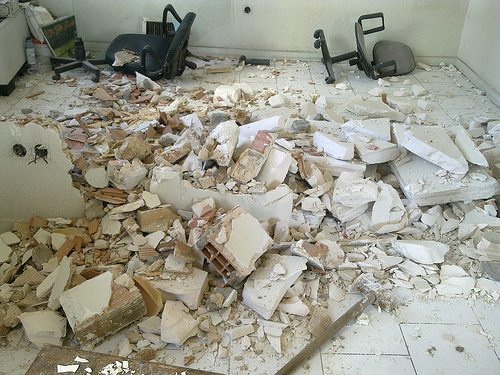
Meanwhile, Joshua blew the trumpet at Jericho and the walls came a-tumblin down.

This is what a system structured on burnout looks like. Eventually.

This is what a system structured on burnout looks like. Eventually.

_____

(photo from flickr, Creative Commons, by Babak Farrokhi, entitled “Office Under Construction.” So it’s not really about sustainable systems OR Jericho.)

Pedagogy Stew in Voice of the River Valley

In the category of New Year/New Adventure, this is my favorite so far. I’m very happy to have a column in the very cool regional publication, Voice of the River Valley. The tagline on the masthead says it pretty well: “A guide to people and events that inspire, educate, and enrich life in the River Valley area.”

That covers a lot because there IS a lot here–I’ve been here for more than twenty years, and I’m still amazed. There really does seem to be some kind of vortex that draws in interesting stuff, and I’ve never lived in a prettier place. (Sure, Missoula was gorgeous, but in a way that alarmed me the whole time I was there–I’d be driving and see MOUNTAIN in my rearview mirror and my Midwestern brain kept telling me “MASSIVE THUNDERHEAD.”)

The current publisher, Sara, is picking up nicely from the founder, Mary, and I’m happy to be a part. I’ll be posting monthly some “stewing” on pedagogy–what we teach, how we teach it, why, whether it works…. This column will typically be focused on the two ends of a spectrum I’m involved in, teaching at the college level and then volunteering at the River Valley Elementary Studio School where Wendell attends. Also, parenting involves a fair bit of educating….

The February issue is available in more than 100 locations around southwest Wisconsin, and also online. The January issue contained this piece, which I’m happy to reprint here (I’ll always wait to post one until the next issue is out–and I’m making almost no changes here, except to add links or correct minor things I meant to say differently.)

ALSO NOTE: I’m happy to take requests. What should I write about as I’m stewing over pedagogy that applies to both college and our public schools?

_____

Howard Gardner’s groundbreaking book, Frames of Mind: The Theory of Multiple Intelligences, came out in 1983, the year I graduated from high school. I saw no evidence of its existence in my college or graduate school courses—as an English major, I was supposed to demonstrate what I knew through exams and essays, and I did a pretty good job of it. In creative writing classes, I was supposed to experiment, but on the page, with regular ink. I did occasionally ask professors to assess my learning in ways they hadn’t announced in the syllabus. I once wrote a poem in response to John Betjeman’s “The Conversion of St. Paul” (better than anything I was writing in creative writing) and asked if the professor would grade it instead of the essay he’d assigned, which wasn’t going well. He was a sweet man and said yes, “But try harder to write an essay next time.”

It wasn’t until I’d been teaching full time for several years that I began to hear about multiple intelligences (or their close cousin, learning styles) from two directions: my university colleagues, typically with much derision; and students, some of whom were very aware of what they were good at and how they learned best. In fact, I’ve had several students over the years tell me they were kinesthetic learners and thus not good essay-writers, and could they have an alternate assignment? (For irony, see previous paragraph.)

I’m interested in how students learn, though, so I do not meet multiple intelligences and learning styles (and I know they’re not the same thing) with the same skepticism as many of my colleagues. Asking about this recently, one common response from my colleagues ran along the lines of, “Wasn’t that all debunked?”

In a 2009 article called “Matching Teaching Style to Learning Style May Not Help Students,” author David Glenn reported on research that shows that although students may have a preferred learning style, the crucial thing, in terms of learning, is whether the teacher has designed the class to best teach whatever concept or skill is currently on the docket. To me, this is the best match-up of theory and practice.

I volunteer a couple of hours a week in my son’s second-grade classroom at River Valley Elementary Studio School, usually during literacy time. His teacher, Nicole Steigenberger, has done a terrific job of setting up a variety of activities for students to choose from, and she nudges them, gently, over the course of a week, to read to themselves, to a partner, draw in response to written descriptions, write in response to pictures with prompts, write their own stories, etc. They also take online assessments periodically, and they get a few minutes just before lunch to do literacy apps on the iPad. These students are not only learning to read and write. They’re learning to learn and demonstrate their knowledge in a variety of ways, which, given the amount of learning they have ahead of them, is almost as important as learning to read and write.