Category Archives: Uncategorized

Pedagogy Stew: September 2013

My brain has a timekeeping section that operates like a not-very-creative grade school teacher’s bulletin board. There’s a snowflake for January and a heart for February and a kite for March. For September, of course, there’s a little red schoolhouse. Or perhaps a pencil, since almost no school looks like a little red schoolhouse any more.

I remember the one-room schoolhouse from my hometown primarily as a huge blaze—they burned it to give the volunteer fire department practice. No one had been a student there for more than thirty years. I started school in a red brick square that’s still being used as a school, but not for long. Taxpayers in my hometown passed a referendum to build a much bigger new school.

Back to school.

It’s an evocative phrase, isn’t it? See the bleary-eyed children—some of them not transitioning well at all from the summer sleeping schedule, some of them suffering so much from ragweed allergies they’re already longing for snow.  Listen to the bells and announcements and the roar of recess. Feel the amazing fast stops and starts and really particular squeaks of new gym shoes. Smell the glue. (Don’t tell me if you can taste the paste.)

O school supplies, how I love thee!

Even when we were homeschooling my son, we went out and bought school supplies at the end of summer. We accumulated such a stash, in fact, that I now scour the writing implement drawer for brand new pencils instead of buying them.

If you haven’t seen a school supply list for a while, they’ve changed some. For one, most schools (around here, anyway) put most supplies in big containers for everyone to use. When I buy a box of crayons, it’s not my son’s box to keep in his desk. The crayons get taken out of the box completely.

Each family is asked to contribute an absurdly high number of glue sticks. The burden of “who pays for this stuff” gets shifted more and more to families. I don’t look forward to the fees I’m hearing about from middle school and high school parents (of kids in public schools, mind you). Still, teachers end up buying a lot of supplies from their own pockets.

At the college level, at least on my campus, students are reminded to budget for their “printing account,” so they can print from campus printers during the semester. A lot of what we used to Xerox “for free” for students is now available online, and they have to print it themselves. It was never free, of course. It was paid for by departments out of “supplies and expenses” budgets that have shrunk in recent years.

Regardless of who pays for what, though, it’s the end of summer, the beginning of autumn, a time of harvest and bounty. The printing accounts are full, the pencils still have their original erasers, and there are reams upon reams of paper just waiting to see what our students have to say.

(This column appeared originally in Voice of the River Valley.)

Pedagogy Stew: August 2013

I’m headed to my 30th high school reunion this month, which causes me to reflect on many things, including my overwhelming urge to find a copy of The Preppy Handbook (pretty sure there were no Southern Illinois locations mentioned in it, also pretty sure I didn’t catch that it was satire when I got it for Christmas, circa 1981, along with some knock-off Topsiders and a belt with little ducks on it).

I was ranked 5th out of a graduating class of about 400. I remember that because I’d been tied for first until my junior year, when I flaked out and could muster only a B in Advanced Algebra/Trig, the same in Chemistry. This coincided with the onset of that whole “imagine this graph/molecule in 3-D inside your head,” which I pretty much totally sucked at.

But overall, those pretty-good-but-not-excellent marks were just further manifestation of my lifelong urge to avoid certain sorts of difficulty.  I’m drawn to some challenges, primarily those of my own devising. Stepping off the valedictorian track involved a rejection of mastering the challenges of classes someone else chose for me. I refused to take calculus my senior year, and as I remember it, my Dad called the man who would’ve taught it (who had taught algebra to my Dad at a local community college) and they grieved together.

I can’t help wondering what kind of challenge students anticipate when they sign up for a MOOC.

MOOC is short for Massively Open Online Course, and they’re all the rage in higher education. They are available online, usually for free, from some terrific universities and professors.

The good part is having free access to lectures, assignments, and tests from some superstar professors.

The bad part is, typically, having zero access to that professor, or to feedback that isn’t automated.

The good part is how easy it is to sign up and participate.

The bad part is the incredibly high dropout rate.

The good part is that a highly motivated student can learn a lot, for free.

The bad part is that a student who is motivated to avoid the challenge of sitting in a traditional college classroom, or taking what now seems like a “traditional” online college course…this student may not be up for the challenge of learning in a less structured, less obligation-driven environment.

In general, as a college student, I’d have crashed and burned in a MOOC, especially if I were taking it to speed through requirements I didn’t see the point of.

But what if taking a MOOC were my own idea? And not required?

It might be like my sophomore English class, at that point. I insisted on doing my book reports on the silliest books—a biography of Colonel Sanders and one I still remember the title of, Sherlock Bones—Pet Detective.  But I was reading Shakespeare’s Venus and Adonis and Kazantzakis’s The Last Temptation of Christ on my own. A challenge of my own devising.

(This column appeared originally in Voice of the River Valley.)

Pedagogy Stew: July 2013

As I write this, my husband and son are in the living room, reading Harry Potter and the Half Blood Prince.  We’ve spent a lot of 2013 so far reading those books, just plowing through them.  (I almost said “burning through them,” but that sounds bad.) With summer here, the pace has increased, well, apace.

In one way, I’m jealous of my son. Remember how long we had to wait between each book? But in another way, I’m sad for him. How amazing it must have been to be a child when the first one came out, and then grow up with Harry, with a book coming along every year or so, just when you thought you couldn’t possibly wait any longer.

On the third hand, wow do I love to binge through TV and book series.

Late May and June were Maisie Dobbs weeks for me this year. I read all ten of Jacqueline Winspear’s mysteries featuring the “psychologist and investigator,” quickly, not exactly in order, but saving the 10th for last.

Leaving Everything Most Loved is in some ways a summary of the previous novels, mentioning their plots and characters, and serving as something of a “final accounting” for the whole series (though it doesn’t seem to be final—I’ve scoured the interwebs, and there’s no word of this being “THE LAST Maisie Dobbs novel.” Whew).

What is a “final accounting?”   Winspear defines it as what Maisie does as she makes “the essential visits to places and people encountered,” and calls it “a task that brought work on a particular investigation to a more settled close.” It’s more nuanced than our clichéd use of “closure.” When Maisie has wrapped up each case, she prepares a report for whomever hired her and then returns to locations crucial to solving whatever mystery there was.

It’s easy enough to end a semester as a professor by turning in grades, cleaning up my office, making a to do list for the summer, and no more.

But I’ve long tried to spend some time reflecting—what went well? Not so well? Why? And what can I do differently? I keep track of how promptly (or molasses-slowly) I return student work in an Excel spreadsheet, and I give students grading feedback on Excel, so I can run reports that way, too. Looking at the data for multiple years if sometimes almost a revelation.

This time, in addition to all the reflecting I typically do, I think I will visit each classroom I taught in, and my son’s classroom, where I volunteered, and see, like Maisie Dobbs, what each room has to say to me.

It also can’t hurt to think of all my semesters as mysteries, most of them solved (a few cold cases, I have to admit, still lingering).

What about you? What season has just ended for you? What case have you just solved? How will you do your final accounting?

(This column originally appeared in Voice of the River Valley.)

Pedagogy Stew: June 2013

June’s a hot month for ceremonies—weddings and graduations all over the place.

I’m not so big on ceremonies.

When I got married, I eloped. I did attend my high school graduation and baccalaureate programs (skipping would never have occurred to me at the time), but I was thrilled to miss my own Bachelor’s Degree commencement at Southern Illinois University. My Mom was graduating the same day, and it would have taken major logistics to get to both ceremonies, so I said, “Let’s just all go to Mom’s!” We took a picture of me in her mortarboard.  Then for my M.A., and M.F.A., I just didn’t go.

But I tend to enjoy graduation at UW-Richland.

First, I like looking at the UW-Richland faculty and staff on graduation night, in all our robes and signifiers. “We clean up good,” as my Uncle Earle would have said. Also, we look just the tiniest bit like Hogwarts teachers on that night. (I call dibs on McGonagall.)

And then there is always at least one student who crosses the stage that makes the whole ceremony worthwhile.

After the 2012 ceremony, I asked one of our first-year students, Darryl, to do a pinky-swear with me that he’d be crossing the stage in 2013. 

I learned about pinky-swears from my son. They seem to be a mix of “let’s shake on it” and “cross my heart and hope to die.”  You hook pinky fingers and promise, and for my son, it’s nearly sacred. If he does one, I know he’s serious. This Bible verse comes to mind (from my favorite book of the Bible):  Ecclesiastes 5:5 “It is better not to make a vow, than to make one and not fulfill it.”

Darryl seemed to have the same attitude. He wouldn’t do a pinky swear with me last year.

But he did cross the stage this spring. You’d have noticed him if you’d been there (or if you stumbled across the video on cable access television). He’s hard to miss—tall, long dreadlocks, LARGE personality. I was so happy for him, personally, but even happier for other students following him. He is a leader, and more students will follow him, students who might not follow anyone else.

In last month’s “Pedagogy Stew,” I talked about how important it is for students to be able to tell their own stories to themselves. If they feel in control of their own narrative, they are more likely to tell stories about overcoming obstacles, rather than giving in.

There’s so much we don’t know when we look at a student. We don’t know where they are in their narrative arc. We don’t know what story they’re telling to themselves about the present moment, and whether “graduation” or “grade in this class” or “using spell check” shows up in the story at all.

I hope “education” is part of how their stories end happily. Or how their stories begin well. I promise I’ll keep working to make that happen. Pinky-swear.

 (This column originally appeared in Voice of the River Valley.)



The problem isn’t teachers.

for Heather, and so, so many more

The gritty nasty easy complaints take root
even when we try to weed them out.
The problem isn’t teachers. It isn’t you,

not if you’re teaching, it’s sure not.
We know what it’s all about
when gritty nasty easy complaints take root

in public discourse. Money is the root,
the square root, when we hear how
the problem is teachers. It isn’t you,

no, not you, rich man, you tell the truth
about those lazy public employees. Shout
those gritty nasty easy complaints! The root

is poverty, and unearned self-esteem, and too,
too much testing and less learning, but
the problem isn’t teachers. It isn’t you

my friend, my hero, my diligent compatriot.
Teaching well is about telling the truth.
Gritty nasty easy complaints may take root,
but the problem isn’t teachers. It isn’t you.

If I'd made one bale every semester I taught....

If I’d made one bale every semester I taught….

Doodling the Future

20131109-101928.jpg

Trying to doodle how I see my immediate future. It’s atop in this part of this morning’s doodle. Note its blankness.

20131109-101940.jpg

The middle is this semester’s “half-battical.” A little more room to breathe.

20131109-101951.jpg

Note the drop-off to DON’T KNOW? at the top of this rickety staircase.

20131109-102000.jpg

Self-portrait during half-battical.

20131109-103032.jpg

The bottom here is a normal semester. Not horrible, but really, too, too much.

Jesus H. Coulson

I have a copy of this somewhere. It was given to me approximately 30 years before I became a fangirl.

I have a copy of this somewhere. It was given to me approximately 30 years before I became a fangirl.

I’m not the first one to think about Phil Coulson as a Christ figure. You can Google it–Jimmy Kimmel said he might be Jesus or a zombie, and in response Clark Gregg made that half-sheepish/half-sly face he makes and said, “I look a little different, but it’s basically the same character….I believe Jesus has super powers.”

After The Avengers movie, even before we knew about “Agents of S.H.I.E.L.D.,one blogger was seeing Coulson as Jesus partly because of Nick Fury saying, “He died for us!”

But wait! There’s more!

5. He keeps putting together teams of disparate individuals to enact good in the world. He did it with the Avengers & he does it on Agents of Shield.

4. He answers to higher powers. We all know about Nick Fury, but apparently in the new Captain America, we get to meet Nick Fury’s boss, and he’s Robert Redford.  Now there’s a holy trinity.

3. He is VERY egalitarian about the role women play in his life. Ming-Na Wen(whom I’ve admired since she was on “As the World Turns” a million years ago) plays Agent May, and Coulson treats her with the utmost respect. (I know the official 12 disciples were guys, but Jesus had a great crew around him and let’s never ever forget that Mary Magdalene was the first who saw him post-resurrection.  The episode “FZZT,” Coulson and May have a really touching scene where she actually reaches out and touches his chest.  Lots of “sacred heart” image synchronicity there!)

2.He is forgiving.  In both “Eye Spy” and “FZZT” he takes the lead in forgiving an agent who has behaved badly.

1. The whole resurrection from the dead thing.

(NOTE:  Clark Gregg does not appear to be in either the new Thor movie or the new Captain America movie as Coulson–it apparently takes place during the post-resurrection period in which many of the Avengers do not know he’s alive– maybe both took place when he was in Tahiti.  Kind of like when Jesus descended to Hell to free the captives, which was so secret it’s in the Apostle’s Creed but harder to find in the Bible.)

This is mostly silliness, I know. I’m not trying to make the case that this is Marvel’s intent (although a bigger bunch of smarties is hard to come by) or that our lives are better thinking these things.  But it’s fun.

And I sort of wonder if Mr. Gregg his own self would enjoy the speculation.  In the special features section of the DVD of Choke (which he adapted from Chuck Palahnuik’s novel AND directed), they talk about a scene in which Sam Rockwell’s character talks to a stripper about whether Jesus was born good or learns how to become good through life, and she replies that Paul talks about that in Galatians. That’s apparently not in the book (which I haven’t read–it’s on my list, after seeing the movie).  It came from Gregg talking to his father, who was on the faculty of Stanford Divinity school.

The academic in me just beams at that.

I’m late to the whole Marvel-is-marvelous world, but I’m here now, and loving it, and Clark Gregg’s Phil Coulson is a humongous part of why.

I can’t not love the Cardinals

I will always be a St. Louis Cardinals fan, but I’m not as big a baseball fan as I used to be. Less time for television viewing. No cable television. No reliable free radio coverage until recently when I got a smart phone (we’ll see how next season goes).

And also, steroids.

I sometimes think the last 20 years should have a big, fat asterisk next to it. It’s hard for me to get swept away by a game when I think so many of the players are gaming the system. Thus, Albert Pujols with his bigness always made me nervous (though as far as I know, he’s not on the lists of “guys we’re pretty sure are juiced.”)

Plus I never liked Tony LaRussa’s hair. (And I never forgave him for the way George Will gave LaRussa credit for some of what Whitey Herzog did with the Cardinals.)

But I can’t not love the Cardinals, even when they’re stinking up the field the way they did Monday night against Boston. Once I start, I can’t stop watching this moment during which I am fairly certain Wainwright was jinxed.

But even if they hadn’t won last night (whoo hoo!), I’d still love them.

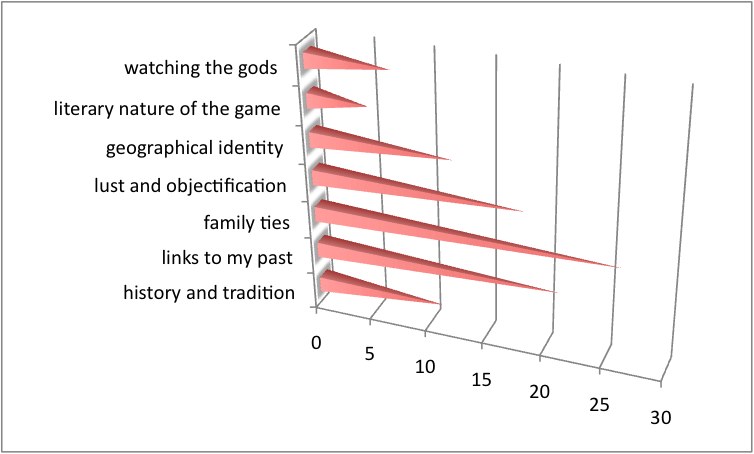
Basically, here’s why:

Seriously.

Seriously.

Watching the gods: these aren’t really normal people. We’re watching them do things we could not do.

Literary nature of the game: lots of people have written about this. It’s true. Bull Durham is my favorite movie, partly because of this.

Geographical identity: I don’t know when I’ll ever live in Southern Illinois again, but being a Cardinals fan is part of how I remind myself I’m from there.

Lust and objectification: Can I help it that I first REALLY noticed the Cardinals in 1982, when they won the Series, when I was 17, in the flush of my first waves of womanly hormone energy and girlfriends of mine pointed out things like “Tommy Herr has a great butt.” Objectification is bad, of course. But wow, are these guys fun to watch. Some more than others.

Family Ties: whatever else makes us different, the vast majority of my Southern Illinois family and I are Cardinals fans, and we can always share that. I love it that my Gran’daddy, who’s been gone for two years now, was a HUGE Yadier Molina fan. (I never told Gran’daddy my theories about Yadi waxing his eyebrows.)

Links to my past: I was such a huge fan in the late 80s. I remember sitting on the deck of one of many trailers I lived in while a grad student in Carbondale, listening to KMOX, drinking a Budweiser, sweating like crazy because birds had built a next in the a.c. and I didn’t want to bother them. I don’t want to ever forget that part of myself.

History and tradition: I never got to see Stan Musial or Lou Brock play, but I have a #6 cap and I would love, love, love to own a Brock-a-brella. St. Louis has been so dominant the last few years, it almost seems it’s cool now to hate them (NOTE:  they were NOT dominant in the late 80s and early 90s when I spent the most time actively following them), but it’s an awesome club with a rich tradition and I’m so, so happy to see them relying on their farm clubs again.

I tend to cheer for the underdogs, nonetheless. I would love to see the Cubs dominate, head to the World Series and win, win, win.  The last time the Brewers were threatening, I actually cheered for them against the Cards in the playoffs. I didn’t really mind when Boston won in 2004 (but I do feel like it’s our turn now, regardless of the arguments made by the Red Sox fan I’m married to).

But when it comes down to it, if the Cards are playing, I’m on their side. I can’t not love them.

Girls, Girls, Keep Watch

Hanging out with the gargoyles at 3 a.m.,
the demon dogs, the dragon cats,
astride the roof of my brain.

Girls, girls, keep watch for me,
scare the bad buys off, don’t wake me up
with lists of all my ineptnesses.

In the morning, when you sleep,
I promise I’ll attack myself.
I always do. Meanwhile, do the job
I made you for, dreamcatchers,
stone oracles, armed guards at the door.

Spiraling: Writing the Unthinkable

20131005-192623.jpg

Lynda Barry had us draw spirals today.

I got to do a workshop with her in her Image Lab at the Wisconsin Institutes for Discovery, where she is a (jolly good) fellow. It was a writing workshop, but we drew a little. We spiraled.

20131005-192636.jpg

When we were getting ready to write, or when we were listening to someone else read, we drew spirals.


20131005-192643.jpg

We were supposed to draw it as tight and close as we could without having the lines touch. I got too big on this one and it turned into a labyrinth.


20131005-192651.jpg

Sometimes I closed my eyes and drew.


20131005-192658.jpg

Here’s more of the labyrinth.


20131005-192707.jpg

Eyes closed for a bit.

I like how these pics look a little spooky. I went to scary places today, and I even wrote a ghost story.