Category Archives: Uncategorized

Speakeasy Love Hard: One Year On

David working with Nate.

These pictures were taken a year ago today at the Sh*tty Barn, when David Daniel did a terrific job directing these fine actors.

They brought to life the poems called “Speakeasy Love Hard.” One year on, and I haven’t moved the project forward (it was a busy, busy year).  I will move that project forward at some point.  My husband recorded it at the time; maybe if I get to listen to it, I’ll know what comes next.

In the meantime, I’m working on a different play, and enjoying sweet, sweet memories of that night a year ago.

Sarah reacting to Nate singing.

Ashleigh’s sweet smile.

Nate reading “Mobius Strip of a Man.”

Gentlemen in the Rain, Women in the Sun

How fitting that a play highlighting Proteus
would play on a day with various weathers,
rainy and warm then steamy and warm then pouring and warm
then breezy and cool then cool and calm then warm and calm
with the sun changing clouds into haze and then,
when Sylvia crossed the threshold from backstage,
that moment, I would swear it, did the sun
come out, full on,  and turn her blonde hair into blazing
waves of light. I still can’t see, can’t comprehend
why Valentine forgives his awful friend,
why Sylvia forgives her Valentine
for giving her to an inconstant man.
The woman seeming pitiful I get.
The man offending everyone I get.
I choose to see the Bard as having gaps,
not my heart not my brain with this big lapse.

_____


Every Thursday this semester I’m trying to do at least one big thing that reminds me I’m teaching only two courses, and have been allowed the grace and space to spend 20 hours a week on my creativity research.


Waiting for Two Gentlemen of Verona to start this morning, I was able to touch base with one of the many wonderful folks at APT who do their work offstage—at some point this fall, I’ll be doing some interviews about creativity (and especially, ironically, when they try NOT to be creative).


But it was the play itself I was most focused on today.


After all—why research creativity without enjoying the fruits of creativity that my fine little town has to offer?


Nice job, everyone—very nice to see Marcus Truschinski in another leading role, and Travis Knight right there with him (and very fun watching the high school girls at the matinee get all swoony).  I think no one does fragility mixed with strength the way Susan Shunk does—it’s like glass and steel all curving around each other. Nice job, Steve Haggard as Launce, and Will Mobley as Speed, using their terrific comic timing to sharpen the focus of the students who were, for the MOST part, dealing admirably with the distractions of rain and wind and then bright sun and heat.


And I swear, the sun really did come out right at the moment Abbey Siegworth stepped onstage in her tower.


This isn’t my favorite Shakespeare play by any stretch, but I’ve seen APT do it well two times now, and seeing it today gave me fond and bittersweet memories of the last time.  Then, it seemed to me and my friend Lee (may she rest in peace), the director emphasized every possible bit of homo-eroticism in the play (which made Valentine’s actions a little more understandable, if he’s as in love with Proteus as Julia is)

“That was hot,” Lee said to me when we chatted in the aisle right after a performance one night. As I remember it, I could only nod yes.

*


“September was again September”

Time sometimes seems more like a spiral than a cycle for me. It’s a funnel, spreading up and out, looping over months and seasons from farther and farther away.

Some years are just fucking tornadoes. Just a nice breeze today, though.

I’m very far away from my earliest Septembers, when I slogged through school in a Children’s Allerest fog.  But I’m peering straight down at them from this one, as we try to find the right antihistamine for my son. He doesn’t want chewables anymore, but unless the pill is coated, he has trouble swallowing it quickly…._____

I’ve just finished An Excellent Mystery by Ellis Peters.  I love to reread the Brother Cadfael mysteries seasonally, but there aren’t many for August or September.  The book ends with this:

“September was again September, mellowed and fruitful after the summer heat and drought. Much of the abundant weight of fruit had fallen unplumped by reason of the dryness, but even so there would still be harvest enough for thanksgiving. After every extreme the seasons righted themselves, and won back the half at least of what was lost. So might the seasons of men right themselves, with a little help by way of rain from heaven.”

It seems so hopeful to say so. And wise, if it’s true.

Which seems like a pretty big “if” to me, living in a time of violent people and violent weather.

It is Brother Cadfael himself, peacefully surveying his fruit trees, thinking these final September thoughts.

And one of the reasons I love that character, it occurs to me, is that his hopefulness is tempered by his use of “might” in that last sentence. So it seems more like wisdom, after all.

Our own pears.

Our own pears.

Half-battical and How

My son used to scare me when I got home from work by leaping out of the foxhole he’d dug in our yard. I miss those days, though I’m glad to say we filled in the foxhole before anyone broke any bones stepping in it inadvertently (nominee for person most likely to have done  that = me).

I miss the days when he dug tunnels and canals and poured water all over. A filthy, dirty, muddy, mucky kid–that’s the mark of a good summer day in my book.

So when I tell you that I feel as though I’m now sitting in a hole in my backyard that I dug over the last year or two–not big enough to stand up in, just big enough to sit in–you should understand a few things.

1. I had a lot of help digging this hole.

2. It isn’t muddy because we haven’t had much rain AT ALL lately.

3. I’m actually sitting inside my kitchen as I’m writing this.

4. It wasn’t easy, digging this hole, but I’m very happy right now, sitting in it.

I could have, a year ago, or two years ago, or three years ago, applied for traditional funding for a sabbatical, and because I have a good project and because I write good proposals, I probably could be on a fully funded sabbatical this semester, teaching zero classes.  The UW Colleges doesn’t have enough funding to fund very many sabbaticals, but it still funds a few (three this semester), and if you take one semester instead of a year, you get your full salary and benefits.

I took a full year ten years ago, traditionally funded. My husband and I figured out how to make the 35% pay cut work. It worked.

This time, for a variety of reasons, the traditional funding route did not appeal to me at all. (As I’m spending my MWF on campus teaching two classes, I continue to reflect on WHY that did not appeal to me at all.  Will probably write about it soon.)

Instead, I chose the route of trying to raise my replacement costs. I’d hoped to raise around $24,000 before July 1 of this year, and if I had, I’d be teaching zero classes this fall.

It turns out there are parts of fundraising and being a grant-hound I’m good at, and then other parts, not so much.

I think this is symbolic of something.

I think this is symbolic of something.


But with a lot of help,  I made it halfway, and I count myself lucky to be in a place where my dean agreed that the money I’d raised could “buy me out of” two of the classes I would normally teach, and where my business office geniuses figured out the logistics.

Teaching zero classes for a semester would be a terrific break and give me ample time for my project.

But teaching two classes instead of four is lovely. And it gives me a good chunk of time.

So, for example, today I get to go have lunch with a friend and talk to her about what kind of creativity workshop she might benefit from.

That’s my project–designing creativity workshops for businesses, organizations, and individuals.  Right now, I’m in the surveying/needs assessment phase.

At the end of my half-battical (because I made it  halfway, get it?), I’ll be ready to work with people to help them become more creative in measurable, useful, and wonderful ways.

Thus all my funders, all the people who helped me dig this hole–thank you.

One example I will have, henceforth, of BEING creative is the fundraising I’ve done, which is, of course, one of the big reasons I was so drawn to the idea of doing it.

Today’s creativity reading (I’m trying to get caught up on all the web pages, blogs, articles, and books I’ve put on my reading list) is “Twelve Things You Were Not Taught About Creative Thinking in School.”    Several of them seem relevant to what I went through as I was fundraising–#2 “creative thinking is work” (yes, exhausting–I sort of collapsed from it in early July). #7 “expect the experts to be negative” was truer than I expected. I had a ton of support, but there are people who JUST DIDN’T GET IT, why I was not drawn at all to seeking traditional sabbatical funding.  #8 “trust your instincts” is what I was doing, what I’m still doing. I don’t really understand all of why my gut was telling me LOUDLY to raise my own funds, but I listened.

#9 “There is no such thing as failure” is a comfort to me, as I tell myself that halfway is terrific. It doesn’t feel like failure, having cobbled together the $11,534 needed to replace me in the classroom.

And finally for today, #10, “You do not see things as they are; you see them as you are.”

And right now, I see myself blissed out in a hole in my own backyard.

This is symbolic of how awesome my yard is.

This is symbolic of how awesome my yard is.

Other Ways I am a Bad Person

High on the snark and humor index, low on the logic and evidence, Allison Benedikt’s “If You Send Your Kid to Private School, You Are a Bad Person” made the rounds on my Facebook newsfeed last week. One person sort of apologized for the provocative title, but the whole piece is provocative, really.  The essence is that public schools are good for the common good and thus we should all be connected to public schools so closely that we work to make them better. That’s a valid argument, one my Aunt Becky has made for as long as I can remember, but in Benedikt’s hands, sentences like this:  “chances are that your spawn will be perfectly fine at a crappy public school,” make me wonder what the target and purpose really were.

Friends who posted it seemed to be taking it seriously. In the event it was in any way intended seriously, let me say the following.

I believe in public education. I am against voucher schools. I vote for people who want to fund education and don’t want tax dollars going to private schools.

At the moment, my son goes to a public school, and I volunteer there.

But if, on balance, I decide there’s a better match for him elsewhere, he’s outta there. We won’t make that decision impulsively or quickly or blithely, but when we stopped homeschooling him, and sent him to public school, we told him (and ourselves) that what mattered was whether he was learning and whether he was happy….That’s still what matters, as far as I’m concerned.

I don’t care if that makes me a bad person. Bad citizen. Don’t care. It makes me a good mother, and I care much, much more about that.  Besides, if he’s happy, and reaching anywhere close to his full potential, the world will be better off.

Here are some other ways I’m a bad person.

1. I spend more per week on my food budget than I would if I were on food stamps. I guess if I really cared about the state of nutrition for our working and nonworking poor, I would eat a lot more beans and advocate more on behalf of the poor. I could share recipes with Allison Benedikt, who, I’m sure, cares as much about this government function as she cares about public schools.

Beans

2. If I get arrested and have to go to trial, I will corral all my finances for the best lawyer I can afford. I suppose if I weren’t such a bad person, I would rely on the public defender, who’s likely overstretched.  Sitting in jail, I’d have a lot of time to advocate for better justice for people who can’t afford lawyers. Maybe my cellie would be Allison (no last names needed, if we’re on the same cell block), and we could co-author articles.

3. My salary as a UW System professor isn’t stellar, but I have pretty good benefits, so I get pretty good health care. If I weren’t such a bad person, I would limit myself to what someone without insurance could access with help from state or federal programs, but there you have it.

I also buy books and movies that are not available through my public library system, and am pickier about what seafood I eat than the FDA would indicate is necessary.

Just a bad person, through and through.

_____

Couldn’t we all just encourage each other to contribute to our communities in public and private ways as best we can to make everything better for everyone?

_____

If Allison Benedikt’s purpose was to convince me to keep my son in public school from here on out, it didn’t work. If her purpose was to make me feel bad for homeschooling him for his kindergarten year, it didn’t work. Make me feel bad for keeping homeschooling open as an option in the future? Didn’t work.

If her purpose was to give a snarky huzzah to parents who keep their kids in public schools partly out of a sense of “the greater good,” it may have worked.

But since the only evidence she presented was a well-written bit of autobiography, I suspect the purpose was to be a writer and express herself and get some attention, and I would say that worked.

Follow up a provocative title with a provocative column and provoke?  It worked on me, anyhow.

Join the Robbie Alliance!

Since I am, by my genes and by long habit, a worst-case scenario thinker, I have spent a fair bit of my child’s life (beginning when he was still in my belly) worrying  about every little thing that could go wrong.

I am trying to do less of this, this refusal to enjoy what’s going well TOO much.

Brené Brown calls it “foreboding joy” and explains it this way: “We’re trying to beat vulnerability to the punch. We don’t want to be blindsided by hurt. We don’t want to be caught off-guard, so we literally practice being devastated.”

At some point in my pregnancy, I stopped looking at the scary chapters in What to Expect. I was pregnant, after all, after finally accepting that I would not ever get pregnant, and I wanted to enjoy it.  And I did.

However, the revving up of the school year revs up a particular anxiety for me–how to help my son navigate a world that seems full of peas, peanuts,tree nuts, eggs, dairy products and sesame, all of which he is allergic to, in varying degrees.

All in all, it’ll be fine. I’m meeting with the school nurse tomorrow. I’m checking to make sure his epi pens are not expired. I may write a letter to parents of kids in his class. For me, this has to go in the category of Bad Things That Could Happen to my Kid Which I Need to Prepare for and Then Forget About.

I’m not blase about it, but it doesn’t fill my thoughts every day, so in the realm of Bad Things That Could Happen, it has way less suckitude than other things.  I need to stop reminding myself how scary he looked the one time he went into anaphylactic shock. I have to remember to take epi pens with us, and I have to read and re-read labels, but it isn’t constant vigilance.

My friends Beth and Mat, however much they are able to be joyful (and they are, actually, a VERY joyful family, way better at it than my own family), do have to practice constant vigilance because their son Robbie, the same age as my son, has Juvenile Diabetes. Here’s what Beth had to say about it today on Facebook:

I’ve been trying to limit my type 1 diabetes-related posts so that you all don’t get tired of hearing me talk about it. But know that T1D never gets tired of imposing itself on our lives. Every day we take it on and it affects everyone in the family, though obviously Robbie most of all. Just last night we had ice cream before bed and a bit later R’s blood sugar was super high. We went to sleep thinking that maybe the insulin was slow taking effect since we treated him afterwards. Then an hour or so later I woke up with a jolt and realized we’d never actually treated him. We gave him his insulin, but he continued to be high the rest of the night. I invite you to pick a day and pick a child (or yourself) and imagine having to account for every bite of food that enters the body. Imagine trying to calculate how exercise affects the blood sugar – running around a lot? Less than usual? Going swimming? Imagine calculating how excitement or nerves impacts the blood sugar level too. Imagine watching your child as he lives his life, always wondering in the back of your mind if he’s going low, risking a seizure or going high and risking all the scary long term complications. Every day is a new battle. We hang tough and the terrain grows familiar, but we pray for a cure daily. That’s why we support JDRF.

What a life motto: “we hang tough and the terrain grows familiar, but we pray for a cure daily.”

That’s so different from my worst-case-scenario worry-wart-ism. It’s almost its opposite. It’s dealing with reality and still figuring out how to enjoy ice cream when you can.

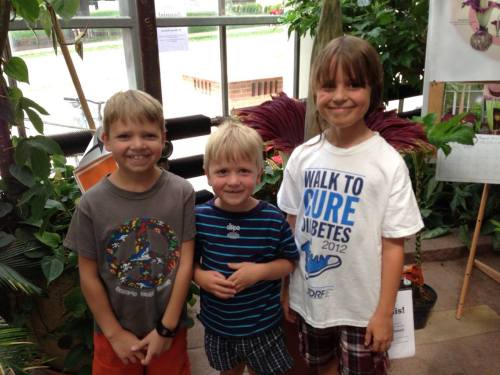
Look at their amazing boys–

Great kids! That's Robbie on the left, with the peace shirt.

Great kids! That’s Robbie on the left, with the peace shirt.

We don’t get to see this great family much any more, but in honor of how awesome they are, and what a great cause this is, I’ve contributed to the Juvenile Diabetes Research Foundation.

You can contribute to, through the Robbie Alliance. I know we can’t all say yes to all the good causes we’d like to contribute to, but I hope you can help this organization, this family, and this really terrific kid.

And also, they have a terrific logo:

robbiealliance

_____

This post is partially a thank you and a perk from my Indiegogo campaign, which I called “a shout out on my blog.”

I like to think it would have occurred to me to promote this very good cause even if Beth hadn’t contributed to my fundraiser, but it didn’t occur to me last year, even when I made a contribution to the JDRF. I am so slow sometimes….

WTF Wisconsin

Well, o.k., I’ll admit it. I haven’t gotten too riled up about the Solidarity Singers getting arrested.  Sorry.

I mean–I did mention it at my 30th high school reunion over the weekend, that they were arresting old people in my state, but I’m pretty sure I shrugged my shoulders at some point each time I mentioned it.

Partly it’s me tending my own emotional acre–I’ve sort of made a rule for myself, in an ongoing attempt to be more sane, that if I don’t have time to DO SOMETHING about a particular issue, I can give myself a free pass not reading about it/getting worked up about it.

(NOTE: I see this disengagement as a temporary state. When I feel healthier, when I feel as though my own emotional acre is well-tended, I will peek farther again. When I have maintained my house for a few months of NOT feeling as though I were half a matchbook collection away from being an episode of Hoarders, I will re-engage.  Hell–maybe I’m there now, because….)

Wow am I pissed about Matt Rothschild getting arrested today.

It’s not that I was ever against the Solidarity Singers. I sang with them a couple times. I was proud to sing with them standing next to Margaret Rozga, now famous for speaking truth to power at  an MLK, Jr. event.

I think maybe I was just tired of protest. Spring 2011, Wisconsin’s Arab-esque spring, was wonderful and horrible. I took my son to march–he made a sign that had pictures of cats on it that said, “Hey Hey Meow Meow Walker Talk to Unions Now.”

I overcame my one bit of introversion–I don’t like to knock on people’s doors to ask them about politics (or Jesus, for that matter)–and gathered some signatures for the Recall.

But when the Recall failed, I just felt politically wiped out.  Tom Barrett? Really? Seems like a nice guy, but really? That’s all we could muster on behalf of half a million signatures?

So like a lot of other people, I’ve just hunkered down & tried to do my job and love my family and maybe just maybe work on de-cluttering my house in case I decide there’s a state I can move to where all this won’t happen. (Where is that? Vermont?)

And at first, when the not-cool, not Tubbs-cops, started arresting singers, I will admit that I was thinking “just apply for a permit already.” But here’s the thing. I really think if there were a group of people showing up every day at noon to sing songs in praise of Scott Walker, the Wisconsin Department of Administration would never have made the policy about requiring permits in the first place.

And after a few weeks of this, I’ve decided I agree–this is political speech set to music. If we have freedom of speech, if we want to honor the proud Wisconsin tradition of honoring dissent, then permits shouldn’t be required for protests in the Capitol Rotunda.

I’ll admit one other thing–I’ve been wondering if all my liberal friends who are outraged about this would be equally supportive if a pro-life protesters were to go to the Capitol (if we ever have a pro-choice governor again), and sing “Jesus Loves the Little Children” and hold up signs of dead babies. (That may not be equivalent, but it would all fall under the category of political speech, and now that I’m getting worked up, I’ll just go ahead and throw my wondering out there.)

But today–arresting a journalist for observing and calling it “obstruction?” I’m so angry and scared I can’t muster disengagement.

And yet, I don’t know what to do. Go to the Capitol and observe? Protest? Sing? Get arrested? I really don’t have time. I would totally have a panic attack. And what would that help?

I don’t know what to do, but I know what I need. Or at least what I wish for.

1. Examples of liberals supporting conservative speech at the Capitol, especially that which made them feel icky.

2. Famous people to come and sing and get arrested. Lots of folks are tweeting in support. That’s pretty much nothing. Even I’m doing that.

3. Famous journalists to come and observe and get arrested. I mean–I know who Matthew Rothschild is, but more people know who Jon Stewart is.  Isn’t that sabbatical of his about over?

4. I really need someone amazing to run against Walker in 2014. I don’t know if he could do it, but I’m most excited about Mahlon Mitchell.

5. Mostly I need someone to tell me what I might do to make any of this better. (I’ll ask Dale Schultz next time I see him in Richland Center.) Other than just being pissed and scared and feeling icky, I mean. Because I’m already doing that.


_____

Update:  a friend reminds me that when Doyle was governor, pro-life protestors were on the square frequently, and we’re assuming they didn’t have to get a permit.

2013 Wisconsin Professor Mindset List

On August 20, Beloit College will do what it’s been doing since 1998 and release the Mindset List for incoming college freshman. These lists are fun, especially if you don’t look every single year. So, for example, last year’s #20 “Exposed bra straps have always been a fashion statement, not a wardrobe malfunction to be corrected quietly by well-meaning friends,” amused me. I think about bras straps now and then. Other deep things I think about include trying to figure out when we’ll all decide shirts need to be shorter than the jackets they are worn under, or at least tucked in. I hope someone tells me when this happens. It took me a while to notice it was o.k. to have a shirt hanging out below a jacket.

This list is written in the spirit of “young folks live in a different world,” and to the extent that professors are old folks who are out of it, and a little more out of it each year, I think the list is helpful.

But honestly, if you’re the sort of professor who hasn’t noticed that students get their music in digital format now, a glance at this list won’t help much. And going overboard with the impression that “they often listen to it on their laptops or replace it with music downloaded onto their MP3s and iPods” (last year’s #15) might make  us miss out on an awesome opportunity to talk about the deep pleasure of listening to music on vinyl, a pretty big trend among youngsters at the moment (maybe that will be on this year’s list).

Dana Falconberry, who looks almost old enough to drink legally, had an awesome show at the Sh*tty Barn last night. She sells her song in CD, MP3 and LP format.

It turns out that spending time with young people is a really good way to learn about their mindset.

I was terribly impressed with Dana Falconberry, for example. Not only was the music awesome, her gratitude was really shiny and sweet to see. She said repeatedly how honored she was to play music in a venue where people were listening. Sitting in their chairs and listening. And totally engaged. She thanked Chris and Martha, the owners of the Sh*tty Barn, repeatedly, and followed up one of her compliments with “especially considering the state of the music industry right now.”

So, yes, I have to have it in my heart to reach out to students this fall who truly, truly, love Justin Bieber. But they don’t all love Justin Bieber (mentioned in last year’s #1).

I will check out the list when it comes out next week, remembering that it is written by guys who are older than me, who seem to be nostalgic about a world that was already gone when I started college in 1983.

Meanwhile, although I am utterly unqualified to write a list about anyone’s mindset but my own, I thought it might be fun to try to list some things that are true of me and at least one other professor (how’s that for a high standard in statistics and the logic of generalization?) I’m not the first professor to have done this–professors doing their own mindset lists may become as much of an August tradition as people passing around the Beloit list, which contains 75 items.

I don’t have the attention span or time for that many. I’m sure the fact that Sesame Street came on the air when I was four (and I thought for a while it was JUST FOR ME and was upset when I found out other kids had it in their houses, too) has something to do with my relatively recently diagnosed ADHD, the existence of which I’m sure was bemoaned in an earlier list.

1. If you’re a traditional age student, I have been teaching since before you were born.

2. If you’re a non-traditional student, first of all, you are my favorite kind of student. Seriously. Second, I am assuming you’ve been doing a lot of interesting things other than getting a college degree, and I’m looking forward to hearing about them.

3. Even though I did less of what I call “work-work” this summer than I usually do, I didn’t “have the summer off.” I did some work I got paid for (evaluating student writing samples for composition class placement) and some writing and research and class prep (which I consider “pro bono,” since I didn’t get paid for those).

4. You should know I am open to questions and complaints. This will become clear as the semester proceeds. (Or you’ll find out that I like to see myself as open but am really a bitch–I don’t think that’s true, but it’s within the realm of what’s possible. I ask for student feedback A LOT, in a variety of ways, including anonymous surveys, so I feel certain someone would have told me by now if I were pretending to be open but not really open.)

5. Even though I’m open to questions and complaints, I don’t get all happy hearing the “I paid for this class so I should be able to do what I want” argument, also known as the “student as consumer” model.

Let me assure all students and parents contributing to my students’ education (tuition now covers almost half of what it costs to run my institution–it used to be a third), and the good taxpayers of Wisconsin (state support for higher education is dwindling, but it’s still there), and taxpayers all over the country (federal financial aid, etc.) that I am determined to give good bang for the buck in and out of my classroom.

I am a well-published, award-winning, full professor in my 26th year of teaching at the college level. Moreover, I am working to improve. All the time. Every year. Every semester, actually.

But students aren’t really consumers. Even if a student of mine is paying 100% of her or his own tuition (which is rare), that isn’t half of what it costs to educate that one student. (And in a classroom of 24, it’s 1/2 of 1/24th.)

So if we stick with the consumer model, then the consumers are the ones who pay the most, and in that case, the student is a product.

Fortunately for all of us, I don’t like the consumer model much at all.

I’m getting paid a good salary to do an important job, and I’m on it. I got this.

6. However, you should also know that I don’t respond well to the “You should be available to me 24 hours a day since you make $80,000 a year” argument. Like a lot of professors my age (I’m 48), I am in the sandwich generation.  I have a son who’s eight and a half, and parents whose doctor appointments I track on Google calendar–not because I have to take them to the doctor every time, but because that’s just what they do a lot of during the week, and I’m close to my parents. I’m also married to a pretty terrific guy.

Thus, because of all my important and socially acceptable obligations, I simply cannot be available 24/7.  But honestly?  I’m not even trying.

I spend a fair bit of time on things that are only important in the sense that it’s important to enjoy life.

I just don’t think my (relatively) good salary means I should be available to students 24/7.  This applies to my colleagues as well, btw.

I don’t know how much you’d have to pay me to be that available, but it’s way more than I will ever make as a professor.

But I’m VERY available. Students praise me for it year after year in the end of term ANONYMOUS surveys the UW Colleges distribute. I’m in my office a lot and on email a lot and even available for online chats.

Also, I don’t make $80,000 a year, which leads us to the next point:

7. It’s kind of an icky time to work in the public sector in Wisconsin. It’s probably better if we don’t talk about it much.

8. I am a lifelong underachiever. My talents and my potential have almost never led to the kind of success other people anticipate for me. So I totally get skipping class, procrastinating, doing sub-par work, and generally all manner of slacking. Keep in mind, since I was born in 1965, I’m not a Baby Boomer. I’m Generation X, known across the universe for slacking.

Here’s what I don’t get:  the student who doesn’t do the work and somehow expects a grade other than what is indicated by the work that was done.

I get it if you don’t want to bring your A Game to my class. I won’t take it personally. Or I’ll try not to. But if you don’t bring your A Game, don’t be all fussy at me when your grade isn’t an A.

(And you probably ought to bring your B Game to class if you want a C, because it turns out college is often more challenging than high school. Not always. But often.)

9. If I can figure out where to get a bunch of them for free, I’m going to have a big bowl of condoms and dental dams in my office. Come by and grab a handful. (I’d buy them for y’all, but can’t really afford that, cf. #7.)  I heard on the radio last spring the rate of AIDS infection is going down except for traditional-age college students. Geez, people. Watch Philadelphia, would you? Seriously. Most of you aren’t going to get jobs with good benefits, so you won’t be able to afford all the awesome AIDS drugs we have now. And hello–what you do or do not do now can give you or keep you from getting things like cervical, anal, or mouth or throat cancer. So really, could you just try to not get any STDs? And wait just A LITTLE LONGER to get pregnant? Sheesh.

10. When I first started teaching, my group of graduate assistants was  told that part of our job was to help “thin the herd,” that SIU had admitted more freshmen than it could accommodate in sophomore classes. I can’t remember the exact percentage, but we were supposed to make sure there were at least a few Fs on our final grades, and if there weren’t, we were in danger of not being re-hired.

A snootier way to talk about this would be to say that first-year courses and instructors are “gatekeepers,” and in charge of getting rid of students who aren’t really “college material.”

It’s ridiculously easy to teach in such a way that a certain number of students are guaranteed to fail.

It’s much, much harder to try and teach in such a way that students are sufficiently supported on their way to  meeting appropriately high standards.

But that’s what I’m trying to do. If you’re in my classroom, I want you to succeed.

_____

So there you go. My 2013 Mindset List. What was on my mind when I started college? Eye shadow, apparently:
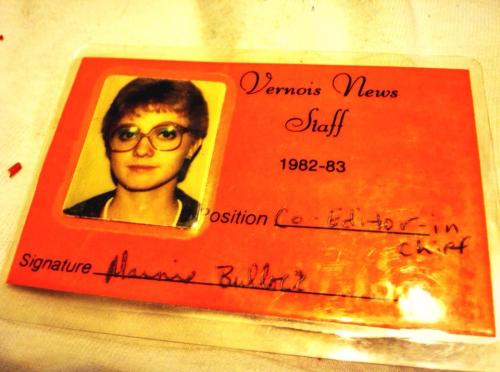
I don't know yet as much as I thought I knew then.

I don’t know yet as much as I thought I knew then.

The Word Made Flesh is Sylvia

And tremblingly, we’ve all partook.
The only question’s whether
we’re cannibals or communicants.
Either way, we eat her

grave cave crisp papery skin,
we suck her red homunculus
right off our own chapped lips.
We do it again and again.

The only way to know
if, instead of gruesome, all is holy,
(but all is both), is when we’re done,
we can’t be, she can’t be,
not one single living word can be
diminished. None.

_____
So, once again, I agree with Chuck Rybak. We do suck Sylvia. 🙂

APT’s Hamlet is Awesome. Go See It.

Q: How’s Hamlet?

rgbackdrop

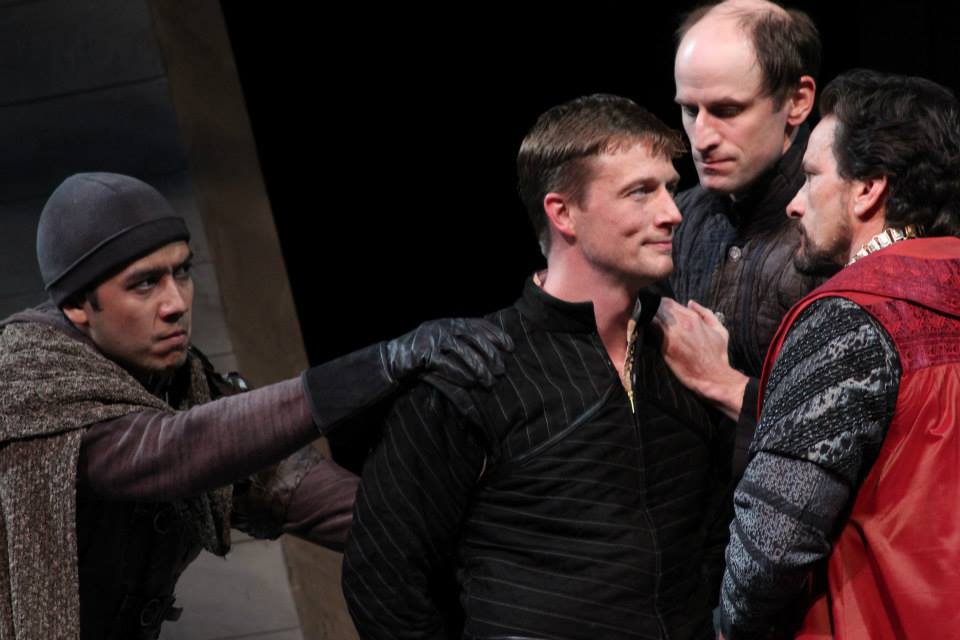
The short answer, for American Players Theatre’s 2013 production is that it’s terrific and I’m still processing how terrific it is.

It took me to my APT happy place numerous times on Sunday night (a very muggy-buggy night), by which I mean I forgot I was watching a play, forgot I knew the actor playing the part, forgot I was anywhere but in the moment on the stage.

Part of me wants to stop there–to say, simply, it was great. Everyone who can get here should get here and see it.

Except this Hamlet was so freakingly brilliant–I thought about it for hours after I got home, and I’ve thought about it all day.

So at the risk of revealing my theatrical and Shakespearean ignorance (the vastness of which undiscovered country has not been mapped), here are some of those thoughts.
____

I really think John Langs, the director, is brilliant. I know a theater production is a collaborative process, so my appreciation of the unnerving, stark, gorgeous, imposing, spare set goes to Takeshi Kata and Andrew Boyce. And the way the lighting shows two Hamlets–his posture saying one thing, his face saying another?  Credit for that goes to Michael A. Peterson.

The shadow seems much surer of itself here.

The shadow seems much surer of itself here.

But over and over, each component worked with every other component. The costumes worked with the set. And the set worked with the lighting. And the lighting emphasized the performances. And the performances were awesome. That’s to the director’s credit.

And having James Pickering–a really well-known Milwaukee actor who’s never appeared on the APT stage before–play the ghost and the player who plays the king parts and the gravedigger–that’s not just a casting idea. That’s an interpretive idea.

It made it seem like the ghost was showing up ALL THE TIME.

The child longing for the nuclear family that no longer exists.

The child longing for the nuclear family that no longer exists.

I know directors pluck from other performances (and there are a lot of Shakespeare casting traditions that would be utterly lost on me–I mean, I know about Cordelia/the fool, but that’s about it), and I know Langs directed Darragh Kennan in Hamlet in Seattle pretty recently, so I don’t know if this is the FIRST Hamlet to do that with the ghost/player/gravedigger, and I don’t know if the ghost has shown up other times when he doesn’t have lines, as he does in this performance (I won’t say where-all, because at least one of them seemed like a big risk with a big payoff), but it all went beyond “interpretive idea,” actually. It felt like vision. Genuine artistic vision.

What a counterpoint to Bassanio and Antonio from Merchant of Venice.

What a counterpoint to Bassanio and Antonio from Merchant of Venice.

Casting at APT is a complicated thing–eight plays done in repertory, core company and guest artist needs and contributions considered (who had a huge part last year, who had only supporting roles, who has one huge role this year and needs other supporting roles, who has reliable chemistry with who else)–so I can’t attribute the genius casting of this production of Hamlet to John Langs alone. Whoever had a hand in it, though–bravo.

If I’d been asked, prior to seeing this performance, to list Shakespeare’s really nasty kings, I’d have said Richard and Richard and then changed the subject, since I don’t know the histories as well as I ought. I might not have thought of Claudius at all. It’s not what I would typically think of as a meaty part.

But in Jim DeVita’s hands? Well, I hear Jim’s a fine cook, so I could say it’s like carving a chicken and understanding there’s good meat to be found places other than the drumstick and breast. Anyway, he found the meat. And chewed it up.

I mean, wow. When he says, of Fortinbras, “Holding a weak supposal of our worth,/ Or thinking by our late dear brother’s death / Our state to be disjoint and out of frame,” the delivery was so powerful I found myself wondering if Langs had somehow let Claudius deliver one of Hamlet’s speeches. (He didn’t. At least that one’s not Hamlet’s.)

“I like him not,” he says of Hamlet. And you think, “uh oh.”

I don’t mean Jim was upstaging or scene-stealing or anything bad. He just made it so clear how powerful Claudius was. How mean.

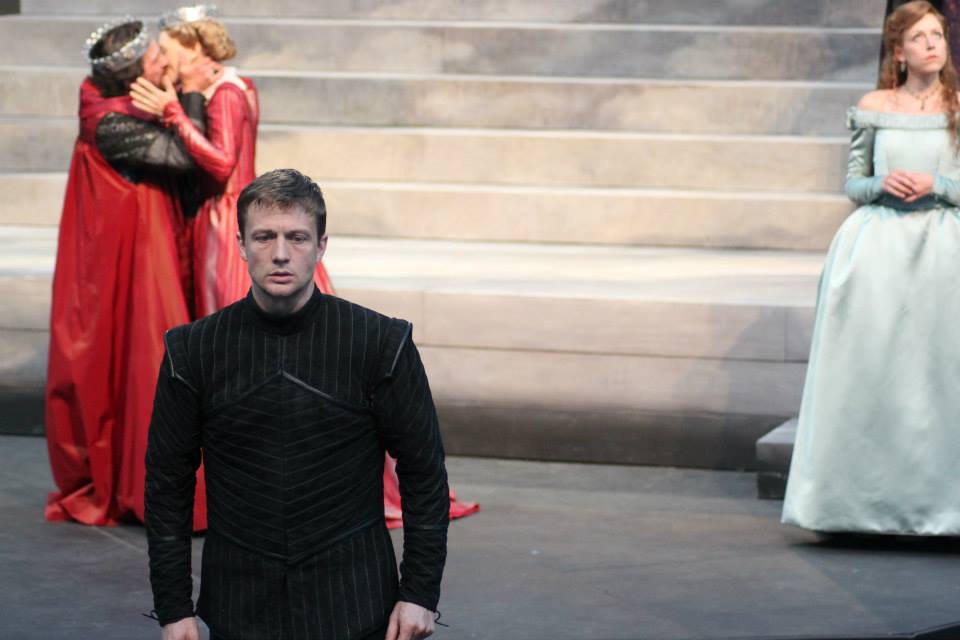
And unlike some productions, which maybe emphasize the Oedipal-incestuous-icky embraces between Hamlet and his Mom because no one can possibly imagine her really being turned on by whatever Claudius they’ve cast (the pompous guy in the Slings and Arrows production comes to mind, Season Two, Episode One, not the first season’s Claudius), De Vita and Staples have awesome onstage chemistry. One review found it “puzzling” why they were “hanging all over each other.” It didn’t puzzle me at all. Wouldn’t you, on him, were you she? And wouldn’t you, her, were you he? I, me, we would, methinks.

Gert and Claud

Gert and Claud

And then of course there’s Hamlet his own self.

Bravo, Matt Schwader. Bravo.

Mike Fischer’s review gets it right, that Matt’s “intensity adds bite and even menace to Hamlet’s encounters.” He calls him “white-hot,” and says he “handles Shakespeare’s verse as well as anyone at APT.” Yes, and yes, and yes.

I am enjoying reading and re-reading about Matt’s Hamlet process in his blog, “Bounded in a Nutshell.”

(He’s not just pretty. He’s also thinky.)

Matt’s explanation of his process helps explain one of the things that amazed me last night: the BIG ASS SPEECHES melded into the play so smoothly. They weren’t under-played, and not muted, but at no point did the production feel like this:

Druuuuuuuuummmmmmmroll: SOLILOQUY. (more stuff, more stuff, more stuff) and then
Druuuuuuummmmmroll: SOLILOQUY.

For example, leading up to the most famous of the BIG ASS SPEECHES, the “to be or not to be” one, because David Daniel’s Polonius is so strong, and Jim De Vita’s Claudius is so strong, and Christina Panfilio’s Ophelia is so strong, I found myself focused on what THEY were doing. Especially Ophelia. (I’ve never felt so pissed at Shakespeare for killing someone off as this Ophelia. She had spunk, damn it.)

Lou Grant to Mary Richards: "You've got spunk. I hate spunk."

Lou Grant to Mary Richards: “You’ve got spunk. I hate spunk.”

So when Matt came onstage and began speaking, to the audience, it took me a beat or two to realize that what he was saying was one of those speeches, even though I’d known what was coming.

In terms of speaking to the audience, as he was, part of the time, in this speech, Matt has this to say, “I’ve found that it is simply much more dramatic and engaging to watch an actor speak with another person (or group of persons, as is the case with direct address), than to be muttering to his or herself. Tremendous drama lives in the unexpected. What unexpected thing can happen to a person talking to his or her self? Not much. On the other hand, talking with an audience opens a flood of possibilities as to what might happen.”

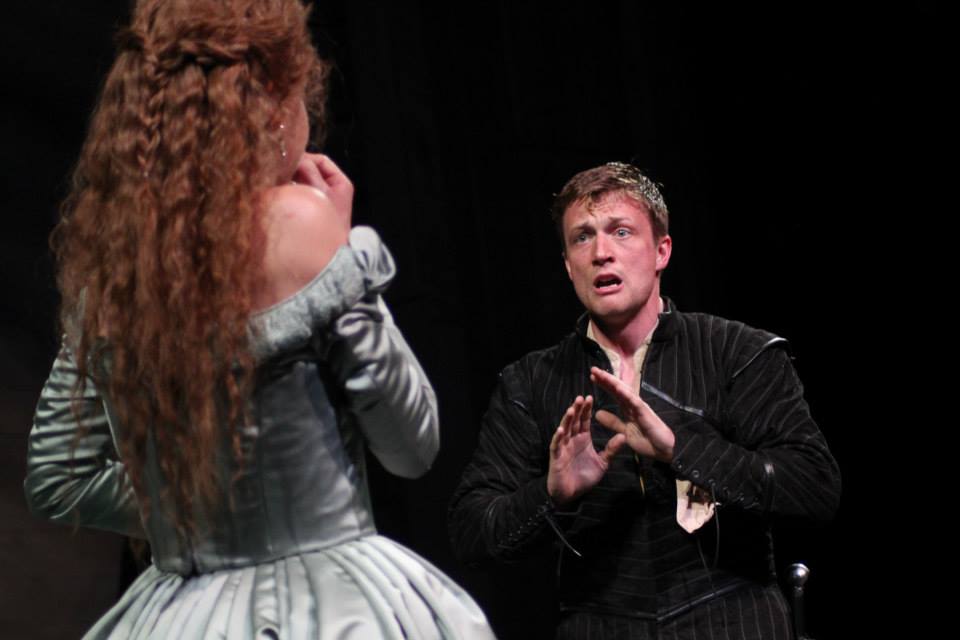
The unexpected here is that Ophelia is listening, and she startles Hamlet, which was startling. In a good way. Because then the “get thee to a nunnery” lines seem startling, even though I knew they were coming.

Hamlet and Ophelia.

Hamlet and Ophelia.

_____

Matt did a fantastic job, which wasn’t startling. Anyone who’s watched him the last few years knew this was coming, that he’d earned it & that he could do it.

But what was startling overall was how his performance seemed utterly in service of the play.

I don’t mean I expected Matt to be selfish or show boaty. I’m just used to thinking of Hamlet as a vehicle for Hamlet (the character and the actor who plays him). This didn’t feel vehicular at all.

What a great play.

Another fantastic shot from Carissa Dixon

Another fantastic shot from Carissa Dixon

_____
(All these awesome images of the production are used with permission from the awesome Carissa Dixon.)