Category Archives: Uncategorized

Pedagogy Stew #2

The following can be found in the February 2013 Voice of the River Valley.  The March edition is available online in the archives (I will post it when the April edition comes out).

I appreciate everyone’s feedback on the column when I’m out and about–glad to know it’s hitting the spot (at least for some folks!)

Any requests? I’m about done with the April column, but what should I write about next?

[And here’s a curious thing–I’ve just now realized I mentioned my bad handwriting in February’s column AND March’s. Both in the context of teaching–this time in terms of writing on the board, in March in context of commenting on student papers. So, two things:  I should perhaps re-read previous columns right before I send off the brand new ones, and 2)perhaps I need to write a whole blog post on the handwriting thing. Apparently it’s heavy on my mind.]

_____

Even though most college faculty no longer see themselves as “the sage on the stage,”

Look! A sage on the stage!

Look! A sage on the stage!

lecturing for full class periods, filling up the empty vessels of our students’ minds, the lecture-style classrooms we teach in are typically set up for someone to come in, and, sage-like, to stand at the front of the room and begin talking to students who sit with their desks facing forward. Now that a lot of us rely on PowerPoint slides for lectures (I like them because they keep me on track, and students can read them, unlike my handwriting, which is largely illegible—worst grade I ever got was a C in fourth grade for penmanship), even when we can move the desks around, we don’t, because we want students to keep their eyes on the slides.

I realized how attached I was to what I saw as the “default” setup for the basic humanities/social science college classroom last fall, when a fellow professor regularly had her students sitting in a circle—and often left the chairs in a circle when they left. I was annoyed at having to rearrange chairs, but I tried not to grumble—after all, “fusty don” is not the teaching persona I’m going for. (I do have students work in small groups in the course of most class periods, and 200-level classes more often have discussions in which they sit in a circle.)
I think my time volunteering at my son’s school makes me highly conscious of these matters. In a chapter from a book called Learning Spaces, Nancy Van Note Chism points out that “[s]pace can have a powerful impact on learning; we cannot overlook space in our attempts to accomplish our goals.” The teachers at the River Valley Elementary Studio School make an ongoing effort to support learning by shaping the space.
A couple of Saturdays ago, I went in to help one of the kindergarten teachers begin work on an igloo made of milk jugs. What lucky students! Lessons in physical science, social science, math, environmental conservation, creativity—all right there in their room in a way they can see and touch. My son’s teacher, that same Saturday, was rearranging furniture she’d brought in so that their classroom now has a living room. On a recent morning she met with students individually on the sofa, to go over their most recent reading test scores (while I worked with the rest of the class as they did individualized literacy work). In the afternoons, students read to themselves in the living room if they want.
Van Note Chism finishes her piece with this quote: “No longer can we assume that any old furniture and any old room arrangement will do—we know better. Like all academicians, we should ensure that current knowledge informs practice.” For a variety of reasons, professors tend to tolerate “any old,” but we could learn a lot from the emphasis K-12 teachers place on space.
—–
(Picture from flickr, Creative Commons. Tulane Public Relations, “student in class.”)

Either that, or spring training has started

Question #1:
“Things are gonna slide, slide in all directions
Won’t be nothing you can measure anymore
The blizzard of the world has crossed the threshold
And it’s overturned the order of the soul”
Leonard Cohen, “The Future”

This describes
a. my mood
b. the weather
c. pop culture
d. the sequester
d. none of the above

Oh, we’re mighty tired of winter up north here in Wisconsin. Mighty tired.

But I’ve heard a rumor that, in Florida, the Cardinals have gathered, not to select the next pope, but to work their magic which will put all the gears in motion to move spring northward. I’m pretty sure that’s how it works.

Question #2:
“You throw the ball, you catch the ball, you hit the ball. Sometimes you win, sometimes you lose, sometimes it rains.”

This quote is
a. from Bull Durham
b. spoken by Nuke La Loosh
c. spoken by Skip
d. a nice counter-balance to Leonard Cohen
e. all of the above

from the photographer: "It must be Spring Training. Motorcycle parked in the batting cages at Royals/Rangers Spring Training Stadium"

from the photographer: “It must be Spring Training. Motorcycle parked in the batting cages at Royals/Rangers Spring Training Stadium”

And this image, of course, reminds me of another baseball movie, which breaks my heart too much to watch most times my husband wants to watch it–Bang the Drum Slowly. Perhaps I should re-watch it, write about it, and have yet one more post for Bradley Cooper (on account of DeNiro being in the movie).

But for now, I’ll just mutter to myself all day, “We must never have another motorcycle in camp.”

_____

(Photo from flickr, Creative Commons, by Charles Sollars)

Leviticus Tattooing Lent

What I want to say this Easter, a.k.a. “the end of Lent,” is “what a long, strange trip it’s been.”

The snow feels like some sort of collective meteorological flagellation (another storm tomorrow). Meanwhile, I’m trying to give up comparison for Lent.

But this Lent does feel like a journey (more than usual, I mean, you know, compared to other Lents, oops) thanks to one of my online guides, Nadia Bolz-Weber, a Lutheran minister and founding pastor of House for All Sinners and Saints in Denver. (Where they have had, among other events, “Beer and Hymns” and “Beer and Carols.”)

I like to imagine how fun it would be IF Paul’s bellicose advice in Ephesians 6 had said, in addition to,

“Therefore take up the whole armour of God, so that you may be able to withstand on that evil day, and having done everything, to stand firm. Stand therefore, and fasten the belt of truth around your waist, and put on the breastplate of righteousness. As shoes for your feet put on whatever will make you ready to proclaim the gospel of peace. With all of these, take the shield of faith, with which you will be able to quench all the flaming arrows of the evil one. Take the helmet of salvation, and the sword of the Spirit, which is the word of God.”

Also this, “Fashion sleeves of armour which are the holy images of God.”

Of course it didn’t say that, because if it did we might begin to think the Bible contradicted itself in the matter of tattooing. After all, if you were considering, for example, tattooing a verse from Leviticus that condemns homosexuality, you might want to consider the verse in Leviticus that forbids tattooing.

There will eventually be leaves on the trees, right?

There will eventually be leaves on the trees, right?

Or you could just go to Leviticus Tattoo in Minneapolis and get some sleeves in the fashion of Reverend Bolz-Weber who blogs and tweets as The Sarcastic Lutheran.

Or you could just thank the Lord for her and continue to make your way as a Zen Baptist in this world. (By which “you” I mean “I.”)

I started going back to church in the 90s (I suppose I could say Gay 90s but I honestly don’t think we were quite there yet), among other reasons, because I wanted my week and my year to be structured on something other than the work-week and the academic calendar.

Advent and Lent help me mark progress through each year in ways other than “grades turned in yet?” even now, when I’m not part of an official faith community.

(Let me just say, as an aside here, that Minneapolis is a happening place. Not only do they have a tattoo parlor called Leviticus Tattoo, they have a gay bar called the Gay Nineties.)

I’m too contrary to have followed each suggestion in this “House for All Sinners and Saints’ 40 Ideas for Keeping a Holy Lent,” plus I haven’t quite remembered to look each day, plus on the day it suggested donating to Goodwill I wasn’t in a town where there is one when it was open, BUT, it has been one of my checkpoints this Lent.

Today’s suggestion is “forgive someone.” Tomorrow’s is “internet diet.” I’m on it for tomorrow, as long as diet isn’t interpreted as “fast.” This semester already I’ve avoided Facebook (which I dearly love) on several Sunday-through-Thursday stretches, just because I was feeling over-socialized. And this week is one of those weeks.

As for forgiveness, we’ll see. It’s not something I’m particularly good at. Perhaps I could work on forgiving myself for that. Or for something else. It is, of course, a point of pride for me that I am worse at forgiving myself than I am at forgiving anyone else.

I’m a mess.

On a morning after a night full of dreams when I went into buildings and couldn’t get back out the way I came in, or left buildings and couldn’t go back in at all, I think I will simply meditate on the path of forgiveness. Where does it start? How might I start?

And if you landed here looking for ways to condemn homosexuality and you’ve realized I’m ONE OF THOSE who love Jesus and support equality for all, or you want to condemn homosexuality AND tattoos and you’ve realized I think they’re both terrific, well–I forgive you. Do you forgive me?

(And by “I forgive you,” obviously I mean I will work on it. Seriously.)

But if we are in the business of taking the Bible literally (by which “we” I mean “you,” since I’m not in that business), we can agree that one is allowed, on the 491st visit to this site, NOT to forgive me, since Jesus said to forgive not just seven times, but seventy times seven. (491! We’re talking serious blog traffic there.)

In benediction I will say I am finding my Crocs good footwear this a.m. for proclaiming the gospel of peace.

_____

(photo from flickr, Creative Commons, by Lime Spiked)

Lazy, Lazy Thinking in the Noon Day Sun

I always used to talk about racism when I talked about logical flaws in my composition classes–that stereotypes came from generalizing badly. Sample size too small, oversimplifying, etc. (I don’t spend much time on logical flaws now, and I miss them–such fun names! Such color and metaphor–one day, the Straw Man smelled a Red Herring and Ergo, Propter Hoc!)

It never occurred to me until I read “Study: Racial stereotyping linked to creative stagnation” on Salon.com that racism was connected (in inverse proportion) to creativity. It makes sense, though.

I’ve written once before in this blog on the notion of lowering associative borders, in a post called “I Can’t Get No Satisficing.”  Having high associative borders is similar to what this study (described in more detail in in this article, “Racial Essentialism Reduces Creative Thinking, Makes People More Closed-Minded” in Science Daily) calls categorical thinking.

The lead researcher, Carmit Tadmor, and her co-authors say that although creative stagnation and racism “concern very different outcomes, they both occur when people fixate on existing category information and conventional mindsets.”

The study is hopeful that people can change their thinking. I am too–part of the reason I want to begin doing workshops on creativity is that studies show people can become more creative thinkers. We’re not stuck with what we were born with.

What I would call a “creativity workshop” is typically called “enhancement training” or “creativity training” in cognitive research. Hsen-Hsing Ma published an article in 2006 with overall terrific news about the possibility that we can become more creative.

Ma cites an early researcher, Paul Torrance,  who found that “programs teaching children to think creatively were at least 50% successful.” Another study from those rockin’ 1970s by Mansfield, et. al., showed “most evaluation studies of creativity training programs seem to support the view that creativity can be trained.”

SO WE’VE KNOWN THIS FOR A LONG TIME.

For the 2006 article, jazzily titled, “A Synthetic Analysis of the Effectivieness of Single Components and Packages in Creativity Training Programs,” Ma did what is called meta-analysis of studies (reading LOTS of studies on an issue and summarizing and analyzing their results), showing the following:

Good news item #1: “Overall, the finding of this study confirms the result of Torrance’s (1972) investigation; namely, that children can be taught to think creatively.”

But oh, gracious, the news is better than that:

“This study also found that creativity training programs tended to be more successful with older participants than younger ones.”

So–watch out old racists and stagnant thinkers everywhere. The times they are a changin’ (NOTE: if you’re old enough to recognize that song, you’re just the right age to benefit from creativity training.)

We can become more creative.

We can become more creative.

___

(Image from Creative Commons on flickr, “Coloured Rooms Doorways-Brian Eno Speaker Floers Sound Installation at Marlborough House” by Dominic Alves.)

On the Enduring Appeal of Bureaucracy

A roller coaster isn’t scary because
The car’s attached to the rail (you hope it is),
However high you loop, you’re certain you will
End up right where you started. A reliable thrill.
A blanket. Mowed trails. Molded cafeteria tray.
We do it this way because we’ve always done it this way.
And if you want to make a radical change,
We’ll say no. Quickly. Firmly. Again and again.
“So rather than shift to what it needed to do,
The Army would continue doing what it knew
How to do, which is how bureaucracies act
When they lack strong leadership.” Thomas E. Ricks.
Of course it worked so well in Vietnam.
So we do what we do and thus stay safe and warm.

_____

Cafeteria trays at the Googleplex

Cafeteria trays at the Googleplex

The cafeteria tray I had in mind was the kind that has spaces for your food–elementary school tray, of course. But aren’t these Googleplex trays pretty? Gosh. Might make you think it was possible to have a mix of the creative and the tried-and-true.

Also:  The Generals is just an amazing book. I applaud Tom Ricks once again.

_____

(Picture from Creative Commons on flickr, taken by John “Pathfinder” Lester)

Longing for the Sh*tty Barn

All those blizzard letters snaking across
the yard spelling “shiver,” spelling “cold,”
and one whole sentence, “spring will never come,”
they piss me off. An icicle of frozen piss
hangs down from a neighbor’s house, gold
in direct sunlight, briefly. Nope. Now it’s gone.

How I long for a warm night in May at the Barn,
Chastity Brown singing “oh la oh la” and then drums,
those drums…when I listen in the car, I pound
the steering wheel, I thump it, I hit it hard,
I sing along. Winter’s stalled. The doldrums
(“a belt of calms and light baffling winds”)
sound utterly lovely compared to this.
This snow. This mood. This lack of beer. This ice.

_____

Fortunately, the lack of beer can be remedied. Were I at the Sh*tty Barn, it would be a Fatty Boombalatty I’d be drinking. So I will hoist one, this evening perhaps, and trust that someday soon, I’ll be at the barn.

And if you haven’t listened to Chastity Brown, you oughta. The song where she’s singing “oh la oh la” (and I’m not at all sure how to spell that) is called “After You.”

how do you like your blueeyed boy Mister Weinstein

As we close out 21 Days of Bradley Cooper, I am so happy that Silver Linings Playbook won SOMETHING last night at the Oscars, and I’m pretty crazy about Jennifer Lawrence, even without watching these videos, in which she gushes over and then is kind of annoyed by Jack Nicholson “Is he back? I need a rear view mirror.”  And also expresses actual authentic reactions to media-ishy questions, post-Win.

I loved Winter’s Bone, too. And in Silver Linings Playbook, her character Tiffany had my favorite line from the movie:

“I was a slut. There will always be a part of me that is dirty and sloppy, but I like that, just like all the other parts of myself. I can forgive. Can you say the same for yourself, fucker? Can you forgive? Are you capable of that?”

To me this is one of the signature lines of the movie, not just because of the brashness and crassness, but because it’s about integration, moving beyond shame, and redeeming your own self, from the inside out.  Jennifer Lawrence’s Tiffany teaches Bradley Cooper’s Pat how to do that.

Which reminds me, this was never 21 Days of Jennifer Lawrence (maybe that’s next! probably not).  It was 21 Days of Bradley Cooper.

He didn’t win. It is entirely possible that only his mother thought he really had a chance to. As much as I’ve enjoyed my little foray into Bradley Cooperstown, I have to admit that I agree with the “brutally honest director” who did a think-aloud of his Oscar ballot, who said, “For Bradley Cooper, the nomination is his award.”

One wonders about direction after the Oscars–I think if Mr. Cooper had won, people would have remembered him as the guy who stole it from Abe Lincoln, not as the guy who took huge strides in the role of Pat Solitano.

I was hopeful Silver Linings Playbook would win more, though–the movie hit me at just the right time, and I really, really wanted the Academy to give more love to a smart comedy with a happy ending.

(I’m sure I should want to see Amour. I do not want to.)

The “brutally honest director” said this about David O. Russell’s chances for Best Director, that  “it took David O. Russell to figure out that Bradley Cooper is a great actor,” and Nate Silver had the movie trending a little for Best Picture, so I was hopeful.

Nonetheless, the Oscars are over, and I find that I still have not answered my friend Jen’s question, “So there is a movie in which Bradley Cooper’s character is not a psychopath?”

His character, Pat, in Silver Linings Playbook, begins the movie figuring out how to manage his bipolar disorder. So, not a psychopath. Previously delusional and violent, but no, not a psychopath. And in the movie, appealingly upbeat, hopeful, earnest, vulnerable, and relentless.

There is corroboration for the psychopath idea, though, here: “The Creepiness of Bradley Cooper,” in which the author says she sees “something of the psychopath about him,” but is ultimately not troubled by it: “Dark times call for dark celebrities, and these times are dark.”

Amen.

That article featured his turn in Limitless, which I see as essentially an ambivalent fable about Adderall.

All my Google searches and alerts had not turned up that article, though–it was referenced in this one in the New Republic Article, “Bradley Cooper: Beefcake Thespian How the “Silver Linings Playbook” star became a serious actor.”

This article is pretty heavy on the snark, emphasizing Mr. Cooper’s tendency to play characters you wouldn’t necessarily trust. Or like.

And it seems to have multiple axes it wants to grind. Curious.

My favorite Bradley Cooper article is this one from Esquire, “Dinner with Bradley,” post-Limitless, pre-Silver Linings Playbook, which likens him to a young Senatorial Jack Kennedy. It’s smart writing, and seems to give Mr. Cooper credit for some of the same things the New Republic article criticizes him for (pushing himself to be serious, being ambitious). It does this thing where I wondered if the author was trying to imply SOMETHING HAPPENED, (“Eleven o’clock on a Saturday morning and Bradley Cooper is sleeping. Russell Crowe is Robin Hood on the television and there has been another day of Limitless publicity in between and Cooper is tired. Five days earlier, Entertainment Weekly declared that ‘A Serious Movie Star Is Born.’ He is on his side and unshaven and not snoring and smiling.”) but is otherwise pretty interesting.

I’m sort of exhibit A of how nominations can bolster a movie–it definitely caught my attention because of the Oscar talk, and I’m pretty sure that’s why it showed at Sundance (and when I go see a movie, I typically would HOPE it would be showing at Sundance).

It’s been a fun ride for me. But Bradley Cooper had WAY more fun as evidenced in this Happy Hugger slideshow.

Full disclosure: in regards to my plan three weeks ago in which I imagined myself posting something about Bradley Cooper every day until the Oscars. That didn’t happen because
1. I got bored.
2. I got busy.
3. My calculated and cynical attempt to bolster blog traffic by blogging about a hot commodity was not successful. I think I’m still getting all those David Bowie hits because there weren’t that many people blogging about his new single. Whereas there are approximately (number approaching infinity) people blogging about Bradley Cooper.

One of my blogs, though, wondered about all Harvey Weinstein’s machinations on behalf of Silver Linings Playbook, thus the title.

"Stop looking at me, Bradley Cooper."

“Stop looking at me, Bradley Cooper.”

(photo by wrestlingentropy on flickr, Creative Commons)

“How do I do that? How do I become a person who says no to things?”

(If you’re keeping score at home, this is also “How to Get the Pay Raise You Deserve, Part V”)

Here’s one of my favorite drums to pound:

You can raise your hourly wage by working fewer hours.

(You have to be on salary for the math to work.)

How? Here’s how to do less:

10. Take people at their word. Take them up on their offers. For example, when I get an email from someone who says, “Would you like to do X, or do you need me to do it?” I mostly say, “That would be great if you would do it! Thanks!” Because what are the possibilities there?

a. It was a passive-aggressive way of asking me to do it.

b. It was a genuine offer to do X.

c. It was a way to try to shame me into doing it, hoping I wouldn’t admit to “needing” anything.

So, for a. my response is that I might sometimes accede to passive-aggressive bullshit without realizing what I’m doing, but when I see it, I like to mess with it, and play dumb, and pretend like I’m dealing with someone who says what they mean. (Because they totally should say what they mean, or at least stop talking to me.)

For b., my response is THANKS! Then I try to make the offer back  when I can. (I’m not a selfish jerk. I’m just trying to stay relatively sane.)

For c., I would, if I were forced to name names, say call 1-800-Shame Resilience and ask to talk to Brené Brown. She’ll give you the what-for. And I have many, many needs about which I have so little shame that I’m happy to let someone else feel needed.

My need to admit I have needs and someone else’s need to feel needed = pie and ice cream.

This is how great it feels to be needed.

This is how great it feels to be needed.

9. Ask for help. Don’t even wait for someone drive their passive-aggressive sedan by you so slowly that it’s easy-peasy for you to grab the bumper and ride your skateboard along in their fumes for a while. Just ask for help.  You’re a good person. You’re helpful. When someone who isn’t ALWAYS asking for  help asks you for help, do you think that person is horrible?  (Don’t tell me if you do.)
8. Pretend you’re someone you’re not. Would the Mansplainer say yes to everything asked of him? He would not. If you were a rock star, would your personal assistant field this request to you? He would not.
7. Wait to say yes. Lots of people have talked about this, so I won’t say much. But it’s pure gold in terms of effectiveness. It’s hard to say no in the moment of social pressure ACK ACK ONE OF THOSE BAD DREAMS WHERE I CAN’T SPEAK, but it’s way easier half a day later to email and say, “I’m sorry. I just looked at my to do list and my calendar and I just can’t.”

6. Don’t LIE and say you looked at your to do list and your calendar. Actually do it. And try to make it a really accurate to do list and a calendar on which you’ve sketched out when you’re going to do what’s on the list. (Please allow me once again to recommend Things and “Sunday Meeting” by Kerry Rock-My-World.)

5.Stop thinking up new things to do that no one even asked you to come up with.

4. Don’t wait until your wicked-burnout ways land you in a health or relationship crisis (they will, eventually). Get that calendar back out and imagine you’ve been warned that approximately two weeks from now, there will be a one to two-day crisis that you absolutely have to deal with.

Or, if that feels icky, imagine that the grandmother of a former student wants to give your campus a check for $100,000 dollars and because that student spoke so fondly of you, you have to accept the check in person. Two weeks from now. It will take two days.

What would you do? Cancel some stuff? Ask people to cover for you? Reschedule some stuff? Imagine blocking out two whole days. Make a plan.

Then follow through.  Or, if that feels too indulgent, do it for one day. Or an hour.

If you really can’t do it just for yourself, to get caught up, or catch a movie, or take a nap, or work on your favorite part of your job that you never get to work on, or go on a date, or WHATEVER, then schedule an appointment with a healthcare professional and use sick leave. That is what sick leave is for. It is for when you have a health problem. If you can’t make time for what is important, you have a problem.

3. Find that one thing on your to do list that you haven’t done yet, that you don’t want to do, that you keep putting off, for whatever reason. Cross it off your list. If someone else needs to know you’re done with it, email them and say, “I’m so sorry, but I said yes to too many things this semester/month/week/year/time on the planet. I am not going to do this. I am very, very sorry.”

This is not the BEST way to be a people pleaser, but you know what? Ms. People wasn’t pleased at how long it was taking you to do whatever. At least now Ms. People can make other plans.

And even though it wasn’t taking up your time because you weren’t doing it, it was taking up a lot of psychological energy hanging around on your to do list. Kind of like that creepy guy that kept asking you what kind of batteries he should buy with his special massage implement when you worked at Spencer’s Gifts.

2. Check in with people who know you & will tell you the truth (their truth, anyway) who can fulfill these roles (these might or might not be people you actually work with, and these may be the only useful roles the fun house mirrors play in your life):

MIRROR: person who sees things pretty much as you see them in terms of philosophy, values, work-life balance, who respects you and cares for you. Ask the MIRROR person: am I working too much? am I working enough? Jussssssssst right? Make adjustments as needed, in consultation with that person.

FUN HOUSE MIRROR SKINNY WORKAHOLIC VERSION: ask someone who lives to work and works to live the same questions. If that person EVER, EVER, EVER says something along the lines of “You’re working an awful lot lately,” you know it’s crisis time (see #4 above).

(Don’t wait for that person to say “You’re working too much.” They don’t believe that is possible.)

FUN HOUSE MIRROR LOVE-HANDLED BELUSHI-BOY: if you say to this terrific guy, who’s probably wearing a Hawaiian shirt & shorts with 700 pockets, “hey, am I working enough?” and he says, “No, you’ve been super mellow and ready to play pool a lot lately” go back and double-check with your MIRROR and then make a plan if you need to. Could be you’re making time for a precious friend or it could be you got TOO GOOD at setting boundaries. Don’t worry if that happened, because

Here’s what there will always be plenty of: people asking you to do stuff. You will never lack for opportunities to do a little back-fill if you realize you were slacking. Which you probably weren’t.

1. Do whatever you can to be the kind of person who operates from a base of worth and plenty rather than inadequacy and scarcity.

I still struggle with this, but I’m trying to listen less to the voice in me that wants everyone to like me all the time, especially the people I don’t like. I’m trying to listen more to the voice that says I am enough, and that I get to be picky about who rides on the bus with me. People who bring me down can’t get on my bus. Or they at least can’t sit in the back where we’re singing “One Tin Soldier.”

This isn’t possible for all of us, I know, at least maybe not now, not this year, not this week, not with this boss, not in this job, not in this economy–I get it. I feel it. I feel gobsmacked by it sometimes. But when and where it’s possible, we need to listen to Nancy Reagan’s quavery, moneyed, seat-of-power voice:

JUST SAY NO.

Getting the Pay Raise You Deserve, Part IV

Part of healing from burnout is learning to set boundaries. Making time for what’s important (yourself. family. friends. fun. community. yourself again) other than your work.

Easier said than done. Really easily said. “Set boundaries.” Unless you have a cute little hint of a lisp the way John F. Kennedy, Jr. had. Then it’s a little harder to say.

Pretty hard to do.

But those of us who’ve emerged from the Pretty Good Depression still employed find ourselves picking up the slack left behind when people were laid off, or  not replaced, or carrying a heavier load in terms of student enrollment, juggling new initiatives, etc. etc.

It is just so easy to do too much for too long and end up having your soul scrape up against your to do list like bone-on-bone-bad arthritis.

In the long run, as I mentioned to my boss’s boss’s boss last Valentine’s Day (ahem), a system that is structured to rely on people burning themselves out LIKE OURS is not sustainable. (It also doesn’t get the best work out of people, even in the relative short-run–but that’s the subject of yet another blog yet to be written. Stay tuned.)

For me, the urge  to work too much (and the actuality of working too much and the guilt of perhaps not working enough) mixes with my long-term tendencies toward depression and anxiety into a toxic burnout brew that makes me less of everything I want to be (loving, enthusiastic, effective) and more of everything I’d rather not be (chronically irritated, cynical, spastically ineffective).

I’m still learning, but I’m making progress.

If you click on “burnout” in my blog categories, you’ll see it’s something I write about a lot. (cf: fixate upon.)

In Getting the Pay Raise You Deserve, Parts I, II, and III,

I acknowledge:

It is all too easy to come across as whining, and something like “I had to spend an hour on the phone getting my insurance coverage worked out today” can come across as ingratitude, a classic First World Problem….it is a luxury to consider what changes we could make to improve our lot. But you know what? A lot of us in academia do have that luxury, especially those of us with tenure.

I assert:

You can raise your hourly wage by working fewer hours.

I celebrate myself, I sing myself:

I don’t work too hard. I work hard enough.

Here’s how good I am at setting boundaries.  I got folks pounding on one of the walls I built hollering at me  like they’re possessed by the spirit of Chico Marx: “You no work enough.”

Here’s the contested boundary of the month:

In response to Scott Walker’s 2011 budget bombs (which resulted in less take home pay for my family), I looked around to find ways to save money. We love Culver’s just as much as we always did, but we don’t go as much as we used to. INSERT LOTS AND LOTS OF OTHER EXAMPLES OF BUDGET TRIMMING HERE. And then, to save money on gas, I started working from Spring Green some Tuesdays (my teaching schedule is MWF). That enabled me to volunteer in my son’s classroom now and then. That turned into a regular gig. That turned into a commitment. Which turned into a column in the Voice of the River Valley.

I do a lot of work on Tuesdays, and I check email a lot during the day. I’m considering setting up virtual office hours to make sure students and advisees remember that I am available on Tuesdays, just not in person in my office on my campus. And as I mentioned in one of the three prior posts in this series, I average more than 40 hours a week during the 9-month contract. Since I try to take a week off between semesters, and two days off at Thanksgiving, and two or three days off during spring break, and maybe Labor Day if I’ve got my course syllabi ready, that means I typically average 45 hours during an actual teaching week.  (I don’t count how many hours I work in the summer, but it probably averages to about 20. )

I don’t see why it’s anyone’s beeswax, if I’m accessible to students, if I’m doing my job well (I have official recognition of that), and if I’m doing my share for service (and I do), WHY it matters how many of those hours are in my office or on campus or in my kitchen or at a coffee shop or wherever.

But there are people for whom dedication to campus life is measured in hours worked (more hours = more dedication) and hours on campus (more = more). I don’t agree. I hope the issue goes away. If it doesn’t–well, gracious. You won’t like me when I’m angry.

Take this one boundary skirmish as a warning, all ye who dare to dream of  work life balance. Sometimes when you set a boundary, you have to defend it. But a lot of times, people don’t even notice.

If you’re brave enough, if you’re tired enough, if you’re burned out enough, tune in next time when I share my Top List of Ways to Work Less. (Remember: if you’re on salary, you can raise your hourly wage by working fewer hours.  The hilarious irony is that the quality of your work will actually go up, and in some cases, the quantity too–because you have more energy to focus on the things you’re still doing. Shh. Don’t tell.)

Meanwhile, Joshua blew the trumpet at Jericho and the walls came a-tumblin down.

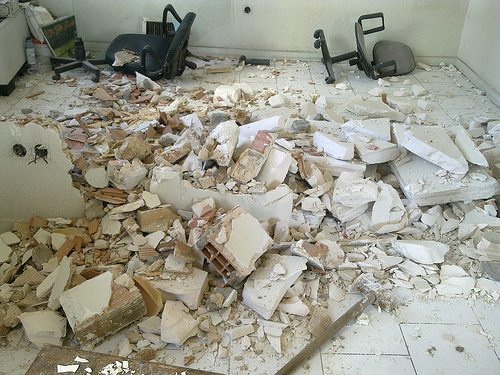
This is what a system structured on burnout looks like. Eventually.

This is what a system structured on burnout looks like. Eventually.

_____

(photo from flickr, Creative Commons, by Babak Farrokhi, entitled “Office Under Construction.” So it’s not really about sustainable systems OR Jericho.)

Little Shot of Sunshine A.S.A.F.P.

I have a serious case of the Februaries (as my friend Jessica calls them). Tired of winter. Tired of dark. Tired of tired of tired of tired.

So you know how we sometimes say someone or something is a force of nature?

Well–the sun is THE force of nature, right?

So let’s MacGyver our moods, shall we? Borrow our myopic buddy’s glasses and make a prism to focus what little sun there is on whatever target needs it most.

BOOM! Fire! Explosion! And we’re free.

(That’s how it works on TV anyhow.)

Seriously. Give someone a compliment. Say thanks. Apologize. Tell a joke. Randomly shoot a thumbs-up when you see someone doing anything remotely thumbs-uppable. Do it now. Or As Soon As Freaking Possible.

I know I need it. I know I’m not alone.

And lest anyone mistake this for a Pollyanna moment (or, as someone near and dear to me is capable of, a Nucleanna moment)–I think there’s a poopload of bleakness and bad news around.

But a little shot of sunshine now and then, that makes the poop more bearable.

At least in theory.

My favorite color.

My favorite color.

Cheers!

{photo from flickr, Creative Commons, by Beau B–no real name given because he is apparently a high school student. Usage of this photo should not be construed as an endorsement of underage drinking, drinking to excess, or drinking in the workplace. It’s just pretty. And a pun.n Plus, if you know me, you know the acrylic nails just crack me up.]