Category Archives: Writing

Car Sonnets, Bloems, and Pogs

UPDATE: I no longer write sonnets while driving. Nothing bad happened, but on reflection, it seemed so clear it was distracted driving.

Did you land here look for sonnets about cars? If you leave a comment, I’ll write you one…..

ORIGINAL POST:

Lions and tigers and bears, oh my. Kind of like that.

Also not entirely unlike “father son and holy ghost” because I side with the Orthodox idea there, that the Trinity is meant to be un-understandable, to remind us there is always going to be something we can’t fathom about God. (I can’t remember where I read that, but it’s probably from my Holy Trinity of theology–Karen Armstrong, Kathleen Norris, or Anne Lamott. Probably Kathleen Norris.)

But my list is MOST like “gypsies, tramps, and thieves,” because one person could be a gypsy AND a tramp AND a thief, or there could be lots of people fulfilling those roles.

So, to define:

A CAR SONNET is a sonnet that was written entirely, or at least begun, while I was driving, usually on my commute to work. Unless that’s illegal, in which case of course I don’t do that. Who would do that? Not me.

A BLOEM is a poem I wrote primarily to post in my blog, upon which I usually commentate in the same blog.

A POG is a poem I post in the blog, which I think could probably stand alone (even though I go ahead and commentate anyway).

Of these, I would say the bloems have the least poetential. (Poetential, adj. Meaning: Least likely to stand the test of time, or the smell test, or the urge-to-revise test, or the put-in-a-manuscript urge.) They’re in response to current events or current concerns. Here’s a recent example of a bloem, a poem I wrote because I was so freaking excited that David Bowie had a new album & a new single.

And another bloem, about Ding Dongs.

Here’s a recent example of a pog (much of which I probably did write in the car as I drove to work, but I was writing only one line a day, so that didn’t take the whole commute). Since “Sustainable Chaos” is my life motto, this is an important poem, and like other pogs, has some level of poetential. One of my goals when I work on my full-length manuscript of poetry (either Summer 2013 or Fall 2013 or Winter 2014) is to look back through the blog and see which poems still excite me. I wonder if this one will.

Here’s another pog, called “Yes. No–wait” in which I have a conversation with competing voices. And which I do have in mind for a particular collection, a chapbook called “Each Other’s Anodyne,” all about teaching and work-life balance issues. It has a pretty particular audience in mind, and we may try to publish some to raise money for my sabbatical (speaking of work life issues).

And “On Conscientiousness” is an important topic for me, and I do love this poem.

Not surprisingly, “Truck Pulling the Moon” was written while I was driving.

And another car sonnet (not surprisingly, I’m often thinking of work when I’m commuting), called “The Moan Tax.”

I’m not entirely sure why these distinctions(and non-disctinctions, since a car sonnet could be a pog or a bloem) are important to me. Especially since I’ve realized one of my biggest weaknesses as a poet is the ability to view my work in terms of audience–who will love what? What should get submitted where? What will stand the test of time? (Or the smell test.)

All I know is what I do, and that I feel compelled to share, and thus–poetry is a part of my blog.

(I’ve meditated on this once before, sans categories, here.)

C-word, N-word, R-word: Forward!

Seriously considering putting a warning in my syllabi for spring semester:

CAUTION! Profanity Uttered Here.

By me, by other students, by Louis C.K. in our pop culture unit in my composition classes….

Probably thinking, "man, I don't want to be in a composition class."

Probably thinking, “man, I don’t want to be in a composition class.”

When I was tenure-track, I was getting some negative comments from students about my profanity in the classroom, (probably based on The Five-Paragraph Fuck) and my student evaluation numbers weren’t as high as they needed to be to make satisfactory progress on what I used to call “the march to tenure,” so I made swearing less one of my goals. At the time, I asked myself “how important is swearing to me vs. making sure I get tenure?” Seemed like an easy choice.

Since then, I had the honor of working with a male professor who swore like crazy in class, and got terrifically high student eval numbers (mostly because he was an amazing teacher). One of the conclusions I drew from that, rightly or wrongly, was that it’s o.k. for boys to swear. Girls, not so much.

Well, fuck that shit.

It isn’t as though I swear a whole lot, actually, in life or in class. More as a writer probably than any other time. But the freedom to do so feels important, and gosh, sometimes it’s just fun.

But I suppose I’m wanting to give my students fair warning, in case they’re likely to take too much offense. Of course, we’re a small campus, so there aren’t very many sections of any given class, so it isn’t as though students have a lot of choice in course scheduling. So maybe I just want them to steel themselves….

I guess showing Louis C.K. in class gives me automatic membership in the “It’s Our Job to Complicate Students’ Worldview” Club.” Note: I have also shown Slapshot in class. But it isn’t as simple as that.

I have two goals as a teacher that often come into conflict with each other:
1. I want to create a learning environment where students feel safe to learn and grow.
2. I want part of that learning and growing to come through experimentation and boundary-expansion.

So, for example, #2 is being satisfied when students have to grapple with the episode of Louie called “Heckler/Cop Movie,” when Louie goes absolutely nuclear on a female heckler. He calls her a c*&t and calls her mother a c*&t. He says, at one point, “You’re the worst thing that ever happened to America.” I ask students to analyze it (and some episodes of Roseanne) in terms of humor, and it didn’t take very long this past fall semester for students to notice that Louie doesn’t fare so well in that episode, that every offensive thing he does gets punished one way or the other. Then they did research, and many of them found this article: “The Filthy Moralist: How the comedian Louis C.K. became America’s unlikely conscience” from the Atlantic. So there you go, worldview complicated.

Well, worldview complicated for a lot of students. Complicated in one way for students who were appalled by his humor and needed to see how freaking brilliant he is. Complicated, too, for students (primarily male and white) who already thought Louie was hilarious, but couldn’t imagine he might, possibly, be making fun of THEM for laughing and not thinking.

You’ll notice I couldn’t quite bring myself to spell out the c-word. The DVD I had bleeped it, and we had some relatively hilarious, inadvertently hilarious class moments when we discovered that not everyone knew what “c-word” stood for, or what the word meant, or why it struck some people as different than saying “dick” instead of “penis.” #whyIloveteaching

And this takes me back to point #1 above: in our culture, the c-word has a lot of baggage, much of it painful for women. As a teacher, I now feel it is my duty, to be even-handed, to find something that some male students might feel not-just-offended-but-wounded by in the same way some way some female students felt in response to Louie’s rant. Open to suggestions here. (Seriously. Post suggestions.)

My big concern, in other words, is that I don’t guide students in pursuing #2 at the expense of the same people over and over–people who are often picked on in our society.

Just in the realm of vocabulary alone, it’s hard for me to think of a _-word that slams a heterosexual white man without any obvious disabilities. But if we were brainstorming, insults for women, those in the LGBTQ community, people of color, people who are differently-abled…those insults would just spring trippingly and quickly off our tongues.

I’m completely comfortable deleting a post on my own Facebook thread when someone casually uses language I am offended by (or worry a friend might be offended by). In the classroom, the rules of propriety and etiquette don’t seem as clear to me.
_____

As part of my ongoing creativity research, and in preparation for spring semester, I’m continuing to read Dispatches from the Classroom: Graduate Students on Creative Writing Pedagogy, a terrific book I got excited about FIRST because there are precious few articles, let alone whole BOOKS on creative writing pedagogy. This book, edited by Christ Drew, Joseph Rein, and David Yost, came out last year and I find it consistently thought-provoking.

Just this week, I finished M. Thomas Gammarino’s “Invoking the Muzzle: Censorship and the Creative Writing Classroom” and found much to applaud and agree with, but a few places I found sticky.

It’s pretty obviously connected to my concerns above.

He positions himself as a libertarian sort of professor for the most part (for which I feel some kinship, cf: assigning Louis CK, above).

“Can fiction create a hostile learning environment?” he asks as he discusses one of his own experiences as a student writer, when he turned a story into a workshop about a pedophile keeping “pets” in the basement. The teacher reacted strongly, reasoning that other students would essentially have been forced to read it, that they weren’t as free to put it down as they would have been if it had been in a magazine, etc. Gammarino dropped that class, but as he points out, the problem remains.

He summarizes another incident (that he was not involved in) in which a teacher was disturbed by the violence in a student story and sought help outside the classroom–this ended with the student getting expelled and the instructor losing her job. Gammarino blames this on the institution’s overreaction and the attempt at censorship, calling it “prophylactic hysteria” (the phrasing of which I covet).

I like how he distinguishes the basic philosophical positions: “Libertarians may find themselves in the anguished position of having to defend the free speech of people whose viewpoints they find repulsive, but those who favor enacting controls on hate speech appoint themselves to the essentially undemocratic position of prescribing a morality for the masses.”

(I would say in this case it’s not the masses so much as it is the enrollment in any given course, but the point still holds.)

I also appreciate that he asked for feedback from other creative writing teachers, and there’s one response I’d like to highlight, the one from Wilton Barnhardt: “It is, of course, always a judgment call whether this kind of incident is pure aggression, a sociopathic acting out, a smart-ass way to get attention or indulge in hate-speech, or a clumsy attempt by an untrained writer to deal with difficult topics. I think we all know good and well when it’s the former, and I am prepared to sit there and listen and help and edit when it’s the latter.”

Therein lies the sticky place for me. I don’t always know good and well how to distinguish between the former and the latter. Sometimes it’s obvious, sure, but we’ve all seen studies about the higher incidence of mental illness in the field of creative writing, so it wouldn’t be surprising at all to find problems with mental illness in the creative writing classroom.

[Would it automatically be different, I realize I need to ask myself, seeing violent imagery from a student I knew to have mental illness issues, vs. a student who seemed emotionally stable? Hm.]

Violent imagery + mental illness doesn’t automatically add up to “will act on what is described.” Still, when a student I was working with informally began submitting pieces about stalking and harming a female teacher, I wrote him and said I wasn’t comfortable working with him. He cried censorship, and maybe he was right, but one of my absolute life goals is to trust my gut more, and my gut was telling me “RUN!”

I had the choice though–he’d been my student in the past, but wasn’t enrolled in anything at the time.

Gammarino did not give much space to discussing his original teacher’s point about student choice in terms of reading and responding, but I think it’s an important question. He was also very dismissive of another teacher he knows of who asks students to fill out a cover sheet for the pieces they’re going to workshop, describing the potential offensiveness (among other things, I assume). Gammarino says “I want to challenge the warrant behind all of this: namely, that it is part of the writing teacher’s job to protect the comfort level of his students—that is, to keep them from being offended.”

But it isn’t just “being offended” that I’m concerned about. It’s trauma. If a young woman has been raped, a rape scene will be traumatic. The more graphic, the more traumatic (I assume). And even if a young woman hasn’t been raped, do I really want to contribute to the rape culture we live in by asking a whole class to read a graphically violent rape scene?

I’m remembering a particular violent story, a series of revenge fantasies by a student who had writing skills and “issues” in approximately equal measure. It just so happened that the women victims came to more gruesome ends than the men.

I worked with this particular student all semester, and tried to get him to move beyond what I called his “shock and awe” imagery. But there were female students who were deeply uncomfortable working with him, and I don’t feel as though I helped them navigate their discomfort because I wasn’t sure how much of it was sort of an intellectual “ooh. ick.” and how much was simply an appropriate reaction of horror.

Gammarino says “Clearly teachers must do everything they can to protect their students’ safety,” but in this case he means safety in the sense of not actually being the ones killed and hacked up as described in this particular story.

Nothing bad happened in that way with this student; I wasn’t really worried that it would. My “gut,” in other words, was telling me this wasn’t going to make the news.

Gammarino adds that teachers must also “maintain a level of discussion appropriate to higher education,” and that’s where I’m getting stuck. What is appropriate here?

I absolutely agree with him when he says “…insofar as we choose to protect our students from ideas we ourselves may find odious, we also protect them from developing complex minds capable of deciding such matters for themselves.”

So my goal IS helping them navigate their discomfort and their horror. I am wondering if some kind of cover sheet would help–not simply to let students opt-out of reading something they’re alarmed at before reading it, but to also help us keep track of who is pushing what boundaries.

Gammarino describes his own pedophile-with-pets story as “a chance to stretch my imagination,” and that, ultimately, is what I find most troublesome about censorship–it boxes everything up so tightly there is precious little stretching possible.

If we grant that creative writing has to be about more than the craft of writing (the “writing” half of “creative writing”), but also has to be about creativity, then the stretching is crucial, and worth a great deal of student discomfort.

But what if the student writing the scary imagery has been doing that for years? And wants to do only that for the class? How creative is that? What about the student who wants to turn in only masturbation-paced erotica? They’re pushing other people’s boundaries, sure, but not their own.

So here’s my plan for my beginning creative writing class for Spring 2013: students are going to have access to a cover sheet for workshops. Half of it will be what they want to tell other students about the piece they’re submitting, and half of it will be like this (note–VERY ROUGH DRAFT), a way to keep track of how much experimenting people are doing. So if, for example, someone is writing in traditional meter and spouting mainstream ideas all semester, we can all note that and suggest the person push in some other directions. But by the same measure, we can suggest that someone who is consistently writing pieces that “might give your grandmother a stroke” could branch out a little.

I’m also going to Xerox Gammarino’s piece for my creative writing class before the first workshop. I anticipate a good discussion.

(This is also something I’m realizing I need to research more.)

Still haven’t decided about the “CAUTION: Profanity uttered here” warning.

Dear Jodie Foster: I got it (and it wouldn’t matter if I didn’t)

It’s been a long time since I watched an award show, but my husband was getting our son to bed last night, so I got to turn on the Golden Globes, which has long been my favorite awards show because it never seems to take itself too seriously, and just enough big stars always show up to make it fun.

I missed the beginning, so I missed some good Fey-Poehler moments, but thank-you universe, I got to see George Clooney canoodling Amy Poehler during the best actress in a comedy category moment.

And I got to watch all of Jodie Foster’s speech. Live.

And it made me cry. In a good way. Because it’s 2013, I said something on Facebook almost immediately, and then read a comment and HOLY CRAP–that speech was an instant controversy in a way something can be instant controversy only now, with all our immediate access and RESPOND RESPOND RESPOND modes.  I’m glad I wasn’t looking at f.b. or Twitter when she was speaking, because the people complaining might have colored the speech for me.

It’s a pretty Rorschachy cultural moment, apparently. People who watched the same speech I did thought it was incoherent, fragmented, confusing, and inappropriate. On Twitter and Facebook, people have said she was drunk. On drugs. Unhinged. Or sad. Perhaps in need of professional help.

So far, the only article I’ve read that gets it right (from my perspective) is this one from Salon, “Jodie Foster Comes Out, Gritting Her Teeth,” and even there–I thought she was having more fun than that.

In an attempt to figure out why people are responding so differently, I’ve watched the speech several times and analyzed the transcript. Here’s what I think–it was the tone and the pace and the lack of transitions that made people holler “incoherent!” If you watch the speech again, knowing what’s coming, or look at the transcript, it doesn’t seem so wacky. Or even very disorganized or fragmented.

Some caveats for my analysis: I love Jodie Foster. She could pretty much do or say whatever and I would be fine.

Caveat #2: the speech did feel zoomy to me, sort of flight-of-fancy-paced, but HELLO. I like that kind of zooming, that kind of doesn’t-feel-structured-but-it-is feeling.

What did we expect her to do? I suppose we would have expected a brief “thank you, this town has been very good to me, etc.” speech. Something like her Oscar speech, when she won for The Accused in 1988, a 141-word snippet in which she also thanks her mother. She said, “There are very few things: there’s love and work and family. And this movie is so special to us because it was all three of those things. And I’d like to thank all of my families, the tribes that I come from.”

In contrast, last night’s speech was more than 1,100 words. Nearly ten times as long. Lots of time to do lots more.

And I do know from incoherence. I’ve been teaching first and second-year college students for 25 years now. There’s incoherence (no main point, supporting points that don’t match main point, supporting points that don’t connect to each other), and then there’s subtlety.  I also teach creative writing, including creative nonfiction. There are ways to express ourselves that meander, that don’t add up to incoherence. I think Jodie Foster is more akin to Mary Paumier Jone’s “Meander” than a first-year disorganized essay, or a “bizarre” or “incoherent rant,” as many people are labeling the speech.

What she did, as I outline it, is the following:

  • Start with an insider joke (“Well, for all of you ‘SNL’ fans, I’m 50! I’m 50!”)
  • Thank the person who introduced her (“I want to thank you for everything: for your bat-crazed, rapid-fire brain, the sweet intro. I love you and Susan and I am so grateful that you continually talk me off the ledge when I go on and foam at the mouth and say, ‘I’m done with acting, I’m done with acting, I’m really done, I’m done, I’m done.’” MORE ON THIS LATER. IT IS KEY.)
  • Comment on winning a Lifetime Achievement Award (““Trust me, 47 years in the film business is a long time….”)
  • Announce that she is going to pull a rabbit out of a hat (“So while I’m here being all confessional, I guess I have a sudden urge to say something that I’ve never really been able to air in public.”)
  • Thwart our expectations (“I’m single!”)
  • Explain why she’s thwarting our expectations (After a weird moment without audio–I thought it was my TV, but the ABC transcript says “audio went out,” she picks up with “…be a big coming-out speech tonight because I already did my coming out about a thousand years ago back in the Stone Age….”)
  • Comment on culture in a joking way (“But now I’m told, apparently, that every celebrity is expected to honor the details of their private life with a press conference, a fragrance and a prime-time reality show. You know, you guys might be surprised, but I am not Honey Boo Boo Child. No, I’m sorry, that’s just not me….)
  • Comment on culture in a serious way (““But seriously, if you had been a public figure from the time that you were a toddler, if you’d had to fight for a life that felt real and honest and normal against all odds, then maybe you too might value privacy above all else. Privacy.”  That BUT SERIOUSLY does count as a transition, btw.)
  • Impart some wisdom (“There are a few secrets to keeping your psyche intact over such a long career. The first, love people and stay beside them.”)
  • Thank people who have helped her (“That table over there, 222, way out in Idaho, Paris, Stockholm, that one, next to the bathroom with all the unfamous faces, the very same faces for all these years.”)
  • Conclude (“I will continue to tell stories, to move people by being moved, the greatest job in the world. It’s just that from now on, I may be holding a different talking stick. And maybe it won’t be as sparkly, maybe it won’t open on 3,000 screens, maybe it will be so quiet and delicate that only dogs can hear it whistle. But it will be my writing on the wall. Jodie Foster was here, I still am, and I want to be seen, to be understood deeply and to be not so very lonely. Thank you, all of you, for the company. Here’s to the next 50 years.”)

What’s so fragmented about that? Just because she didn’t say, “Next, I would like to comment on culture in a joking way.”  Really? We needed that? “And finally I would like to conclude.”

I always tell students that transitions are for readers. They’re kind. They’re considerate. Jodie Foster wasn’t being so terribly kind and considerate, I suppose–maybe that’s why people actually seem offended by the PERCEIVED lack of coherence. We thought she was nice! We thought she loved us and wanted us along!

One reason I think this seemed incoherent is not because she was incoherent; I think it’s because she is so freaking smart. Who the hell tries to comment on culture and impart wisdom at the Golden Globes? Jode.

I don’t know that we’ll ever know if this was ad-libbed or totally planned or partly ad-libbed and partly planned or how sober she was. We just heard her thoughts on privacy, after all.  But it stands up pretty well to analysis.

And it’s hilarious in some ways, even though people were mostly NOT laughing at the right places (not at the Golden Globes and judging from Twitter, not in a lot of homes).  If we go with the notion that the biggest component of humor is surprise, we can see she was going for it again and again–starting with “I’m 50!” and tossing out the almost Schecky Green style of “my fellow actors out there, we’ve giggled through love scenes, we’ve punched and cried and spit and vomited and blown snot all over one another — and those are just the costars I liked.” (Someone should have done a rim-shot. Maybe if she’d slowed down and said, “bah dum bum” we’d have gotten it, but no, she was ZOOMING.)

Then she moved on  “I’m single” and then with “I’m not Honey Boo Boo,” which, if she’d allowed us to linger, could have taken us to layers upon layers of serious hilarity. Jodie Foster, beautiful, in a shiny dress that matched her great blue eyes, fit, strong, brilliant, no she is not Honey Boo Boo. But wow. If she did have a reality show….But we didn’t get time to picture it and giggle to ourselves because she went zooming on to “I’d have to spank Daniel Craig’s bottom just to stay on the air” (which he did laugh at–another reason to love him).

Then there’s all the deep irony of 1)coming out by thanking your longtime lover when HEY!  You just told us you weren’t coming out!  WAIT A MINUTE!  and 2)sending a message to your mother who apparently has dementia and is close to death, which is a pretty goddam intimate thing to do when you were just lecturing us on PRIVACY, 3)and also, there were your sons, which paparazzi are pretty crappy at grabbing snaps of, beautiful boys, right there at your table when you were just lecturing us on PRIVACY….

[And this actually wasn’t the first time she “came out” in public. I’m looking for the link, but she thanked Cydney publicly at least once before and called her her wife–and if her being a lesbian were a secret at all, it was a pretty open secret. I know some people have been angry at her for years for not “coming out” in a big way, but obviously, she wanted to do it her way.]

Caveat #3: I love Robert Downey Jr’s performance in Home for the Holidays, and Foster’s commentary on the DVD of that movie makes it sound like he ad-libbed almost constantly, and that she loved it.

So maybe I wasn’t as startled at the pace and lack of transitions in the speech because Robert Downey Jr. introduced her. He set the tone, and he set the pace. He was ironic almost all the way through, and silly, and almost no one laughed, it seemed, when he praised her for her philanthropy and the Jodie Foster Aquatic Pavilion, which he followed up quickly with a picture of her face photo-shopped onto Bo Derek’s famous “10” shot, with the caption, “Let’s Get Wet!”

He didn’t pause to let any of his jokes sink in. He just plowed on through.

And when she thanked him, she specifically mentioned his “bat-crazed, rapid-fire brain,” and “the sweet intro.”  You know what? The intro wasn’t sweet. It was, I trust, sweetly intended, since they’re friends, but it was mostly for her I think, an individualized, Robert Downey Jr.-ized chunk of what she would find funny.

She just picked up that baton and ran with it, and if we couldn’t keep up, well–we don’t get to hang out with them, do we? We’re not in their league.

Mel Gibson did look a little lost. I’d rather not be in his category of lost-ness.

But it says something, doesn’t it, that the two actors she chose to have at her table are not known for their clear-headedness and decorum? I take from this that she is loyal as the day is long and she has a fondness for the crazy. Both traits I happen to share.

I did feel dizzy at the end of her speech, no doubt, and the “I may never be on stage again” was a very weird moment, but we got a lot of Jodie Foster last night, more than I ever thought we’d get. Just looking at who was at her table–that was a lot, by itself.

She’s been in the public so publicly, so long, I’m not going to say “we got the real Jodie Foster!” There are layers upon layers upon layers there.

But in a room where she feels at home, where she can take whatever tone she wants and zoom however fast she wants, she ended with good news, “I will continue to tell stories, to move people by being moved,” and what I took to be the storyteller’s basic credo: “Jodie Foster was here, I still am, and I want to be seen, to be understood deeply and to be not so very lonely.”

She finished with “Thank you, all of you, for the company. Here’s to the next 50 years.”

That’s why it matters, right, why it was bothering me for people to react to the speech so differently than I did? Because I was, very distantly, keeping her company. I’m 47. Beginning with her picture on the Coppertone bottle (and I could write a whole blog about Coppertone, the very name working as a transporter, and if I ever smell it–wow, I’m gone), she has been a part of my life.

She was never not there.

I wish her well and I loved, loved, loved that speech.

Zoom zoom!

_____

UPDATE: Here’s a story from 2007 when Jodie Foster thanked Cydney Bernard. She isn’t quoted as having said “wife,” so I’m either remembering a different story, or remembering this one wrong, but this is from five years ago.

Two Week Sonnet, Day 6

Riding the line between abundance and chaos,
My stupid focus is on lack, lack, lack.
I try gratitude, but follow the switchback
Back toward loud whiny-assedness:
Too much. Too much! There really ought to be less
Except of course when there needs to be much more.
_____
12/8/12
Decisions, decisions. Today we reach the end of a sestet–a little six-line cluster. If we’re going traditional Petrarchan, we’ll push on for a couple more lines to complete the octave (8 lines, if you didn’t know) and THEN shift gears. The rhymes seem to indicate I’m in an octave, not a sestet. I was kind of mis-remembering, forgetting I’d set up “whiny-assedness” to rhyme with “abundance and chaos,” only remembering that “less” rhymed with “ness.” I thought briefly about trying to rhyme with “less” so this could decide to be a sestet.

I’m a little worried that the two less/more lines are too obvious, but I like having them as end words there in the early-middle of the poem.

Well, really, it’s tomorrow’s decision, where to go from here. Just feeling the impendingness of it today.

p.s. I told my husband last night what I was up to with this and he totally got it, how hard it is for me to do this just one line a day, since I often write a sonnet, or most of a sonnet, in the car on the way to work.

Fortunately, this isn’t the only writing I’m doing.
_____
12/7/12
So, no Babe the Blue Ox in the Slough of Despond yet. But there’s time. We’re only five lines in. A whole universe of crap can happen in 9 lines in a sonnet. Right now I’m thinking the next line will begin

Except for when

but I could totally change my mind by tomorrow.
_____
12/6/12
I decided I’d try to write a sonnet over a two-week period (14 days–seemed liked fate), one line a day. Curious if I’ll do it–I’m trying not to anticipate what I might write the next day or later, though it occurred to me this is kind of a version of Bunyan’s Pilgrim’s Progress, which made me think of Paul Bunyan, so they might show up, with Babe in the slough of despond or something. Or not.

RERUN: Dry Stretch: Beer and Creativity (or, Beerativity)

[New blogging goals in my second year of blogging:  host more guest blogs + rerun some of my “notes” from Facebook, which I was clearly trying to use as a blog. The following is from July 27, 2011. Update afterward.]

My husband commented at dinner last night that it had been 18 days since he’d mowed, which he thought was a record. We’ve had such a hot, dry stretch here in Wisconsin that you can’t really even tell–the only things growing in the yard are those spiky things which we called plantains in Southern Illinois (so they’re probably called something else everywhere else).

It occurred to me that this is approximately the same amount of time I’ve gone without drinking.  No beer, no wine, and I hadn’t even gotten around to having my first G&T of the summer—I like to make tonic water ice cubes so the drink doesn’t get watery (though it does get tonic-watery).

A writer I know announced yesterday that he’ll be avoiding alcohol for 21 days in August & reporting for Men’s Health.

And doing more reading for my ongoing research on creativity, this section came up yesterday: “Alcoholism and Drug Abuse.” In this section, leading creativity researcher Mark Runco (who I like to pretend looks like Mark Ruffalo) makes these points, which seemed relevant to the whole dry-stretch theme:

  • In summarizing multiple findings, Runco gives these numbers:  One researcher “found a full 60 percent of those involved in theater probably having alcoholism, with writers of fiction and musicians not far behind (41% and 49% respectively).” Another researcher “found writers to be especially prone to alcoholism” (131).
  • (NOTE: poets score higher on the whole suicide index, to be fair.)

To make sense of the next point, you have to know that Wallas was an early creativity researcher, and any time a researcher discusses the stages of creativity, the basis began with Wallas, who described these as the stages of creativity: preparation (defining the problem, setting the task, doing research, mulling over different possibilities), incubation (setting the project aside & letting things stew/coalesce at a subconscious or preconscious level), illumination (that a-ha! moment), verification (when other people confirm whether the creativity is successful or just bizarro).

  • Runco reports two researchers who looked at drinking and creativity “found alcohol consumption to be related to improved incubation…as well as high originality but only in the illumination phase of the creative process. Alcohol seems to inhibit flexibility during illumination. It was also related to poor verification….” These researchers “were extremely precise in the methods used to administer alcohol. They used 1.0 milliliter of alcohol (100% pure alcohol, not Bud Light nor even Captain Morgan Rum) for each kilogram of body weight” (132).

Then he describes alcohol’s effect on primary processes (“Primary process is associative and uninhibited. It is impulsive, libidinal, and free of censorship”) and secondary processes (“realistic, practical, and reality-oriented”) (133).

  • Yet another group of researchers “administered alcohol with two experimental groups in an attempt to manipulate primary and secondary process. Surprisingly [they] reported that the alcohol group seemed to use secondary process more than primary process. The prediction had been that alcohol would allow primary process but inhibits secondary process….The surprising finding may explain the common misconception that alcohol frees up our thinking and therefore improves our creativity. Thinking while intoxicated may actually be more original, but it may also be unrealistic and worthless. Truly creative insights are both original and worthwhile Perhaps intoxicated individuals are simply very poor judges of their own thinking. They may indeed have a really bizarre and therefore original idea, and they may like it because it is original, but they fail to see that even though it is original, it is worthless” (132).

I have always been good at the preparation & incubation & illumination stages—it’s just the verification I’ve struggled with. And the notion of flexibility seems most relevant to revising—looking at options and not getting locked in to the original plan or draft.

So. It’s raining today in southwest Wisconsin, but at least at the moment, I’m still not drinking.  I’m sleeping better and feeling calmer overall. And it comforts me to know that I’m probably not losing anything in terms of creativity by staying sober.

Runco, Mark. Creativity: Theories and Themes: Research, Development, and Practice. Amsterdam: Elsevier,

2007. Print.

[11/26/12: I stopped drinking until I could imagine myself having a glass of wine or a beer without having a second or third automatically. It was the right thing to do–since I started drinking again (I think I went a couple months total without drinking), it hasn’t felt out of control at all. I’m checking to see if I can find the article Benjamin Percy wrote about his dry stretch.  One of the biggest disappointments about finding out that Jonah Lehrer is a big fat liar is that I really liked how his book on creativity talked about the benefits and drawbacks of drugs/alcohol on the creative process. Perhaps I’ll check his sources and write about that myself in a future blog.]

Guest Blog from my Dad! “Unseen Shadows and Unheard Echoes”

Hello, everyone! One of my big goals as I begin my second year of blogging is to host more guest bloggers. My first guest is my Dad, Everett Bullock.

Born in 1939 in Southern Illinois, he has to his credit full retirement from the U.S. Army, including time in Viet Nam during the Tet Offensive. Also to his credit: the ability to dance the Charleston on roller skates when he was a teenager (I have no video proof, but I do trust him on this).

He and my Mom will celebrate their 54th wedding anniversary on November 29th. That’s to their credit–good job, guys!

Also, he’s a terrific Dad–loving and present. I know I learned a lot of what I know as a writer and thinker from him–you’ll see why, below.

(And, just so you know, if you’re concerned after reading the poem & commentary, he’ll be surrounded by family and love on Thanksgiving AND after–it’s a huge reason I lured my parents up to Spring Green, so I can bother them ALL THE TIME at their house.)

Happy Thanksgiving everyone, and without further ado, here’s my Dad’s post:

_______

Amateur writers of prose or poetry often hesitate to put words on paper or in their computer. At times it is because of a lack of confidence in their ability, and other times we literally cannot think of anything to write. For better or worse, there are also occasions when our emotions, dreams, or nightmares reduce our ability to think clearly and write sensibly. Several years ago, members of my family departed after a Holiday visit, and I experienced a period such as this. I could not think of any cause for my feeling or any means for moving out of it. After suffering for a few hours, I started trying to write, planning to draft a poem or a paragraph or two that might clarify my problem. The attached poem was the result, finished several hours and days later. It was a relief to finish it, and I buried it with my other treasures for some time.

I must have done a poor job of burial, as the poem would come to mind every time a family member or friend would depart after a visit. I finally excavated the poem and tried to improve it. I had no success. I found that every time I read the poem, it caused me to miss those who were gone and caused me to think of how I might let them know how much I cared for them the next time they visited. While I have improved greatly, I am still less open about my caring than I should be, and I still seek out the poem to consider the empty house, empty of life, love, caring, or passion. May those who read this poem reach out to their loved ones before they depart and be sure to let them know of your love before their departure. There is no guarantee you will be able to do this at the next visit.

Everett Bullock
November 18, 2012

Unseen Shadows and Unheard Echoes

Now the house sits quietly, with feeling.
The chairs are in their places, empty.
The floors are bare and clean.
Tables are loaded with empty space.

In the dim corners, latent shadows stir,
stretch, and observe without blinking,
present, but not present,
old dust undisturbed.

The walls push faint noises from
one room to the next, pausing,
while silence catches up and passes,
leaving faint echoes.

Outside, the flowers nod with approval
as the grass straightens.
Trees hold their own conversation
with large, slow gestures.

The wind seeks familiarity,
Examining with gentle fingers,
passing with kind rejection,
continuing its search.

The fence sturdily fences out,
and fences in,
providing a beginning
and an end.

The house is still,
And waits patiently
for decay or use,
secure but empty.

Also Not Sinatra, Except I’m Not Retiring

Philip Roth says he’s retired from writing:


‘“I didn’t say anything about it because I wanted to be sure it was true,’ he said. ‘I thought, “Wait a minute, don’t announce your retirement and then come out of it.” I’m not Frank Sinatra. So I didn’t say anything to anyone, just to see if it was so.’”


According to the author of the New York Times article, “Mr. Roth stopped because he feels he has said what he has to say.”  Later, though, he quotes Roth as saying


“’I know I’m not going to write as well as I used to. I no longer have the stamina to endure the frustration. Writing is frustration — it’s daily frustration, not to mention humiliation. It’s just like baseball: you fail two-thirds of the time.’ He went on: ‘I can’t face any more days when I write five pages and throw them away. I can’t do that anymore.’” 


Which seems different to me than not having anything more to say.


In any case, although I am also not Frank Sinatra, I am not retiring.


I’m still up for all the frustrations, more up for them than ever, really. I’m trying to be very intentional about which projects I work on and what actions I’m taking to build my audience.  We’ll see what the payoff is soon enough, but what’s nice about where I am right now is that if I’m not satisfied with the payoff, I’ll change what I’m doing.


Interviewing a friend last week about creativity—more on that in an upcoming post—he commented on all the work I’m doing, not just the writing, but the work of getting the writing out there in front of people (Shitty Barn, blogging, etc.) and said sort of casually that I was someone who actually had something to say (as opposed to people who seem to get in front of an audience regularly but don’t have much important to say).


Pretty huge compliment from someone I respect hugely.


And I don’t feel as though I’ve come anywhere close to saying it all.  Maybe in 33 years, when I’m nearing 80 as Philip Roth is, I’ll be done.  If I’m lucky enough to live that long, a whole Jesus-on-earth-lifetime, with my faculties intact, maybe then.


But not yet.


My first blog post was November 20, 2011. Although I had used Facebook’s “Notes” as a kind of blog  previously, and had published the occasional op-ed in the Cap Times or Wisconsin State Journal, blogging is the first time I’ve genuinely felt as though I was writing “my letter to the world,” in any kind of format that might allow the world to actually receive the letter, let alone read it, in any kind of consistent fashion.


So here’s where we are so far:

With this post,

  • 52 posts published.
  • 3,828 views all time.
  • 278 views on my busiest day (thank-you Aeron Haynie!)
  • 1,179 views in my busiest month (thank-you  Aeron Haynie!)
  • Hits from all over the world—many of which are spam, or people Googling something and landing on my blog by error or curiosity. And yet, it’s a pretty picture:

Image

(And there are more one-hit wonders below Ukraine (with its blue sky/wheat field flag), including Germany, Japan, Hungary, and Tunisia. But hey!  I have former students in Japan.  Why aren’t they reading my blog for real?  HarrrUMPH.)

These stats don’t say how many people actually read the blog, or GOT IT, or enjoyed it, but they’re interesting, nonetheless. More telling, perhaps, are my

  • 204 comments,
  • 38 “followers,” and
  • 64 “likes.”


I had no expectations going into this but still have been pleasantly surprised by the response (so I must have expected less somehow). I want to do some research to get a sense of what an appropriate goal might be for expanding my readership, but the blog has led to another writing opportunity already (more on that soon!) and more importantly, it’s given me a way to share what I’ve always done a lot of—writing.


Goals I’ve settled on for my second year of blogging:

  • try to post at least once a week (I aimed for 52 because that means I averaged one a week, but they came in very spurty spurts).
  • host guest blogs!

In fact, I want my next blog to be a guest blog from one of my favorite writers, my Dad.

In this week of giving thanks, I am thankful for everyone who’s tuned in and given my little radio show a listen. I’ll be back soon spinning the discs and dancing in the privacy of my padded room.  (Did I ever mention I started out in radio?  It’s true.  Why, one time I interviewed Big Jim Thompson when he was governor down in Illinois…..)


NaNoWriMo (no-whoa) NoCanDo

I’m happy for and jealous of friends and colleagues who plunge annually into National Novel Writing Month.  They post their daily word counts and I pout a little to myself.  I tried, two years ago, and felt swamped by the semester toward the end of the month, and gave up.

Now I have friends who are posting about DigiWriMo, and I was tempted, since I’m blogging, to sign up for this, but I resisted.

I’ve had to be brave and sing to myself, “no can do.”

See, my problem has never been finding time to write. My problem has never been lack of output.  I’m prolific as all get out.

Profligate, in fact. All those hours, all those drafts, all those poems, warehouses full really. Going to waste in isolation.

What I need is NaFiOnGoProBeYoMoOnMo:  National Finish One Goddam Project Before You Move On Month.

So that’s my November–continue working on “Guided Trespass,” a draft of a scholarly chapter for a book on creativity.

But I don’t want to feel utterly deprived, and I won’t. I’m still blogging, and writing poems in the car on the way to work, and here’s my big treat:  for every hour I spend researching and writing on “Guided Trespass,” I get to spend an hour working on expanding one of my approximately six billion ten-minute plays into a full-length play.

Because what I need is long-term success, not a good month. Kerry Rockquemore has not only a terrifically cool name, she has terrific advice. In her 2010 piece, “30 Days Until Finals,” she has the following as items on a list–

“Prioritizing your research and writing,” “Developing a consistent daily writing habit,” “Creating support and accountability for your writing.”

It’s that third one that I most need to work on.  Later in the list, we also get “understand what is holding you back,” which will maybe make December into UndWhaIsHoYoBacMo.

She finishes with “Releasing yourselves from the need to be Super Professor” and “Developing a spirit of compassion towards yourself as a writer.”

I don’t want to spend a month on either of those goals. I want to spend the rest of my career on the first, and the rest of my life on the latter.

Muncie Jones and the “Lawn Sprinkler of Hope”

It’s so easy for me to take an uncharitable view of the last 21 years and zoom in on the goals I haven’t met.

Tongue-in-crater-where-there-used-to-be-a-tooth.

A sort of obsessing that can be genuinely damaging.

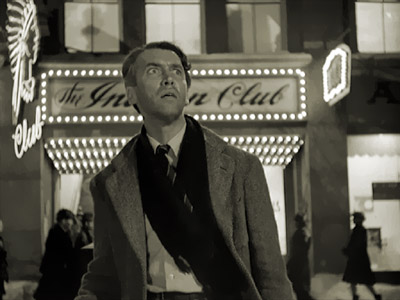
If I do it long enough, I feel like George Bailey, surveying Potterville, with the full horror of it beginning to dawn on me:

(That’s actually a pretty good depiction of how I felt at AWP in Chicago, last spring, and Unmetgoalville was pretty much why, although I also get awfully used to my little town and don’t necessarily function well in towns larger than 17,000 or so, at least not without some self-coaching. Pitiful, really, given that 17,000 is how big Mt. Vernon is, where I went to high school–if you’d told 17-year-old Marnie that 47-year-old Marnie would have a hard time feeling comfortable in Chicago, the teenager would’ve laughed, since she regularly drove in the Windy City whilst visiting her brother.)

And here I am, coming across the teaching job that doesn’t even seem to recognize me.

“But I’m a full professor,” I yell, chasing the poor ad hoc position into the bar where she faints.

“My life’s not like that,” I says to myself. “Really it’s not,” I assure myself on a cold, rainy, November afternoon. “I’m not Muncie Jones.”

Whereas, of course, I am in some ways. Indiana Jones’s sister Muncie wasn’t intentionally a play on Virginia Woolf’s Judith (Shakespeare’s sis), but that had to be lurking in my mind somewhere.

However. Now that I’ve seen Shakespeare’s Will, I can’t think of any woman in Shakespeare’s life without thinking of Tracy Michelle Arnold.

Which is where things take a turn for the better. Tracy portrayed Anne Hathaway with a phenomenal range of vulnerability and fierceness. (Now that I’m reading Brene Brown’s Daring Greatly, everything has something to do with vulnerability.)

There is fierceness in this family of women–the Jones family, the Shakespeare family, my own family.

A lot of my life, that fierceness has come out in less-than-productive ways. It may be why I liked playing with fire.

In my middle age, I am finally, finally learning to channel that fierceness into focus and grit.

One of my role models is Jenny Shank, who first caught my eye in Poets & Writers (Jan/Feb 2011), when she wrote about being a “Ham-and-Egger,” a phrase she got from Don DeLillo, which she defines in this way:

“I love that phrase, ham-and-egger. It’s how I think of myself as a writer. I’m not going to dazzle anybody with lyricism or structural ingenuity. But I put my head down and work and sometimes a story comes of it. I ham-and-egg my way through. It took me a long time to figure out that not every writer has to be brilliant.”

She also writes about sobbing during a Fellini movie because it reminded her “of my childhood dream of becoming a writer, one that I haven’t shaken for three decades, a dream that I almost gave up on a number of times, even though I still continued to write.”

And if the subject matter itself weren’t inspiring enough, she referred back to Fellini and said “Okay, so I’m not an orphaned Italian hooker in a ratty fur. But inside, aren’t we all orphaned Italian hookers in ratty furs?”

I know I am.

And I sobbed and sobbed later that spring in 2011, two different times (I don’t sob much, so I remember them). One time was taking a detour on my way to work, to go sit in the gorgeous St. Luke’s in Plain, Wisconsin and pray–this was in the midst of Wisconsin’s Arabesque Spring, when we were protesting in the snow. I felt as though the job I’d worked so hard at for 20 years was just being spit on and ground into the mud by the heel of a governor’s anti-union, anti-education Act 10.

The other sobbing happened when I got my rejection from Wisconsin Wrights. I’d submitted a revised version of Gashouse Love, a full-length play I started writing in February of 2003. I got a full typed page of comments that told me pretty thoroughly the play didn’t work. That was the bad news. But there was plenty of good news in that page–the anonymous commenter took the play very seriously, was clearly hooked by it in several ways, and very much seemed to want it to work. The sobbing came from having put in a lot of hours revising, all those hours COMING TO NAUGHT (that’s how it felt at that moment), but mostly a sense of exhaustion (see previous paragraph’s sobbing) and utter bafflement–I had almost no idea at all how to make the play better, but any little hint of how to revise carried with it a tag of THIS WILL TAKE HOURS, WEEKS, MONTHS, POSSIBLY YEARS OF WORK.

But I didn’t give up. I didn’t. I almost can’t believe it, but I didn’t.

I am sure I had the phrase “ham-and-egger” in mind.

I’d spent most of the summer of 2010 working on the poems of Speakeasy Love Hard. Gashouse Love has three generations of a family dealing with what they call “the flapper girl poems,” and I knew those poems needed to exist in full, regardless of how much showed up in the play.

The anonymous commenter for Wisconsin Wrights said the poems needed to be in the play more, and I didn’t know how to do that. I know a little more, now.

The poems from 2010, whose origin was a play begun in 2003, finally went public in the fall of 2012. It was a wonderful evening. One of the outcomes of getting to hear Sarah Day, Ashleigh LaThrop, and Nate Burger read those poems was that I felt as though a nuclear reaction had gone off in the middle of Gashouse Love.

Is the path to revision any clearer? No–but I’m excited to work on my writing plan for the rest of this semester/academic year, and will include in it “Listen to recording of Speakeasy Love Hard multiple times, with friends, taking notes and getting feedback on revising Gashouse Love.” I’m giddy with the thought of it because that play needs those poems. All of them.

Forever is how long I’ve heard you have to focus less on publication and more on enjoying revision. Could it be I’m finally there?

Not that I’m giving up on publishing. I’m not. But I am compartmentalizing and strategizing. Here again, Jenny Shank’s article was helpful: she says she invented “Johnny Business” as a way to compartmentalize the publication goals. It seems to me he lives in the same neighborhood as Michael Perry’s muse–Perry says his muse is the guy at the bank who’ll repossess his house if he doesn’t write more and get paid for it.

All of this is validated in creativity studies. In a textbook on creativity (would love to teach or take a class using this as a textbook!), Mark Runco summarizes several sources on persistence and calls it “a prerequisite for creative accomplishment,” saying that “important insights often demand a large investment of time.”

“A decade may be necessary for the person to master the knowledge necessary to understand the gaps and nuances of a field.”

[Or in my special, special case, a decade OR TWO.]

Runco quotes Arthur Cropley (one of his books charmingly has a picture of a chicken and an egg on it) who says, “In addition to possessing certain personal traits, creative individuals are characterized by their willingness to expend effort.”

Runco follows that up with a nice reiteration: “That is a good definition of persistence: The willingness to expend effort.”

Jenny Shank’s efforts are paying off–her most recent book, The Ringer, won a High Plains Literary Award. I’m so happy for her!

And Muncie Jones? Maybe she hasn’t spent as much time dodging poison darts as her hotshot brother. But she’s hanging in there. She’s been teaching four sections a year for 21 years, and sure, in one way, you could say that job has has ground her soul down to nubbins.

But you could also say it’s been really helpful ballast, and that her hot air balloon, her ship, her (whatever transportation mode requires ballast), is about to dock somewhere truly exciting.

It’s like what Jenny Shank calls “a lawn sprinkler of hope that just sprays randomly around without any direct target.” That’s not cold, gray rain on my window. That’s hope.