CONTEMPLATING THE DECLINING PERCENTAGE OF INVESTMENT IN HIGHER EDUCATION AND IN PARTICULAR LEGISLATORS AND GOVERNORS WHO NEVERTHELESS CHEER HARD FOR THEIR SPORTS TEAMS, WHILE ALSO MULLING THE CURIOUS MANEUVERS OF UNIVERSITY LEADERSHIP THAT MAY OR MAY NOT YIELD GOOD RESULTS FOR THOSE OF US IN THE TRENCHES, SO TO SPEAK

—a found poem using direct quotes from the first season of The Wire

The game is rigged. But you can’t lose if you don’t play.
You don’t hand no money to nobody that matters,
you don’t get no product from nobody that matters.
We ain’t got shit. But is there any other fucking way?

You start to follow the money, you don’t know
where the fuck it’s going to take you. Shit.
I’m starting to worry more about the ones that claim
to love me than the ones that don’t.

You come at the king, you best not miss.
You know something? You’re no good for people, man.
I mean, damn, everybody around you. Christ.
You’re back from the dead. You rolled away the stone.

All I know is I just love the job. I know the shit is weak
but shit is weak all over. Cool. Whatever. Shit. Fuck.
Fuck fuck fuck fuck fucker motherfucker fuck me.
So you write everything down? Yeah. Everything.

Sparrow on barbed wire. By See-ming Lee from Flickr, Creative Commons

Sparrow on barbed wire. By See-ming Lee from Flickr, Creative Commons

_____

If you want a good voice that isn’t quoting lines from The Wire, check out Chuck Rybak’s Sad Iron blog.

Daylight Savings and Loan

They say you get the hour back in the fall
but it’s so old by then you’ll hardly know
it’s yours. Remember when your postpartum ghost
convinced you that you’d been sent home, arms full
of someone else’s baby? That wasn’t true.
Come fall, don’t fret that time. Just sleep right through.
But what if we got to pick which hour to lose?
The wasted hour? The bad phone call? (To choose–
as if we could control the clock–but wait–we do.)
What interest would that time have then accrued?
Would we regret the moment and the choice?
Would we learn how badly our intentions screw things up?
Yes, and yet–we want to scream it–Cease! Desist!
to our mistakes, to family, friends, and also, yes,
to the officer who shot to kill and not to stop.

—–
I feel the need to say this very carefully.

Another young black man has been shot and killed by the police. There are peaceful protests planned.

I am praying today for the family and for the city of Madison.

I can say, carefully and logically, that I am not anti-police, that I truly appreciate how they put themselves in harm’s way so many times to protect the people they serve.  I understand, logically, and legally, that a police officer can have just cause for shooting. But as much as I believe those sentences, I also know I  write them from a position of middle-class white privilege, so I almost wanted not to write this paragraph at all.

What is more important to say, for me to say, is that the reason police keep NOT getting the benefit of the doubt is because of persistent racism.  That’s what they just found in studying Ferguson.  And there are ongoing conversations about the problems in Madison related to race.  This latest round of talks was sparked by a special editorial by Rev. Alex Gee in the Cap Times called “Justified Anger.”

I find that editorial thoughtful and disturbing. It should disturb me. It should move me to act, but I don’t always know how to act. Or when.

I might not know what to do, but I did know one thing not to do.

I’ve been thinking about Daylight Saving Time, which I hate, and I’m working on some flash fiction about it, and the first two lines of the above poem occurred to me yesterday, and as I began writing it, I wanted it to to be a mildly thoughtful but mostly silly poem about the urge to mess with time, to stop time, to take things out of time.

But what would that mean, to write a mostly silly poem when once again another young black man is dead at the hands of the police, and this time, really close to home? I couldn’t do it.

It’s not much, but I made this poem and this post not totally about me and my silly thoughts.

Of all the recent hours I’d like to lose, I’d like to lose the one where Anthony Robinson died.

Tony Robinson, in a picture from his mother's phone.

Tony Robinson, in a picture from his mother’s phone.

Briefly

The shadow of a hawk shot
through the blowing snow–
it looked like smoke
in steam.

 
I thought of my student,
no longer a student,
a union carpenter now.
Does he, driving to work before dawn,
think the stripes of ice
on the road look like pewter or steel?
 

What did I want for  him instead?
More student debt? A chance to be
a middle manager somewhere?
No, but it hurt me somewhere deep
when he talked about how much
he loved to sing but won’t have time
for choir or plays any more.
 

I guess I wanted choice
to be available to him
and probably it’s near-sighted
of me not to notice he’s made
his choice.

Feedback is what comes second, Part II

Tomorrow begins the fourth week of the sememster, and the grading is already thick. I plan to spend at least two hours grading every day this week, and then more next Saturday, depending on how far along I’ve gotten.

[I really want to work on my metaphors for grading. What occurred to me as I wrote “grading is already thick” was thick underbrush, which implies that I’m heading in with a bushhog or a machete, which is not really how I see myself when I’m actually grading….]

I’m continuing to think about the article “The Power of Feedback” by John Hattie & Helen Temperley, which appeared in Review of Educational Research in 2007.

Today I’m unpacking this chunk of a paragraph, in which they’re summarizing some of their findings:

“Over all comparisons it appears that the power of feedback is influenced by the direction of the feedback relative to performance on a task. Specifically, feedback is more effective when it provides information on correct rather than incorrect responses and when it builds on changes from previous trails.The impact of feedback was also influenced by the difficulty of goals and tasks. It appears to have the most impact when goals are specific and challenging but task complexity is relatively low. Praise for task performance appears to be ineffective, which is hardly surprising because it contains such little learning-related information. It appears to be more effective when there are perceived low rather than high levels of threat to self-esteem, presumably because low-threat conditions allow attention to be paid to the feedback.”

As I think about the reading journals I’ll be looking at later today, I’m pleased that I’ve told students I’m not concerned about grammar and mechanics in them. In general, I’m tired of how I provide feedback on grammar and mechanics (in which, since 1987, I have absolutely provided more information on incorrect responses RATHER THAN correct), and in a literature class, as students are focused on analysis and interpretation, I really don’t want them worried about grammar and mechanics at all. (That will come later, in their formal paper for the class.)

So what I need to make sure to do today is point out where their analysis uses terms from the class correctly, and where their interpretation goes in interesting directions. I will also point out where it goes badly, but I want to make sure I’m showing what works. Then, obviously, part of what I need to do is build, from journal to journal, on what they’ve done before. This seems challenging–there are 26 students in the class. How will I remember? Maybe I can ask them to summarize what went well in the last one (yes, I know I could review the previous one before I grade the next one, but honestly–I’m not sure I’ll take the time to do that). Sometimes I do remember, of course. But I won’t always remember for every student.

And then what about this part? “It appears to have the most impact when goals are specific and challenging but task complexity is relatively low.” I think the reading journal assignment I give meets these goals–I’ve given really specific instructions, and it’s a challenging assignment, but the particular tasks are not that complex (summarize the piece, use terms from class, etc.).

I’m particularly interested in the notions of praise not being effective. They don’t mean that professors shouldn’t be positive. What they mean is that when you praise the person or the effort (“You’re a good student!” or “I can tell you worked hard on this” that you’re not focusing the feedback on the intellectual task itself, and thus the feedback is less effective.) I need to think about this more and write about it more–I think it’s going to be the subject of my next “Pedagogy Stew” for the Voice of the River Valley.

But then, oh, to finish up–I try to set up my classes and tailor my feedback so that the threats to self-esteem are low, but this is hard, hard, hard, especially when we have students for whom any criticism at all feels like a threat to self-esteem.

[And gosh. Could there be a connection between images of a bush hog and student self-esteem? Aargh.]

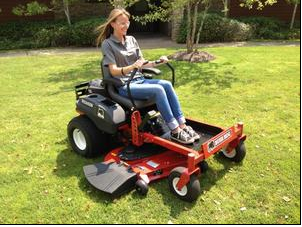
Image from Rural Lifestyle Dealer--look how happy she is to be grading journals.

Image from Rural Lifestyle Dealer–look how happy she is to be grading journals.

Just Try

Sitting at the kitchen table this morning, getting ready for work, I spied, with my big blue eyes, this:
IMG_1860

It reminded me that the origin of our word “essay” is French, “essai,” which I always heard interpreted as “an attempt.” (I don’t actually know French, but I know the things Moliere wrote were called “Essais” and I know Dave Smith wrote some essays called “Assays.”)

So when Bounty wants to tell its French-speaking paper towel customers to try napkins, it tells them to ESSAYEZ. (I picture my French doppelganger in Montreal, finishing her tea, taking a deep breath, hoping it’s going to be a productive day….She’s a lot like me except her clothes look better on her because she’s French.)

And that’s my message to students as they head into a rough draft for their first essay assignment–just try.

“Feedback is what happens second” Part I

Gearing up for spring semester begins late in fall semester for me. That’s a practical matter–if I waited until the fall semester was over to gear up for spring, I’d be behind schedule immediately. It’s more than a practical matter, though. There comes a time in every semester, the deepest, darkest time (which in fall corresponds with shorter days and longer nights) of a semester, when it’s easier to see what’s not working rather than what is working.

One of my ongoing goals as a teacher is to return student work faster. I struggle with it for a number of reasons:

  • I don’t like delivering bad news. I absolutely love sitting down with students and providing feedback on drafts and revisions, but at that point, the possibilities for success are still wide open. With a final draft, some doors are shut. I’ve wondered if switching to a portfolio system would help me here because of how much I enjoy giving feedback early in the process.
  • I’m a master procrastinator when faced with unpleasant tasks.
  • There isn’t a clear deadline for when student work has to be returned except in terms of when they need to turn in the next assignment, or at the very end of the semester. This is one reason I think a portfolio system might work better–I’d be grading final drafts at the end of the semester when the deadlines are very firm and real.

I’m not saying these are GOOD reasons, but they’re reasons I’ve discovered.  I just realized earlier this month that I’m always slower about returning student work in spring semester & one reason for that is probably because I tend to have more problems with anxiety and depression in the spring (ironic, because I love light and love when the days begin to grow longer). I discovered it because I keep track of when student work comes in and when I return it (I call it TIR for turned-in-returned rate) on a spreadsheet & I have numbers going back several years. The good news is that overall, I’m doing much better than I used to. The bad news is that my numbers have gotten ugly the last couple of spring semesters….

Anyway, I’ve decided that I’m going to try something I’ve never tried in relation to solving this problem. (Other things I continue to do: keeping track, rewarding myself if I meet my goals at different points in the semester, reporting to someone on how I’m doing–which is what I was doing earlier this month when I discovered the WORSE IN SPRING PATTERN.  I was putting my numbers in my yearly activity report.)

I’m problematizing the problem. I’m going to do research first, on feedback, and see what the research says.  That’s where I am right now, and at least at the moment, my plan is to report on the research at different points in the semester.

I know it’s important–feedback is the thing that an instructor can do in a real class that an instructor can’t do in a MOOC, and however good AI gets, it still seems to me we’re a long way away from computers being able to give good feedback to writers on much beyond sentence complexity, vocabulary, spelling, and some grammar. Feedback is what makes instructors invaluable.

The first article I’m tackling is called “The Power of Feedback” and it’s by John Hattie and Helen Temperly at the University of Auckland.

One of the first quotes that struck me in the article was this one, “Feedback has no effect in a vacuum; to be powerful in its effect, there must be a learning context to which feedback is addressed.”  That’s why they say “feedback is what happens second.”  Instruction has to happen first.  When I read this quote I thought immediately of my discomfort when a student in creative writing asks me for feedback on something they wrote before the class.  I tell them it feels weird because I don’t know what they were trying for, whereas if they wrote in response to an assignment, I know what they were supposed to be trying to do.

I appreciate Hattie & Temperley’s article for their definitions & clarifications, among other things.  Here’s one:  “The claim is made that the main purpose of feedback is to reduce discrepancies between current understandings and performance and a goal. ” To me this emphasizes the importance of backward design–if my students and I don’t know what our goals are, I just don’t stand a chance of providing effective feedback.

These three questions seem so crucial: “Effective feedback must answer three major questions asked by a teacher and/or by a student: Where am I going? (What are the goals?), How am I going? (What progress is being made toward the goal?), and Where to next? (What activities need to be undertaken to make better progress?)”

I particularly appreciate the emphasis on the role students play in the feedback process. Here’s the good news:  it’s not a passive role. Here are some things students can do. They can

  • “increase their effort, particularly when the effort leads to tackling more challenging tasks or appreciating higher quality experiences rather than just doing ‘more.'”
  • “develop effective error detection skills, which lead to their own self-feedback aimed at reaching a goal.”
  • “seek better strategies to complete the task or be taught them, or they can obtain more information.”

So I dived into this article hoping for motivation for returning student work faster, and it does address that several pages in, and I’ll get to that as I post on the topic, but for now, it’s met a goal I didn’t even realize I had–get me pumped up about a new semester.

What can I do with this enthusiasm? Lots.  “Teachers can also assist by clarifying goals, enhancing commitment or increased effort to reaching them through feedback….More generally, teachers can create a learning environment in which students develop self-regulation and error detection skills.”

I need to model self-assessment and self-regulation by setting goals, monitoring them, and then making adjustments (all processes discussed in the article, but also widely discussed any time metacognition comes up).

So my goal for returning student work in terms of promptness is this.  By the end of Week 5, I want my overall average to be below 7 days, and the average for longer assignments to be below 10 days, but I want the standard deviation to be 2.0 or lower–this past fall my averages met those goals, but the standard deviation was too high (I was still keeping some longer assignments wayyyyyyy too long).

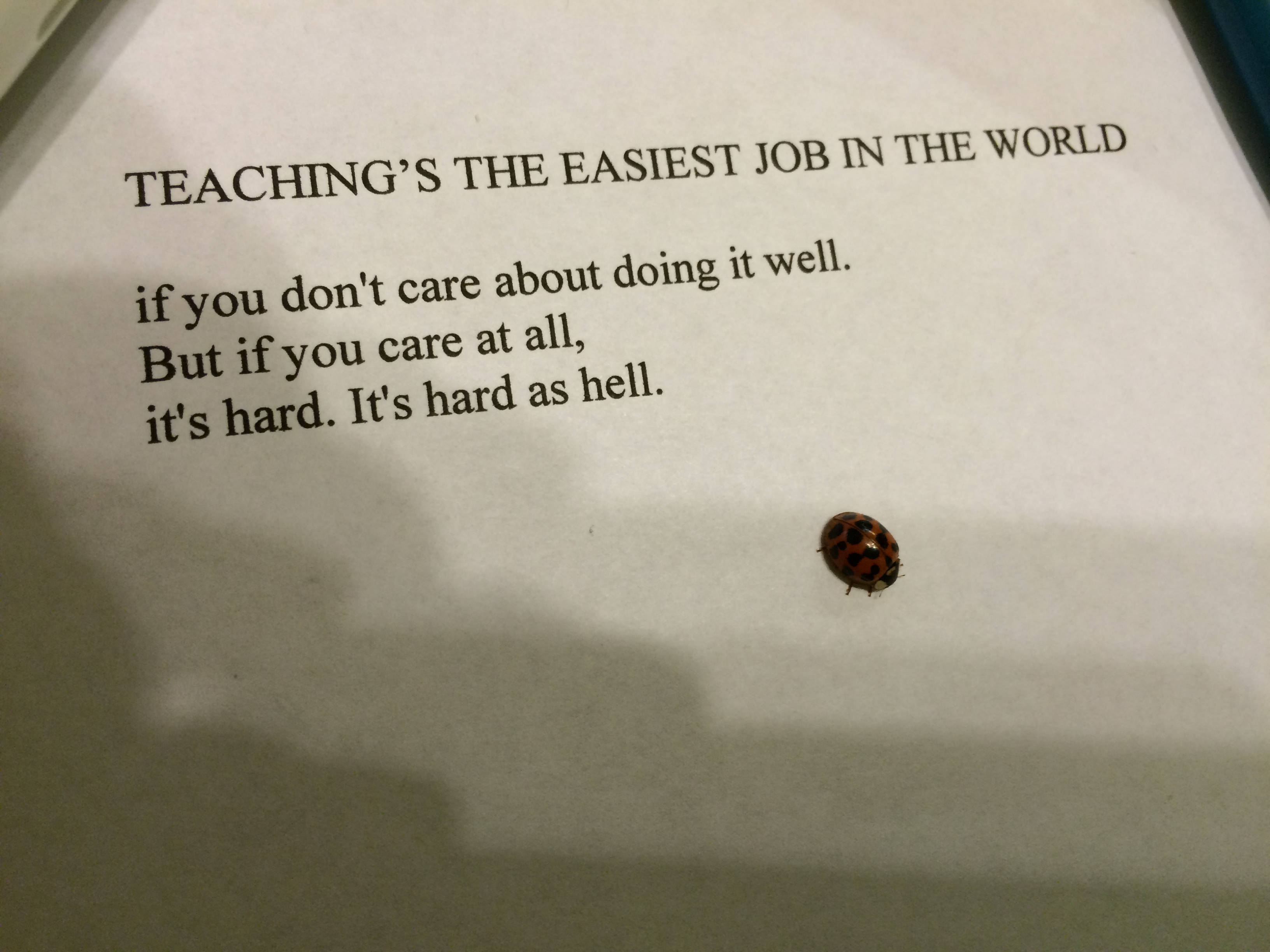
a little poem I wrote with big feelings

a little poem I wrote with big feelings

Beyond that, I’m setting some goals on the quality of feedback. I want to set the questions and good points from “The Power of Feedback” in front of myself as I start to communicate with students about their work, which I’m less than a week away from (classes start on Monday and the first assignments come in next Friday–sooner, since some students will want me to look at rough drafts, more than likely).

My plan is to report on my turned-in-returned rate after Week 5, or sooner, and I’ll also write more about this article & others I’ve found and will find.

Meanwhile–it’s back to finishing up syllabi & schedules for next week!


U(W) Inspire Me

So happy to be back on the UW Colleges English Department Executive Committee, or as I like to think of it, Master Class in Teaching.

When people ask me, “so are you having fun on your break?” I say yes, because my time is more flexible between semesters and that allows more room and time for family and movies (and also doctor appointments, actually). Of course, fun is kind of a priority for me during the semester, too, so I would answer yes to the question most any week of the year.

But calling it a “break” is misleading because even though I’m not in class, I spend Christmas Week shifting between family and grading (since our semester doesn’t start until after Labor Day in the fall, grades are due after Christmas, and since part of what I’m usually grading are portfolios, I don’t grade super-fast). Once the New Year has rolled around, I’m usually finishing up my own activity report, and years when I’m on my department executive committee, I’m reading tenure and retention dossiers, which can be very, very long (hundreds of pages each). We once did the math and figured it added up to 80 hours of work in January. (Which explains why I’m not one of those stalwart workers who are always on the executive committee.)

But it is fun, or rather, in some ways, just an intensely pleasurable experience. So many of my tenure-track colleagues inspire me.

I hum Nick Lowe’s “You Inspire Me” to myself sometimes, reading their reflections on teaching, professional development (i.e., publishing and research), and service (i.e. 700 committees).

I keep two sets of notes as I’m reading. One set is on the particular professor–this is where a professor reflects on what is going well and what might need improvement. As a member of the Executive Committee, I reflect in two directions. I reflect on the professor’s teaching, but I also reflect on my own. Thus, the other set of notes is for myself–what I can learn, what I can do to make my own courses better. And it’s A LOT, what I can learn from them. Everything from how to comment on grammar errors to how to best ask students to work online to how to provide feedback before the final draft is due to…everything.
IMG_1803

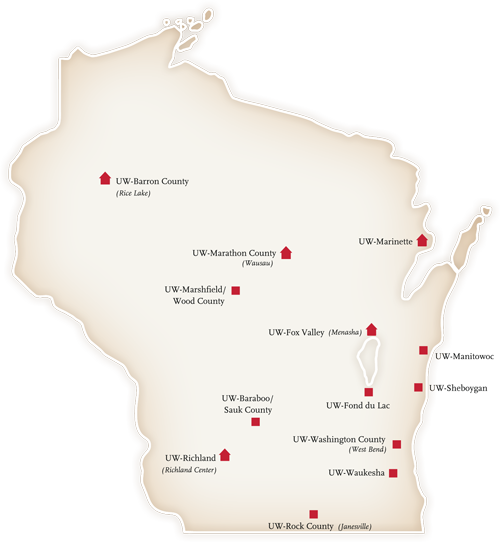
The UW Colleges is made up of 13 campuses, and we’re the 2-year college branch in the UW System tree. It would be lovely to see us mentioned in the local stories about President Obama’s call for making the first two years of college free. Here’s a story about how UW Madison researchers consulted with the president (which is great–Sara Goldrick-Rab does terrific work at the Wisconsin Hope Lab), but no mention that there are two-year colleges in the UW System.

The lack of mention is unfortunate. Tom Kleese, who used to be a terrific professor at UW-Richland before he turned his skills to helping students and parents navigate the college admissions process, had this to say:

“The UW Colleges are the perfect example of what this is for….I don’t know enough about funding or details, but I’m excited to see this on the table and hoping it sparks some productive discussion, not just positioning back and forth in the media, but actual dialogue about what we value as a citizens.” (You can learn more about Tom’s work online, at OnCampus College Planning.)

If we value student success, the UW Colleges should absolutely be part of the discussion. We have statistics that show students who start with us do better once they transfer than students who start at the four-year UW System institutions. And we’re the institution of access–our arms are open wide–so we are working with many students who are seriously under-prepared. They’re in the same class with valedictorians, which presents some teaching challenges.

In Wisconsin, valedictorians can go to any state school without paying tuition. One year my own campus, a very small campus indeed, had six valedictorians. We’re doing so many things right–here’s a recent article on how happy we are to be an international campus.

The tenure-track colleagues who’ve compiled the dossiers that absorb my time and attention for those 80 hours are all over Wisconsin at various of our two-year campuses. If you’re in Wisconsin, there’s one close to you. And if you’re lucky enough to be in class with my inspiring colleagues, you’re in very good hands.uwc-map

Deadline: Epiphany

“Traditionally it is bad luck to keep your Christmas Decorations up beyond Twelfth Night – the last of the 12 Days of Christmas.” Plymouth Herald

Some years I can’t wait for the tree
to come down. I want it up
the day after Thanksgiving and then
everything put away before New Year’s.

My friend Bellamy left hers up
through Valentine’s. Probably more than once.
A real tree—brown by the time
she got it out to the curb.

But this year I’ve wanted Christmas
to last a little longer, for the event
part of Advent not to be here quite yet.
I’m not sure why. I had good holidays,

a nearly perfect mix of quiet and fun.
Maybe that’s why. Of course that’s why.
I’ve brought out other candles to use
because it’s still dark so early in the day.

It’s still cold. I’m still longing
for something to happen and yet not
wanting anything to change.
Waiting for the wise gifts to come.

Just a few of the non-holiday candles I've dug out.  On a clean stove!

Just a few of the non-holiday candles I’ve dug out. On a clean stove!

(I actually also think one of the reasons I’m not ready to be done with the season is that I love, love, love Aimee Mann’s One More Drifter in the Snow. I’m not ready to stop listening to it. So I won’t.)

Gathering it up to put it away. NOTE THE HOLY BLATZ TRAY we use for the advent candles.

Gathering it up to put it away. NOTE THE HOLY BLATZ TRAY we use for the advent candles.

Rage, Rage Against the Dying of the Light, or Maybe Don’t

Because look where it got him, good old D.T., dead before 40,
with some earth-alteringly good poems, sure, but still,
most of us won’t die young, our underwear not only not clean
but possibly unspeakably not clean, and so as we hurtle
into the darkness of winter, the cold, the vortex
awaiting to suck down our moods and run up our bills,
let’s opt for not raging. Let’s do what we can.

Now is the time for the lighting of candles,
the drinking of port, the wearing of wool.
Time for the roasting until they are sweet
of root vegetables with their homely names:

oh turnip, oh beet, oh parsnip,
join your good pal potato,
your fat cousin carrots,
and give us the sun you soaked in through your leaves
all summer long and hid underground until now.

Give us this day our daily whatever
we need to keep going. It might be enough.

Don't worry. Something will turnip.

Don’t worry. Something will turnip.

Note to the Construction Crew

The rose that was still blooming has been moved,
but I should warn you (and I hope you’re forgive me)
I left the lopped-off thorny stems for you.

I know it’s not your fault, construction crew.
It wasn’t your idea, this demolishing.
The rose that was still blooming has been moved

to the backyard; I may have killed it in the move.
Just watch out when you get to work on my street–
I left the lopped-off thorny stems for you.

I don’t have a truck anymore. I wasn’t enthused
about another trip to the dump with the debris
of the rose that was still blooming. It’s been moved

for regrading and storm drains. Whoo hoo!
Let’s hear it for your very big machines!
I left the lopped-off thorny stems for you.

Whatever’s stopping progress is going to lose
so I didn’t try to slow or stop anything.
The rose that was still blooming has been moved.
I left the lopped-off thorny stems for you.

_____

Roses and irises--all moved to the backyard.

Roses and irises–all moved to the backyard.