
Tag Archives: education

Bearably Sad: Bearing Witness to Closure

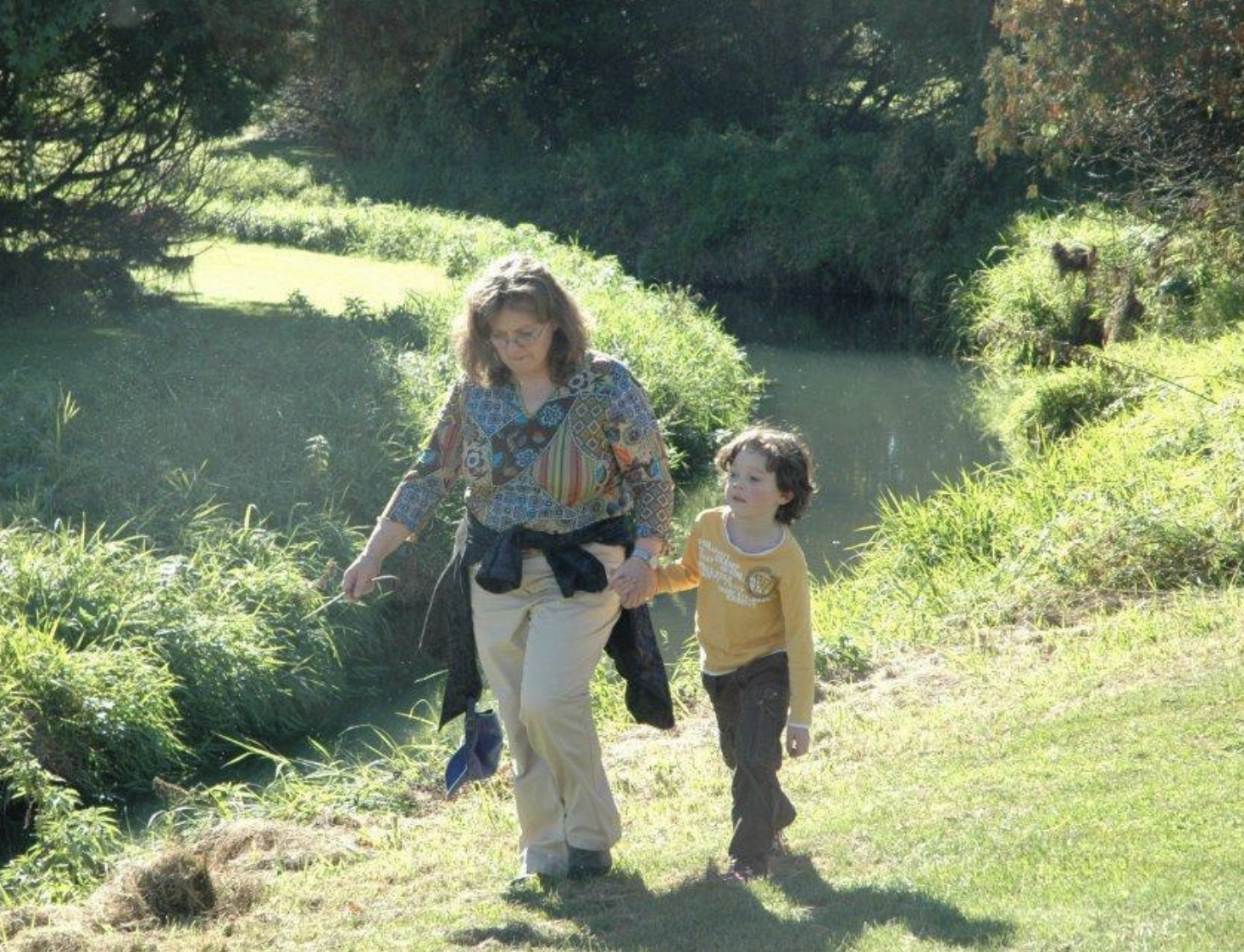
My son and I walking next to Brush Creek at UW-Richland, around 2011.

My son, my mother, my husband and I trekked to Center Cinema in Richland Center last night to watch Ken Brosky’s film Closure. On Facebook, one of my friends commented “I would think this film would be so unbearably sad.” But it’s not. It’s very much bearably sad, and there are some bright spots and funny moments, such as when a UW-Washington County student told a UW-LaCrosse professor who expressed ignorance of the Wisconsin Idea, “Why don’t you fucking Google it,” and when Ken played guitar while waiting for Board of Regents folks to return his calls (spoiler alert: they didn’t return his calls). I also found it therapeutic to boo Ray Cross and Scott Walker. I was wishing we’d set up some sort of interactions, a la Rocky Horror Picture Show, because I very much wanted to throw something when Jay Rothman appeared onscreen (was apparently out of boos by that point).

Obviously those of us directly affected by the closings of various UW Colleges campus (Richland, Washington, Marinette, Fond du Lac, Fox Valley, Waukesha, and counting) find the subject matter compelling. But everyone in Wisconsin has a stake in the education of current and future students, and since Wisconsin ONCE had the reputation of supporting a high-performing university SYSTEM, and had a reputation as a state that cared about education, and now is such a dramatic mess–everyone who cares about education in the United States could find something of interest.

And Ken did a really nice job. He worked fast with a low budget, and it’s his first film, but to his credit he conducted a ton of personal interviews and edited them well, and included so many archival campus photos (and more recent photos, like the one of me & my son above). The film has a clear thesis: these closures weren’t necessary (given the budget surplus–in BILLIONS–that Wisconsin currently has available), were a self-fulfilling prophecy (“your enrollment is low so we’re going to cut your budget and eliminate course offerings and restrict recruiting…hey, wow, your enrollment is really low so now we have to close you”), and that drastic budget cuts brought about by Wisconsin Repugnant-cans are to blame. One really effective moment showed how many lawyers, financiers, and business people were on the Board of Regents when lots of bad decisions were being made–how they had no previous education experience, how much money they donated to Republican candidates. He did also, accurately, and fairly, point out that one recent bad decision (voting to eliminate the positions of/lay off/fire 30+ tenured faculty at UW-Washington County and UW-Waukesha) was made by a Board of Regents that consists largely of appointees by Democratic Governor Tony Evers.

My good friend and former colleague Ellyn Lem writes well about that firing of tenured faculty in an article today in Inside Higher Ed. One poignant quote among many: “What is saddest for me about losing my tenured job is that I used that ‘commitment’ from the UW system to be committed back.” That was certainly true of Ellyn, and I saw my work the same way, as did sooooooo many other faculty members. I’m very luckily and happily retired now, but it’s just luck that I was on a campus where losing my job wasn’t in play.

I should disclose I’m biased about the quality of the personal interviews in Closure, since I was one of them, and I show up a lot early in the movie. (Fair warning if you’re used to my looking snazzy–I look pretty ratty, like someone who’d been moving boxes and had maybe been through a hard time for several years, both of which were just true. Good thing I’m not vain.) It was nice to be able to talk about the campus, about trying to scramble to do something, anything to help keep it going and open, and what it was like to be a parent on campus. Ken, novelist that he is, picked up a nice narrative, that my son grew up on campus, felt comfortable there, took 10-credits of biology on campus, would have taken more except the campus closed, and is currently working retail and working on a novel (about which he would only say is “post-apocalyptic.”)
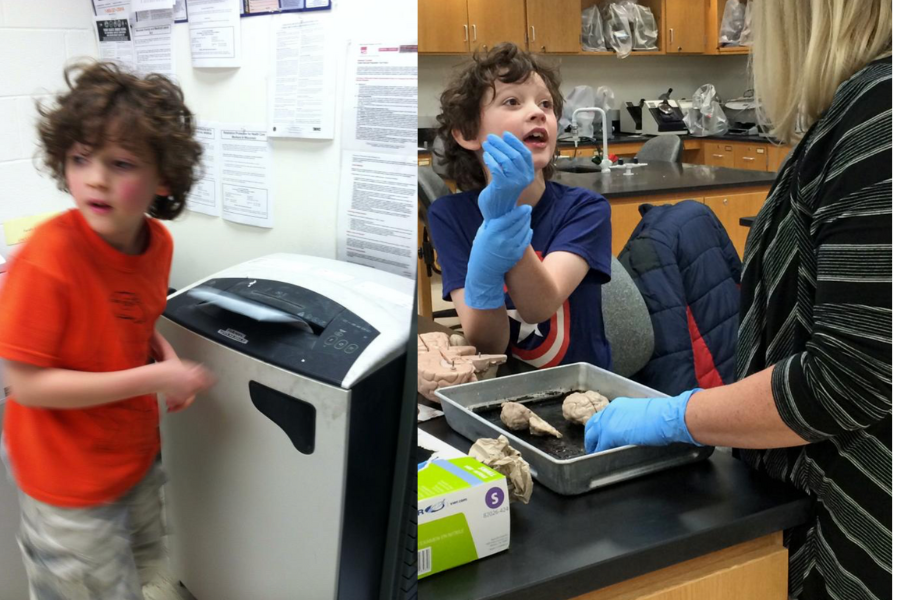
A couple more shots of my son on campus–doing some shredding for me and learning about brains from the amazing biology professor Jennifer Gavinski.

There are several reasons I wanted to blog about Closure. I wanted to recommend Ellyn’s column, I wanted to vent a little/grieve a little, and I wanted to recommend the movie. You can see it in person in Oshkosh, but there is the opportunity this weekend to watch it online. Click here to get tickets to watch it between October 4-5.

It is a very sad story, but I promise it’s not unbearably sad. Regardless, I think it’s really important to bear witness to the work so many of us did for so many students for so many years.
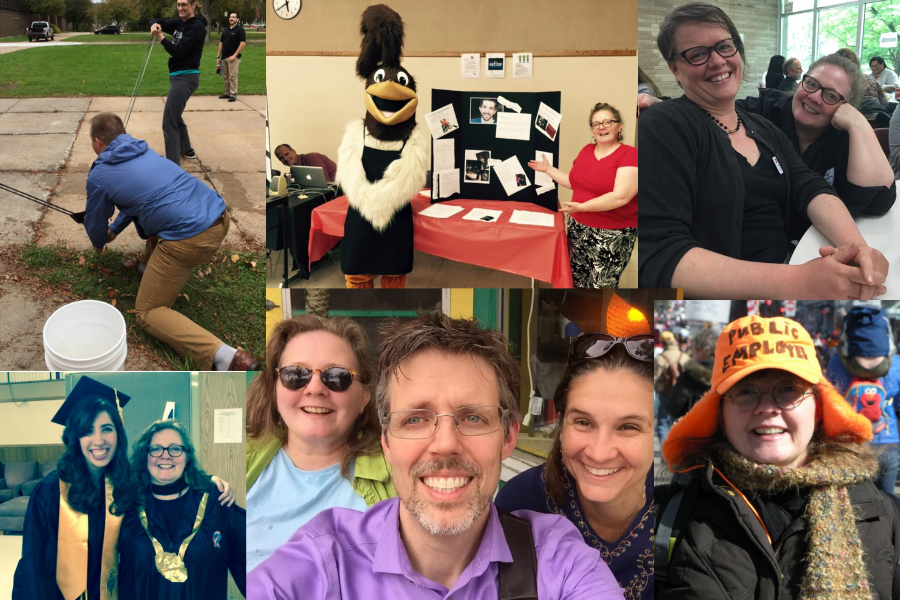
Clockwise from upper left: Fun Infusion Task Force shooting water balloons at the band (we were aiming for the tuba), me & the Roadrunner showing what you might do in the arts with a Richland degree (highlighting rockstar alum Michael), me & English colleague Amy at a meeting, me protesting in Madison in 2011, me & colleagues in Madison at a meeting, me and Rebecca who later volunteered to do recruiting for Richland and was told no thanks. NOTE: the duct tape medallion on my regalia was so I could point to it when speaking to other faculty with medallions and say MINE’S BIGGER.

P.S. if you agree with me that a HUGE part of the problem here is the Wisconsin legislature, dominated by Republicans because of unfair gerrymandering, you should consider donating to Wisconsin Dems. It’s a link connected to my fundraising–I’ve pledged to raise at least $210.

10 Months Ago, Something Awesome

When it was first announced that my sweet little campus would be closing, I was treated very well. The chair of my department emailed right away, and essentially, I could’ve spent Fall 2023 semester teaching at the UW-Platteville campus, or the UW-Baraboo/Sauk County campus, or online, or some mix. Online seemed right at first.

But the more I thought about it, the worse that idea seemed. Not just teaching online (which can be done very well, and which I had done at least competently already), but teaching at all. I was filled with the strongest sense of dread I’d ever felt any time I thought about it. I was writing in my journal at one point and the thought occurred to me, “I’d rather be dead.” Not, as in, I was or am suicidal in any way (I have issues, but that’s NOT one of them), but just–my subconscious trying to let me know DON’T DO THIS.

So I decided to retire and announced it and said right away I wanted a big-ass party. I couldn’t get the kind of party retirees at my campus had gotten in the past, where the retiring faculty or staff member met with the dean’s secretary to sketch out what kind of party, after which people would make donations for the party and the gift(s). Nope, couldn’t do that. By the time the campus was closed, there wasn’t a dean, let alone a dean’s secretary. But dammit, I wanted a party. For myself, yes. As I said in my remarks, any criticism anyone ever had of me as a professor wouldn’t be news to me, because I’m super self-critical as a general rule. Super high ambitions and expectations of myself. But I wanted to end my Richland teaching career with people saying nice things to me. To somewhat balance the scales.

My mother and father very generously funded everything, and the lunch ladies made an amazing spread, and my good friends Gail and Lisa (and Lisa’s whole family) handled logistics so it would just work.

So yes, I wanted it for me. But I also wanted to have at least one final party like the parties we’d had in the past, something people could come to and have kind of a reunion, and that’s exactly what happened.

And I wanted it during the school year, so Richland’s last batch of students could attend. It ended up needing to be in March, because we had two alumni events, spring break, play productions, and awards night taking up other weekends before finals.

Thus, the fact that I’m just now sending out thank-you cards is embarrassing. Tacky. Ridiculous. Awkward. Maybe not worth doing at this point? But I am doing it. With personal cards to people who nicely brought or sent gifts, and then probably postcards eventually to people who brought or sent cards, and if there’s someone on the sign-in sheet that just showed up to wish me well and didn’t bring a gift or a card (or they DID but I’ve lost it, which–I’m kind of a clutter-monkey, so yes, things do get lost, and it has been TEN FREAKING MONTHS).

So, for everyone in the above paragraph–your personal thank is coming, slowly but surely. In the meantime:

That’s the design I made for postcards and coffee mugs. I asked people attending to take a postcard and write a thank-you, not to me, but to someone else who’d helped make Richland wonderful.

If you were there and want to relive it, or wanted to come but couldn’t, or are just curious now, or whatever, it is available on Nova Video’s YouTube page, A Very Marnie Sort of Retirement Party.

I’ve watched it once or twice. I might watch again and transcribe my remarks and do another post with other remarks I considered making but cut because, as my good friend Sarah says, “Never leave them wanting less.”

And maybe that’s a good sentence to remember, when a career ends (just a little) too soon. Feels good when I apply it to my professional English teaching years, 1987-2023. When a much-loved campus closes leaving an educational desert behind, the sentence doesn’t have the same ring to it.

Pedagogy Stew: April 2013

Objects in Motion

I’m so glad dance is part of my son’s education.
Sometimes, sure, an object at rest remains at rest,
But tonight an object in motion continued in motion—

A whole school of molecules kept dancing,
From slow solid to wavy liquid to hyper gas.
I’m so glad dance is part of my son’s education,

unlike mine. When I dance I’m like a squirrel on the ocean.
My grade school almost never danced—toomany Baptists.
Just like the law that keeps all those objects in motion,

he’ll continue to feel what he’s learned, not just emotion—
it’s embodied learning at its cellular best.
I’m so glad dance is part of my son’s education,

not just text and audio, not just construction
paper, more than dioramas, more than tests.
The law says an object in motion continues in motion,

and here’s proof. Still dancing, past bedtime, way past.
Those filthy feet look like a month of dirt amassed.
I’m so glad dance is part of my son’s education.
An object in motion continues in motion.

At least every quarter, the River Valley Elementary Studio Schoolin Spring Green has what is called a “culminating event,” where students display what they’ve learned in the previous unit. We’ve seen art galleries, tableaux, singing and now dance. Students worked with local professional dancers, along with their regular teachers, to choreograph the states of matter and the laws of motion, and at the end of February, we got to see them dance to “Solid Liquid Gas” by the band They Might Be Giants (as well as more classical works).It’s not just what you learn—it’s how you learn it, where you learn it, and how you demonstrate it. All of it matters.

Or, as one of my former students said recently, “You don’t break with your arms. You break with your butt.” He had just executed the most authoritative break I have ever seen. The pool table in the UW-Richland student center always has a mix of some of our most and least diligent students. This particular student has not had the most straightforward path through our traditionally-takes-two-years Associates Degree, but he has some solid momentum going now. It has been interesting, and encouraging, to watch him at rest, in motion, and exerting force—not necessarily in that order.

There are so many ways, and so many places, to learn the laws of motion.

Pedagogy Stew in Voice of the River Valley

In the category of New Year/New Adventure, this is my favorite so far. I’m very happy to have a column in the very cool regional publication, Voice of the River Valley. The tagline on the masthead says it pretty well: “A guide to people and events that inspire, educate, and enrich life in the River Valley area.”

That covers a lot because there IS a lot here–I’ve been here for more than twenty years, and I’m still amazed. There really does seem to be some kind of vortex that draws in interesting stuff, and I’ve never lived in a prettier place. (Sure, Missoula was gorgeous, but in a way that alarmed me the whole time I was there–I’d be driving and see MOUNTAIN in my rearview mirror and my Midwestern brain kept telling me “MASSIVE THUNDERHEAD.”)

The current publisher, Sara, is picking up nicely from the founder, Mary, and I’m happy to be a part. I’ll be posting monthly some “stewing” on pedagogy–what we teach, how we teach it, why, whether it works…. This column will typically be focused on the two ends of a spectrum I’m involved in, teaching at the college level and then volunteering at the River Valley Elementary Studio School where Wendell attends. Also, parenting involves a fair bit of educating….

The February issue is available in more than 100 locations around southwest Wisconsin, and also online. The January issue contained this piece, which I’m happy to reprint here (I’ll always wait to post one until the next issue is out–and I’m making almost no changes here, except to add links or correct minor things I meant to say differently.)

ALSO NOTE: I’m happy to take requests. What should I write about as I’m stewing over pedagogy that applies to both college and our public schools?

_____

Howard Gardner’s groundbreaking book, Frames of Mind: The Theory of Multiple Intelligences, came out in 1983, the year I graduated from high school. I saw no evidence of its existence in my college or graduate school courses—as an English major, I was supposed to demonstrate what I knew through exams and essays, and I did a pretty good job of it. In creative writing classes, I was supposed to experiment, but on the page, with regular ink. I did occasionally ask professors to assess my learning in ways they hadn’t announced in the syllabus. I once wrote a poem in response to John Betjeman’s “The Conversion of St. Paul” (better than anything I was writing in creative writing) and asked if the professor would grade it instead of the essay he’d assigned, which wasn’t going well. He was a sweet man and said yes, “But try harder to write an essay next time.”

It wasn’t until I’d been teaching full time for several years that I began to hear about multiple intelligences (or their close cousin, learning styles) from two directions: my university colleagues, typically with much derision; and students, some of whom were very aware of what they were good at and how they learned best. In fact, I’ve had several students over the years tell me they were kinesthetic learners and thus not good essay-writers, and could they have an alternate assignment? (For irony, see previous paragraph.)

I’m interested in how students learn, though, so I do not meet multiple intelligences and learning styles (and I know they’re not the same thing) with the same skepticism as many of my colleagues. Asking about this recently, one common response from my colleagues ran along the lines of, “Wasn’t that all debunked?”

In a 2009 article called “Matching Teaching Style to Learning Style May Not Help Students,” author David Glenn reported on research that shows that although students may have a preferred learning style, the crucial thing, in terms of learning, is whether the teacher has designed the class to best teach whatever concept or skill is currently on the docket. To me, this is the best match-up of theory and practice.

I volunteer a couple of hours a week in my son’s second-grade classroom at River Valley Elementary Studio School, usually during literacy time. His teacher, Nicole Steigenberger, has done a terrific job of setting up a variety of activities for students to choose from, and she nudges them, gently, over the course of a week, to read to themselves, to a partner, draw in response to written descriptions, write in response to pictures with prompts, write their own stories, etc. They also take online assessments periodically, and they get a few minutes just before lunch to do literacy apps on the iPad. These students are not only learning to read and write. They’re learning to learn and demonstrate their knowledge in a variety of ways, which, given the amount of learning they have ahead of them, is almost as important as learning to read and write.

Professor is “Person of Interest” in Crime Against Civility

My contract starts up again on Monday, and one of the things I’ll be working on before classes start is Xeroxing my yellow and red warning cards–if anyone’s late to class one time, it’s an automatic yellow card, no matter the reason. Late a second time? Red card.

Once you get a red card, you have two options: go talk to our Student Services Director, so he can either kick some serious ass, or do some problem solving. Option #2 means you go to our Roadrunner Café Lunch Ladies and you do

WHATEVER THEY TELL YOU TO.

You don’t get to come back to class until you have the signature from one of those folks.

The policy applies to me as much as my students, and it’s kept me on time, as much as it has my students. (Before motherhood, I swear I was NEVER late to class. But the last 7.5 years, I’ve felt so scrambled for time that I’m always thinking I can get just one more thing done before I walk over to class….)

Sure, it’s a little juvenile, which one of my consistently-tardy students complained, immediately, loudly, last fall when I introduced the cards. But, as another student said to him, “So get to class on time.”

What I like about this policy is that #1, it worked. #2, it was silly enough to bring some lightness to the subject. #3, it was so clear-cut that there wasn’t much fussing about it when someone was late. I think the idea began germinating when one of my colleagues said he has a cardboard box at the front of the room and anyone who was late had to bring a donation for the food pantry the next class period. I liked that, but then there’s a box to deal with, and worrying about students stealing ramen when I wasn’t looking. Warning cards seemed easier, and sillier. (And as we always used to say at Lake Benton Baptist Camp, soccer players have the best legs.)

All the best advice about handling classroom incivility involves making expectations clear and enforcing rules consistently.

The red card/yellow card (in addition to now implying that I perhaps watched more than three minutes of the Summer Olympics) allows me to be clear and consistent.

Do I wish, as a college professor, that I didn’t have to do anything like this, ever?

Sure. But if wishes were horses, I’d find them alarming and probably be allergic to them.

Part of what helps me love my job is that I try to teach the students I have, not the students I wish I had. And honestly? If I had the students I wish I had, I’d probably miss the ones I have now.

If I get out of teaching anytime soon, it won’t be because of my students.

We’ve seemed to have waves of tardiness at UW-Richland in the 20 years I’ve been there. Some semesters it’s an issue, most semesters not.

But I try not to blame students for this, not after I’ve made my expectations clear. I teach at a two-year campus, so I’m getting a lot of 18- and 19-year-old hooligan-wannabes, and my thinking is that they are JUST NOW absolutely responsible for themselves.

I’ve explored the issue of civility in the classroom a number of times in workshops that I facilitated, and that workshop is now available online, at the UW Colleges Virtual Teaching and Learning Center. It’s a narrated power point, and you can watch/listen any time you want, should you want to.

I try to emphasize the notion that if things are going badly in the classroom, it is, first and foremost, the professor’s job to figure out why. It behooves us, frankly, to look at ourselves as a “person of interest” in the case of crimes against civility.

These workshops have worked best in groups where faculty, staff, and students were present—otherwise, it’s too easy for one group to complain about the others. In groups with a cross-section, too, it becomes clear that there isn’t one right way to handle any of this. I would never say, for example, that everyone, or even anyone other than me, should use red warning cards as a way to curb tardiness. It works for me; it’s up to us to find what works for us.

I’m genuinely fond of students, and that comes across pretty consistently, but I’m still guilty of what they’d list as “bad professor behavior” sometimes–being too disorganized. It’s a relative thing, of course. I’m way more organized than some of my peers, and I’m not joking at all when I say I think there’s a lot of undiagnosed ADHD in academia.

But I’m more organized all the time, and one of the BIG crimes against civility I’ve been guilty of over the years–taking too long to return student work–is REMARKABLY improved (which is why I keep remarking on it–a fair number of the posts in my blog on procrastination have to do with this issue).

In fact, the fact that you can access a perfectly lovely version of the narrated power point on the VTLC site is proof I’m more organized. I offered to narrate it last spring so Jennifer Heinert, the current director of the VTLC, could make it part of an online workshop. I didn’t know at the time, but if you use a Mac to narrate a power point, the narration is likely to just cut out. Randomly. I didn’t have time to fix it last spring, but since Jennifer was getting good feedback on “The Good, the Bad, and the Ugly: Civility and Responsibility in the Classroom,” I wanted to make it right, and I told her I’d fix it over the summer.

It took several tries of narrating test power points on the Mac before I finally Googled the issue and found out it was mostly the Mac. Then I had to line up a mic for my office PC. Then I had to copy/paste each slide into a new document, because the mix of ppt/pptx in the old one was making the whole thing freeze up in places.

So it wasn’t perfect last spring, in terms of content, and it’s still not. I wish it were even more of a scholarly project—hope someone else can move it in a more rigorous SoTL/Scholarship of Teaching and Learning direction. It was absolutely FLAWED last spring in terms of execution. Still, it did some good, and now it’s fired up and ready to go for the fall semester.

Thus, even though I do not technically, typically score high in conscientiousness self-assessments, I am capable of doggedly finishing a project.

In this case, it’s because I have immense respect for Jennifer Heinert, and the original UWC VTLC Director, Nancy Chick, and I’m thrilled to be a part of what is a really valuable resource for us in the UW Colleges (and elsewhere—it’s online! It’s free! It’s pretty-much open access! It might be a MOOC!)

But I was also determined to make it work better because civility in the classroom is so important, and if I can do anything to spark conversations that make civility more common, I’m on it.

[The original title of this blog was “Kids These Days,” but I changed it. Even ironically, I didn’t like adding to that chorus. It’s not that I think my students always behave in lovely ways. They don’t, and I call them on it. But “kids these days” not only makes me sound old and crabby even when I insist I’m trying to make a joke about it, it’s not “these days.” I was very squirrelly as a first-year college student, and that was nearly 35 years ago. I was so squirrelly that my son would probably rate it as “Volume A.”]

Getting the Pay Raise You Deserve, Part I

It’s been an interesting couple of weeks to be a professor. March 23 there was the guy from the Washington Post, who proceeds from the basic assumption that professors are overpaid and underworked. A lot of people responded (call for the Day of Higher Ed, Aeron Haynie’s good response), and their responses are valid and important, but if you pair his editorial with news from the Chronicle of Higher Education yesterday, reporting on faculty salaries, the bleak picture suddenly gets sunny for the UW Colleges:

The Washington Post guy isn’t talking about us. He can’t be.

He mentions salaries that are almost $30,000 more than ours, for faculty at a two-year school where scholarship and research aren’t listed as part of their responsibilities. (Their teaching load seems higher, but one class might just about equal the time we’re asked to spend on professional development, at least as we work toward tenure or try to stay competitive in the merit pay pool—oh, wait. There hasn’t been money attached to merit ratings for something like eight years.)

He imagines faculty are capable of spending 20 hours in the classroom (approximately six classes) as opposed to the UW Colleges typical 12 (typically 4 classes) and then getting all the class prep and grading done in another 20 hours a week. I know he’s not talking about us at this point-—that only works if faculty are delivering lectures they’ve delivered before, for classes they’ve taught multiple times before, assessing assignments that are not writing-intensive (maybe he’s imagining multiple-choice tests graded by scan-tron or given online), spending no time on course evaluation or innovation. That’s not us.

He seems to think we take a month off between semesters (I do usually manage to take a week off then), don’t work on spring break (most of us do), and he imagines us lying on the beach on “summer vacation from mid-May until September.” I don’t work full-time during the summer, but I work a lot.

He says that “faculty salaries now mirror those of most upper-middle-class Americans working 40 hours for 50 weeks,” but ours don’t, not in the UW Colleges. And most executives I know get more than 2 weeks of vacation.

THE LUXURY OF IMPROVING OUR LOT

Along with the Washington Post guy’s bad math comes the Chronicle of Higher Ed’s survey of faculty salaries.

Relative to faculty at other two-year institutions, we’re simply not overpaid. For example, I’m a full professor, and I’ve been teaching at UW-Richland for 20 years. My salary is about $5,000 below the $62,000 average for full professors, and that average is in the bottom 25th percentile for salaries at 2-year institutions. “Far below the median,” the Chronicle says. I’m relatively comfortable sharing my salary because it’s available online if you’re on a UW System computer, and available through the mail otherwise. (I think it ought to be online for everyone—I think it used to be. Besides, I’m a public employee. Taxpayers and tuition payers do pay my salary, and many of them, if you look at numbers people throw around when they talk about faculty salaries, think I make a lot more than I do.)

Relative is the key word—-if someone’s out of work, having a job at all seems immeasurably bountiful. If someone has work but not benefits, having a job with decent benefits (even if we’re paying more for them now), sounds terrific. If someone works for a company (or state) who raided pensions already, our nervousness about future raiding might seem almost quaint since, at the moment, the Wisconsin retirement system is sound. Even inside academia, being a tenured faculty member, or even tenure-track, is a position of relative privilege, given how many highly qualified professionals are scrambling to line up as many sections a semester as they can. Those of us with tenure do have something precious—-a measure of security in an insecure economy (although tenure is being starved by neglect, with fewer and fewer new tenure track positions all the time, and tenure is ultimately as vulnerable to changes in legislation as collective bargaining rights–and I don’t think people would show up in the tens of thousands to protest on our behalf if tenure went away). It is all too easy to come across as whining, and something like “I had to spend an hour on the phone getting my insurance coverage worked out today” can come across as ingratitude, a classic First World Problem.

In that context, it is a luxury to consider what changes we could make to improve our lot. But you know what? A lot of us in academia do have that luxury, especially those of us with tenure.

TRUTH AND CONSEQUENCES
Pay raises are possible, even in these budget-cutting times. You can engineer your own, without talking to administrators or legislators or resorting to crime. “Well, it’s happened,” you’re saying to yourself. “Marnie’s gone all the way around the bend.” No, not this time. You can raise your earnings very simply—

Raise your hourly wage by working fewer hours.

(Coming tomorrow in Part II, I’ll tell you how.)