Category Archives: Creativity

Marnie’s Idea Mill–churning out great ideas since…NOW.

I am pleased, excited, terrified and astonished to be announcing the launch of Marnie’s Idea Mill, a crowdfunding campaign on Indiegogo.

I’m raising money to replace myself in the classroom, so that I will have time to design and implement workshops on creativity.

Thanks in advance for checking out the site and considering making a contribution!

You can help other ways–posting the link on your own Facebook page or blog, retweeting, or forwarding to people who might make a contribution will help, too.

I also welcome feedback on any and all parts of this project.

Also accepting good wishes and blessings!

Metaphor 1.1

Metaphor 1.1


_____
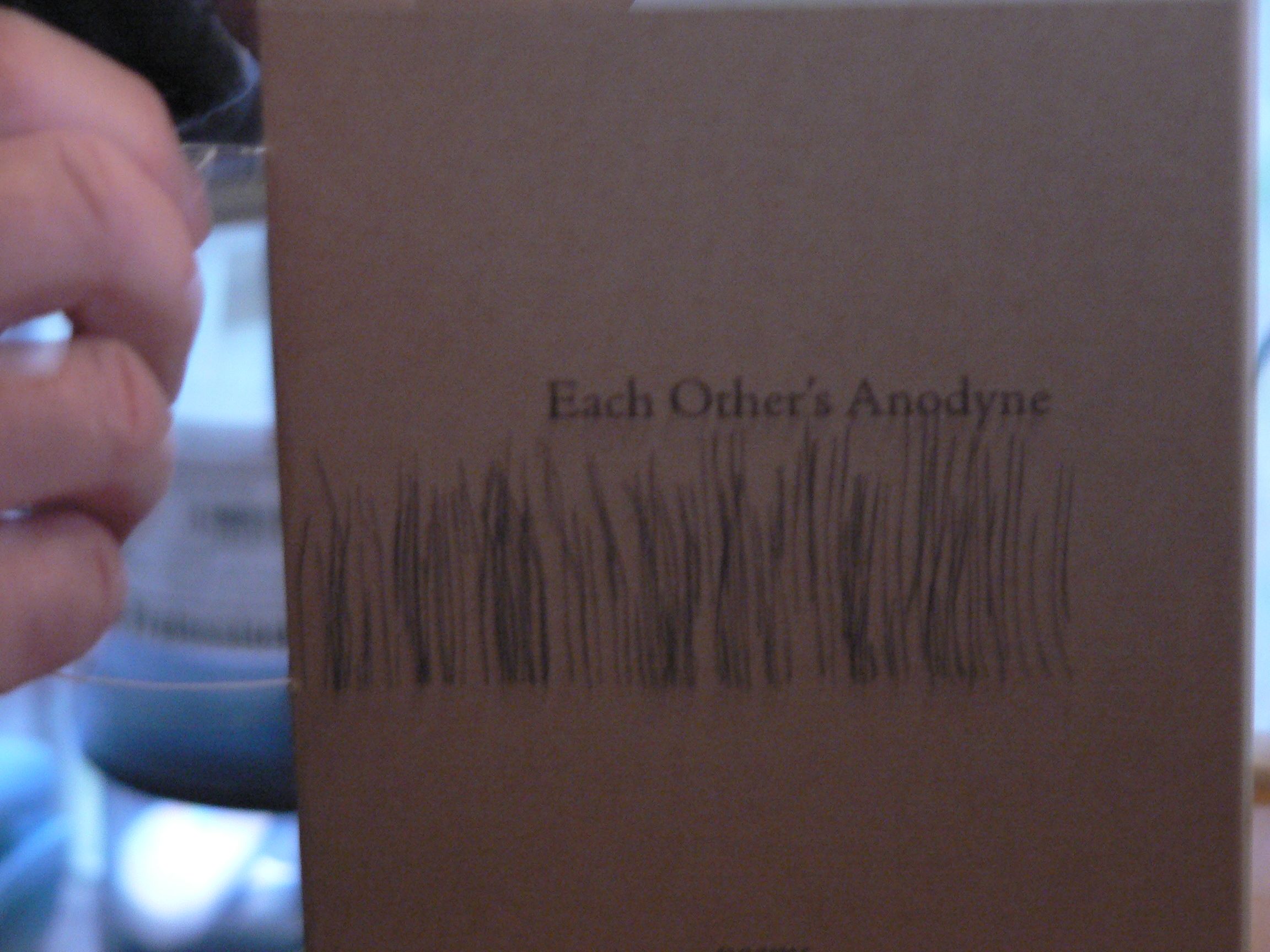
The perks I’m offering include a shout-out on this blog, a copy of Each Other’s Anodyne (a hand-sewn chapbook, a collection of my poems about teaching), feedback on your own creative writing, customized sonnets, and personalized creativity coaching sessions.

As of today, I’ve raised $10,000 in contributions and pledges toward the $24,000 total I need ($6,000 per course x four courses). My fundraising goal on Indiegogo is $4,000, and the deadline for the online campaign is June 17.

My ultimate deadline is July 1.

When I say I love impossible things, I am not kidding.

But I’m trusting Marnie’s Idea Mill can make some magic and attract some magic and make creativity workshops possible (which will then generate even more magic).
_____

Because I am married to a man who is 1/4 Finn, who has read the Kalevala multiple times and also cheers for Finnish drivers in World Rally racing, I know that the Sampo is a mill that generated an infinite supply of flour, salt, and gold.

It was made by Ilmarinen (using a forge, that, as my husband likes to point out, the Kalevala never mentions being destroyed–so maybe it’s still out there…) for the Mistress of the North, who turned out to be a nasty sort, and after a complicated series of events I couldn’t quite follow as my husband described it, the People of the South decided to steal the Sampo. The boat it was in sank, but pieces of the Sampo washed ashore and prosperity accompanied even those pieces.

There used to be a store in Madison called the Magic Mill, which I loved, but it closed. The Sampo, though–that’s a really potent metaphor.

The Sampo one of the images I had in mind when I decided to call my Indiegogo crowdfunding campaign “Marnie’s Idea Mill.”

Idea generation is a huge part of how we measure creativity, so I wanted a metaphor of something that generates. Mill seemed kindlier than factory somehow….

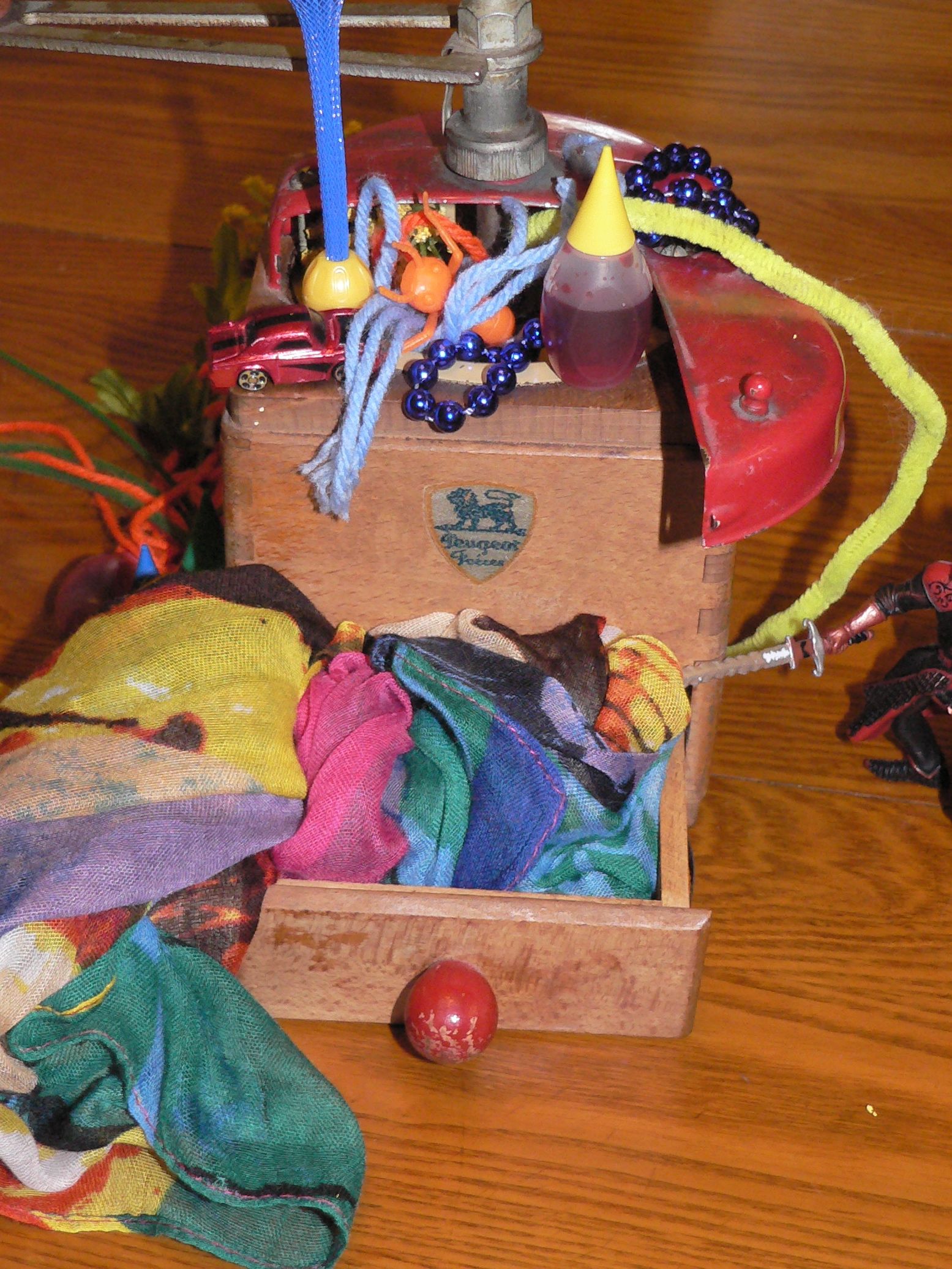
Plus, we have a wide assortment of Peugeot hand grinders (my husband is also 1/4 French).

Another old, old story I had in mind is from 1 Kings 17. In it, Elijah curses the land of Israel, “there shall not be dew nor rain these years, but according to my word.” The Lord sends him to a brook where ravens care for him, and then to a widow, who, when asked for a wee bit of bread by Elijah says, “As the Lord God liveth,” (which I think would now translate to “holy crap, man”). She says she barely has enough to keep herself and her son alive one more day. But Elijah blesses her barrel and says it will not be empty until God sends rain. (I always thought that should be until a few months after the rain showed up, but I’m sure it worked out fine.)

For me, this is a story about living from a place of “enough” rather than a place of “not enough.”

I am trusting there is enough good will and money in the world to help me meet my goal of designing workshops to help people become more creative–more people who can forge amazing mills, more prophets who can see plenty when the rest of us see scarcity….

More where there is currently less.
_____
(You can read more about my creativity research, my fundraising, and my ideas for workshops on various pages here on my blog.)

When a Marriage Makes

When a marriage makes a baby,
no one is surprised.
When a marriage makes a mess,
well, likewise.

When a marriage makes a record,
it is some kind of sign.
When a marriage makes a book,
that book, that marriage–they’re mine.

____

nath doing the hand-sewing

nath doing the hand-sewing

old school

old school

This. Feels. Amazing.

This. Feels. Amazing.

_____
40 years ago, I put together a collection of some of my own poems along with outright thefty poems cobbled from Beatles lyrics & birthday cards. It was made of typing paper, bound with construction paper and yarn. This was in order to get out of trouble in 3rd grade (having been squirrelly in math class).

I still hope, eventually, to publish a collection of poems through conventional channels, but how lovely it is to have a husband who can take a manuscript of my poems related to teaching, and make of it…a book.

Lazy, Lazy Thinking in the Noon Day Sun

I always used to talk about racism when I talked about logical flaws in my composition classes–that stereotypes came from generalizing badly. Sample size too small, oversimplifying, etc. (I don’t spend much time on logical flaws now, and I miss them–such fun names! Such color and metaphor–one day, the Straw Man smelled a Red Herring and Ergo, Propter Hoc!)

It never occurred to me until I read “Study: Racial stereotyping linked to creative stagnation” on Salon.com that racism was connected (in inverse proportion) to creativity. It makes sense, though.

I’ve written once before in this blog on the notion of lowering associative borders, in a post called “I Can’t Get No Satisficing.”  Having high associative borders is similar to what this study (described in more detail in in this article, “Racial Essentialism Reduces Creative Thinking, Makes People More Closed-Minded” in Science Daily) calls categorical thinking.

The lead researcher, Carmit Tadmor, and her co-authors say that although creative stagnation and racism “concern very different outcomes, they both occur when people fixate on existing category information and conventional mindsets.”

The study is hopeful that people can change their thinking. I am too–part of the reason I want to begin doing workshops on creativity is that studies show people can become more creative thinkers. We’re not stuck with what we were born with.

What I would call a “creativity workshop” is typically called “enhancement training” or “creativity training” in cognitive research. Hsen-Hsing Ma published an article in 2006 with overall terrific news about the possibility that we can become more creative.

Ma cites an early researcher, Paul Torrance,  who found that “programs teaching children to think creatively were at least 50% successful.” Another study from those rockin’ 1970s by Mansfield, et. al., showed “most evaluation studies of creativity training programs seem to support the view that creativity can be trained.”

SO WE’VE KNOWN THIS FOR A LONG TIME.

For the 2006 article, jazzily titled, “A Synthetic Analysis of the Effectivieness of Single Components and Packages in Creativity Training Programs,” Ma did what is called meta-analysis of studies (reading LOTS of studies on an issue and summarizing and analyzing their results), showing the following:

Good news item #1: “Overall, the finding of this study confirms the result of Torrance’s (1972) investigation; namely, that children can be taught to think creatively.”

But oh, gracious, the news is better than that:

“This study also found that creativity training programs tended to be more successful with older participants than younger ones.”

So–watch out old racists and stagnant thinkers everywhere. The times they are a changin’ (NOTE: if you’re old enough to recognize that song, you’re just the right age to benefit from creativity training.)

We can become more creative.

We can become more creative.

___

(Image from Creative Commons on flickr, “Coloured Rooms Doorways-Brian Eno Speaker Floers Sound Installation at Marlborough House” by Dominic Alves.)

On the Enduring Appeal of Bureaucracy

A roller coaster isn’t scary because
The car’s attached to the rail (you hope it is),
However high you loop, you’re certain you will
End up right where you started. A reliable thrill.
A blanket. Mowed trails. Molded cafeteria tray.
We do it this way because we’ve always done it this way.
And if you want to make a radical change,
We’ll say no. Quickly. Firmly. Again and again.
“So rather than shift to what it needed to do,
The Army would continue doing what it knew
How to do, which is how bureaucracies act
When they lack strong leadership.” Thomas E. Ricks.
Of course it worked so well in Vietnam.
So we do what we do and thus stay safe and warm.

_____

Cafeteria trays at the Googleplex

Cafeteria trays at the Googleplex

The cafeteria tray I had in mind was the kind that has spaces for your food–elementary school tray, of course. But aren’t these Googleplex trays pretty? Gosh. Might make you think it was possible to have a mix of the creative and the tried-and-true.

Also:  The Generals is just an amazing book. I applaud Tom Ricks once again.

_____

(Picture from Creative Commons on flickr, taken by John “Pathfinder” Lester)

Grateful for my Crazy Life

Just this once, right now, and I wouldn’t say
It will happen again, I’m glad I have too much to do.
My crazy job is almost never boring.
I have the kind of brain that makes big plans
Involving levels and layers and long-term fun
With multiple players and organizations, and—well,
I tell you what—it makes me feel alive.
And tending to the people that I love
Takes time, but look at who I love—a full
Roster of family and friends and coworkers, a whole town
Of creative, funny people. And I LOVE Things,
More than a To Do list, more than software.
My house is messy, yes, because we choose
To read and play instead of clean. What a way
To be allowed to live. I’m grateful. At least today.

Car Sonnets, Bloems, and Pogs

UPDATE: I no longer write sonnets while driving. Nothing bad happened, but on reflection, it seemed so clear it was distracted driving.

Did you land here look for sonnets about cars? If you leave a comment, I’ll write you one…..

ORIGINAL POST:

Lions and tigers and bears, oh my. Kind of like that.

Also not entirely unlike “father son and holy ghost” because I side with the Orthodox idea there, that the Trinity is meant to be un-understandable, to remind us there is always going to be something we can’t fathom about God. (I can’t remember where I read that, but it’s probably from my Holy Trinity of theology–Karen Armstrong, Kathleen Norris, or Anne Lamott. Probably Kathleen Norris.)

But my list is MOST like “gypsies, tramps, and thieves,” because one person could be a gypsy AND a tramp AND a thief, or there could be lots of people fulfilling those roles.

So, to define:

A CAR SONNET is a sonnet that was written entirely, or at least begun, while I was driving, usually on my commute to work. Unless that’s illegal, in which case of course I don’t do that. Who would do that? Not me.

A BLOEM is a poem I wrote primarily to post in my blog, upon which I usually commentate in the same blog.

A POG is a poem I post in the blog, which I think could probably stand alone (even though I go ahead and commentate anyway).

Of these, I would say the bloems have the least poetential. (Poetential, adj. Meaning: Least likely to stand the test of time, or the smell test, or the urge-to-revise test, or the put-in-a-manuscript urge.) They’re in response to current events or current concerns. Here’s a recent example of a bloem, a poem I wrote because I was so freaking excited that David Bowie had a new album & a new single.

And another bloem, about Ding Dongs.

Here’s a recent example of a pog (much of which I probably did write in the car as I drove to work, but I was writing only one line a day, so that didn’t take the whole commute). Since “Sustainable Chaos” is my life motto, this is an important poem, and like other pogs, has some level of poetential. One of my goals when I work on my full-length manuscript of poetry (either Summer 2013 or Fall 2013 or Winter 2014) is to look back through the blog and see which poems still excite me. I wonder if this one will.

Here’s another pog, called “Yes. No–wait” in which I have a conversation with competing voices. And which I do have in mind for a particular collection, a chapbook called “Each Other’s Anodyne,” all about teaching and work-life balance issues. It has a pretty particular audience in mind, and we may try to publish some to raise money for my sabbatical (speaking of work life issues).

And “On Conscientiousness” is an important topic for me, and I do love this poem.

Not surprisingly, “Truck Pulling the Moon” was written while I was driving.

And another car sonnet (not surprisingly, I’m often thinking of work when I’m commuting), called “The Moan Tax.”

I’m not entirely sure why these distinctions(and non-disctinctions, since a car sonnet could be a pog or a bloem) are important to me. Especially since I’ve realized one of my biggest weaknesses as a poet is the ability to view my work in terms of audience–who will love what? What should get submitted where? What will stand the test of time? (Or the smell test.)

All I know is what I do, and that I feel compelled to share, and thus–poetry is a part of my blog.

(I’ve meditated on this once before, sans categories, here.)

C-word, N-word, R-word: Forward!

Seriously considering putting a warning in my syllabi for spring semester:

CAUTION! Profanity Uttered Here.

By me, by other students, by Louis C.K. in our pop culture unit in my composition classes….

Probably thinking, "man, I don't want to be in a composition class."

Probably thinking, “man, I don’t want to be in a composition class.”

When I was tenure-track, I was getting some negative comments from students about my profanity in the classroom, (probably based on The Five-Paragraph Fuck) and my student evaluation numbers weren’t as high as they needed to be to make satisfactory progress on what I used to call “the march to tenure,” so I made swearing less one of my goals. At the time, I asked myself “how important is swearing to me vs. making sure I get tenure?” Seemed like an easy choice.

Since then, I had the honor of working with a male professor who swore like crazy in class, and got terrifically high student eval numbers (mostly because he was an amazing teacher). One of the conclusions I drew from that, rightly or wrongly, was that it’s o.k. for boys to swear. Girls, not so much.

Well, fuck that shit.

It isn’t as though I swear a whole lot, actually, in life or in class. More as a writer probably than any other time. But the freedom to do so feels important, and gosh, sometimes it’s just fun.

But I suppose I’m wanting to give my students fair warning, in case they’re likely to take too much offense. Of course, we’re a small campus, so there aren’t very many sections of any given class, so it isn’t as though students have a lot of choice in course scheduling. So maybe I just want them to steel themselves….

I guess showing Louis C.K. in class gives me automatic membership in the “It’s Our Job to Complicate Students’ Worldview” Club.” Note: I have also shown Slapshot in class. But it isn’t as simple as that.

I have two goals as a teacher that often come into conflict with each other:
1. I want to create a learning environment where students feel safe to learn and grow.
2. I want part of that learning and growing to come through experimentation and boundary-expansion.

So, for example, #2 is being satisfied when students have to grapple with the episode of Louie called “Heckler/Cop Movie,” when Louie goes absolutely nuclear on a female heckler. He calls her a c*&t and calls her mother a c*&t. He says, at one point, “You’re the worst thing that ever happened to America.” I ask students to analyze it (and some episodes of Roseanne) in terms of humor, and it didn’t take very long this past fall semester for students to notice that Louie doesn’t fare so well in that episode, that every offensive thing he does gets punished one way or the other. Then they did research, and many of them found this article: “The Filthy Moralist: How the comedian Louis C.K. became America’s unlikely conscience” from the Atlantic. So there you go, worldview complicated.

Well, worldview complicated for a lot of students. Complicated in one way for students who were appalled by his humor and needed to see how freaking brilliant he is. Complicated, too, for students (primarily male and white) who already thought Louie was hilarious, but couldn’t imagine he might, possibly, be making fun of THEM for laughing and not thinking.

You’ll notice I couldn’t quite bring myself to spell out the c-word. The DVD I had bleeped it, and we had some relatively hilarious, inadvertently hilarious class moments when we discovered that not everyone knew what “c-word” stood for, or what the word meant, or why it struck some people as different than saying “dick” instead of “penis.” #whyIloveteaching

And this takes me back to point #1 above: in our culture, the c-word has a lot of baggage, much of it painful for women. As a teacher, I now feel it is my duty, to be even-handed, to find something that some male students might feel not-just-offended-but-wounded by in the same way some way some female students felt in response to Louie’s rant. Open to suggestions here. (Seriously. Post suggestions.)

My big concern, in other words, is that I don’t guide students in pursuing #2 at the expense of the same people over and over–people who are often picked on in our society.

Just in the realm of vocabulary alone, it’s hard for me to think of a _-word that slams a heterosexual white man without any obvious disabilities. But if we were brainstorming, insults for women, those in the LGBTQ community, people of color, people who are differently-abled…those insults would just spring trippingly and quickly off our tongues.

I’m completely comfortable deleting a post on my own Facebook thread when someone casually uses language I am offended by (or worry a friend might be offended by). In the classroom, the rules of propriety and etiquette don’t seem as clear to me.
_____

As part of my ongoing creativity research, and in preparation for spring semester, I’m continuing to read Dispatches from the Classroom: Graduate Students on Creative Writing Pedagogy, a terrific book I got excited about FIRST because there are precious few articles, let alone whole BOOKS on creative writing pedagogy. This book, edited by Christ Drew, Joseph Rein, and David Yost, came out last year and I find it consistently thought-provoking.

Just this week, I finished M. Thomas Gammarino’s “Invoking the Muzzle: Censorship and the Creative Writing Classroom” and found much to applaud and agree with, but a few places I found sticky.

It’s pretty obviously connected to my concerns above.

He positions himself as a libertarian sort of professor for the most part (for which I feel some kinship, cf: assigning Louis CK, above).

“Can fiction create a hostile learning environment?” he asks as he discusses one of his own experiences as a student writer, when he turned a story into a workshop about a pedophile keeping “pets” in the basement. The teacher reacted strongly, reasoning that other students would essentially have been forced to read it, that they weren’t as free to put it down as they would have been if it had been in a magazine, etc. Gammarino dropped that class, but as he points out, the problem remains.

He summarizes another incident (that he was not involved in) in which a teacher was disturbed by the violence in a student story and sought help outside the classroom–this ended with the student getting expelled and the instructor losing her job. Gammarino blames this on the institution’s overreaction and the attempt at censorship, calling it “prophylactic hysteria” (the phrasing of which I covet).

I like how he distinguishes the basic philosophical positions: “Libertarians may find themselves in the anguished position of having to defend the free speech of people whose viewpoints they find repulsive, but those who favor enacting controls on hate speech appoint themselves to the essentially undemocratic position of prescribing a morality for the masses.”

(I would say in this case it’s not the masses so much as it is the enrollment in any given course, but the point still holds.)

I also appreciate that he asked for feedback from other creative writing teachers, and there’s one response I’d like to highlight, the one from Wilton Barnhardt: “It is, of course, always a judgment call whether this kind of incident is pure aggression, a sociopathic acting out, a smart-ass way to get attention or indulge in hate-speech, or a clumsy attempt by an untrained writer to deal with difficult topics. I think we all know good and well when it’s the former, and I am prepared to sit there and listen and help and edit when it’s the latter.”

Therein lies the sticky place for me. I don’t always know good and well how to distinguish between the former and the latter. Sometimes it’s obvious, sure, but we’ve all seen studies about the higher incidence of mental illness in the field of creative writing, so it wouldn’t be surprising at all to find problems with mental illness in the creative writing classroom.

[Would it automatically be different, I realize I need to ask myself, seeing violent imagery from a student I knew to have mental illness issues, vs. a student who seemed emotionally stable? Hm.]

Violent imagery + mental illness doesn’t automatically add up to “will act on what is described.” Still, when a student I was working with informally began submitting pieces about stalking and harming a female teacher, I wrote him and said I wasn’t comfortable working with him. He cried censorship, and maybe he was right, but one of my absolute life goals is to trust my gut more, and my gut was telling me “RUN!”

I had the choice though–he’d been my student in the past, but wasn’t enrolled in anything at the time.

Gammarino did not give much space to discussing his original teacher’s point about student choice in terms of reading and responding, but I think it’s an important question. He was also very dismissive of another teacher he knows of who asks students to fill out a cover sheet for the pieces they’re going to workshop, describing the potential offensiveness (among other things, I assume). Gammarino says “I want to challenge the warrant behind all of this: namely, that it is part of the writing teacher’s job to protect the comfort level of his students—that is, to keep them from being offended.”

But it isn’t just “being offended” that I’m concerned about. It’s trauma. If a young woman has been raped, a rape scene will be traumatic. The more graphic, the more traumatic (I assume). And even if a young woman hasn’t been raped, do I really want to contribute to the rape culture we live in by asking a whole class to read a graphically violent rape scene?

I’m remembering a particular violent story, a series of revenge fantasies by a student who had writing skills and “issues” in approximately equal measure. It just so happened that the women victims came to more gruesome ends than the men.

I worked with this particular student all semester, and tried to get him to move beyond what I called his “shock and awe” imagery. But there were female students who were deeply uncomfortable working with him, and I don’t feel as though I helped them navigate their discomfort because I wasn’t sure how much of it was sort of an intellectual “ooh. ick.” and how much was simply an appropriate reaction of horror.

Gammarino says “Clearly teachers must do everything they can to protect their students’ safety,” but in this case he means safety in the sense of not actually being the ones killed and hacked up as described in this particular story.

Nothing bad happened in that way with this student; I wasn’t really worried that it would. My “gut,” in other words, was telling me this wasn’t going to make the news.

Gammarino adds that teachers must also “maintain a level of discussion appropriate to higher education,” and that’s where I’m getting stuck. What is appropriate here?

I absolutely agree with him when he says “…insofar as we choose to protect our students from ideas we ourselves may find odious, we also protect them from developing complex minds capable of deciding such matters for themselves.”

So my goal IS helping them navigate their discomfort and their horror. I am wondering if some kind of cover sheet would help–not simply to let students opt-out of reading something they’re alarmed at before reading it, but to also help us keep track of who is pushing what boundaries.

Gammarino describes his own pedophile-with-pets story as “a chance to stretch my imagination,” and that, ultimately, is what I find most troublesome about censorship–it boxes everything up so tightly there is precious little stretching possible.

If we grant that creative writing has to be about more than the craft of writing (the “writing” half of “creative writing”), but also has to be about creativity, then the stretching is crucial, and worth a great deal of student discomfort.

But what if the student writing the scary imagery has been doing that for years? And wants to do only that for the class? How creative is that? What about the student who wants to turn in only masturbation-paced erotica? They’re pushing other people’s boundaries, sure, but not their own.

So here’s my plan for my beginning creative writing class for Spring 2013: students are going to have access to a cover sheet for workshops. Half of it will be what they want to tell other students about the piece they’re submitting, and half of it will be like this (note–VERY ROUGH DRAFT), a way to keep track of how much experimenting people are doing. So if, for example, someone is writing in traditional meter and spouting mainstream ideas all semester, we can all note that and suggest the person push in some other directions. But by the same measure, we can suggest that someone who is consistently writing pieces that “might give your grandmother a stroke” could branch out a little.

I’m also going to Xerox Gammarino’s piece for my creative writing class before the first workshop. I anticipate a good discussion.

(This is also something I’m realizing I need to research more.)

Still haven’t decided about the “CAUTION: Profanity uttered here” warning.

If My Teaching Career Were Keats, It Would Be Dead

T minus 10 days and Spring Semester 2013 officially begins for me (I know many people have started already, and no, I don’t know why our classes begin on a Friday this year).  When I turned in grades for Fall 2012, I officially completed my 25th year of teaching at the college level.  When I started in 1987 at age 22, I was not particularly good at my job, but I was enthusiastic. My skills are solider now, and my enthusiasm…well, it’s pretty solid for the part of my job that takes place in the classroom.

As I approach the beginning of my 26th year of teaching, I find myself wondering about metaphors for semesters.

Of course, it might be better not to have a metaphor for a semester at all. It might be more productive to be the Kings and Queens of Denotation (say what?) and simply proceed, understanding that a semester is a unit of time. But that’s not how I roll.

The rooms we teach in affect how we teach: Nancy Van Note Chism notes “social constructivists point out that the social setting greatly influences learning. Picture the limitations of the standard classroom or study carrel in terms of these ideas. The decor is sterile and unstimulating; the seating arrangements rarely allow for peer-to-peer exchange; and the technology does not allow individual access to information as needed. Rather, the room supports a transmission theory whose built pedagogy says that one person will ‘transfer’ information to others who will ‘take it in’ at the same rate by focusing on the person at the front of the room.”

I think metaphors affect us in much the same way. If our metaphors don’t match our pedagogy, we will find ourselves asking students to balance buckets of water on their heads whilst also spinning on a merry-go-round (one of those old-school ones that are really dangerous and hard to find) without even realizing the impossibility of what we’re asking.

(But wow—wouldn’t that be hilarious? Everyone would just be soaked and dizzy and puking and miserable and laughing like crazy.)

Here are some metaphors I’ve been mulling:

  • Train trip
  • Garden
  • Party
  • Game
  • Business meeting
  • Battle
  • Swimming pool
photo by stingberd on Flickr (available through Creative Commons license)

photo by stingberd on Flickr (available through Creative Commons license)

Pros and cons:

  • Train trip

+ Destination clear. Class schedule much like itinerary. Professor as engineer and conductor.

– Rigidity. Students are simply passengers (passive unless they take over the train, which feels like a bad western).

  • Garden

+Aesthetically pleasing. Students as gardeners. Learning outcomes as harvest

-SLOW. I always plant more than I can manage. Weeds.

  • Party

+Fun

-Learning not always fun

  • Game

+Clear objectives. Fun.

-Competition is stressful.

  • Business meeting

+Businesslike.

-Businesslike.

  • Battle

+Goals, outcome and timeline clear (if Colin Powell is in charge).

-Someone has to lose (die).

  • Swimming pool

+Professor as swimming instructor, coach, and lifeguard.  Fun. Immersion implied (the Baptist in me loves that part). Stakes are high.

-Some people show up with rocks in their pockets and WILL NOT FLOAT.

Think metaphors don’t matter? What about this:  One of my grad school professors said once, while erasing the board from a previous class, “Not erasing a board when you leave a class is as bad as not flushing the toilet when you leave the bathroom.”  It’s hard to get that out of your head, and it’s made me awfully sensitive to this particular sort of professor-etiquette (or lack of it).  But, yuck, for the image, and YUCK to saying what we write on the board is POOP in need of flushing.

As I’m working on syllabi for the spring (notice how I imply the work has already begun), I’m mulling the garden and game metaphors most.

Perhaps croquet the way we used to play at Gran’mommy and Gran’daddy’s… We must have used several sets, because I remember way more than six or eight players. And there was no standard set-up. We put the wickets in the trickiest places–one favorite was on the edge of a steep slope from the yard down to the road. If you missed that one, you were in the road, trying to hit your way back up. And I remember my Dad and my Uncle Ferrell just WHACKING (pardon me, I mean ROQUETING) each other all the way across the road, into the corn fields…

Or maybe not.  Would we actually get to the appropriate learning outcomes in a game like that?

See? That’s why I struggle, every goddam semester I’ve ever taught, with making it all the way through the semester using the week-to-week schedule I pass out on the first day. I have the best intentions of hitting each train station on the appointed day and time, but I’m just not very good at it.

I want to explore what it means to balance train-like, business-assed precision with game-like, adventuring fun.

Meanwhile, what’s your favorite metaphor for a semester? For any other unit of time? For any other job?

RERUN: Dry Stretch: Beer and Creativity (or, Beerativity)

[New blogging goals in my second year of blogging:  host more guest blogs + rerun some of my “notes” from Facebook, which I was clearly trying to use as a blog. The following is from July 27, 2011. Update afterward.]

My husband commented at dinner last night that it had been 18 days since he’d mowed, which he thought was a record. We’ve had such a hot, dry stretch here in Wisconsin that you can’t really even tell–the only things growing in the yard are those spiky things which we called plantains in Southern Illinois (so they’re probably called something else everywhere else).

It occurred to me that this is approximately the same amount of time I’ve gone without drinking.  No beer, no wine, and I hadn’t even gotten around to having my first G&T of the summer—I like to make tonic water ice cubes so the drink doesn’t get watery (though it does get tonic-watery).

A writer I know announced yesterday that he’ll be avoiding alcohol for 21 days in August & reporting for Men’s Health.

And doing more reading for my ongoing research on creativity, this section came up yesterday: “Alcoholism and Drug Abuse.” In this section, leading creativity researcher Mark Runco (who I like to pretend looks like Mark Ruffalo) makes these points, which seemed relevant to the whole dry-stretch theme:

  • In summarizing multiple findings, Runco gives these numbers:  One researcher “found a full 60 percent of those involved in theater probably having alcoholism, with writers of fiction and musicians not far behind (41% and 49% respectively).” Another researcher “found writers to be especially prone to alcoholism” (131).
  • (NOTE: poets score higher on the whole suicide index, to be fair.)

To make sense of the next point, you have to know that Wallas was an early creativity researcher, and any time a researcher discusses the stages of creativity, the basis began with Wallas, who described these as the stages of creativity: preparation (defining the problem, setting the task, doing research, mulling over different possibilities), incubation (setting the project aside & letting things stew/coalesce at a subconscious or preconscious level), illumination (that a-ha! moment), verification (when other people confirm whether the creativity is successful or just bizarro).

  • Runco reports two researchers who looked at drinking and creativity “found alcohol consumption to be related to improved incubation…as well as high originality but only in the illumination phase of the creative process. Alcohol seems to inhibit flexibility during illumination. It was also related to poor verification….” These researchers “were extremely precise in the methods used to administer alcohol. They used 1.0 milliliter of alcohol (100% pure alcohol, not Bud Light nor even Captain Morgan Rum) for each kilogram of body weight” (132).

Then he describes alcohol’s effect on primary processes (“Primary process is associative and uninhibited. It is impulsive, libidinal, and free of censorship”) and secondary processes (“realistic, practical, and reality-oriented”) (133).

  • Yet another group of researchers “administered alcohol with two experimental groups in an attempt to manipulate primary and secondary process. Surprisingly [they] reported that the alcohol group seemed to use secondary process more than primary process. The prediction had been that alcohol would allow primary process but inhibits secondary process….The surprising finding may explain the common misconception that alcohol frees up our thinking and therefore improves our creativity. Thinking while intoxicated may actually be more original, but it may also be unrealistic and worthless. Truly creative insights are both original and worthwhile Perhaps intoxicated individuals are simply very poor judges of their own thinking. They may indeed have a really bizarre and therefore original idea, and they may like it because it is original, but they fail to see that even though it is original, it is worthless” (132).

I have always been good at the preparation & incubation & illumination stages—it’s just the verification I’ve struggled with. And the notion of flexibility seems most relevant to revising—looking at options and not getting locked in to the original plan or draft.

So. It’s raining today in southwest Wisconsin, but at least at the moment, I’m still not drinking.  I’m sleeping better and feeling calmer overall. And it comforts me to know that I’m probably not losing anything in terms of creativity by staying sober.

Runco, Mark. Creativity: Theories and Themes: Research, Development, and Practice. Amsterdam: Elsevier,

2007. Print.

[11/26/12: I stopped drinking until I could imagine myself having a glass of wine or a beer without having a second or third automatically. It was the right thing to do–since I started drinking again (I think I went a couple months total without drinking), it hasn’t felt out of control at all. I’m checking to see if I can find the article Benjamin Percy wrote about his dry stretch.  One of the biggest disappointments about finding out that Jonah Lehrer is a big fat liar is that I really liked how his book on creativity talked about the benefits and drawbacks of drugs/alcohol on the creative process. Perhaps I’ll check his sources and write about that myself in a future blog.]

Also Not Sinatra, Except I’m Not Retiring

Philip Roth says he’s retired from writing:


‘“I didn’t say anything about it because I wanted to be sure it was true,’ he said. ‘I thought, “Wait a minute, don’t announce your retirement and then come out of it.” I’m not Frank Sinatra. So I didn’t say anything to anyone, just to see if it was so.’”


According to the author of the New York Times article, “Mr. Roth stopped because he feels he has said what he has to say.”  Later, though, he quotes Roth as saying


“’I know I’m not going to write as well as I used to. I no longer have the stamina to endure the frustration. Writing is frustration — it’s daily frustration, not to mention humiliation. It’s just like baseball: you fail two-thirds of the time.’ He went on: ‘I can’t face any more days when I write five pages and throw them away. I can’t do that anymore.’” 


Which seems different to me than not having anything more to say.


In any case, although I am also not Frank Sinatra, I am not retiring.


I’m still up for all the frustrations, more up for them than ever, really. I’m trying to be very intentional about which projects I work on and what actions I’m taking to build my audience.  We’ll see what the payoff is soon enough, but what’s nice about where I am right now is that if I’m not satisfied with the payoff, I’ll change what I’m doing.


Interviewing a friend last week about creativity—more on that in an upcoming post—he commented on all the work I’m doing, not just the writing, but the work of getting the writing out there in front of people (Shitty Barn, blogging, etc.) and said sort of casually that I was someone who actually had something to say (as opposed to people who seem to get in front of an audience regularly but don’t have much important to say).


Pretty huge compliment from someone I respect hugely.


And I don’t feel as though I’ve come anywhere close to saying it all.  Maybe in 33 years, when I’m nearing 80 as Philip Roth is, I’ll be done.  If I’m lucky enough to live that long, a whole Jesus-on-earth-lifetime, with my faculties intact, maybe then.


But not yet.


My first blog post was November 20, 2011. Although I had used Facebook’s “Notes” as a kind of blog  previously, and had published the occasional op-ed in the Cap Times or Wisconsin State Journal, blogging is the first time I’ve genuinely felt as though I was writing “my letter to the world,” in any kind of format that might allow the world to actually receive the letter, let alone read it, in any kind of consistent fashion.


So here’s where we are so far:

With this post,

  • 52 posts published.
  • 3,828 views all time.
  • 278 views on my busiest day (thank-you Aeron Haynie!)
  • 1,179 views in my busiest month (thank-you  Aeron Haynie!)
  • Hits from all over the world—many of which are spam, or people Googling something and landing on my blog by error or curiosity. And yet, it’s a pretty picture:

Image

(And there are more one-hit wonders below Ukraine (with its blue sky/wheat field flag), including Germany, Japan, Hungary, and Tunisia. But hey!  I have former students in Japan.  Why aren’t they reading my blog for real?  HarrrUMPH.)

These stats don’t say how many people actually read the blog, or GOT IT, or enjoyed it, but they’re interesting, nonetheless. More telling, perhaps, are my

  • 204 comments,
  • 38 “followers,” and
  • 64 “likes.”


I had no expectations going into this but still have been pleasantly surprised by the response (so I must have expected less somehow). I want to do some research to get a sense of what an appropriate goal might be for expanding my readership, but the blog has led to another writing opportunity already (more on that soon!) and more importantly, it’s given me a way to share what I’ve always done a lot of—writing.


Goals I’ve settled on for my second year of blogging:

  • try to post at least once a week (I aimed for 52 because that means I averaged one a week, but they came in very spurty spurts).
  • host guest blogs!

In fact, I want my next blog to be a guest blog from one of my favorite writers, my Dad.

In this week of giving thanks, I am thankful for everyone who’s tuned in and given my little radio show a listen. I’ll be back soon spinning the discs and dancing in the privacy of my padded room.  (Did I ever mention I started out in radio?  It’s true.  Why, one time I interviewed Big Jim Thompson when he was governor down in Illinois…..)