Category Archives: Sustainable Chaos

Oh children let me tell you of the 80s

Oh children let me tell you of the 80s when
we learned about gay because so many of
the men we loved got sick, they died, so
now when people try to calm themselves
about political mayhem they sigh and say, “Well,
we survived Reagan, we’ll survive ________.”
We say no, we didn’t, we didn’t all survive,
we didn’t, some pretty ones died,
they got skinny and sick with awful red blotches.
People wouldn’t touch them. Doctors wouldn’t
treat them. People wouldn’t say the word.
Reagan wouldn’t say the word.
I will say the word Reagan wouldn’t say,
AIDS, I’ll say it and I’ll also say
I blame him. I blame him. I blame him.

The ones who didn’t die, we worried they would,
the pretty ones, the ones who did their eyes better
than I ever could, and some of them loved women,
too, but we knew they loved men or
maybe they did or they just didn’t care what we knew
or what we thought we knew and we loved them so much
it turned out we didn’t care either and
they’re part of why we have non-binary rainbows now,
but children they’re dying now, too, too
soon, some of the prettiest ones this year, and
your middle-aged people are crying because
we were young and pretty once and
all the prettiest ones are dying.

_____

img_4605

Red wine in a blue glass #sad

_____
Update 12/26

One of my students last week was saying “Freeze frame!” and other students knew the song, and I said, “Wait–are you talking about the J. Geils band?” Yes, they were, they love it. This was in a class where they were practicing teaching a p.e. unit to elementary students (I volunteered to be a naughty student so they could practice how to handle that). One of the lessons involved teaching us the words & motions to “Y.M.C.A.” I asked one of our staffers (who was also volunteering) if he thought students knew what a big part that song played in gay culture, and he didn’t seem to know it, so I’m guessing students don’t, either.

So the 80s are back, but as far as I can see, in a pretty shallow way. Which is fine, except there are things that are important to know about the 80s, including AIDS. One of the reasons I give away condoms on campus is that I heard on the radio a couple of years that the only demographic group where AIDS cases were going up were college-age people in rural, white areas (my students, in other words). I suppose I could look up the stats to be more precise, but the point is, as with so many things, there’s so much they don’t know.

Some caveats: I remember spending so much time early on when we talked about AIDS saying over and over again “it’s not just a gay disease,” and it wasn’t, and isn’t, but we nearly lost a generation of gay men, so many of them creative and amazing–what would the world be like if we could’ve slowed it sooner?

(I also remember that we said to each other that men wearing so much makeup didn’t mean they were gay–or two earrings, or one earring on the right–and of course it didn’t, but we wondered. I remember spending a lot of time wondering. Just barely post-adolescent, I remember how sad I was to find out some singer I loved was gay because that added one more layer of impossibility he’d ever marry me. I felt the same way when I found out Walt Whitman was gay, because not only was he dead, he wouldn’t have loved me like that, anyway. Because, of course, it was all about me.)

And another thing–I revised the wording here a little. The day after the election there were several tweets saying “But we didn’t all survive Reagan/Bush.” I can’t find one that said “The thing is,” but I woke up this morning worried I’d copied the wording too closely. So I changed it. If I find that specific tweet, I’ll link it.

Bellamy

I was pregnant at your funeral so I know
how long it’s been—twelve years without your voice,
North Carolina humming like a soft-spoken ghost
in the house of your sentences. But you could be hard. Oh
my God—you made us practice our phrasing when we sang
medieval rounds. Around a freaking campfire.
I never knew just how much edge you’d bring.
You could really give the higher-ups what for,
and no one does that at our work, not any more.
Such beauty and talent and genius and grace!
And yet I saw you clip your nails in a meeting once.
(I just sat there praying you wouldn’t do your toes.)
My house is almost, not quite, as big a mess
as yours. I haven’t felt the grief you muddled through.
I haven’t done the brave things I saw you do.
You loved good friends so much and good food too.
We always met at Christmas. I miss you.

13000123_10102428318688878_6787468066648980001_n

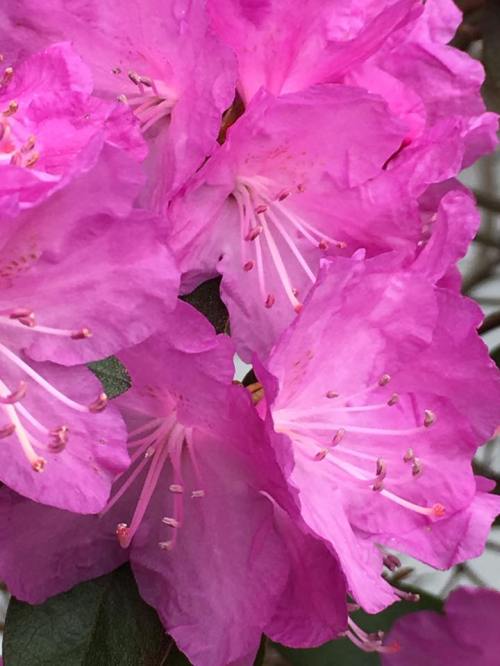
Azaleas–a pretty southern sort of plant.

No, I don’t know where your snow pants are.

No, I don’t know where your snow pants are.
Here are your snow boots, but they might not fit.
This same moment happens every year.

I always swear to myself, “next year I’ll remember.”
The spring equivalent is baseball glove and cleats.
No, I don’t know where your snow pants are.

Did you look in your closet? They should be there,
if you had an organized mother, that is. Yours isn’t.
This same moment happens every year.

Your snow boots are tight? Your feet got bigger?
Well, you’ll only have to hobble a little bit.
No, I don’t know where your snow pants are.

The coat rack? The front hall? The back porch?
The oven? Space station? Tardis? I quit.
This same moment happens every year.

It’s faster just to buy new ones, I swear.
I’m thinking of a word that rhymes with spit.
No, I don’t know where your snow pants are.
This same moment happens every year.

p1010058

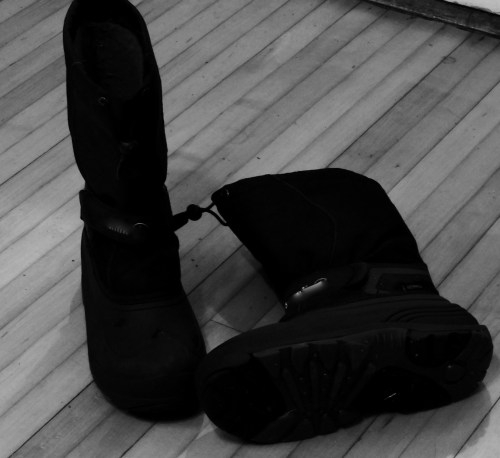
The alarmingly tight snow boots.

If I Loved You Before the Election, I Probably Still Do

If I loved you before the election, I probably still do.
Even more than how you voted, I’m thinking about
what’s good and bad, what scares us most, what’s true.

I’m worried who the bad things are happening to.
Our list of bad things might be different, but
if I loved you before the election, I probably still do.

It isn’t like I thought we lived in a commune,
but Jesus, how can we be so far apart
on what’s good and bad, what scares us most, what’s true?

Do you feel this frightened when my side wins and you lose?
I’m sorry if you do. I didn’t know that.
If I liked you before the election, I probably still do,

unless I can only be your friend if I voted like you.
It makes me anxious when we’re asking what
is good and bad, what scares us most, what’s true

because we can’t even manage to watch the same news.
It looks like a storm cloud to me. What’s it look like to you?
If I loved you before the election, I probably still do.
What’s good? What’s bad? What scares us most? What’s true?

_____

Don’t get me wrong–I have really firm opinions about the election. My side lost in the primary and the general. I’m trying to figure out how to process it, how to understand it, what to do. But one of the things that freaks me out the most is how far apart we are as a country, as a state. It feels to me like we could bust out into our own version of the Troubles any moment. (Some violence is already here.) I honestly don’t know what to do.  I decided to start re-learning Spanish.  And I did buy, but haven’t started reading yet, Katherine Cramer’s book, The Politics of Resentment: Rural Consciousness in Wisconsin and the Rise of Scott Walker.

And speaking of Scott Walker, here are some thoughts I had on similar matters five years ago. I just read the Cadfael books again and they still seem to have so much to say about disagreeing and either empathizing or not with the people you’re disagreeing with. There are two parts,  Grief for the Uncousinly Chasm. And then Grief for the Uncousinsly Chasm, Part II. There’s a part III I haven’t had the nerve to write yet, on the chasm between what I believed when I was actively Baptist and what I believe now as what I call a Zen Baptist–the chasm between what some of my friends and family believe and what I do.

You can take this line from the villanelle as either taking the Lord’s name in vain or a prayer (or both–I mean it as both):

Jesus, how can we be so far apart?

fullsizerender-6

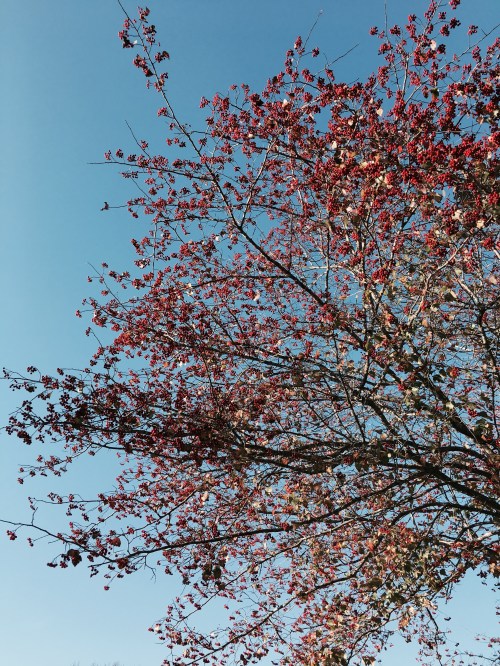
It looks like bleak November to me. What’s it look like to you?

Monday Morning Nonetheless

“And all my senses rise against this coming back to you”  Leonard Cohen

Almost an ampersand of fog
against the bare trees on the bluff.
The wind must have swirled it around,
or maybe it’s smoke. It’s cold enough
someone could have had a fire last night.

Such beauty and such mystery right there
on a Monday morning, nonetheless,
I have to drive beyond it to where
light industrial meets water treatment
and everything is ordinary, planned, and organized,
and on the other side of that, my job.fullsizerender

Totally on top of things! Oh, except for

I’ve done something today that I have almost never done in almost 30 years of teaching. I finished grading a set of skill check assignments for my Creativity & Problem-Solving class, and the moment I finished them–BAM!  I am 100% caught up with grading.  There is nothing for me to grade, not even if I wanted to (which I almost never do, which is why this almost never happens).

Here’s how the rest of the day was supposed to go–I’d finish grading, work on my to do list for next week and do a Sunday meeting a day early, take a hot bath (it’s a nice, chilly October day here in Wisco), and then eat some supper and head to American Players Theatre to see Beckett’s Endgame, with some of my absolute favorite APT actors.

Except, when I bothered to actually look at my calendar, and then the actual ticket–it was a matinee. And of course the matinee had already begun.  I suppose I could’ve rushed out & gotten seated, but wow did I not want to do that in the very small, very intimate Touchstone Theater.

So, oh well.   The nice thing is that I got results yesterday from the battery of cognitive tests I took in September to get a baseline of my functioning.  My dad has Alzheimer’s, so I wanted to know what my baseline was, but I was also curious about various brain-farts and space-outs I had over the last couple of years.  The doctor I talked to yesterday said all of those could be attributed to being a middle-aged working mother who has a stressful job. He further said that almost all my test results were superior. Only one where I was on the low end of average.

Here’s the test I didn’t ace. It’s called Trail Making, and you have to draw a line from number to number, in order.  I remember not liking the test.  I remember feeling kind of dumb.  And bored. The visual part of it is part of what makes it make sense to me I was slower–I just don’t process things visually that well. But here’s a weird twist–the next test is harder because you have to do letters and numbers in order: 1-A, 2-B, 3-C, etc., and I did better on that one, apparently. It doesn’t surprise me, really–more challenging = more interesting to me.

And yes, now that I’ve found it online, I want to try it again and see if I get a better score.

Still, overall–very glad of the timing of the consult with the psychiatrist yesterday, so  I can, with confidence, attribute today’s space-out to just spacing out. It’s not a sign of any kind of decline. It’s only the second time in all my years of going to APT that I forgot I had matinee tix.

So no reason to freak out. And also, I’m really, really blissed out about being caught up with my grading. This bliss will last until Monday when I get two sets of essays and another skill check assignment.

Good news and bad news.  Like the rose below.  I dug it up when they redid the  street in front of my house and I really thought I had totally killed it, but n0–there’s a scraggly bit of rose that’s alive. The bad news is how sad my garage looks.  And yet–I’m caught up with grading.

img_4205

Foreground: mostly dead rose. One skinny living bit. And a sad garage.

Where is the Wisconsin Idea?

13938295_250701055328531_6234391863184962089_o

The Wisconsin Idea is pretty simple. It means that whatever wonderful stuff goes on in a UW classroom, or lab, or program—that wonderful stuff should be shared. It has to leave campus. Almost everyone who talks about the Wisconsin Idea quotes an early UW president, Charles Van Hise, who said “I shall never be content until the beneficent influence of the University reaches every home in the state.” (I misquote that in my head as the “beneficent arm” and I kind of picture a weird cartoon in my head of a giant arm reaching in through someone’s kitchen window.  Now that I think about it, not really what I’m going for here. Nevermind about the arm.)

The Wisconsin Idea is the basis for the UW Extension, and all kinds of community service, all over the state. It’s a huge part of what makes the UW and Wisconsin wonderful.

Sometimes people talk about “sifting and winnowing” as the Wisconsin Idea, but technically, that’s from a plaque from the Board of Regents, or at least some of them, in 1894, and I think it’s the UW System mission statement (or maybe just UW Madison?), and it’s a part of state law. (Changing that is what a certain so-and-so called a “drafting error,” but which is actually a totally different category of error.)

So that’s what it is.  I was wondering how cool it would be if we could talk to each other not so much about WHAT it is, but WHERE it is.

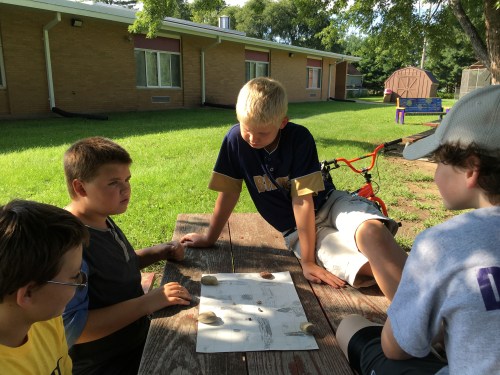
I asked for help from these youngsters, who found the Wisconsin Idea in Arena.

IMG_4088

What I’m hoping is that more people will find the Wisconsin Idea, and make videos, and challenge other people to find it. People can use the hashtag #wefoundtheWisconsinIdea and tag me @MarnieDresser and post on Where is the Wisconsin Idea?.

The format I’m imagining for the videos is pretty short & simple:

We found the Wisconsin Idea in _____________.

(Explain how something from the UW helped some way, any way, OUTSIDE the UW.)

We challenge _______ and __________ and __________ to find the Wisconsin Idea!

(Merriment and confetti entirely appropriate.  Youngsters and community members and current students and former students most definitely appropriate.)

**I’m especially hoping 4-Hers will do videos because 1) 4H is awesome, 2)4H can be VERY creative, and  3)4H just simply IS the Wisconsin Idea.

Who’s the audience for this?  The people who make the videos–it’s a way for them to articulate for themselves what the Wisconsin Idea really does for them, right where they are.  Also for faculty and staff–there are a lot of negative messages out there about the work we do, and these should all be positive.

Beyond that, if there are people who don’t know what the idea is, or don’t understand why it’s important, well–these videos should make that clearer.

Will this spread like I want it to?  Will my one little raindrop be joined by others and turn into a rainshower? A downpour? A gullywasher?

Will other voices join my voice, or will it just be this one little voice? (Can’t help thinking of Barry Manilow.  Love that song, actually.  But I won’t post a video because the work he’s had done just makes me miss his 1970s nose.)

Maybe it’ll only ever be this one little video.  Even so–the Wisconsin Idea is out there. I know it is.  Want to help me show where?


Once Again The Wire Explains My Life to Me


Yes, once again The Wire has helped me figure out my life. WHY WHY WHY have I seen an uptick in essays that have a gorgeous structure—intro/thesis, clear transitions, academic style, good introductions of sources, clear citations AND YET almost entirely random quotes that DO NOT MATCH the general statements that precede them?

I’m just guessing on account of teaching to the test.


Screen Shot 2016-05-26 at 8.44.47 PM

The Wire Season 4, Episode 9, “Know Your Place”

In this episode of The Wire (NO SPOILERS! I’m only on Season 4 for chrissakes) Pryzbylewski is lamenting having to teach students to begin and end each answer in a formulaic way, and somehow KAZAAM! everything was clear to me.

I have clever students who are (as Ken Bain would point out) strategic enough to do what they need to do to get the grade they want, so they learn the format, and the tone, and YET:

It looks something like this (totally made up, not based on a particular student paper):

General statement: Even though girls are thought of as being cleaner and neater than boys, that’s not always true.

Quote used: “RQ1: How do male college students’ self-reported hand washing behaviors compare to perceptions of hand washing prevalence in the population of male students on campus?”

Or, even, “In a scholarly, peer-reviewed article called ‘Testing the Effects of Social Norms and Behavioral Privacy on Hand Washing: A Field Experiment,’ Lapinski et al. ask “how do male college students’ self-reported hand washing behaviors compare to perceptions of hand washing prevalence in the population of male students on campus?”‘(Lapinski et al. 341)*,

p.s. I’ve lost track of the whole single quote/double quote thing.

p.p.s. *I totally made up that page number

THE POINT IS, if you’re just skimming, the way I’m sure I would if I were an AP exam reader (and the way in which I’m sure actual AP readers don’t skim, right?), it sounds fine. But if you actually read for content, for substance, for MEANING, Jaysus, it don’t work at all. I mean, Jeebus.

Which reminds me of a Bible verse: 2 Timothy Chapter3, verses  (written, as we like to say, by the Apostle Paul to the lovely young Timothy):

“3 But mark this: There will be terrible times in the last days. People will [all kinds of stuff Paul is bothered by, some of which I am bothered by, some not so much] having a form of godliness but denying its power. Have nothing to do with such people.”

A form of godliness, but denying its power. That so much applies to churches, and “godly” folks, but also language, to quote scripture: “The word of god is seldom, and  tremblingly partook.”

Did Paul get exhausted? This exhausts me. Have nothing to do with such  people.


Dear Jodie Foster: I got it (and it wouldn’t matter if I didn’t)

Update:  An article today  in The New York Times confirms–Jodie Foster’s REALLY FAMOUS 2013 Golden Globes speech was a scripted speech.  I was right that it felt intentionally structured.  I was right.  Did I mention I was right? Original post below:

_____

It’s been a long time since I watched an award show, but my husband was getting our son to bed last night, so I got to turn on the Golden Globes, which has long been my favorite awards show because it never seems to take itself too seriously, and just enough big stars always show up to make it fun.

I missed the beginning, so I missed some good Fey-Poehler moments, but thank-you universe, I got to see George Clooney canoodling Amy Poehler during the best actress in a comedy category moment.

And I got to watch all of Jodie Foster’s speech. Live.

And it made me cry. In a good way. Because it’s 2013, I said something on Facebook almost immediately, and then read a comment and HOLY CRAP–that speech was an instant controversy in a way something can be instant controversy only now, with all our immediate access and RESPOND RESPOND RESPOND modes.  I’m glad I wasn’t looking at f.b. or Twitter when she was speaking, because the people complaining might have colored the speech for me.

It’s a pretty Rorschachy cultural moment, apparently. People who watched the same speech I did thought it was incoherent, fragmented, confusing, and inappropriate. On Twitter and Facebook, people have said she was drunk. On drugs. Unhinged. Or sad. Perhaps in need of professional help.

So far, the only article I’ve read that gets it right (from my perspective) is this one from Salon, “Jodie Foster Comes Out, Gritting Her Teeth,” and even there–I thought she was having more fun than that.

In an attempt to figure out why people are responding so differently, I’ve watched the speech several times and analyzed the transcript. Here’s what I think–it was the tone and the pace and the lack of transitions that made people holler “incoherent!” If you watch the speech again, knowing what’s coming, or look at the transcript, it doesn’t seem so wacky. Or even very disorganized or fragmented.

Some caveats for my analysis: I love Jodie Foster. She could pretty much do or say whatever and I would be fine.

Caveat #2: the speech did feel zoomy to me, sort of flight-of-fancy-paced, but HELLO. I like that kind of zooming, that kind of doesn’t-feel-structured-but-it-is feeling.

What did we expect her to do? I suppose we would have expected a brief “thank you, this town has been very good to me, etc.” speech. Something like her Oscar speech, when she won for The Accused in 1988, a 141-word snippet in which she also thanks her mother. She said, “There are very few things: there’s love and work and family. And this movie is so special to us because it was all three of those things. And I’d like to thank all of my families, the tribes that I come from.”

In contrast, last night’s speech was more than 1,100 words. Nearly ten times as long. Lots of time to do lots more.

And I do know from incoherence. I’ve been teaching first and second-year college students for 25 years now. There’s incoherence (no main point, supporting points that don’t match main point, supporting points that don’t connect to each other), and then there’s subtlety.  I also teach creative writing, including creative nonfiction. There are ways to express ourselves that meander, that don’t add up to incoherence. I think Jodie Foster is more akin to Mary Paumier Jone’s “Meander” than a first-year disorganized essay, or a “bizarre” or “incoherent rant,” as many people are labeling the speech.

What she did, as I outline it, is the following:

  • Start with an insider joke (“Well, for all of you ‘SNL’ fans, I’m 50! I’m 50!”)
  • Thank the person who introduced her (“I want to thank you for everything: for your bat-crazed, rapid-fire brain, the sweet intro. I love you and Susan and I am so grateful that you continually talk me off the ledge when I go on and foam at the mouth and say, ‘I’m done with acting, I’m done with acting, I’m really done, I’m done, I’m done.’” MORE ON THIS LATER. IT IS KEY.)
  • Comment on winning a Lifetime Achievement Award (““Trust me, 47 years in the film business is a long time….”)
  • Announce that she is going to pull a rabbit out of a hat (“So while I’m here being all confessional, I guess I have a sudden urge to say something that I’ve never really been able to air in public.”)
  • Thwart our expectations (“I’m single!”)
  • Explain why she’s thwarting our expectations (After a weird moment without audio–I thought it was my TV, but the ABC transcript says “audio went out,” she picks up with “…be a big coming-out speech tonight because I already did my coming out about a thousand years ago back in the Stone Age….”)
  • Comment on culture in a joking way (“But now I’m told, apparently, that every celebrity is expected to honor the details of their private life with a press conference, a fragrance and a prime-time reality show. You know, you guys might be surprised, but I am not Honey Boo Boo Child. No, I’m sorry, that’s just not me….)
  • Comment on culture in a serious way (““But seriously, if you had been a public figure from the time that you were a toddler, if you’d had to fight for a life that felt real and honest and normal against all odds, then maybe you too might value privacy above all else. Privacy.”  That BUT SERIOUSLY does count as a transition, btw.)
  • Impart some wisdom (“There are a few secrets to keeping your psyche intact over such a long career. The first, love people and stay beside them.”)
  • Thank people who have helped her (“That table over there, 222, way out in Idaho, Paris, Stockholm, that one, next to the bathroom with all the unfamous faces, the very same faces for all these years.”)
  • Conclude (“I will continue to tell stories, to move people by being moved, the greatest job in the world. It’s just that from now on, I may be holding a different talking stick. And maybe it won’t be as sparkly, maybe it won’t open on 3,000 screens, maybe it will be so quiet and delicate that only dogs can hear it whistle. But it will be my writing on the wall. Jodie Foster was here, I still am, and I want to be seen, to be understood deeply and to be not so very lonely. Thank you, all of you, for the company. Here’s to the next 50 years.”)

What’s so fragmented about that? Just because she didn’t say, “Next, I would like to comment on culture in a joking way.”  Really? We needed that? “And finally I would like to conclude.”

I always tell students that transitions are for readers. They’re kind. They’re considerate. Jodie Foster wasn’t being so terribly kind and considerate, I suppose–maybe that’s why people actually seem offended by the PERCEIVED lack of coherence. We thought she was nice! We thought she loved us and wanted us along!

One reason I think this seemed incoherent is not because she was incoherent; I think it’s because she is so freaking smart. Who the hell tries to comment on culture and impart wisdom at the Golden Globes? Jode.

I don’t know that we’ll ever know if this was ad-libbed or totally planned or partly ad-libbed and partly planned or how sober she was. We just heard her thoughts on privacy, after all.  But it stands up pretty well to analysis.

And it’s hilarious in some ways, even though people were mostly NOT laughing at the right places (not at the Golden Globes and judging from Twitter, not in a lot of homes).  If we go with the notion that the biggest component of humor is surprise, we can see she was going for it again and again–starting with “I’m 50!” and tossing out the almost Schecky Green style of “my fellow actors out there, we’ve giggled through love scenes, we’ve punched and cried and spit and vomited and blown snot all over one another — and those are just the costars I liked.” (Someone should have done a rim-shot. Maybe if she’d slowed down and said, “bah dum bum” we’d have gotten it, but no, she was ZOOMING.)

Then she moved on  “I’m single” and then with “I’m not Honey Boo Boo,” which, if she’d allowed us to linger, could have taken us to layers upon layers of serious hilarity. Jodie Foster, beautiful, in a shiny dress that matched her great blue eyes, fit, strong, brilliant, no she is not Honey Boo Boo. But wow. If she did have a reality show….But we didn’t get time to picture it and giggle to ourselves because she went zooming on to “I’d have to spank Daniel Craig’s bottom just to stay on the air” (which he did laugh at–another reason to love him).

Then there’s all the deep irony of 1)coming out by thanking your longtime lover when HEY!  You just told us you weren’t coming out!  WAIT A MINUTE!  and 2)sending a message to your mother who apparently has dementia and is close to death, which is a pretty goddam intimate thing to do when you were just lecturing us on PRIVACY, 3)and also, there were your sons, which paparazzi are pretty crappy at grabbing snaps of, beautiful boys, right there at your table when you were just lecturing us on PRIVACY….

[And this actually wasn’t the first time she “came out” in public. I’m looking for the link, but she thanked Cydney publicly at least once before and called her her wife–and if her being a lesbian were a secret at all, it was a pretty open secret. I know some people have been angry at her for years for not “coming out” in a big way, but obviously, she wanted to do it her way.]

Caveat #3: I love Robert Downey Jr’s performance in Home for the Holidays, and Foster’s commentary on the DVD of that movie makes it sound like he ad-libbed almost constantly, and that she loved it.

So maybe I wasn’t as startled at the pace and lack of transitions in the speech because Robert Downey Jr. introduced her. He set the tone, and he set the pace. He was ironic almost all the way through, and silly, and almost no one laughed, it seemed, when he praised her for her philanthropy and the Jodie Foster Aquatic Pavilion, which he followed up quickly with a picture of her face photo-shopped onto Bo Derek’s famous “10” shot, with the caption, “Let’s Get Wet!”

He didn’t pause to let any of his jokes sink in. He just plowed on through.

And when she thanked him, she specifically mentioned his “bat-crazed, rapid-fire brain,” and “the sweet intro.”  You know what? The intro wasn’t sweet. It was, I trust, sweetly intended, since they’re friends, but it was mostly for her I think, an individualized, Robert Downey Jr.-ized chunk of what she would find funny.

She just picked up that baton and ran with it, and if we couldn’t keep up, well–we don’t get to hang out with them, do we? We’re not in their league.

Mel Gibson did look a little lost. I’d rather not be in his category of lost-ness.

But it says something, doesn’t it, that the two actors she chose to have at her table are not known for their clear-headedness and decorum? I take from this that she is loyal as the day is long and she has a fondness for the crazy. Both traits I happen to share.

I did feel dizzy at the end of her speech, no doubt, and the “I may never be on stage again” was a very weird moment, but we got a lot of Jodie Foster last night, more than I ever thought we’d get. Just looking at who was at her table–that was a lot, by itself.

She’s been in the public so publicly, so long, I’m not going to say “we got the real Jodie Foster!” There are layers upon layers upon layers there.

But in a room where she feels at home, where she can take whatever tone she wants and zoom however fast she wants, she ended with good news, “I will continue to tell stories, to move people by being moved,” and what I took to be the storyteller’s basic credo: “Jodie Foster was here, I still am, and I want to be seen, to be understood deeply and to be not so very lonely.”

She finished with “Thank you, all of you, for the company. Here’s to the next 50 years.”

That’s why it matters, right, why it was bothering me for people to react to the speech so differently than I did? Because I was, very distantly, keeping her company. I’m 47. Beginning with her picture on the Coppertone bottle (and I could write a whole blog about Coppertone, the very name working as a transporter, and if I ever smell it–wow, I’m gone), she has been a part of my life.

She was never not there.

I wish her well and I loved, loved, loved that speech.

Zoom zoom!

_____

UPDATE: Here’s a story from 2007 when Jodie Foster thanked Cydney Bernard. She isn’t quoted as having said “wife,” so I’m either remembering a different story, or remembering this one wrong, but this is from five years ago.

And also I look like Bernie Sanders

Even with my super-short, super-straight bangs, I was an adorable child:

393489_2101279191124_155254841_n

Kindergarten Cute

Whatever body-image issues I’ve developed since then, there’s no question in my mind I was cute then.  When I was a baby, one or two of my uncles (depends on who’s telling the story) said there should be a “Marnie Doll” because I was cuter than a Kewpie Doll.

When I was a baby, my parents and brother and I got one of the two good pictures of the four of us we’ve ever managed to get:

384749_2101265950793_1949350502_n

There’s also a picture of us in the 80s that’s pretty good. But in general, the four of us don’t photograph well together.

Recently, my Great-Uncle Logan passed away, and my cousin Jewell is going through his photo albums to divide up the pictures. She’ll give the originals to my mother, but she scanned this one and sent it to me:

1689697_10102386058738158_1728250219445087742_n

This is generally how it goes when the four of us have our picture taken. The looking in different directions. The some of us all swanky and others not so much. In this one, the squinting. Still, I’m loving this picture. First, my mother looks remarkably like one of my younger cousins & I always find those resemblance moments compelling.

And also I look like Bernie Sanders. When I posted this on Facebook, a few people tried to tell me I was actually cute, but I said, no, no–I was a cute child, but this is not a cute picture of me.

Thus, my thoughts when I saw it were “I look like Bernie Sanders” and “Mom looks like Jamie” and also “Mom looks so cool!”

When my Mom saw the picture, she was trying to figure out what year it was.

When my brother saw the picture, he agreed that I looked like Bernie Sanders, but pointed out it was before Dad went to Vietnam–he knew because Dad didn’t have much of  a tan.

Dad agreed it was before Vietnam because he came back from that war with a higher rank and medals.

The Bernie Sanders pic made us all remember the following picture, the first one of all of us when Dad came back from Vietnam (Mom’s standing behind Dad–you can see her hair a little–again, challenging to get a good pic of all four of us).

FullSizeRender-3

I don’t know if the four of us were ever happier than we were in that picture. In that moment.

After that, we would have two adolescences and career challenges and the ordinary life stresses of keeping it all together as adults and then weathering deaths in the family and now my father’s memory is so spotty that he’s confabulating–remembering things that didn’t happen. When he saw the Bernie Sanders pic, he talked about remembering seeing it before, but Mom and I are pretty sure we never saw it. That Uncle Logan snapped it, and it went in their photo albums, and we’re just now seeing it.

That’s the thing about confabulation–it’s hard to know if I should play along (at which point I almost feel like I’m gaslighting myself) or challenge Dad (which is troubling, since the confabulated memory seems as real to him as any other). And in this case, does it really matter? Probably not.

But if we skip to the end of the war and focus on the picture of Dad holding Brian and me, Mom right behind, that white car in the drive–we’re on Gran’mommy and Gran’daddy’s back porch, in their old house on the farm (before the new house, before they had to sell the farm).

If we focus on that picture, well, it’s just pure bliss. I’m sure of it.