Category Archives: Sustainable Chaos

Half-battical and How

My son used to scare me when I got home from work by leaping out of the foxhole he’d dug in our yard. I miss those days, though I’m glad to say we filled in the foxhole before anyone broke any bones stepping in it inadvertently (nominee for person most likely to have done  that = me).

I miss the days when he dug tunnels and canals and poured water all over. A filthy, dirty, muddy, mucky kid–that’s the mark of a good summer day in my book.

So when I tell you that I feel as though I’m now sitting in a hole in my backyard that I dug over the last year or two–not big enough to stand up in, just big enough to sit in–you should understand a few things.

1. I had a lot of help digging this hole.

2. It isn’t muddy because we haven’t had much rain AT ALL lately.

3. I’m actually sitting inside my kitchen as I’m writing this.

4. It wasn’t easy, digging this hole, but I’m very happy right now, sitting in it.

I could have, a year ago, or two years ago, or three years ago, applied for traditional funding for a sabbatical, and because I have a good project and because I write good proposals, I probably could be on a fully funded sabbatical this semester, teaching zero classes.  The UW Colleges doesn’t have enough funding to fund very many sabbaticals, but it still funds a few (three this semester), and if you take one semester instead of a year, you get your full salary and benefits.

I took a full year ten years ago, traditionally funded. My husband and I figured out how to make the 35% pay cut work. It worked.

This time, for a variety of reasons, the traditional funding route did not appeal to me at all. (As I’m spending my MWF on campus teaching two classes, I continue to reflect on WHY that did not appeal to me at all.  Will probably write about it soon.)

Instead, I chose the route of trying to raise my replacement costs. I’d hoped to raise around $24,000 before July 1 of this year, and if I had, I’d be teaching zero classes this fall.

It turns out there are parts of fundraising and being a grant-hound I’m good at, and then other parts, not so much.

I think this is symbolic of something.

I think this is symbolic of something.


But with a lot of help,  I made it halfway, and I count myself lucky to be in a place where my dean agreed that the money I’d raised could “buy me out of” two of the classes I would normally teach, and where my business office geniuses figured out the logistics.

Teaching zero classes for a semester would be a terrific break and give me ample time for my project.

But teaching two classes instead of four is lovely. And it gives me a good chunk of time.

So, for example, today I get to go have lunch with a friend and talk to her about what kind of creativity workshop she might benefit from.

That’s my project–designing creativity workshops for businesses, organizations, and individuals.  Right now, I’m in the surveying/needs assessment phase.

At the end of my half-battical (because I made it  halfway, get it?), I’ll be ready to work with people to help them become more creative in measurable, useful, and wonderful ways.

Thus all my funders, all the people who helped me dig this hole–thank you.

One example I will have, henceforth, of BEING creative is the fundraising I’ve done, which is, of course, one of the big reasons I was so drawn to the idea of doing it.

Today’s creativity reading (I’m trying to get caught up on all the web pages, blogs, articles, and books I’ve put on my reading list) is “Twelve Things You Were Not Taught About Creative Thinking in School.”    Several of them seem relevant to what I went through as I was fundraising–#2 “creative thinking is work” (yes, exhausting–I sort of collapsed from it in early July). #7 “expect the experts to be negative” was truer than I expected. I had a ton of support, but there are people who JUST DIDN’T GET IT, why I was not drawn at all to seeking traditional sabbatical funding.  #8 “trust your instincts” is what I was doing, what I’m still doing. I don’t really understand all of why my gut was telling me LOUDLY to raise my own funds, but I listened.

#9 “There is no such thing as failure” is a comfort to me, as I tell myself that halfway is terrific. It doesn’t feel like failure, having cobbled together the $11,534 needed to replace me in the classroom.

And finally for today, #10, “You do not see things as they are; you see them as you are.”

And right now, I see myself blissed out in a hole in my own backyard.

This is symbolic of how awesome my yard is.

This is symbolic of how awesome my yard is.

APT’s Hamlet is Awesome. Go See It.

Q: How’s Hamlet?

rgbackdrop

The short answer, for American Players Theatre’s 2013 production is that it’s terrific and I’m still processing how terrific it is.

It took me to my APT happy place numerous times on Sunday night (a very muggy-buggy night), by which I mean I forgot I was watching a play, forgot I knew the actor playing the part, forgot I was anywhere but in the moment on the stage.

Part of me wants to stop there–to say, simply, it was great. Everyone who can get here should get here and see it.

Except this Hamlet was so freakingly brilliant–I thought about it for hours after I got home, and I’ve thought about it all day.

So at the risk of revealing my theatrical and Shakespearean ignorance (the vastness of which undiscovered country has not been mapped), here are some of those thoughts.
____

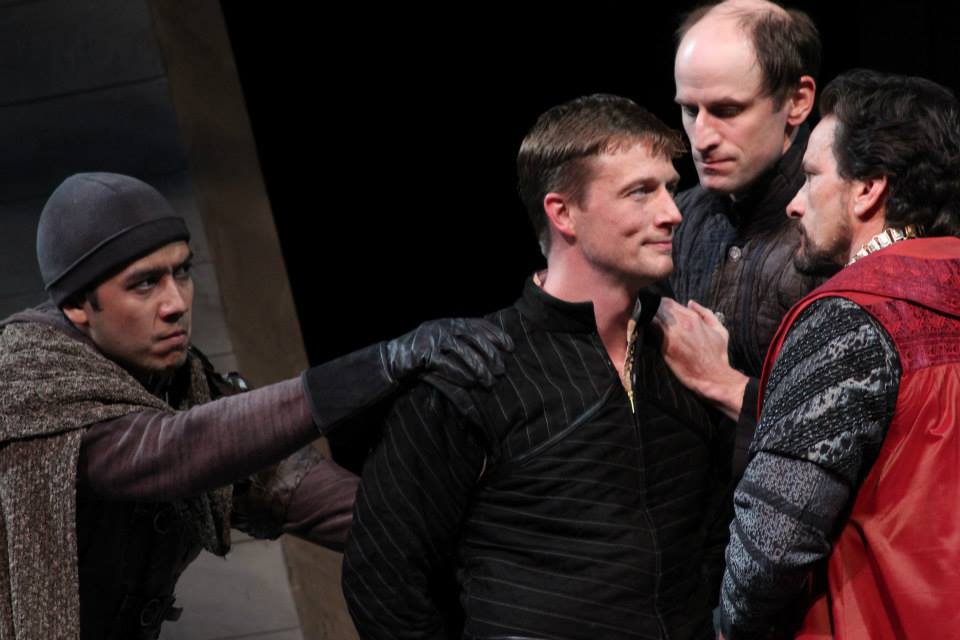
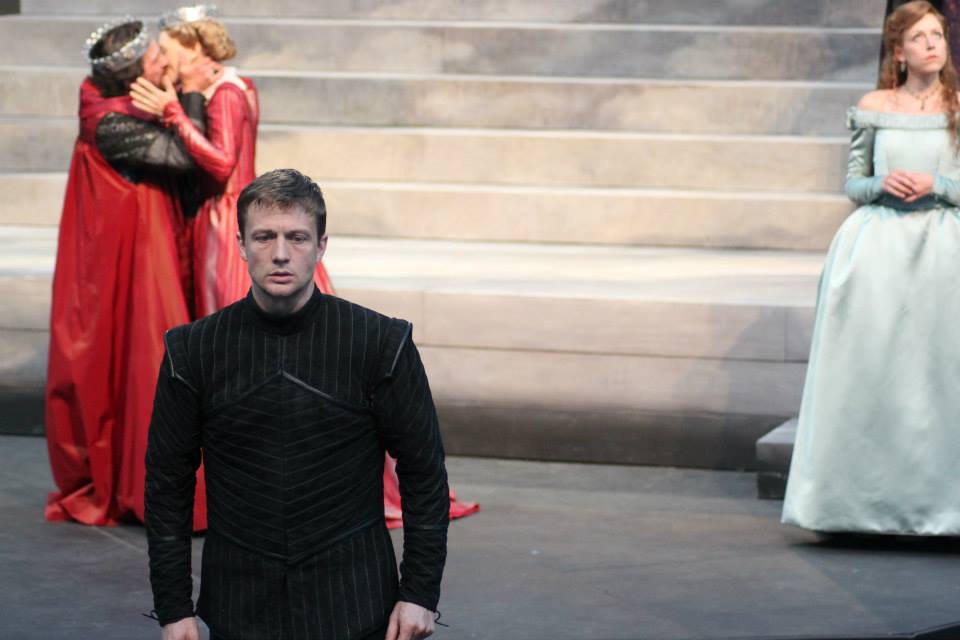
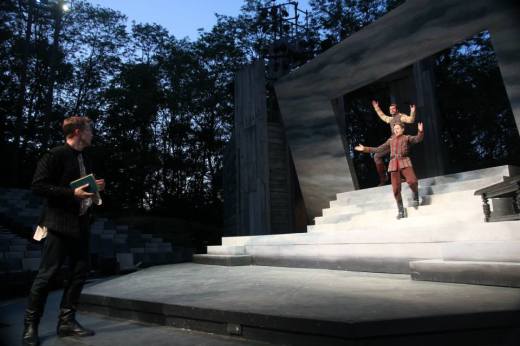
I really think John Langs, the director, is brilliant. I know a theater production is a collaborative process, so my appreciation of the unnerving, stark, gorgeous, imposing, spare set goes to Takeshi Kata and Andrew Boyce. And the way the lighting shows two Hamlets–his posture saying one thing, his face saying another?  Credit for that goes to Michael A. Peterson.

The shadow seems much surer of itself here.

The shadow seems much surer of itself here.

But over and over, each component worked with every other component. The costumes worked with the set. And the set worked with the lighting. And the lighting emphasized the performances. And the performances were awesome. That’s to the director’s credit.

And having James Pickering–a really well-known Milwaukee actor who’s never appeared on the APT stage before–play the ghost and the player who plays the king parts and the gravedigger–that’s not just a casting idea. That’s an interpretive idea.

It made it seem like the ghost was showing up ALL THE TIME.

The child longing for the nuclear family that no longer exists.

The child longing for the nuclear family that no longer exists.

I know directors pluck from other performances (and there are a lot of Shakespeare casting traditions that would be utterly lost on me–I mean, I know about Cordelia/the fool, but that’s about it), and I know Langs directed Darragh Kennan in Hamlet in Seattle pretty recently, so I don’t know if this is the FIRST Hamlet to do that with the ghost/player/gravedigger, and I don’t know if the ghost has shown up other times when he doesn’t have lines, as he does in this performance (I won’t say where-all, because at least one of them seemed like a big risk with a big payoff), but it all went beyond “interpretive idea,” actually. It felt like vision. Genuine artistic vision.
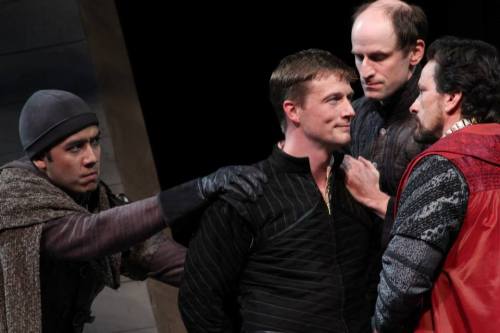
What a counterpoint to Bassanio and Antonio from Merchant of Venice.

What a counterpoint to Bassanio and Antonio from Merchant of Venice.

Casting at APT is a complicated thing–eight plays done in repertory, core company and guest artist needs and contributions considered (who had a huge part last year, who had only supporting roles, who has one huge role this year and needs other supporting roles, who has reliable chemistry with who else)–so I can’t attribute the genius casting of this production of Hamlet to John Langs alone. Whoever had a hand in it, though–bravo.

If I’d been asked, prior to seeing this performance, to list Shakespeare’s really nasty kings, I’d have said Richard and Richard and then changed the subject, since I don’t know the histories as well as I ought. I might not have thought of Claudius at all. It’s not what I would typically think of as a meaty part.

But in Jim DeVita’s hands? Well, I hear Jim’s a fine cook, so I could say it’s like carving a chicken and understanding there’s good meat to be found places other than the drumstick and breast. Anyway, he found the meat. And chewed it up.

I mean, wow. When he says, of Fortinbras, “Holding a weak supposal of our worth,/ Or thinking by our late dear brother’s death / Our state to be disjoint and out of frame,” the delivery was so powerful I found myself wondering if Langs had somehow let Claudius deliver one of Hamlet’s speeches. (He didn’t. At least that one’s not Hamlet’s.)

“I like him not,” he says of Hamlet. And you think, “uh oh.”

I don’t mean Jim was upstaging or scene-stealing or anything bad. He just made it so clear how powerful Claudius was. How mean.

And unlike some productions, which maybe emphasize the Oedipal-incestuous-icky embraces between Hamlet and his Mom because no one can possibly imagine her really being turned on by whatever Claudius they’ve cast (the pompous guy in the Slings and Arrows production comes to mind, Season Two, Episode One, not the first season’s Claudius), De Vita and Staples have awesome onstage chemistry. One review found it “puzzling” why they were “hanging all over each other.” It didn’t puzzle me at all. Wouldn’t you, on him, were you she? And wouldn’t you, her, were you he? I, me, we would, methinks.

Gert and Claud

Gert and Claud

And then of course there’s Hamlet his own self.

Bravo, Matt Schwader. Bravo.

Mike Fischer’s review gets it right, that Matt’s “intensity adds bite and even menace to Hamlet’s encounters.” He calls him “white-hot,” and says he “handles Shakespeare’s verse as well as anyone at APT.” Yes, and yes, and yes.

I am enjoying reading and re-reading about Matt’s Hamlet process in his blog, “Bounded in a Nutshell.”

(He’s not just pretty. He’s also thinky.)

Matt’s explanation of his process helps explain one of the things that amazed me last night: the BIG ASS SPEECHES melded into the play so smoothly. They weren’t under-played, and not muted, but at no point did the production feel like this:

Druuuuuuuuummmmmmmroll: SOLILOQUY. (more stuff, more stuff, more stuff) and then
Druuuuuuummmmmroll: SOLILOQUY.

For example, leading up to the most famous of the BIG ASS SPEECHES, the “to be or not to be” one, because David Daniel’s Polonius is so strong, and Jim De Vita’s Claudius is so strong, and Christina Panfilio’s Ophelia is so strong, I found myself focused on what THEY were doing. Especially Ophelia. (I’ve never felt so pissed at Shakespeare for killing someone off as this Ophelia. She had spunk, damn it.)

Lou Grant to Mary Richards: "You've got spunk. I hate spunk."

Lou Grant to Mary Richards: “You’ve got spunk. I hate spunk.”

So when Matt came onstage and began speaking, to the audience, it took me a beat or two to realize that what he was saying was one of those speeches, even though I’d known what was coming.

In terms of speaking to the audience, as he was, part of the time, in this speech, Matt has this to say, “I’ve found that it is simply much more dramatic and engaging to watch an actor speak with another person (or group of persons, as is the case with direct address), than to be muttering to his or herself. Tremendous drama lives in the unexpected. What unexpected thing can happen to a person talking to his or her self? Not much. On the other hand, talking with an audience opens a flood of possibilities as to what might happen.”

The unexpected here is that Ophelia is listening, and she startles Hamlet, which was startling. In a good way. Because then the “get thee to a nunnery” lines seem startling, even though I knew they were coming.

Hamlet and Ophelia.

Hamlet and Ophelia.

_____

Matt did a fantastic job, which wasn’t startling. Anyone who’s watched him the last few years knew this was coming, that he’d earned it & that he could do it.

But what was startling overall was how his performance seemed utterly in service of the play.

I don’t mean I expected Matt to be selfish or show boaty. I’m just used to thinking of Hamlet as a vehicle for Hamlet (the character and the actor who plays him). This didn’t feel vehicular at all.

What a great play.
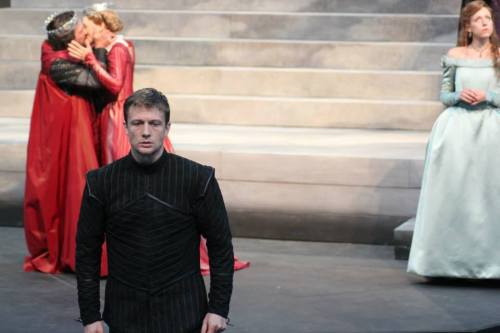
Another fantastic shot from Carissa Dixon

Another fantastic shot from Carissa Dixon

_____
(All these awesome images of the production are used with permission from the awesome Carissa Dixon.)

My Last Transition Metal for a While

The end of this month, I’ll turn 48. Inspired by Oliver Sacks, I looked up 48 on my Periodic Table of Elements place mat and found that Cadmium is element 48. It is a Transition Metal, the last I’ll experience for a while. Next up is Indium, which is grouped under “Other Metals,” (so no telling what that’ll be like), and then a couple of Nonmetals, and then, at age 54, a noble gas! Xenon. That’s something to look forward to.

More about Cadmium, from a lovely blog called GrrlScientist, which has an “element of the week” feature:

  • It’s highly toxic.
  • Used in nuclear reactors.

Cadmium also “adds fatigue resistance to many solders,” which I mis-read first as “adds fatigue resistance to many soldiers.” In any case, fatigue-resistance sounds lovely. Just what I need.

It can make strong batteries and then pollute the environment.

It makes pretty colors.

This post on cadmium yellow says that “Claude Monet (1840-1926) liked to use cadmium yellow for outdoor settings in paintings such as Autumn at Argenteuil, as he believed it would better guarantee the survival of his art. For this reason he abandoned chrome yellow pigments (with the exception of zinc chromate yellow) in the latter part of his career.”

Cadmium green, meanwhile, shows up online as all the shades of green I’ve been obsessed with lately. I may have to go to an art store soon just to get a tube of Winsor & Newton:

cadmiumgreen

So, other than being toxic and all, 48 should be an interesting year.

If you haven’t yet, you should read “The Joy of Old Age. (No Kidding.)” in which Oliver Sacks points out that his upcoming birthday, 80, is Mercury on the Periodic Table (I don’t know if he has the table on a place mat or not). It’s a lovely piece, with several notable moments. My favorite is this:

“At nearly 80, with a scattering of medical and surgical problems, none disabling, I feel glad to be alive — ‘I’m glad I’m not dead!’ sometimes bursts out of me when the weather is perfect. (This is in contrast to a story I heard from a friend who, walking with Samuel Beckett in Paris on a perfect spring morning, said to him, ‘Doesn’t a day like this make you glad to be alive?’ to which Beckett answered, ‘I wouldn’t go as far as that.’)”

I have elements of both those sentiments. Sometimes I do feel “every day is a gift,” but some days, I admit, the gift feels like a total white elephant.

Here’s hoping 48 is more Sacks than Beckett. In most ways.

The Thinger for the Clutter Contained

Having declared repeatedly in public that my home was “half a matchbook collection away from being an episode of Hoarders” (saying this I am exaggerating, but not by as much as I would prefer), I have been plunging this summer, over and over, into our accumulated everything.

This is not easy.

One becomes a pack rat through a combo pack of habits, issues, and inept strategies.

For me, nearly every bit of sorting, cleaning, pitching, packing, reorganizing, moving, shifting, recycling, re-gifting, tagging for yard sales, and donating involves a commensurate inner activity.

Ideally, the inner activity means reflecting on and evaluating all the habits and strategies mentioned previously, and also gently, gently nudging apart the layers of issues involved that led me to the place in the first place.

Sometimes the inner activity is limited to “Ack!” or “oh my god” or “sheesh.”

But I keep at it.

I can be very persistent.

Some of this is deeply satisfying, the emptying of a container of stuff I no longer want, thus making it available to contain other stuff I do want.

And fairly often when I say or even think the word “container,” I think of James Thurber, and “Here Lies Miss Groby” (the first paragraph of which is available even to non-subscribers of the New Yorker, which fortunately contains the quote I was remembering).

“He remembers staying awake nights saying over and over ‘The thinger for the thing contained’ or thinking of an example of the Thing Contained for the Container. If a woman were to grab a bottle of Grade A and say to her husband, ‘Get away from me, or I’ll hit you with the milk’, that would be a Thing Contained for the Container.”

This is a way of talking about metonymy. I wonder if the act of blogging about metonymy will help me remember its definition in contrast to synecdoche. Probably not. But I would like to stake a claim here: I began saying “Schenectady” in place of “synecdoche” years and years before Charlie Kaufman made a movie called Synecdoche, New York, which I still haven’t seen.

All this is a way of procrastinating, by the way.

One last bit of reverie, before I head once more unto the breach, my friends:

I called my blog “marniere” because I’m fascinated by sinkholes. Fascinated and horrified by the idea of a chasm opening up where there previously was none. A chasm with ample space.

If you pitched your clutter in a sinkhole, you wouldn’t be able to access any of it easily. But you would be able to pitch and keep pitching for the longest time.

(I need to write part 2 for this a reminiscence of my childhhood entitled, “The Ravine Where We Threw Trash.” But for now, it’s once more unto the breach I’ve made in the wall of accumulated everything.)

Much Ado (Very, Very Much)

My anxious thoughts do woo me like Don John,
with wild tales of catastrophe, with shame,
and I play stupid Claudio each and every time.
I fall for lies. I forget everything I’ve known.
Up next the betrayed Hero inside me dies.
Not really dead, but a bad-ass swoon, or worse–
the split-second wish that everything would end
if this building, choking, chewing panic can’t.
Only Beatrice says it can. I always lose
when I argue with myself. I am a mess.
Only Benedick, in pill form, thus,
can hush me, with his little medicated kiss.

_____
That Joss Whedon. I tell you what. I loved, loved, loved his Much Ado About Nothing.

Having been swamped a bit with anxiety lately, I’ve been thinking on it, and am concluding that anxiety is a big, fat liar. But sneaky, and seductive.

Today’s wisdom, thus: if the sneaky liar is as cute as Sean Maher playing Don John, no wonder I keep falling for it.

Sean Maher  taken by Gage Skidmore

Sean Maher
taken by Gage Skidmore

And, fortunately, all’s well that ends well, right? (Because in this case, Beatrice is right–the panic never lasts. Also note: I’m so sorry to repeat the structure of Shakespeare here in my sonnet, giving Benedick the last word. I just tell myself he must be an awesome kisser in that last scene, if she stops talking entirely.)

But wouldn’t it be lovely, if my inner Claudio developed his shit-detector a wee bit more?

And if my inner Hero freaking stood up for herself instead of swooning?

Well. One does what one can to line one’s psychological ducks up*, and then one hopes the duck poop doesn’t give everyone swimmer’s itch.

_____

*including the appropriate and authorized use of anti-anxiety meds, thank you very much

(Image of Sean Maher available through Creative Commons license on Flickr.)

I Do Stew.

I’m so grateful to have a column in the Voice of the River Valley.

1. Even though it has a website, it functions largely as a print publication. You can see it all over southwest Wisconsin, lovely cream pages in stacks here and there.
2. It’s free!
3. The cover has fantastic photography, sometimes from my favorite photographer (hint: he has the same last name as I do).
4. It’s an audience I wouldn’t ordinarily reach. People come up to me in Richland Center, in Spring Green–they don’t read my blog. They don’t have a Twitter feed. But they read the Voice of the River Valley.
5. Regular deadlines help me. Speaking of which, today’s the 15th, isn’t it. Hm.
6. Word count maximums challenge me. I can write a sonnet pretty easily, or I can go on and on in prose–1,000 words, 1,500…. But 500 is HARD.
7. The editor/publisher Sara and I worked pretty hard to figure out what the focus of my column should be & when we landed on writing about the world of teaching from my perspective–long-time professor at UW-Richland and recent volunteer at the River Valley Elementary Studio School, we both knew there was a rich vein of material to mine.
8. I continue to be pleased with the name we settled on for the column. I wanted something to go with “pedagogy” in a way that was provocative or at least startling, and “stew” ended up being the one we kept going back to. It fits, you know? Because I do stew.
9. And so does Sara. The publication already has a pretty big audience and circulation, but she’s interesting in pushing the boundaries and experimenting, and I applaud that, in principle and in actuality.

Back to work on my 7th “Pedagogy Stew” column! The June column is available online; I’ll post it here when the July issue comes out.

Creative People Say Yes (Sometimes)

I once came upon my cousin Reid practicing different ways to say “no.” He was 3 or 4 at the time. “No, I couldn’t possibly,” he said. “Absolutely not.”

He was onto something, that little ‘un. At least in my family, saying no takes practice.

Saying no? I’m big on it. Sometimes I’m even good at it. I certainly like the IDEA of saying no.

I’ve written about a fair number of times:
“How do I do that? How do I become the sort of person who says no to things?”

Clitter-Clatter Clutter Time , which references two terrific posts by my favorite tattooed Lutheran blogger, Nadia Bolz Weber, “The Spiritual Practice of Saying No,” and its companion piece, “The Spiritual Practice of Saying Yes!”

The Sarcastic Lutheran says, “The people who are inclined to say yes to everything do all the work and then burn out and become resentful about the people who are inclined to say no to everything. It’s as though the world is divided into martyrs and slackers.”

I don’t make a very good martyr or slacker, either one, not for very long.

I worked enough 50+ hours this spring semester, I worry my slacker credentials are in danger of not being renewed.

Busy as I’ve been, I’m nowhere close to martyrdom. I have some regrets, but I don’t regret all of the times I said yes. (Or came up with something to do that no one even asked me to do.)

Recent things that added to my to do list that I am particularly happy to locate in the land of “yes!”:

  • In addition to volunteering in my son’s classroom at the River Valley Elementary Studio School a couple hours a week, presenting a lesson on storytelling, with a way of talking about narrative arc that was a big hit.
  • Leading the Westby Co-Op Credit Union Board of Directors and branch managers in creativity exercises.
  • Serving as a (paid) reader for writing sample/placement tests for incoming UW-R students, and as a local developmental writing coordinator (unpaid).

In general, I am unrealistic about how the number of things I try to get done will fit into the number of available hours, and I don’t necessarily do things in the right order (which sometimes does and sometimes does not qualify as procrastination).

Thus, some of my commitments (such as returning student work promptly) suffered this spring, and probably, saying “yes” to new stuff impacted the ongoing stuff.

In general, I need to parse, pare, and prune my To Do list.

So, in one way, I totally get Kevin Ashton’s “Creative People Say No.”

He is right that “We do not have enough time as it is. There are groceries to buy, gas tanks to fill, families to love and day jobs to do.”

And he is right that “Time is the raw material of creation.”

Time is a precious resource. It must be guarded. I get it.

But wow did that blog post bug me.

(more on page 2!)

Something Beyond Cynicism

On the other side of burnout
there is rest, there is a place
where even my incompetence
has a bucket it fits into.

As I compost all my bitterness,
my misplaced hopefulness,
my misspent hours,
I watch the steam

rise up from what’s rotten.

A wisp of a moist gray ghost,
a sign of moving on,
a sweet portent

there and gone.

What’s done
is done.

Marnie’s Idea Mill–churning out great ideas since…NOW.

I am pleased, excited, terrified and astonished to be announcing the launch of Marnie’s Idea Mill, a crowdfunding campaign on Indiegogo.

I’m raising money to replace myself in the classroom, so that I will have time to design and implement workshops on creativity.

Thanks in advance for checking out the site and considering making a contribution!

You can help other ways–posting the link on your own Facebook page or blog, retweeting, or forwarding to people who might make a contribution will help, too.

I also welcome feedback on any and all parts of this project.

Also accepting good wishes and blessings!

Metaphor 1.1

Metaphor 1.1


_____
The perks I’m offering include a shout-out on this blog, a copy of Each Other’s Anodyne (a hand-sewn chapbook, a collection of my poems about teaching), feedback on your own creative writing, customized sonnets, and personalized creativity coaching sessions.

As of today, I’ve raised $10,000 in contributions and pledges toward the $24,000 total I need ($6,000 per course x four courses). My fundraising goal on Indiegogo is $4,000, and the deadline for the online campaign is June 17.

My ultimate deadline is July 1.

When I say I love impossible things, I am not kidding.

But I’m trusting Marnie’s Idea Mill can make some magic and attract some magic and make creativity workshops possible (which will then generate even more magic).
_____

Because I am married to a man who is 1/4 Finn, who has read the Kalevala multiple times and also cheers for Finnish drivers in World Rally racing, I know that the Sampo is a mill that generated an infinite supply of flour, salt, and gold.

It was made by Ilmarinen (using a forge, that, as my husband likes to point out, the Kalevala never mentions being destroyed–so maybe it’s still out there…) for the Mistress of the North, who turned out to be a nasty sort, and after a complicated series of events I couldn’t quite follow as my husband described it, the People of the South decided to steal the Sampo. The boat it was in sank, but pieces of the Sampo washed ashore and prosperity accompanied even those pieces.

There used to be a store in Madison called the Magic Mill, which I loved, but it closed. The Sampo, though–that’s a really potent metaphor.

The Sampo one of the images I had in mind when I decided to call my Indiegogo crowdfunding campaign “Marnie’s Idea Mill.”

Idea generation is a huge part of how we measure creativity, so I wanted a metaphor of something that generates. Mill seemed kindlier than factory somehow….

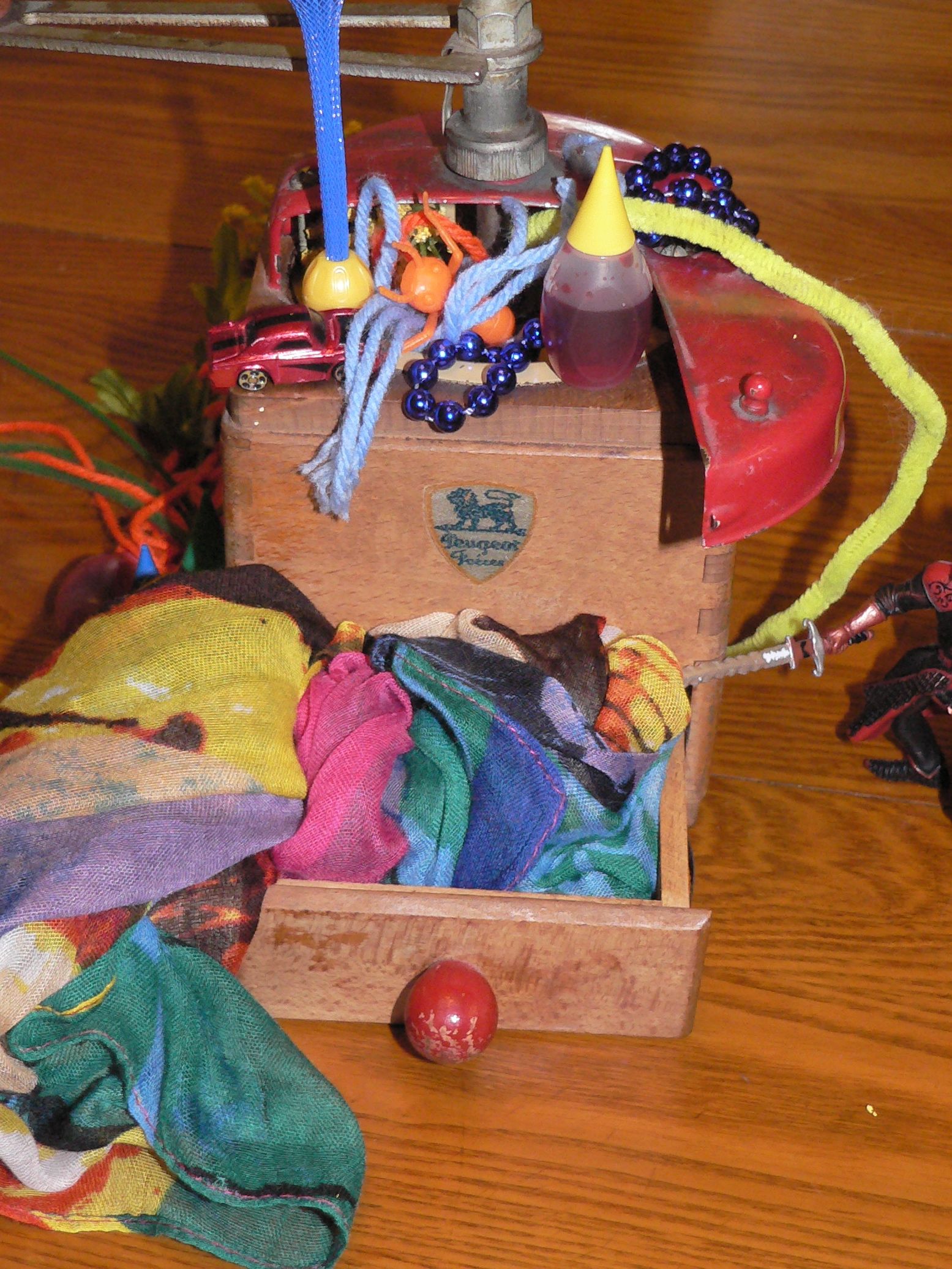
Plus, we have a wide assortment of Peugeot hand grinders (my husband is also 1/4 French).

Another old, old story I had in mind is from 1 Kings 17. In it, Elijah curses the land of Israel, “there shall not be dew nor rain these years, but according to my word.” The Lord sends him to a brook where ravens care for him, and then to a widow, who, when asked for a wee bit of bread by Elijah says, “As the Lord God liveth,” (which I think would now translate to “holy crap, man”). She says she barely has enough to keep herself and her son alive one more day. But Elijah blesses her barrel and says it will not be empty until God sends rain. (I always thought that should be until a few months after the rain showed up, but I’m sure it worked out fine.)

For me, this is a story about living from a place of “enough” rather than a place of “not enough.”

I am trusting there is enough good will and money in the world to help me meet my goal of designing workshops to help people become more creative–more people who can forge amazing mills, more prophets who can see plenty when the rest of us see scarcity….

More where there is currently less.
_____
(You can read more about my creativity research, my fundraising, and my ideas for workshops on various pages here on my blog.)

If God’s going to all the trouble of sending a tornado after you….

When I was little, I wasn’t scared of tornadoes.

My Dad always said, “If God’s going to go to all the trouble of sending a tornado after you…” and I actually don’t remember the exact words of what came after that, but the idea was, just give up. If God wants you to die in a tornado and you survive that tornado, he’ll send another tornado. Or a car wreck. Or a brown recluse spider.

I found that profoundly comforting when I was a child and beyond, but I’m sure my Dad’s calm helped, too. (Note to self: try not to freak out ENTIRELY as you’re fleeing your own home, your child in tow, to your parents’ basement across town. When I said, “Get in the car right now!” I’m pretty sure I had the same intonation & volume as “You can’t handle the truth!”)

Back in the 70s, there were watches and warnings pretty much all the time, it seemed, from March through September. We ignored watches entirely, and only grew concerned about warnings if the sky turned green.

Dad and I used to stand in our garage and watch sheets of rain come across the open field northeast of our house. He was probably smoking a pipe. I was probably petting Wooly and Daisy (the best dogs ever in the history of the world).

Regardless.

I now note several problems with Dad’s tornado wisdom.

1. Even if my belief in God had not changed, OH MY GOD. Really? I’m a good Baptist girl and God might just, out of pretty much fucking nowhere, send a tornado to kill me? And I can’t get away no matter what?

2. My belief in God has changed. I have a kind of wacked-out sort of X-Files Mulder/Scully hybrid of beliefs. As in:
a. I want to believe.
b. Maybe God could steer tornadoes in a pinch, but tends not to.

3. The basically impossibly huge question of how a loving God could allow horrible things to happen. (I’m not going to solve that here. Sorry if you’re disappointed.)

When I lived in the second of a series of three trailers I called home as a graduate student at Southern Illinois University, I began to have a recurring nightmare about tornadoes. In it, I would wake up in the middle of a horrible storm, feel the trailer begin to shake, watch the walls suck inward, watch the roof blow away, and then try to hold onto my bed to keep from getting sucked into the sky. Then I would wake up.

I suspect this had to do with being in miscellaneous precarious emotional situations in those years. And also living in a trailer. “God’s bowling alleys,” my brother always called trailer parks.

(So, o.k. What is it with men in my family and tornadoes?)

But during one actual tornado warning, I stayed in Trailer #1 and announced to God, “I’ll just die here with my cats, thank you.” Very green sky. Large branches flying by the window. Trailer rocking in real life, not the dream world. (Oh, that girl. I could just smack my 21-year-old self!)

I think, over the years, I’ve just grown less and less fatalistic. Certainly less suicidal! It is also possible my frontal lobe has developed some.

And then having a husband I love and I son I am OVER THE MOON ABOUT makes storms really stressful.

We’ve had a wacky weather week in Wisconsin. More storms coming.

Is it possible, in what I now called the land of “Zen Baptist” on my faith journey, to take wise precautions and yet be at peace about whatever comes?

Sure hope so.

Because what comforted me as a child, comforts me not at all right now.

_____
Here’s what fun about social media. Someone named Kevin posted this on Channel 3000’s Facebook page. The comments are hilarious. Including: “it’s sunny in beloit” and a whole thread of “don’t take pictures while you’re driving” and “it’s not a tornado.”

So. Probably not a tornado. (No one actually said it was.) And also not my picture. But gracious. I wouldn’t mind some boring weather.

Not a tornado.

Not a tornado.