Category Archives: Teaching

Pedagogy Stew: July 2013

As I write this, my husband and son are in the living room, reading Harry Potter and the Half Blood Prince.  We’ve spent a lot of 2013 so far reading those books, just plowing through them.  (I almost said “burning through them,” but that sounds bad.) With summer here, the pace has increased, well, apace.

In one way, I’m jealous of my son. Remember how long we had to wait between each book? But in another way, I’m sad for him. How amazing it must have been to be a child when the first one came out, and then grow up with Harry, with a book coming along every year or so, just when you thought you couldn’t possibly wait any longer.

On the third hand, wow do I love to binge through TV and book series.

Late May and June were Maisie Dobbs weeks for me this year. I read all ten of Jacqueline Winspear’s mysteries featuring the “psychologist and investigator,” quickly, not exactly in order, but saving the 10th for last.

Leaving Everything Most Loved is in some ways a summary of the previous novels, mentioning their plots and characters, and serving as something of a “final accounting” for the whole series (though it doesn’t seem to be final—I’ve scoured the interwebs, and there’s no word of this being “THE LAST Maisie Dobbs novel.” Whew).

What is a “final accounting?”   Winspear defines it as what Maisie does as she makes “the essential visits to places and people encountered,” and calls it “a task that brought work on a particular investigation to a more settled close.” It’s more nuanced than our clichéd use of “closure.” When Maisie has wrapped up each case, she prepares a report for whomever hired her and then returns to locations crucial to solving whatever mystery there was.

It’s easy enough to end a semester as a professor by turning in grades, cleaning up my office, making a to do list for the summer, and no more.

But I’ve long tried to spend some time reflecting—what went well? Not so well? Why? And what can I do differently? I keep track of how promptly (or molasses-slowly) I return student work in an Excel spreadsheet, and I give students grading feedback on Excel, so I can run reports that way, too. Looking at the data for multiple years if sometimes almost a revelation.

This time, in addition to all the reflecting I typically do, I think I will visit each classroom I taught in, and my son’s classroom, where I volunteered, and see, like Maisie Dobbs, what each room has to say to me.

It also can’t hurt to think of all my semesters as mysteries, most of them solved (a few cold cases, I have to admit, still lingering).

What about you? What season has just ended for you? What case have you just solved? How will you do your final accounting?

(This column originally appeared in Voice of the River Valley.)

Pedagogy Stew: June 2013

June’s a hot month for ceremonies—weddings and graduations all over the place.

I’m not so big on ceremonies.

When I got married, I eloped. I did attend my high school graduation and baccalaureate programs (skipping would never have occurred to me at the time), but I was thrilled to miss my own Bachelor’s Degree commencement at Southern Illinois University. My Mom was graduating the same day, and it would have taken major logistics to get to both ceremonies, so I said, “Let’s just all go to Mom’s!” We took a picture of me in her mortarboard.  Then for my M.A., and M.F.A., I just didn’t go.

But I tend to enjoy graduation at UW-Richland.

First, I like looking at the UW-Richland faculty and staff on graduation night, in all our robes and signifiers. “We clean up good,” as my Uncle Earle would have said. Also, we look just the tiniest bit like Hogwarts teachers on that night. (I call dibs on McGonagall.)

And then there is always at least one student who crosses the stage that makes the whole ceremony worthwhile.

After the 2012 ceremony, I asked one of our first-year students, Darryl, to do a pinky-swear with me that he’d be crossing the stage in 2013. 

I learned about pinky-swears from my son. They seem to be a mix of “let’s shake on it” and “cross my heart and hope to die.”  You hook pinky fingers and promise, and for my son, it’s nearly sacred. If he does one, I know he’s serious. This Bible verse comes to mind (from my favorite book of the Bible):  Ecclesiastes 5:5 “It is better not to make a vow, than to make one and not fulfill it.”

Darryl seemed to have the same attitude. He wouldn’t do a pinky swear with me last year.

But he did cross the stage this spring. You’d have noticed him if you’d been there (or if you stumbled across the video on cable access television). He’s hard to miss—tall, long dreadlocks, LARGE personality. I was so happy for him, personally, but even happier for other students following him. He is a leader, and more students will follow him, students who might not follow anyone else.

In last month’s “Pedagogy Stew,” I talked about how important it is for students to be able to tell their own stories to themselves. If they feel in control of their own narrative, they are more likely to tell stories about overcoming obstacles, rather than giving in.

There’s so much we don’t know when we look at a student. We don’t know where they are in their narrative arc. We don’t know what story they’re telling to themselves about the present moment, and whether “graduation” or “grade in this class” or “using spell check” shows up in the story at all.

I hope “education” is part of how their stories end happily. Or how their stories begin well. I promise I’ll keep working to make that happen. Pinky-swear.

 (This column originally appeared in Voice of the River Valley.)


The problem isn’t teachers.

for Heather, and so, so many more

The gritty nasty easy complaints take root
even when we try to weed them out.
The problem isn’t teachers. It isn’t you,

not if you’re teaching, it’s sure not.
We know what it’s all about
when gritty nasty easy complaints take root

in public discourse. Money is the root,
the square root, when we hear how
the problem is teachers. It isn’t you,

no, not you, rich man, you tell the truth
about those lazy public employees. Shout
those gritty nasty easy complaints! The root

is poverty, and unearned self-esteem, and too,
too much testing and less learning, but
the problem isn’t teachers. It isn’t you

my friend, my hero, my diligent compatriot.
Teaching well is about telling the truth.
Gritty nasty easy complaints may take root,
but the problem isn’t teachers. It isn’t you.

If I'd made one bale every semester I taught....

If I’d made one bale every semester I taught….

Spiraling: Writing the Unthinkable

20131005-192623.jpg

Lynda Barry had us draw spirals today.

I got to do a workshop with her in her Image Lab at the Wisconsin Institutes for Discovery, where she is a (jolly good) fellow. It was a writing workshop, but we drew a little. We spiraled.

20131005-192636.jpg

When we were getting ready to write, or when we were listening to someone else read, we drew spirals.


20131005-192643.jpg

We were supposed to draw it as tight and close as we could without having the lines touch. I got too big on this one and it turned into a labyrinth.


20131005-192651.jpg

Sometimes I closed my eyes and drew.


20131005-192658.jpg

Here’s more of the labyrinth.


20131005-192707.jpg

Eyes closed for a bit.

I like how these pics look a little spooky. I went to scary places today, and I even wrote a ghost story.


Half-battical and How

My son used to scare me when I got home from work by leaping out of the foxhole he’d dug in our yard. I miss those days, though I’m glad to say we filled in the foxhole before anyone broke any bones stepping in it inadvertently (nominee for person most likely to have done  that = me).

I miss the days when he dug tunnels and canals and poured water all over. A filthy, dirty, muddy, mucky kid–that’s the mark of a good summer day in my book.

So when I tell you that I feel as though I’m now sitting in a hole in my backyard that I dug over the last year or two–not big enough to stand up in, just big enough to sit in–you should understand a few things.

1. I had a lot of help digging this hole.

2. It isn’t muddy because we haven’t had much rain AT ALL lately.

3. I’m actually sitting inside my kitchen as I’m writing this.

4. It wasn’t easy, digging this hole, but I’m very happy right now, sitting in it.

I could have, a year ago, or two years ago, or three years ago, applied for traditional funding for a sabbatical, and because I have a good project and because I write good proposals, I probably could be on a fully funded sabbatical this semester, teaching zero classes.  The UW Colleges doesn’t have enough funding to fund very many sabbaticals, but it still funds a few (three this semester), and if you take one semester instead of a year, you get your full salary and benefits.

I took a full year ten years ago, traditionally funded. My husband and I figured out how to make the 35% pay cut work. It worked.

This time, for a variety of reasons, the traditional funding route did not appeal to me at all. (As I’m spending my MWF on campus teaching two classes, I continue to reflect on WHY that did not appeal to me at all.  Will probably write about it soon.)

Instead, I chose the route of trying to raise my replacement costs. I’d hoped to raise around $24,000 before July 1 of this year, and if I had, I’d be teaching zero classes this fall.

It turns out there are parts of fundraising and being a grant-hound I’m good at, and then other parts, not so much.

I think this is symbolic of something.

I think this is symbolic of something.


But with a lot of help,  I made it halfway, and I count myself lucky to be in a place where my dean agreed that the money I’d raised could “buy me out of” two of the classes I would normally teach, and where my business office geniuses figured out the logistics.

Teaching zero classes for a semester would be a terrific break and give me ample time for my project.

But teaching two classes instead of four is lovely. And it gives me a good chunk of time.

So, for example, today I get to go have lunch with a friend and talk to her about what kind of creativity workshop she might benefit from.

That’s my project–designing creativity workshops for businesses, organizations, and individuals.  Right now, I’m in the surveying/needs assessment phase.

At the end of my half-battical (because I made it  halfway, get it?), I’ll be ready to work with people to help them become more creative in measurable, useful, and wonderful ways.

Thus all my funders, all the people who helped me dig this hole–thank you.

One example I will have, henceforth, of BEING creative is the fundraising I’ve done, which is, of course, one of the big reasons I was so drawn to the idea of doing it.

Today’s creativity reading (I’m trying to get caught up on all the web pages, blogs, articles, and books I’ve put on my reading list) is “Twelve Things You Were Not Taught About Creative Thinking in School.”    Several of them seem relevant to what I went through as I was fundraising–#2 “creative thinking is work” (yes, exhausting–I sort of collapsed from it in early July). #7 “expect the experts to be negative” was truer than I expected. I had a ton of support, but there are people who JUST DIDN’T GET IT, why I was not drawn at all to seeking traditional sabbatical funding.  #8 “trust your instincts” is what I was doing, what I’m still doing. I don’t really understand all of why my gut was telling me LOUDLY to raise my own funds, but I listened.

#9 “There is no such thing as failure” is a comfort to me, as I tell myself that halfway is terrific. It doesn’t feel like failure, having cobbled together the $11,534 needed to replace me in the classroom.

And finally for today, #10, “You do not see things as they are; you see them as you are.”

And right now, I see myself blissed out in a hole in my own backyard.

This is symbolic of how awesome my yard is.

This is symbolic of how awesome my yard is.

2013 Wisconsin Professor Mindset List

On August 20, Beloit College will do what it’s been doing since 1998 and release the Mindset List for incoming college freshman. These lists are fun, especially if you don’t look every single year. So, for example, last year’s #20 “Exposed bra straps have always been a fashion statement, not a wardrobe malfunction to be corrected quietly by well-meaning friends,” amused me. I think about bras straps now and then. Other deep things I think about include trying to figure out when we’ll all decide shirts need to be shorter than the jackets they are worn under, or at least tucked in. I hope someone tells me when this happens. It took me a while to notice it was o.k. to have a shirt hanging out below a jacket.

This list is written in the spirit of “young folks live in a different world,” and to the extent that professors are old folks who are out of it, and a little more out of it each year, I think the list is helpful.

But honestly, if you’re the sort of professor who hasn’t noticed that students get their music in digital format now, a glance at this list won’t help much. And going overboard with the impression that “they often listen to it on their laptops or replace it with music downloaded onto their MP3s and iPods” (last year’s #15) might make  us miss out on an awesome opportunity to talk about the deep pleasure of listening to music on vinyl, a pretty big trend among youngsters at the moment (maybe that will be on this year’s list).

Dana Falconberry, who looks almost old enough to drink legally, had an awesome show at the Sh*tty Barn last night. She sells her song in CD, MP3 and LP format.

It turns out that spending time with young people is a really good way to learn about their mindset.

I was terribly impressed with Dana Falconberry, for example. Not only was the music awesome, her gratitude was really shiny and sweet to see. She said repeatedly how honored she was to play music in a venue where people were listening. Sitting in their chairs and listening. And totally engaged. She thanked Chris and Martha, the owners of the Sh*tty Barn, repeatedly, and followed up one of her compliments with “especially considering the state of the music industry right now.”

So, yes, I have to have it in my heart to reach out to students this fall who truly, truly, love Justin Bieber. But they don’t all love Justin Bieber (mentioned in last year’s #1).

I will check out the list when it comes out next week, remembering that it is written by guys who are older than me, who seem to be nostalgic about a world that was already gone when I started college in 1983.

Meanwhile, although I am utterly unqualified to write a list about anyone’s mindset but my own, I thought it might be fun to try to list some things that are true of me and at least one other professor (how’s that for a high standard in statistics and the logic of generalization?) I’m not the first professor to have done this–professors doing their own mindset lists may become as much of an August tradition as people passing around the Beloit list, which contains 75 items.

I don’t have the attention span or time for that many. I’m sure the fact that Sesame Street came on the air when I was four (and I thought for a while it was JUST FOR ME and was upset when I found out other kids had it in their houses, too) has something to do with my relatively recently diagnosed ADHD, the existence of which I’m sure was bemoaned in an earlier list.

1. If you’re a traditional age student, I have been teaching since before you were born.

2. If you’re a non-traditional student, first of all, you are my favorite kind of student. Seriously. Second, I am assuming you’ve been doing a lot of interesting things other than getting a college degree, and I’m looking forward to hearing about them.

3. Even though I did less of what I call “work-work” this summer than I usually do, I didn’t “have the summer off.” I did some work I got paid for (evaluating student writing samples for composition class placement) and some writing and research and class prep (which I consider “pro bono,” since I didn’t get paid for those).

4. You should know I am open to questions and complaints. This will become clear as the semester proceeds. (Or you’ll find out that I like to see myself as open but am really a bitch–I don’t think that’s true, but it’s within the realm of what’s possible. I ask for student feedback A LOT, in a variety of ways, including anonymous surveys, so I feel certain someone would have told me by now if I were pretending to be open but not really open.)

5. Even though I’m open to questions and complaints, I don’t get all happy hearing the “I paid for this class so I should be able to do what I want” argument, also known as the “student as consumer” model.

Let me assure all students and parents contributing to my students’ education (tuition now covers almost half of what it costs to run my institution–it used to be a third), and the good taxpayers of Wisconsin (state support for higher education is dwindling, but it’s still there), and taxpayers all over the country (federal financial aid, etc.) that I am determined to give good bang for the buck in and out of my classroom.

I am a well-published, award-winning, full professor in my 26th year of teaching at the college level. Moreover, I am working to improve. All the time. Every year. Every semester, actually.

But students aren’t really consumers. Even if a student of mine is paying 100% of her or his own tuition (which is rare), that isn’t half of what it costs to educate that one student. (And in a classroom of 24, it’s 1/2 of 1/24th.)

So if we stick with the consumer model, then the consumers are the ones who pay the most, and in that case, the student is a product.

Fortunately for all of us, I don’t like the consumer model much at all.

I’m getting paid a good salary to do an important job, and I’m on it. I got this.

6. However, you should also know that I don’t respond well to the “You should be available to me 24 hours a day since you make $80,000 a year” argument. Like a lot of professors my age (I’m 48), I am in the sandwich generation.  I have a son who’s eight and a half, and parents whose doctor appointments I track on Google calendar–not because I have to take them to the doctor every time, but because that’s just what they do a lot of during the week, and I’m close to my parents. I’m also married to a pretty terrific guy.

Thus, because of all my important and socially acceptable obligations, I simply cannot be available 24/7.  But honestly?  I’m not even trying.

I spend a fair bit of time on things that are only important in the sense that it’s important to enjoy life.

I just don’t think my (relatively) good salary means I should be available to students 24/7.  This applies to my colleagues as well, btw.

I don’t know how much you’d have to pay me to be that available, but it’s way more than I will ever make as a professor.

But I’m VERY available. Students praise me for it year after year in the end of term ANONYMOUS surveys the UW Colleges distribute. I’m in my office a lot and on email a lot and even available for online chats.

Also, I don’t make $80,000 a year, which leads us to the next point:

7. It’s kind of an icky time to work in the public sector in Wisconsin. It’s probably better if we don’t talk about it much.

8. I am a lifelong underachiever. My talents and my potential have almost never led to the kind of success other people anticipate for me. So I totally get skipping class, procrastinating, doing sub-par work, and generally all manner of slacking. Keep in mind, since I was born in 1965, I’m not a Baby Boomer. I’m Generation X, known across the universe for slacking.

Here’s what I don’t get:  the student who doesn’t do the work and somehow expects a grade other than what is indicated by the work that was done.

I get it if you don’t want to bring your A Game to my class. I won’t take it personally. Or I’ll try not to. But if you don’t bring your A Game, don’t be all fussy at me when your grade isn’t an A.

(And you probably ought to bring your B Game to class if you want a C, because it turns out college is often more challenging than high school. Not always. But often.)

9. If I can figure out where to get a bunch of them for free, I’m going to have a big bowl of condoms and dental dams in my office. Come by and grab a handful. (I’d buy them for y’all, but can’t really afford that, cf. #7.)  I heard on the radio last spring the rate of AIDS infection is going down except for traditional-age college students. Geez, people. Watch Philadelphia, would you? Seriously. Most of you aren’t going to get jobs with good benefits, so you won’t be able to afford all the awesome AIDS drugs we have now. And hello–what you do or do not do now can give you or keep you from getting things like cervical, anal, or mouth or throat cancer. So really, could you just try to not get any STDs? And wait just A LITTLE LONGER to get pregnant? Sheesh.

10. When I first started teaching, my group of graduate assistants was  told that part of our job was to help “thin the herd,” that SIU had admitted more freshmen than it could accommodate in sophomore classes. I can’t remember the exact percentage, but we were supposed to make sure there were at least a few Fs on our final grades, and if there weren’t, we were in danger of not being re-hired.

A snootier way to talk about this would be to say that first-year courses and instructors are “gatekeepers,” and in charge of getting rid of students who aren’t really “college material.”

It’s ridiculously easy to teach in such a way that a certain number of students are guaranteed to fail.

It’s much, much harder to try and teach in such a way that students are sufficiently supported on their way to  meeting appropriately high standards.

But that’s what I’m trying to do. If you’re in my classroom, I want you to succeed.

_____

So there you go. My 2013 Mindset List. What was on my mind when I started college? Eye shadow, apparently:
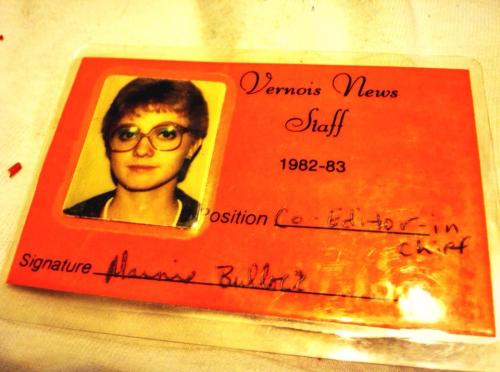
I don't know yet as much as I thought I knew then.

I don’t know yet as much as I thought I knew then.

I Do Stew.

I’m so grateful to have a column in the Voice of the River Valley.

1. Even though it has a website, it functions largely as a print publication. You can see it all over southwest Wisconsin, lovely cream pages in stacks here and there.
2. It’s free!
3. The cover has fantastic photography, sometimes from my favorite photographer (hint: he has the same last name as I do).
4. It’s an audience I wouldn’t ordinarily reach. People come up to me in Richland Center, in Spring Green–they don’t read my blog. They don’t have a Twitter feed. But they read the Voice of the River Valley.
5. Regular deadlines help me. Speaking of which, today’s the 15th, isn’t it. Hm.
6. Word count maximums challenge me. I can write a sonnet pretty easily, or I can go on and on in prose–1,000 words, 1,500…. But 500 is HARD.
7. The editor/publisher Sara and I worked pretty hard to figure out what the focus of my column should be & when we landed on writing about the world of teaching from my perspective–long-time professor at UW-Richland and recent volunteer at the River Valley Elementary Studio School, we both knew there was a rich vein of material to mine.
8. I continue to be pleased with the name we settled on for the column. I wanted something to go with “pedagogy” in a way that was provocative or at least startling, and “stew” ended up being the one we kept going back to. It fits, you know? Because I do stew.
9. And so does Sara. The publication already has a pretty big audience and circulation, but she’s interesting in pushing the boundaries and experimenting, and I applaud that, in principle and in actuality.

Back to work on my 7th “Pedagogy Stew” column! The June column is available online; I’ll post it here when the July issue comes out.

Pedagogy Stew: May 2013

When I teach plot in a literature or creative writing class, Freytag’s triangle is usually part of the lesson. (Picture a scalene triangle, with a long slope upward
on the left, and a shorter slope coming down on the right.) Good old Gustav came up with his triangle in the 19th century as a way of describing the structure of Shakespeare and Greek tragedies, and as it’s taught now, it’s typically labeled with terms like “rising action,” “climax” and “denouement.” (The last always gives me pause, since, as a Southern Illinois native, I grew up hearing Beaucoup Creek pronounced “buck up.”)

Asked to teach a unit on storytelling to each of the four classes at the River Valley Elementary
Studio School, I wanted a way to translate this triangle for younger students. Here’s what I came up with:

Hello.
Uh-oh.
Oh no!
Now we know.

I’m pleased to say the teachers at the Studio School have found this useful as they’ve continued to work on storytelling. Students will be writing and performing plays to demonstrate what they’ve
learned about the Oregon Trail.

When I told some of my UW-Richland students about my translation, a couple of them said, “Hey! How come you never explained it to us like that?” I will, henceforth.

We do need students to be able to tell stories well. Not just to demonstrate what they’ve learned. Not just to sharpen their analytical skills. Not just to make sure they transfer smoothly into upper-level creative writing courses and move one step closer to publication. All those things are important, of course, but what seems most important to me is that we want them to be able to tell their own stories, to themselves.

We want them, as Brené Brown says, to own their own stories. “If you own the story you get to write the ending,” she says in Daring Greatly. As UW-Richland’s psych professor, Dennis Carpenter, explained to me, the technical term for this is “cognitive appraisal.” Our reaction to what happens depends a great deal on the story we tell ourselves about the event. When students own their stories, they’ll be able to decide whether a week of insults was the uh-oh leading to full-scale bullying, or the oh no! in which they put a stop to the insults. Students will be able to decide if a few weeks of falling behind in assignments meant they needed to buckle down and finish strong, or admit that the story of a particular class ended with dropping.

I go back again and again to the end of Robert Penn Warren’s book-length poem Audubon:

“In this century, and moment,
of mania, / Tell me a story.”

We all need to do that, right? We have a lot of different stories (and, gasp! that triangle doesn’t always work for the telling), but I know what kind of story I need the most right now. It’s the very last line of Audubon:

“Tell me a story of deep delight.”

Pedagogy Stew: April 2013

Objects in Motion

I’m so glad dance is part of my son’s education.
Sometimes, sure, an object at rest remains at rest,
But tonight an object in motion continued in motion—

A whole school of molecules kept dancing,
From slow solid to wavy liquid to hyper gas.
I’m so glad dance is part of my son’s education,

unlike mine. When I dance I’m like a squirrel on the ocean.
My grade school almost never danced—toomany Baptists.
Just like the law that keeps all those objects in motion,

he’ll continue to feel what he’s learned, not just emotion—
it’s embodied learning at its cellular best.
I’m so glad dance is part of my son’s education,

not just text and audio, not just construction
paper, more than dioramas, more than tests.
The law says an object in motion continues in motion,

and here’s proof. Still dancing, past bedtime, way past.
Those filthy feet look like a month of dirt amassed.
I’m so glad dance is part of my son’s education.
An object in motion continues in motion.

At least every quarter, the River Valley Elementary Studio Schoolin Spring Green has what is called a “culminating event,” where students display what they’ve learned in the previous unit. We’ve seen art galleries, tableaux, singing and now dance. Students worked with local professional dancers, along with their regular teachers, to choreograph the states of matter and the laws of motion, and at the end of February, we got to see them dance to “Solid Liquid Gas” by the band They Might Be Giants (as well as more classical works).It’s not just what you learn—it’s how you learn it, where you learn it, and how you demonstrate it. All of it matters.

Or, as one of my former students said recently, “You don’t break with your arms. You break with your butt.” He had just executed the most authoritative break I have ever seen. The pool table in the UW-Richland student center always has a mix of some of our most and least diligent students. This particular student has not had the most straightforward path through our traditionally-takes-two-years Associates Degree, but he has some solid momentum going now. It has been interesting, and encouraging, to watch him at rest, in motion, and exerting force—not necessarily in that order.

There are so many ways, and so many places, to learn the laws of motion.

Pedagogy Stew: March 2013

I’ve invented the most amazing computer game for my
composition students.

When I comment on their essays, which they’ve turned in online, I use “insert comment” to give feedback. There are pros and cons to this, of course, but one major PRO is that I’m now confident students can read my feedback. (I have handwriting issues. Lowest grade I ever got in my life? Penmanship. Fourth grade. At the time, I was sure Mrs. Cox had it in for me, but on reflection, I
think, no, that “C” was generous.)

Here’s the game: After I’ve finished grading the essays, their next assignment is a short exercise in which they should copy/paste one of the comments I’ve made, and then describe what
resource they looked to for help (online grammar site? our textbook? class notes?) and what
they plan to do to improve before the next essay.

All right, so…not so hot as a game.

It is, however, a fairly good test of their ability to navigate the online environment of digital essays and professorial feedback. Fairly often I have a non-traditional student who struggles online. (Drop-down list? Double-click? What’s that?) It’s not just non-traditional students. We think of Millennials (those born between 1980 and 2000) as being 100 percent wired, but I don’t
find them to be 100 percent proficient in computer usage that helps in the classroom. They can text,but word processing? Maybe not. They all use Google, but they may struggle when online research involves a database that uses Boolean logic or traditional Library of Congress Subject headings.

This round of essays, in each final draft, I am burying a link to an article in Nature
on the subject of “distributed thinking.” In “People Power: Networks of Human Minds Are Taking Citizen Science to a New Level,” Eric Hand describes how a group of scientists came up with Foldit, an online game in which “players compete, collaborate, develop strategies, accumulate game points and move to different playing levels, all while folding proteins.”
Computer models were thorough but slow—when gamers got involved, things went faster because, as Hand points out, “humans[are] blessed with a highly evolved talent for spatial manipulation, [and] can often see the solution intuitively.”

Beyond gamification (which means structuring learning, or anything else, like a game, with rewards—like giving chocolate for correct answers), what distributed thinking makes possible is
turning those skills our students use in gaming (and, um, some of us might possibly, occasionally, use in something girly and ridiculous like “Candy Crush,” a game that reports results on Facebook) into skills that could help solve real-world problems.

It isn’t just that I would like students to bring some of that persistence to their academic tasks. I would. But I would also love to figure out how to translate challenges (inside and outside academia) into the LANGUAGE and CULTURE of gaming, ina deep and serious way. Maybe then, when my son grows up, all his app-addled gaming hours will be a real asset.
______
6/15/13 NOTE: I ended up putting the link to the Nature article inside some Extra Credit directions–three students were very excited to find it. Next semester, I’ll think of more ways to make their hunting & clicking more rewarding.

I was talking about this to a student as we were searching EbscoHost (and online service with multiple databases to find articles) for sources for one of his papers, and told him I wished someone could structure searches like this as a game. He got it instantly: “Well, sure, like EbscoHost is a hallway, and….”

I can’t wait for the iOS version!