Category Archives: Teaching

Lazy, Lazy Thinking in the Noon Day Sun

I always used to talk about racism when I talked about logical flaws in my composition classes–that stereotypes came from generalizing badly. Sample size too small, oversimplifying, etc. (I don’t spend much time on logical flaws now, and I miss them–such fun names! Such color and metaphor–one day, the Straw Man smelled a Red Herring and Ergo, Propter Hoc!)

It never occurred to me until I read “Study: Racial stereotyping linked to creative stagnation” on Salon.com that racism was connected (in inverse proportion) to creativity. It makes sense, though.

I’ve written once before in this blog on the notion of lowering associative borders, in a post called “I Can’t Get No Satisficing.”  Having high associative borders is similar to what this study (described in more detail in in this article, “Racial Essentialism Reduces Creative Thinking, Makes People More Closed-Minded” in Science Daily) calls categorical thinking.

The lead researcher, Carmit Tadmor, and her co-authors say that although creative stagnation and racism “concern very different outcomes, they both occur when people fixate on existing category information and conventional mindsets.”

The study is hopeful that people can change their thinking. I am too–part of the reason I want to begin doing workshops on creativity is that studies show people can become more creative thinkers. We’re not stuck with what we were born with.

What I would call a “creativity workshop” is typically called “enhancement training” or “creativity training” in cognitive research. Hsen-Hsing Ma published an article in 2006 with overall terrific news about the possibility that we can become more creative.

Ma cites an early researcher, Paul Torrance,  who found that “programs teaching children to think creatively were at least 50% successful.” Another study from those rockin’ 1970s by Mansfield, et. al., showed “most evaluation studies of creativity training programs seem to support the view that creativity can be trained.”

SO WE’VE KNOWN THIS FOR A LONG TIME.

For the 2006 article, jazzily titled, “A Synthetic Analysis of the Effectivieness of Single Components and Packages in Creativity Training Programs,” Ma did what is called meta-analysis of studies (reading LOTS of studies on an issue and summarizing and analyzing their results), showing the following:

Good news item #1: “Overall, the finding of this study confirms the result of Torrance’s (1972) investigation; namely, that children can be taught to think creatively.”

But oh, gracious, the news is better than that:

“This study also found that creativity training programs tended to be more successful with older participants than younger ones.”

So–watch out old racists and stagnant thinkers everywhere. The times they are a changin’ (NOTE: if you’re old enough to recognize that song, you’re just the right age to benefit from creativity training.)

We can become more creative.

We can become more creative.

___

(Image from Creative Commons on flickr, “Coloured Rooms Doorways-Brian Eno Speaker Floers Sound Installation at Marlborough House” by Dominic Alves.)

On the Enduring Appeal of Bureaucracy

A roller coaster isn’t scary because
The car’s attached to the rail (you hope it is),
However high you loop, you’re certain you will
End up right where you started. A reliable thrill.
A blanket. Mowed trails. Molded cafeteria tray.
We do it this way because we’ve always done it this way.
And if you want to make a radical change,
We’ll say no. Quickly. Firmly. Again and again.
“So rather than shift to what it needed to do,
The Army would continue doing what it knew
How to do, which is how bureaucracies act
When they lack strong leadership.” Thomas E. Ricks.
Of course it worked so well in Vietnam.
So we do what we do and thus stay safe and warm.

_____

Cafeteria trays at the Googleplex

Cafeteria trays at the Googleplex

The cafeteria tray I had in mind was the kind that has spaces for your food–elementary school tray, of course. But aren’t these Googleplex trays pretty? Gosh. Might make you think it was possible to have a mix of the creative and the tried-and-true.

Also:  The Generals is just an amazing book. I applaud Tom Ricks once again.

_____

(Picture from Creative Commons on flickr, taken by John “Pathfinder” Lester)

“How do I do that? How do I become a person who says no to things?”

(If you’re keeping score at home, this is also “How to Get the Pay Raise You Deserve, Part V”)

Here’s one of my favorite drums to pound:

You can raise your hourly wage by working fewer hours.

(You have to be on salary for the math to work.)

How? Here’s how to do less:

10. Take people at their word. Take them up on their offers. For example, when I get an email from someone who says, “Would you like to do X, or do you need me to do it?” I mostly say, “That would be great if you would do it! Thanks!” Because what are the possibilities there?

a. It was a passive-aggressive way of asking me to do it.

b. It was a genuine offer to do X.

c. It was a way to try to shame me into doing it, hoping I wouldn’t admit to “needing” anything.

So, for a. my response is that I might sometimes accede to passive-aggressive bullshit without realizing what I’m doing, but when I see it, I like to mess with it, and play dumb, and pretend like I’m dealing with someone who says what they mean. (Because they totally should say what they mean, or at least stop talking to me.)

For b., my response is THANKS! Then I try to make the offer back  when I can. (I’m not a selfish jerk. I’m just trying to stay relatively sane.)

For c., I would, if I were forced to name names, say call 1-800-Shame Resilience and ask to talk to Brené Brown. She’ll give you the what-for. And I have many, many needs about which I have so little shame that I’m happy to let someone else feel needed.

My need to admit I have needs and someone else’s need to feel needed = pie and ice cream.

This is how great it feels to be needed.

This is how great it feels to be needed.

9. Ask for help. Don’t even wait for someone drive their passive-aggressive sedan by you so slowly that it’s easy-peasy for you to grab the bumper and ride your skateboard along in their fumes for a while. Just ask for help.  You’re a good person. You’re helpful. When someone who isn’t ALWAYS asking for  help asks you for help, do you think that person is horrible?  (Don’t tell me if you do.)
8. Pretend you’re someone you’re not. Would the Mansplainer say yes to everything asked of him? He would not. If you were a rock star, would your personal assistant field this request to you? He would not.
7. Wait to say yes. Lots of people have talked about this, so I won’t say much. But it’s pure gold in terms of effectiveness. It’s hard to say no in the moment of social pressure ACK ACK ONE OF THOSE BAD DREAMS WHERE I CAN’T SPEAK, but it’s way easier half a day later to email and say, “I’m sorry. I just looked at my to do list and my calendar and I just can’t.”

6. Don’t LIE and say you looked at your to do list and your calendar. Actually do it. And try to make it a really accurate to do list and a calendar on which you’ve sketched out when you’re going to do what’s on the list. (Please allow me once again to recommend Things and “Sunday Meeting” by Kerry Rock-My-World.)

5.Stop thinking up new things to do that no one even asked you to come up with.

4. Don’t wait until your wicked-burnout ways land you in a health or relationship crisis (they will, eventually). Get that calendar back out and imagine you’ve been warned that approximately two weeks from now, there will be a one to two-day crisis that you absolutely have to deal with.

Or, if that feels icky, imagine that the grandmother of a former student wants to give your campus a check for $100,000 dollars and because that student spoke so fondly of you, you have to accept the check in person. Two weeks from now. It will take two days.

What would you do? Cancel some stuff? Ask people to cover for you? Reschedule some stuff? Imagine blocking out two whole days. Make a plan.

Then follow through.  Or, if that feels too indulgent, do it for one day. Or an hour.

If you really can’t do it just for yourself, to get caught up, or catch a movie, or take a nap, or work on your favorite part of your job that you never get to work on, or go on a date, or WHATEVER, then schedule an appointment with a healthcare professional and use sick leave. That is what sick leave is for. It is for when you have a health problem. If you can’t make time for what is important, you have a problem.

3. Find that one thing on your to do list that you haven’t done yet, that you don’t want to do, that you keep putting off, for whatever reason. Cross it off your list. If someone else needs to know you’re done with it, email them and say, “I’m so sorry, but I said yes to too many things this semester/month/week/year/time on the planet. I am not going to do this. I am very, very sorry.”

This is not the BEST way to be a people pleaser, but you know what? Ms. People wasn’t pleased at how long it was taking you to do whatever. At least now Ms. People can make other plans.

And even though it wasn’t taking up your time because you weren’t doing it, it was taking up a lot of psychological energy hanging around on your to do list. Kind of like that creepy guy that kept asking you what kind of batteries he should buy with his special massage implement when you worked at Spencer’s Gifts.

2. Check in with people who know you & will tell you the truth (their truth, anyway) who can fulfill these roles (these might or might not be people you actually work with, and these may be the only useful roles the fun house mirrors play in your life):

MIRROR: person who sees things pretty much as you see them in terms of philosophy, values, work-life balance, who respects you and cares for you. Ask the MIRROR person: am I working too much? am I working enough? Jussssssssst right? Make adjustments as needed, in consultation with that person.

FUN HOUSE MIRROR SKINNY WORKAHOLIC VERSION: ask someone who lives to work and works to live the same questions. If that person EVER, EVER, EVER says something along the lines of “You’re working an awful lot lately,” you know it’s crisis time (see #4 above).

(Don’t wait for that person to say “You’re working too much.” They don’t believe that is possible.)

FUN HOUSE MIRROR LOVE-HANDLED BELUSHI-BOY: if you say to this terrific guy, who’s probably wearing a Hawaiian shirt & shorts with 700 pockets, “hey, am I working enough?” and he says, “No, you’ve been super mellow and ready to play pool a lot lately” go back and double-check with your MIRROR and then make a plan if you need to. Could be you’re making time for a precious friend or it could be you got TOO GOOD at setting boundaries. Don’t worry if that happened, because

Here’s what there will always be plenty of: people asking you to do stuff. You will never lack for opportunities to do a little back-fill if you realize you were slacking. Which you probably weren’t.

1. Do whatever you can to be the kind of person who operates from a base of worth and plenty rather than inadequacy and scarcity.

I still struggle with this, but I’m trying to listen less to the voice in me that wants everyone to like me all the time, especially the people I don’t like. I’m trying to listen more to the voice that says I am enough, and that I get to be picky about who rides on the bus with me. People who bring me down can’t get on my bus. Or they at least can’t sit in the back where we’re singing “One Tin Soldier.”

This isn’t possible for all of us, I know, at least maybe not now, not this year, not this week, not with this boss, not in this job, not in this economy–I get it. I feel it. I feel gobsmacked by it sometimes. But when and where it’s possible, we need to listen to Nancy Reagan’s quavery, moneyed, seat-of-power voice:

JUST SAY NO.

Getting the Pay Raise You Deserve, Part IV

Part of healing from burnout is learning to set boundaries. Making time for what’s important (yourself. family. friends. fun. community. yourself again) other than your work.

Easier said than done. Really easily said. “Set boundaries.” Unless you have a cute little hint of a lisp the way John F. Kennedy, Jr. had. Then it’s a little harder to say.

Pretty hard to do.

But those of us who’ve emerged from the Pretty Good Depression still employed find ourselves picking up the slack left behind when people were laid off, or  not replaced, or carrying a heavier load in terms of student enrollment, juggling new initiatives, etc. etc.

It is just so easy to do too much for too long and end up having your soul scrape up against your to do list like bone-on-bone-bad arthritis.

In the long run, as I mentioned to my boss’s boss’s boss last Valentine’s Day (ahem), a system that is structured to rely on people burning themselves out LIKE OURS is not sustainable. (It also doesn’t get the best work out of people, even in the relative short-run–but that’s the subject of yet another blog yet to be written. Stay tuned.)

For me, the urge  to work too much (and the actuality of working too much and the guilt of perhaps not working enough) mixes with my long-term tendencies toward depression and anxiety into a toxic burnout brew that makes me less of everything I want to be (loving, enthusiastic, effective) and more of everything I’d rather not be (chronically irritated, cynical, spastically ineffective).

I’m still learning, but I’m making progress.

If you click on “burnout” in my blog categories, you’ll see it’s something I write about a lot. (cf: fixate upon.)

In Getting the Pay Raise You Deserve, Parts I, II, and III,

I acknowledge:

It is all too easy to come across as whining, and something like “I had to spend an hour on the phone getting my insurance coverage worked out today” can come across as ingratitude, a classic First World Problem….it is a luxury to consider what changes we could make to improve our lot. But you know what? A lot of us in academia do have that luxury, especially those of us with tenure.

I assert:

You can raise your hourly wage by working fewer hours.

I celebrate myself, I sing myself:

I don’t work too hard. I work hard enough.

Here’s how good I am at setting boundaries.  I got folks pounding on one of the walls I built hollering at me  like they’re possessed by the spirit of Chico Marx: “You no work enough.”

Here’s the contested boundary of the month:

In response to Scott Walker’s 2011 budget bombs (which resulted in less take home pay for my family), I looked around to find ways to save money. We love Culver’s just as much as we always did, but we don’t go as much as we used to. INSERT LOTS AND LOTS OF OTHER EXAMPLES OF BUDGET TRIMMING HERE. And then, to save money on gas, I started working from Spring Green some Tuesdays (my teaching schedule is MWF). That enabled me to volunteer in my son’s classroom now and then. That turned into a regular gig. That turned into a commitment. Which turned into a column in the Voice of the River Valley.

I do a lot of work on Tuesdays, and I check email a lot during the day. I’m considering setting up virtual office hours to make sure students and advisees remember that I am available on Tuesdays, just not in person in my office on my campus. And as I mentioned in one of the three prior posts in this series, I average more than 40 hours a week during the 9-month contract. Since I try to take a week off between semesters, and two days off at Thanksgiving, and two or three days off during spring break, and maybe Labor Day if I’ve got my course syllabi ready, that means I typically average 45 hours during an actual teaching week.  (I don’t count how many hours I work in the summer, but it probably averages to about 20. )

I don’t see why it’s anyone’s beeswax, if I’m accessible to students, if I’m doing my job well (I have official recognition of that), and if I’m doing my share for service (and I do), WHY it matters how many of those hours are in my office or on campus or in my kitchen or at a coffee shop or wherever.

But there are people for whom dedication to campus life is measured in hours worked (more hours = more dedication) and hours on campus (more = more). I don’t agree. I hope the issue goes away. If it doesn’t–well, gracious. You won’t like me when I’m angry.

Take this one boundary skirmish as a warning, all ye who dare to dream of  work life balance. Sometimes when you set a boundary, you have to defend it. But a lot of times, people don’t even notice.

If you’re brave enough, if you’re tired enough, if you’re burned out enough, tune in next time when I share my Top List of Ways to Work Less. (Remember: if you’re on salary, you can raise your hourly wage by working fewer hours.  The hilarious irony is that the quality of your work will actually go up, and in some cases, the quantity too–because you have more energy to focus on the things you’re still doing. Shh. Don’t tell.)

Meanwhile, Joshua blew the trumpet at Jericho and the walls came a-tumblin down.

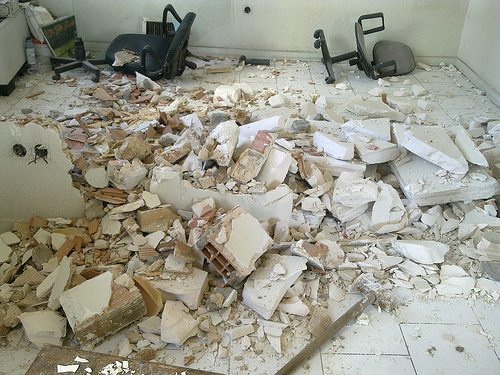
This is what a system structured on burnout looks like. Eventually.

This is what a system structured on burnout looks like. Eventually.

_____

(photo from flickr, Creative Commons, by Babak Farrokhi, entitled “Office Under Construction.” So it’s not really about sustainable systems OR Jericho.)

Little Shot of Sunshine A.S.A.F.P.

I have a serious case of the Februaries (as my friend Jessica calls them). Tired of winter. Tired of dark. Tired of tired of tired of tired.

So you know how we sometimes say someone or something is a force of nature?

Well–the sun is THE force of nature, right?

So let’s MacGyver our moods, shall we? Borrow our myopic buddy’s glasses and make a prism to focus what little sun there is on whatever target needs it most.

BOOM! Fire! Explosion! And we’re free.

(That’s how it works on TV anyhow.)

Seriously. Give someone a compliment. Say thanks. Apologize. Tell a joke. Randomly shoot a thumbs-up when you see someone doing anything remotely thumbs-uppable. Do it now. Or As Soon As Freaking Possible.

I know I need it. I know I’m not alone.

And lest anyone mistake this for a Pollyanna moment (or, as someone near and dear to me is capable of, a Nucleanna moment)–I think there’s a poopload of bleakness and bad news around.

But a little shot of sunshine now and then, that makes the poop more bearable.

At least in theory.

My favorite color.

My favorite color.

Cheers!

{photo from flickr, Creative Commons, by Beau B–no real name given because he is apparently a high school student. Usage of this photo should not be construed as an endorsement of underage drinking, drinking to excess, or drinking in the workplace. It’s just pretty. And a pun.n Plus, if you know me, you know the acrylic nails just crack me up.]

Each Other’s Anodyne

I’m working today on the manuscript of a chapbook of poems about teaching and working as a professor. The working title is Each Other’s Anodyne, in which case this is the title poem.

I posted it as a note on Facebook two years ago. During Wisconsin’s Arab(esque) Spring.

The ice on our streets and sidewalks, the way the snow is crunchy, the way slush turned to gray iron–it would be so treacherous if we were protesting in Madison today. So I’m glad we’re not.

In general, the political turmoil is overall lower, and I am relieved–I felt wiped out emotionally and spiritually by that spring, and the failed recall didn’t help revive me. Other things have helped. The passage of time has helped.

Finding this poem again for the manuscript brings it all back, though, and I have to ask:

How much has changed, really?

This poem still resonates with me. (And I still need to revise the second sonnet to focus more on Firefly.)

(It’s a crown of sonnets, if you’re into form at all.)

_____
EACH OTHER’S ANODYNE

The weary teacher lays his pen aside
And rubs his eyes, says to his wife, “All right,
I’ll come to bed.” They both know he will try
To grade some more in the morning. All through the night
Another teacher wakes up anxious, mad
At everyone. She yells at her husband and son,
But it’s not their fault. It’s not the teachers’ fault.
In a dark time, our hard work shines too bright.
We’re public target practice. We’re spittoons.
For a time, a shining time, we were solid
In the middle class, rewarded for working hard
To help synapses snap and shimmer in the light.
Tempus fugit, damn it, sad but true:
The best shows all get cancelled way too soon.

The best shows all get cancelled way too soon.
Post-modernly they hooked us and we swooned
At heroes rounding all the genres up
To drove them o’er the plains. Inspire us!
The hooker with the heart of brass blew up
The patriarchy, blam! The runt did chin-ups
Until he made the winning catch, two times.
The rocket rounded earth, accompanied by chimes
At midnight, and we, we got attached too fast
To what the larger corporate sponsor failed
To see a profit in. It couldn’t last,
But we had no idea the cruise ship had sailed.
We made a snack and snuggled, and watched the show.
The nights were longer then, with deeper snow.

The nights were longer then, and deeper snow
Made driving slower. Now darker days have come
Despite the later sunsets. We didn’t know
How sweet it was—our biggest worry was some
Stupid internet scam our students fell for—
An octopus living in trees. Like always, slow
In winter—we did our jobs, shoveled some more,
And then the Packers won the Super Bowl!
For Valentine’s, our governor went nuclear.
So far he’s systematic—everything
We care about, he wants to cut. Budget despair
Has set in hard. It will not ever be spring.
Thick fog, black scabs of snow, raw time, hard earth.
But up in the gray, three sand hill cranes, flying north.

Up in the gray, three sand hill cranes, flying north.
Inexorably, the seasons change. They do.
But broken-hearted, raw, beleaguered blue—
We cannot trust the calendar. It’s death
We see when we look around—dead trees, dead grass
Below the layered shale of sooty ice.
Just like “always winter and never Christmas,”
We long for a miraculous thaw or a looking glass.
Not knowing is the worst; at least we think
It is—we’ll think that until we learn the worst.
However far we’ve learned our hopes can sink,
they’ve sunk so far, and farther, and farthest.
We thought we had a thaw, but it froze again.
The ditches are full of ice. But it is thin.

The ditches are full of ice, but it’s too thin
For skating. It makes a satisfying crunch
When you stomp it. Let’s watch the two of them—
These women hiking, sharing a picnic lunch.
One’s tiny—she can almost walk across
The ice before it breaks. Almost. Not quite.
Crashing, they are each other’s anodyne.
One lover catches another and she laughs,
“You silly thing.” And just like that, the tears
come flying out, “I’m sorry I dragged you here.
I can’t even make you my wife. This stupid state
Is stupid. I hate it. Hate, hate, hate.”
“Please don’t hate on my account. Not ever.
We’ve made a home. Your students need you here.”

We’ve made a home where students need us. Here
In the trenches, in the cold and the muck of open admission,
We’re spinning plates for students, showing where
Centrifugal becomes centripetal
With just the right transitional phrase. They take
The plates away from us, they break the glass
Bell jars and ceilings, they celebrate the figures
That animate their dreams the night they made
The quadratic formula prove itself on threat
Of death, organismic, de dicto, real.
Whatever ivory tower there ever was,
It’s gone for good, and most of us are thrilled.
We may stay—we may move on—but we are sure—
If not Wisconsin, somewhere, someone will learn.

If not Wisconsin, somewhere, someone will learn
That when you titillate the lesser devils
Of our nature, when you go all Soviet
And wish my cow would die (you ate your own),
You’re just a toddler berserker tearing down
the walls, affronted when the ceiling lands.
America seemed like such a good idea.
I guess it’s possible it might again.
Uncertain of so much save that we stand,
The union of other and each, screaming
At the snow, we can keep each other warm.
We can be each other’s anodyne,
Inventing for each other a kind of summer
When weary teachers lay their pens aside.

_____

Heroes

Heroes

This is what I remember from the protest. Unlike anti-war protests I’d been to in the past, so many of the protestors two years ago were older than me, middle class, looking for all the world like the mild-mannered sort of folk who’d never consider leaving home to protest. When I look at them now all I can think is “heroes.”

The good work goes on. Teachers are still teaching, and even though “Each Other’s Anodyne” is the title poem from my chapbook, it is not the end of the story. This is: “No One Can Stop Us.”

And even though we lost the recall, and the vast majority of the protesting is done, there are still voices out there that inspire me. Recently, Margaret Rozga accepted a Martin Luther King Jr. Award on behalf of her late husband, James Groppi. Her speech was terrific, and the video is inspiring to watch. Her poetry is terrific, and I’m so pleased for her at the attention it’s getting. But you know what else inspires me about Peggy? The years and years and years and years she taught.
_____
[Photo from flickr, Creative Commons. Taken by Richard Hurd on February 19, 2011.]

“I see it . . . I see you”

In the yinny-yangy world of work, my last post, “Welcome to UW-Bitchland,” was a protest against a criticism I responded badly to–someone suggested that full-time faculty should be on campus five days a week. Since I’m not, I took it personally. I absolutely don’t agree. I’m VERY available to students in person when I’m on campus (four days a week), and on email when I’m not (I check email six days a week). Also this: “Relax! You’ll Be More Productive!” (I took their energy audit and I am officially only 20% energized. Sheesh. More on that another time.)

But today, I’m really, truly feeling the love. A colleague who’s probably 15 years younger than me checked in through email–someone had criticized me in a way she thought was simply not true, and she just wanted to check in.

Driving to work I was thinking how lucky I am to have worked in a place with people ahead of me and behind me (chronologically) who supported me.

It’s more than support. I truly feel that I have a solid cohort of folks who see me, who get me, who appreciate me.

So of course, I was reminded of Bradley Cooper.

In multiple interviews, he relates this story, how he had “taped an audition scene with his mother, hoping to land a role as De Niro’s son in 2009’s ‘Everybody’s Fine.’ A hotel meeting ensued, Cooper remembers, that was typically short and pointed.’He looked at me,’ Cooper says, ‘and he said, “Yeah, you’re not gonna get it [Sam Rockwell did], but I see it . . . I see you . . . I see you . . . oh, uh, who was reading the other role, your mother? Yeah, I thought that.'”

What you see when you watch a lot of Bradley Cooper interviews is how over-the-moon he has been and still is about Robert DeNiro. It’s unabashed. And apparently, it’s mutual–Mr. DeNiro also gushed on Katie Couric’s show.

So here’s me gushing: I’m celebrating love of colleagues this Valentine’s Day. I’m not saying I love every single one of my colleagues (what are the odds of that even being possible?), but I am saying thank-you to people who have said to me in so many ways over the years, “I see it…I see you.”

I want to try harder than ever to say it back, to seek out those people and those moments and say it loud and proud: “I see it…I see you.” I love you.

_____

Valentines in the window of the British Heart Foundation Charity Shop - Uxbridge

Valentines in the window of the British Heart Foundation Charity Shop – Uxbridge


_____
(photo from flickr creative commons by Spixey)

Welcome to UW-Bitchland

timeclock
On further reflection we have removed the timeclocks
We asked you to use to punch in and out every day.
We were never pleased with the level of compliance
among certain faculty members who shall be unnamed,
and we recently learned student workers were employed
to clock in and out, being notified by email and text.
And even after the reasonable minimum had been set,
there were those who insisted 40 hours qualified
as full-time. Oh really? Since when? Well, nevermind.
The purchase of GPS ankle bracelets has been authorized
and yours will arrive sometime this week. As you can see,
they are unobtrusive. They match everything.
anklebracelet

We’ll now know every minute you’re on campus.
Actual productivity means much less to us.
_____
(timeclock pic from flickr, creative commons, posted by Philo Nordlund. Ankle bracelet from Wikipedia, Wikipedia commons.)

_____
This post should probably always be paired with the next one, “I see it…I see you.”

Pretty Bleak

UPDATE! ENG 203 students helped me revise.  We put in “bleeding” instead of “blue-gray” in line five, AND we’re contemplating using a verb/gerund in the last line, something along the lines of dancing/prancing like a gas (based on the heaving and skipping preceding it).

_____

for Alayne

PRETTY BLEAK

Unremittingly gray and beige and white,

The forecast should have called for headache weather.

This must be what arthritis looks like

From inside the land of pain. Frozen virus showers.

Bleeding  pewter, slate, graphite, gray.

Dirty snow. Even pine trees look more black than green.

Oh, February. Oh, Wisconsin. Oh.

I would flush this bleakness like shit if I could.

Another month at least of scraping the windshield.

Of all plans depending on what the weather pretties say.

I almost don’t believe in hot and humid,

In a day when there is zero percent chance of snow.

And yet, just that fast, the snow’s subliming,

Heaving from solid, skipping liquid, free as a gas.

______

Snow in Italy (NASA Goddard Photo and Video NASA Goddard Space Flight Center)

Snow in Italy (NASA Goddard Photo and Video NASA Goddard Space Flight Center)

We know it snows in Italy.  Here’s proof.

But that’s not what we think of when we think of Italy. Here’s to a sunny day, sitting on a stone veranda, drinking a chewy wine out of one of those little water glasses.  Cheers!

_____

(photo from Flickr, Creative Commons)

Being Strategic About Lent

Convergence of the universe, February 10, 2013 example:

We’re heading into a week with Mardi Gras and Lent, and then Valentine’s Day, which will feature a visit to my campus from the UW Colleges Chancellor and Provost.

Really feels like the universe got its dates mixed up. Shouldn’t it be Mardi Gras, Valentine’s, and THEN Lent? I would say, in general, prolonged contact with administrators makes me feel Lenten. (I mean that in the sweetest possible way, of course.)

So take that week of big dates and mash it up with a book I’m reading, The Generals, by Thomas Ricks (“One of Ricks’s strengths is that his judgments are nuanced” says one reviewer. I’ll say. I bought two copies of the book as a “family book club” selection–my parents and my husband and I are making our way through it.)

So then take that book and those dates and layer them on top of my recent attempts to make good use of Things and a Sunday meeting, and here’s what we get:

I’m feeling the need to be my own General Patton, my own Ike, my own General George C. Marshall, and be strategic about how I’m spending my time, supremely allying my short-term goals with my long-term goals and the available hours.

Here are the quotes I’m finding stunning this morning:

According to Ricks, “Marshall understood that Eisenhower had a talent for implementing strategy. And that job, Marshall believed, was more difficult than designing it. ‘There’s nothing so profound in the logic of the thing….But the execution of it, that’s another matter.'”

Interestingly, until I typed it, I was misreading this as “nothing so profound AS the logic of the thing,” which is telling, since I LOVE, love, love designing plans, so of course I’d be biased in their favor.

When Marshall met with Eisenhower right after Pearl Harbor , he gave him a test, saying, “Look, there are two things we have got to do. We have to to do our best in the Pacific and we’ve got to win this whole war. Now, how are we going to do it? Now, that is going to be your problem.” Ricks presents the next part in an understated way that emphasizes the drama:

“‘Give me a few hours,’ Eisenhower requested.”

Can you imagine? Mind-blowing.

Ricks quotes Eisenhower repeatedly from Ike’s memoirs (which I now very much want to read), here matching a quote from Ike to the incredible test above, “I loved to do that kind of work” Ike wrote. “Practical problems have always been my equivalent of crossword puzzles.”

According to Ricks, the thing Ike was amazingly good at was prioritizing.

Which is something I’m amazingly bad at sometimes. So I want to learn from this:

“Prioritizing tends to be a forgotten aspect of strategy. The art of strategy is foremost not about how to do something but about what to do. In other words, the first problem is to determine what the real problem is. There are many aspects to any given problem, the strategist must sort through them and determine its essence, for there lies the key to its solution. Eisenhower clearly understood the need to separate the essential from the merely important.”

Wowie, zowie. That’s my task: separating the essential from the merely important. To some extent, this echoes other works I’ve read, such as Steven Covey’s Seven Habits of Highly Effective People, which I read as a birthday present TO my father one year. I was broke since his birthday is in September (and academics don’t get their first paycheck until October–it took me a lot of years to figure out how NOT to be broke in September), so I pledged to read books he’d been recommending.  I was pleasantly surprised by Covey’s book.

But somehow reading about these things in the context of WWII seems really compelling to me right now, and wow–I had no idea how HUGE George Marshall was in effecting our success.

I enjoyed the chapter on Patton, about whom Ricks says, “The blustery Patton behaved in ways that would have gotten other officers relieved, but he was kept on because he was seen, accurately, as a man of unusual flaws and exceptional strengths.”  And I’m now on the chapter about Mark Clark, who, according to Ricks, “was perhaps, never quite bad enough to relieve but not quite good enough to admire.” That’s damning.

So I’m summoning my inner General Marshall to appoint my inner Ike to implement my plan and keep my inner Patton under control.

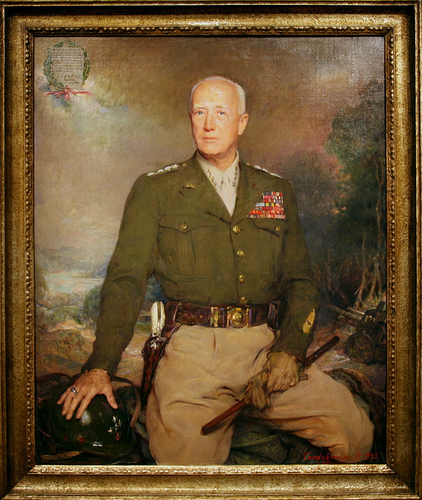
General Patton, from Flickr Creative Commons, attr. to clif1066

General Patton, from Flickr Creative Commons, attr. to clif1066

Forward, march!

Party on Mardi Gras.  Express love on Valentine’s Day. Give nothing up for Lent; instead add IN supreme focus on prioritizing.

Left-right-left-right-left-right (doo wah diddy diddy dum diddy doo).