Category Archives: Work Life

It’s Hard to Teach When Gollum’s in Your Class

It’s hard to teach when Gollum’s in your class.
He’s not the ideal student by any stretch,
but he’ll blame you if he doesn’t pass.

He’s very disruptive, all that muttering “my precious”
and small group work with him is just a bitch.
It’s hard to teach when Gollum’s in your class

because even saying Sméagol when you take attendance,
even smiling when you really want to screech,
you can be sure that he’ll blame you if he doesn’t pass.

He misses class a lot. Just vanishes.
Then swears he was too there. It’s hard to teach
the earnest students when Gollum’s in your class,

but you owe it to the ones who are not treacherous,
the step by by step by steps, the clear approach.
That rat-like monkey will blame you if he doesn’t pass,

but don’t dumb things down. Just do your best.
Backwards design might save you in a hitch.
It’s hard to teach if Gollum’s in your class,
but don’t blame yourself if he shall not pass.


_____

If fish were learning outcomes, Gollum would get an A+.

If fish were learning outcomes, Gollum would get an A+.

_____
(photo by Larry and Linda on Flickr, Creative Commons)

(OH that last line–“He shall not pass” sounds so foreordained and the teacher in me keeps hoping, hoping that Gollum will pull it together and squeak out a decent grade. But how can I not play on “shall not pass?” Decisions, decisions…)

2013 Wisconsin Professor Mindset List

On August 20, Beloit College will do what it’s been doing since 1998 and release the Mindset List for incoming college freshman. These lists are fun, especially if you don’t look every single year. So, for example, last year’s #20 “Exposed bra straps have always been a fashion statement, not a wardrobe malfunction to be corrected quietly by well-meaning friends,” amused me. I think about bras straps now and then. Other deep things I think about include trying to figure out when we’ll all decide shirts need to be shorter than the jackets they are worn under, or at least tucked in. I hope someone tells me when this happens. It took me a while to notice it was o.k. to have a shirt hanging out below a jacket.

This list is written in the spirit of “young folks live in a different world,” and to the extent that professors are old folks who are out of it, and a little more out of it each year, I think the list is helpful.

But honestly, if you’re the sort of professor who hasn’t noticed that students get their music in digital format now, a glance at this list won’t help much. And going overboard with the impression that “they often listen to it on their laptops or replace it with music downloaded onto their MP3s and iPods” (last year’s #15) might make  us miss out on an awesome opportunity to talk about the deep pleasure of listening to music on vinyl, a pretty big trend among youngsters at the moment (maybe that will be on this year’s list).

Dana Falconberry, who looks almost old enough to drink legally, had an awesome show at the Sh*tty Barn last night. She sells her song in CD, MP3 and LP format.

It turns out that spending time with young people is a really good way to learn about their mindset.

I was terribly impressed with Dana Falconberry, for example. Not only was the music awesome, her gratitude was really shiny and sweet to see. She said repeatedly how honored she was to play music in a venue where people were listening. Sitting in their chairs and listening. And totally engaged. She thanked Chris and Martha, the owners of the Sh*tty Barn, repeatedly, and followed up one of her compliments with “especially considering the state of the music industry right now.”

So, yes, I have to have it in my heart to reach out to students this fall who truly, truly, love Justin Bieber. But they don’t all love Justin Bieber (mentioned in last year’s #1).

I will check out the list when it comes out next week, remembering that it is written by guys who are older than me, who seem to be nostalgic about a world that was already gone when I started college in 1983.

Meanwhile, although I am utterly unqualified to write a list about anyone’s mindset but my own, I thought it might be fun to try to list some things that are true of me and at least one other professor (how’s that for a high standard in statistics and the logic of generalization?) I’m not the first professor to have done this–professors doing their own mindset lists may become as much of an August tradition as people passing around the Beloit list, which contains 75 items.

I don’t have the attention span or time for that many. I’m sure the fact that Sesame Street came on the air when I was four (and I thought for a while it was JUST FOR ME and was upset when I found out other kids had it in their houses, too) has something to do with my relatively recently diagnosed ADHD, the existence of which I’m sure was bemoaned in an earlier list.

1. If you’re a traditional age student, I have been teaching since before you were born.

2. If you’re a non-traditional student, first of all, you are my favorite kind of student. Seriously. Second, I am assuming you’ve been doing a lot of interesting things other than getting a college degree, and I’m looking forward to hearing about them.

3. Even though I did less of what I call “work-work” this summer than I usually do, I didn’t “have the summer off.” I did some work I got paid for (evaluating student writing samples for composition class placement) and some writing and research and class prep (which I consider “pro bono,” since I didn’t get paid for those).

4. You should know I am open to questions and complaints. This will become clear as the semester proceeds. (Or you’ll find out that I like to see myself as open but am really a bitch–I don’t think that’s true, but it’s within the realm of what’s possible. I ask for student feedback A LOT, in a variety of ways, including anonymous surveys, so I feel certain someone would have told me by now if I were pretending to be open but not really open.)

5. Even though I’m open to questions and complaints, I don’t get all happy hearing the “I paid for this class so I should be able to do what I want” argument, also known as the “student as consumer” model.

Let me assure all students and parents contributing to my students’ education (tuition now covers almost half of what it costs to run my institution–it used to be a third), and the good taxpayers of Wisconsin (state support for higher education is dwindling, but it’s still there), and taxpayers all over the country (federal financial aid, etc.) that I am determined to give good bang for the buck in and out of my classroom.

I am a well-published, award-winning, full professor in my 26th year of teaching at the college level. Moreover, I am working to improve. All the time. Every year. Every semester, actually.

But students aren’t really consumers. Even if a student of mine is paying 100% of her or his own tuition (which is rare), that isn’t half of what it costs to educate that one student. (And in a classroom of 24, it’s 1/2 of 1/24th.)

So if we stick with the consumer model, then the consumers are the ones who pay the most, and in that case, the student is a product.

Fortunately for all of us, I don’t like the consumer model much at all.

I’m getting paid a good salary to do an important job, and I’m on it. I got this.

6. However, you should also know that I don’t respond well to the “You should be available to me 24 hours a day since you make $80,000 a year” argument. Like a lot of professors my age (I’m 48), I am in the sandwich generation.  I have a son who’s eight and a half, and parents whose doctor appointments I track on Google calendar–not because I have to take them to the doctor every time, but because that’s just what they do a lot of during the week, and I’m close to my parents. I’m also married to a pretty terrific guy.

Thus, because of all my important and socially acceptable obligations, I simply cannot be available 24/7.  But honestly?  I’m not even trying.

I spend a fair bit of time on things that are only important in the sense that it’s important to enjoy life.

I just don’t think my (relatively) good salary means I should be available to students 24/7.  This applies to my colleagues as well, btw.

I don’t know how much you’d have to pay me to be that available, but it’s way more than I will ever make as a professor.

But I’m VERY available. Students praise me for it year after year in the end of term ANONYMOUS surveys the UW Colleges distribute. I’m in my office a lot and on email a lot and even available for online chats.

Also, I don’t make $80,000 a year, which leads us to the next point:

7. It’s kind of an icky time to work in the public sector in Wisconsin. It’s probably better if we don’t talk about it much.

8. I am a lifelong underachiever. My talents and my potential have almost never led to the kind of success other people anticipate for me. So I totally get skipping class, procrastinating, doing sub-par work, and generally all manner of slacking. Keep in mind, since I was born in 1965, I’m not a Baby Boomer. I’m Generation X, known across the universe for slacking.

Here’s what I don’t get:  the student who doesn’t do the work and somehow expects a grade other than what is indicated by the work that was done.

I get it if you don’t want to bring your A Game to my class. I won’t take it personally. Or I’ll try not to. But if you don’t bring your A Game, don’t be all fussy at me when your grade isn’t an A.

(And you probably ought to bring your B Game to class if you want a C, because it turns out college is often more challenging than high school. Not always. But often.)

9. If I can figure out where to get a bunch of them for free, I’m going to have a big bowl of condoms and dental dams in my office. Come by and grab a handful. (I’d buy them for y’all, but can’t really afford that, cf. #7.)  I heard on the radio last spring the rate of AIDS infection is going down except for traditional-age college students. Geez, people. Watch Philadelphia, would you? Seriously. Most of you aren’t going to get jobs with good benefits, so you won’t be able to afford all the awesome AIDS drugs we have now. And hello–what you do or do not do now can give you or keep you from getting things like cervical, anal, or mouth or throat cancer. So really, could you just try to not get any STDs? And wait just A LITTLE LONGER to get pregnant? Sheesh.

10. When I first started teaching, my group of graduate assistants was  told that part of our job was to help “thin the herd,” that SIU had admitted more freshmen than it could accommodate in sophomore classes. I can’t remember the exact percentage, but we were supposed to make sure there were at least a few Fs on our final grades, and if there weren’t, we were in danger of not being re-hired.

A snootier way to talk about this would be to say that first-year courses and instructors are “gatekeepers,” and in charge of getting rid of students who aren’t really “college material.”

It’s ridiculously easy to teach in such a way that a certain number of students are guaranteed to fail.

It’s much, much harder to try and teach in such a way that students are sufficiently supported on their way to  meeting appropriately high standards.

But that’s what I’m trying to do. If you’re in my classroom, I want you to succeed.

_____

So there you go. My 2013 Mindset List. What was on my mind when I started college? Eye shadow, apparently:
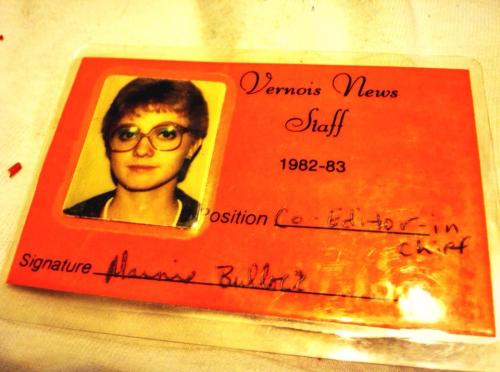
I don't know yet as much as I thought I knew then.

I don’t know yet as much as I thought I knew then.

Creative People Say Yes (Sometimes)

I once came upon my cousin Reid practicing different ways to say “no.” He was 3 or 4 at the time. “No, I couldn’t possibly,” he said. “Absolutely not.”

He was onto something, that little ‘un. At least in my family, saying no takes practice.

Saying no? I’m big on it. Sometimes I’m even good at it. I certainly like the IDEA of saying no.

I’ve written about a fair number of times:
“How do I do that? How do I become the sort of person who says no to things?”

Clitter-Clatter Clutter Time , which references two terrific posts by my favorite tattooed Lutheran blogger, Nadia Bolz Weber, “The Spiritual Practice of Saying No,” and its companion piece, “The Spiritual Practice of Saying Yes!”

The Sarcastic Lutheran says, “The people who are inclined to say yes to everything do all the work and then burn out and become resentful about the people who are inclined to say no to everything. It’s as though the world is divided into martyrs and slackers.”

I don’t make a very good martyr or slacker, either one, not for very long.

I worked enough 50+ hours this spring semester, I worry my slacker credentials are in danger of not being renewed.

Busy as I’ve been, I’m nowhere close to martyrdom. I have some regrets, but I don’t regret all of the times I said yes. (Or came up with something to do that no one even asked me to do.)

Recent things that added to my to do list that I am particularly happy to locate in the land of “yes!”:

  • In addition to volunteering in my son’s classroom at the River Valley Elementary Studio School a couple hours a week, presenting a lesson on storytelling, with a way of talking about narrative arc that was a big hit.
  • Leading the Westby Co-Op Credit Union Board of Directors and branch managers in creativity exercises.
  • Serving as a (paid) reader for writing sample/placement tests for incoming UW-R students, and as a local developmental writing coordinator (unpaid).

In general, I am unrealistic about how the number of things I try to get done will fit into the number of available hours, and I don’t necessarily do things in the right order (which sometimes does and sometimes does not qualify as procrastination).

Thus, some of my commitments (such as returning student work promptly) suffered this spring, and probably, saying “yes” to new stuff impacted the ongoing stuff.

In general, I need to parse, pare, and prune my To Do list.

So, in one way, I totally get Kevin Ashton’s “Creative People Say No.”

He is right that “We do not have enough time as it is. There are groceries to buy, gas tanks to fill, families to love and day jobs to do.”

And he is right that “Time is the raw material of creation.”

Time is a precious resource. It must be guarded. I get it.

But wow did that blog post bug me.

(more on page 2!)

Something Beyond Cynicism

On the other side of burnout
there is rest, there is a place
where even my incompetence
has a bucket it fits into.

As I compost all my bitterness,
my misplaced hopefulness,
my misspent hours,
I watch the steam

rise up from what’s rotten.

A wisp of a moist gray ghost,
a sign of moving on,
a sweet portent

there and gone.

What’s done
is done.

Marnie’s Idea Mill–churning out great ideas since…NOW.

I am pleased, excited, terrified and astonished to be announcing the launch of Marnie’s Idea Mill, a crowdfunding campaign on Indiegogo.

I’m raising money to replace myself in the classroom, so that I will have time to design and implement workshops on creativity.

Thanks in advance for checking out the site and considering making a contribution!

You can help other ways–posting the link on your own Facebook page or blog, retweeting, or forwarding to people who might make a contribution will help, too.

I also welcome feedback on any and all parts of this project.

Also accepting good wishes and blessings!

Metaphor 1.1

Metaphor 1.1


_____
The perks I’m offering include a shout-out on this blog, a copy of Each Other’s Anodyne (a hand-sewn chapbook, a collection of my poems about teaching), feedback on your own creative writing, customized sonnets, and personalized creativity coaching sessions.

As of today, I’ve raised $10,000 in contributions and pledges toward the $24,000 total I need ($6,000 per course x four courses). My fundraising goal on Indiegogo is $4,000, and the deadline for the online campaign is June 17.

My ultimate deadline is July 1.

When I say I love impossible things, I am not kidding.

But I’m trusting Marnie’s Idea Mill can make some magic and attract some magic and make creativity workshops possible (which will then generate even more magic).
_____

Because I am married to a man who is 1/4 Finn, who has read the Kalevala multiple times and also cheers for Finnish drivers in World Rally racing, I know that the Sampo is a mill that generated an infinite supply of flour, salt, and gold.

It was made by Ilmarinen (using a forge, that, as my husband likes to point out, the Kalevala never mentions being destroyed–so maybe it’s still out there…) for the Mistress of the North, who turned out to be a nasty sort, and after a complicated series of events I couldn’t quite follow as my husband described it, the People of the South decided to steal the Sampo. The boat it was in sank, but pieces of the Sampo washed ashore and prosperity accompanied even those pieces.

There used to be a store in Madison called the Magic Mill, which I loved, but it closed. The Sampo, though–that’s a really potent metaphor.

The Sampo one of the images I had in mind when I decided to call my Indiegogo crowdfunding campaign “Marnie’s Idea Mill.”

Idea generation is a huge part of how we measure creativity, so I wanted a metaphor of something that generates. Mill seemed kindlier than factory somehow….

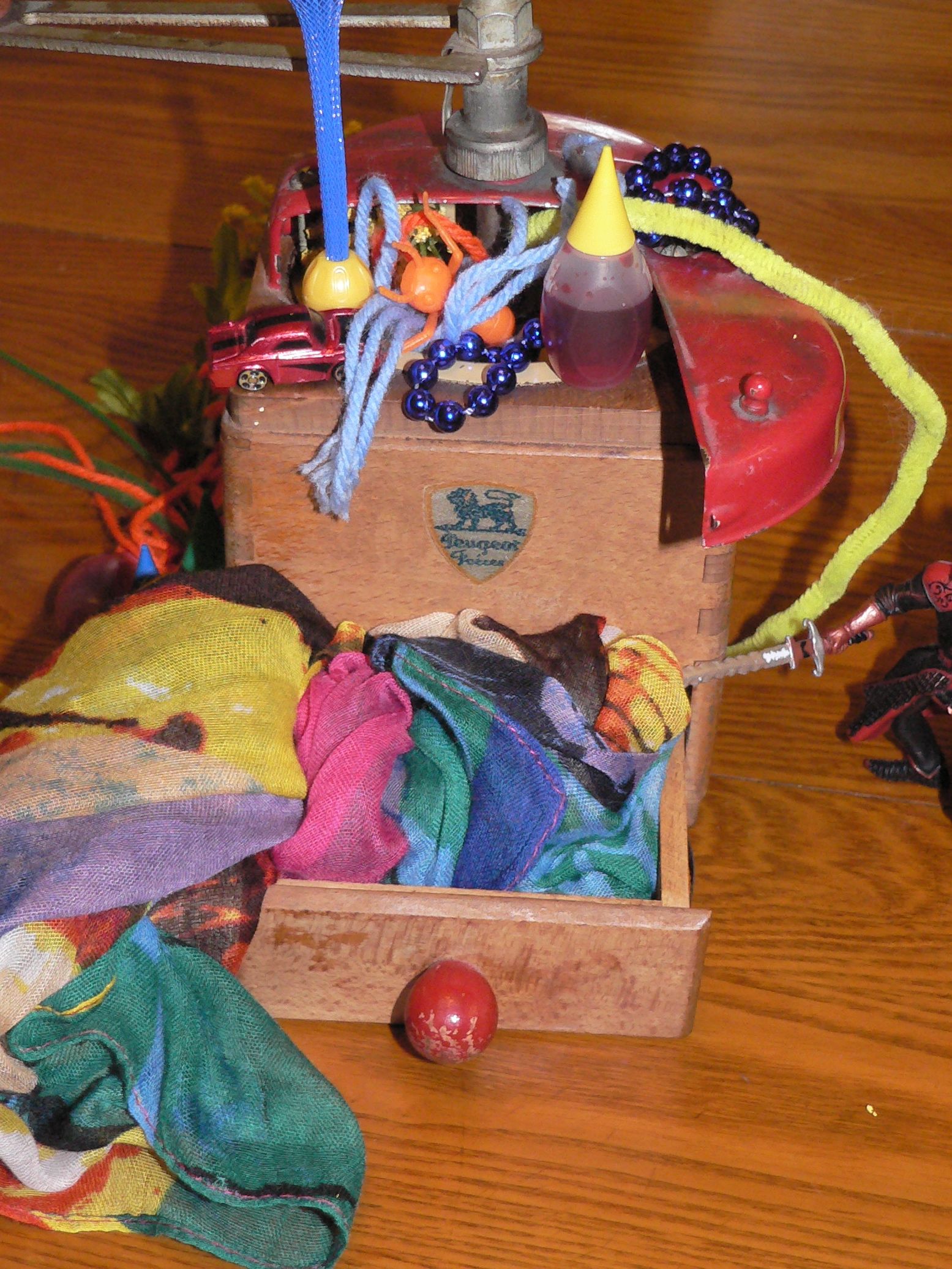
Plus, we have a wide assortment of Peugeot hand grinders (my husband is also 1/4 French).

Another old, old story I had in mind is from 1 Kings 17. In it, Elijah curses the land of Israel, “there shall not be dew nor rain these years, but according to my word.” The Lord sends him to a brook where ravens care for him, and then to a widow, who, when asked for a wee bit of bread by Elijah says, “As the Lord God liveth,” (which I think would now translate to “holy crap, man”). She says she barely has enough to keep herself and her son alive one more day. But Elijah blesses her barrel and says it will not be empty until God sends rain. (I always thought that should be until a few months after the rain showed up, but I’m sure it worked out fine.)

For me, this is a story about living from a place of “enough” rather than a place of “not enough.”

I am trusting there is enough good will and money in the world to help me meet my goal of designing workshops to help people become more creative–more people who can forge amazing mills, more prophets who can see plenty when the rest of us see scarcity….

More where there is currently less.
_____
(You can read more about my creativity research, my fundraising, and my ideas for workshops on various pages here on my blog.)

Teacher Lady! a new magazine for lady teachers!

I get my best ideas during finals week.

I get my best ideas during finals week.

On the Enduring Appeal of Bureaucracy

A roller coaster isn’t scary because
The car’s attached to the rail (you hope it is),
However high you loop, you’re certain you will
End up right where you started. A reliable thrill.
A blanket. Mowed trails. Molded cafeteria tray.
We do it this way because we’ve always done it this way.
And if you want to make a radical change,
We’ll say no. Quickly. Firmly. Again and again.
“So rather than shift to what it needed to do,
The Army would continue doing what it knew
How to do, which is how bureaucracies act
When they lack strong leadership.” Thomas E. Ricks.
Of course it worked so well in Vietnam.
So we do what we do and thus stay safe and warm.

_____

Cafeteria trays at the Googleplex

Cafeteria trays at the Googleplex

The cafeteria tray I had in mind was the kind that has spaces for your food–elementary school tray, of course. But aren’t these Googleplex trays pretty? Gosh. Might make you think it was possible to have a mix of the creative and the tried-and-true.

Also:  The Generals is just an amazing book. I applaud Tom Ricks once again.

_____

(Picture from Creative Commons on flickr, taken by John “Pathfinder” Lester)

“How do I do that? How do I become a person who says no to things?”

(If you’re keeping score at home, this is also “How to Get the Pay Raise You Deserve, Part V”)

Here’s one of my favorite drums to pound:

You can raise your hourly wage by working fewer hours.

(You have to be on salary for the math to work.)

How? Here’s how to do less:

10. Take people at their word. Take them up on their offers. For example, when I get an email from someone who says, “Would you like to do X, or do you need me to do it?” I mostly say, “That would be great if you would do it! Thanks!” Because what are the possibilities there?

a. It was a passive-aggressive way of asking me to do it.

b. It was a genuine offer to do X.

c. It was a way to try to shame me into doing it, hoping I wouldn’t admit to “needing” anything.

So, for a. my response is that I might sometimes accede to passive-aggressive bullshit without realizing what I’m doing, but when I see it, I like to mess with it, and play dumb, and pretend like I’m dealing with someone who says what they mean. (Because they totally should say what they mean, or at least stop talking to me.)

For b., my response is THANKS! Then I try to make the offer back  when I can. (I’m not a selfish jerk. I’m just trying to stay relatively sane.)

For c., I would, if I were forced to name names, say call 1-800-Shame Resilience and ask to talk to Brené Brown. She’ll give you the what-for. And I have many, many needs about which I have so little shame that I’m happy to let someone else feel needed.

My need to admit I have needs and someone else’s need to feel needed = pie and ice cream.

This is how great it feels to be needed.

This is how great it feels to be needed.

9. Ask for help. Don’t even wait for someone drive their passive-aggressive sedan by you so slowly that it’s easy-peasy for you to grab the bumper and ride your skateboard along in their fumes for a while. Just ask for help.  You’re a good person. You’re helpful. When someone who isn’t ALWAYS asking for  help asks you for help, do you think that person is horrible?  (Don’t tell me if you do.)
8. Pretend you’re someone you’re not. Would the Mansplainer say yes to everything asked of him? He would not. If you were a rock star, would your personal assistant field this request to you? He would not.
7. Wait to say yes. Lots of people have talked about this, so I won’t say much. But it’s pure gold in terms of effectiveness. It’s hard to say no in the moment of social pressure ACK ACK ONE OF THOSE BAD DREAMS WHERE I CAN’T SPEAK, but it’s way easier half a day later to email and say, “I’m sorry. I just looked at my to do list and my calendar and I just can’t.”

6. Don’t LIE and say you looked at your to do list and your calendar. Actually do it. And try to make it a really accurate to do list and a calendar on which you’ve sketched out when you’re going to do what’s on the list. (Please allow me once again to recommend Things and “Sunday Meeting” by Kerry Rock-My-World.)

5.Stop thinking up new things to do that no one even asked you to come up with.

4. Don’t wait until your wicked-burnout ways land you in a health or relationship crisis (they will, eventually). Get that calendar back out and imagine you’ve been warned that approximately two weeks from now, there will be a one to two-day crisis that you absolutely have to deal with.

Or, if that feels icky, imagine that the grandmother of a former student wants to give your campus a check for $100,000 dollars and because that student spoke so fondly of you, you have to accept the check in person. Two weeks from now. It will take two days.

What would you do? Cancel some stuff? Ask people to cover for you? Reschedule some stuff? Imagine blocking out two whole days. Make a plan.

Then follow through.  Or, if that feels too indulgent, do it for one day. Or an hour.

If you really can’t do it just for yourself, to get caught up, or catch a movie, or take a nap, or work on your favorite part of your job that you never get to work on, or go on a date, or WHATEVER, then schedule an appointment with a healthcare professional and use sick leave. That is what sick leave is for. It is for when you have a health problem. If you can’t make time for what is important, you have a problem.

3. Find that one thing on your to do list that you haven’t done yet, that you don’t want to do, that you keep putting off, for whatever reason. Cross it off your list. If someone else needs to know you’re done with it, email them and say, “I’m so sorry, but I said yes to too many things this semester/month/week/year/time on the planet. I am not going to do this. I am very, very sorry.”

This is not the BEST way to be a people pleaser, but you know what? Ms. People wasn’t pleased at how long it was taking you to do whatever. At least now Ms. People can make other plans.

And even though it wasn’t taking up your time because you weren’t doing it, it was taking up a lot of psychological energy hanging around on your to do list. Kind of like that creepy guy that kept asking you what kind of batteries he should buy with his special massage implement when you worked at Spencer’s Gifts.

2. Check in with people who know you & will tell you the truth (their truth, anyway) who can fulfill these roles (these might or might not be people you actually work with, and these may be the only useful roles the fun house mirrors play in your life):

MIRROR: person who sees things pretty much as you see them in terms of philosophy, values, work-life balance, who respects you and cares for you. Ask the MIRROR person: am I working too much? am I working enough? Jussssssssst right? Make adjustments as needed, in consultation with that person.

FUN HOUSE MIRROR SKINNY WORKAHOLIC VERSION: ask someone who lives to work and works to live the same questions. If that person EVER, EVER, EVER says something along the lines of “You’re working an awful lot lately,” you know it’s crisis time (see #4 above).

(Don’t wait for that person to say “You’re working too much.” They don’t believe that is possible.)

FUN HOUSE MIRROR LOVE-HANDLED BELUSHI-BOY: if you say to this terrific guy, who’s probably wearing a Hawaiian shirt & shorts with 700 pockets, “hey, am I working enough?” and he says, “No, you’ve been super mellow and ready to play pool a lot lately” go back and double-check with your MIRROR and then make a plan if you need to. Could be you’re making time for a precious friend or it could be you got TOO GOOD at setting boundaries. Don’t worry if that happened, because

Here’s what there will always be plenty of: people asking you to do stuff. You will never lack for opportunities to do a little back-fill if you realize you were slacking. Which you probably weren’t.

1. Do whatever you can to be the kind of person who operates from a base of worth and plenty rather than inadequacy and scarcity.

I still struggle with this, but I’m trying to listen less to the voice in me that wants everyone to like me all the time, especially the people I don’t like. I’m trying to listen more to the voice that says I am enough, and that I get to be picky about who rides on the bus with me. People who bring me down can’t get on my bus. Or they at least can’t sit in the back where we’re singing “One Tin Soldier.”

This isn’t possible for all of us, I know, at least maybe not now, not this year, not this week, not with this boss, not in this job, not in this economy–I get it. I feel it. I feel gobsmacked by it sometimes. But when and where it’s possible, we need to listen to Nancy Reagan’s quavery, moneyed, seat-of-power voice:

JUST SAY NO.

Getting the Pay Raise You Deserve, Part IV

Part of healing from burnout is learning to set boundaries. Making time for what’s important (yourself. family. friends. fun. community. yourself again) other than your work.

Easier said than done. Really easily said. “Set boundaries.” Unless you have a cute little hint of a lisp the way John F. Kennedy, Jr. had. Then it’s a little harder to say.

Pretty hard to do.

But those of us who’ve emerged from the Pretty Good Depression still employed find ourselves picking up the slack left behind when people were laid off, or  not replaced, or carrying a heavier load in terms of student enrollment, juggling new initiatives, etc. etc.

It is just so easy to do too much for too long and end up having your soul scrape up against your to do list like bone-on-bone-bad arthritis.

In the long run, as I mentioned to my boss’s boss’s boss last Valentine’s Day (ahem), a system that is structured to rely on people burning themselves out LIKE OURS is not sustainable. (It also doesn’t get the best work out of people, even in the relative short-run–but that’s the subject of yet another blog yet to be written. Stay tuned.)

For me, the urge  to work too much (and the actuality of working too much and the guilt of perhaps not working enough) mixes with my long-term tendencies toward depression and anxiety into a toxic burnout brew that makes me less of everything I want to be (loving, enthusiastic, effective) and more of everything I’d rather not be (chronically irritated, cynical, spastically ineffective).

I’m still learning, but I’m making progress.

If you click on “burnout” in my blog categories, you’ll see it’s something I write about a lot. (cf: fixate upon.)

In Getting the Pay Raise You Deserve, Parts I, II, and III,

I acknowledge:

It is all too easy to come across as whining, and something like “I had to spend an hour on the phone getting my insurance coverage worked out today” can come across as ingratitude, a classic First World Problem….it is a luxury to consider what changes we could make to improve our lot. But you know what? A lot of us in academia do have that luxury, especially those of us with tenure.

I assert:

You can raise your hourly wage by working fewer hours.

I celebrate myself, I sing myself:

I don’t work too hard. I work hard enough.

Here’s how good I am at setting boundaries.  I got folks pounding on one of the walls I built hollering at me  like they’re possessed by the spirit of Chico Marx: “You no work enough.”

Here’s the contested boundary of the month:

In response to Scott Walker’s 2011 budget bombs (which resulted in less take home pay for my family), I looked around to find ways to save money. We love Culver’s just as much as we always did, but we don’t go as much as we used to. INSERT LOTS AND LOTS OF OTHER EXAMPLES OF BUDGET TRIMMING HERE. And then, to save money on gas, I started working from Spring Green some Tuesdays (my teaching schedule is MWF). That enabled me to volunteer in my son’s classroom now and then. That turned into a regular gig. That turned into a commitment. Which turned into a column in the Voice of the River Valley.

I do a lot of work on Tuesdays, and I check email a lot during the day. I’m considering setting up virtual office hours to make sure students and advisees remember that I am available on Tuesdays, just not in person in my office on my campus. And as I mentioned in one of the three prior posts in this series, I average more than 40 hours a week during the 9-month contract. Since I try to take a week off between semesters, and two days off at Thanksgiving, and two or three days off during spring break, and maybe Labor Day if I’ve got my course syllabi ready, that means I typically average 45 hours during an actual teaching week.  (I don’t count how many hours I work in the summer, but it probably averages to about 20. )

I don’t see why it’s anyone’s beeswax, if I’m accessible to students, if I’m doing my job well (I have official recognition of that), and if I’m doing my share for service (and I do), WHY it matters how many of those hours are in my office or on campus or in my kitchen or at a coffee shop or wherever.

But there are people for whom dedication to campus life is measured in hours worked (more hours = more dedication) and hours on campus (more = more). I don’t agree. I hope the issue goes away. If it doesn’t–well, gracious. You won’t like me when I’m angry.

Take this one boundary skirmish as a warning, all ye who dare to dream of  work life balance. Sometimes when you set a boundary, you have to defend it. But a lot of times, people don’t even notice.

If you’re brave enough, if you’re tired enough, if you’re burned out enough, tune in next time when I share my Top List of Ways to Work Less. (Remember: if you’re on salary, you can raise your hourly wage by working fewer hours.  The hilarious irony is that the quality of your work will actually go up, and in some cases, the quantity too–because you have more energy to focus on the things you’re still doing. Shh. Don’t tell.)

Meanwhile, Joshua blew the trumpet at Jericho and the walls came a-tumblin down.

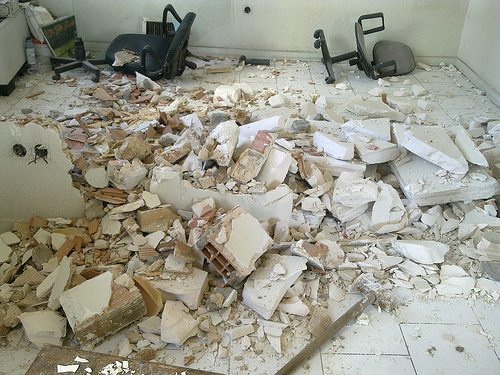
This is what a system structured on burnout looks like. Eventually.

This is what a system structured on burnout looks like. Eventually.

_____

(photo from flickr, Creative Commons, by Babak Farrokhi, entitled “Office Under Construction.” So it’s not really about sustainable systems OR Jericho.)

Little Shot of Sunshine A.S.A.F.P.

I have a serious case of the Februaries (as my friend Jessica calls them). Tired of winter. Tired of dark. Tired of tired of tired of tired.

So you know how we sometimes say someone or something is a force of nature?

Well–the sun is THE force of nature, right?

So let’s MacGyver our moods, shall we? Borrow our myopic buddy’s glasses and make a prism to focus what little sun there is on whatever target needs it most.

BOOM! Fire! Explosion! And we’re free.

(That’s how it works on TV anyhow.)

Seriously. Give someone a compliment. Say thanks. Apologize. Tell a joke. Randomly shoot a thumbs-up when you see someone doing anything remotely thumbs-uppable. Do it now. Or As Soon As Freaking Possible.

I know I need it. I know I’m not alone.

And lest anyone mistake this for a Pollyanna moment (or, as someone near and dear to me is capable of, a Nucleanna moment)–I think there’s a poopload of bleakness and bad news around.

But a little shot of sunshine now and then, that makes the poop more bearable.

At least in theory.

My favorite color.

My favorite color.

Cheers!

{photo from flickr, Creative Commons, by Beau B–no real name given because he is apparently a high school student. Usage of this photo should not be construed as an endorsement of underage drinking, drinking to excess, or drinking in the workplace. It’s just pretty. And a pun.n Plus, if you know me, you know the acrylic nails just crack me up.]