Category Archives: Work Life

Each Other’s Anodyne

I’m working today on the manuscript of a chapbook of poems about teaching and working as a professor. The working title is Each Other’s Anodyne, in which case this is the title poem.

I posted it as a note on Facebook two years ago. During Wisconsin’s Arab(esque) Spring.

The ice on our streets and sidewalks, the way the snow is crunchy, the way slush turned to gray iron–it would be so treacherous if we were protesting in Madison today. So I’m glad we’re not.

In general, the political turmoil is overall lower, and I am relieved–I felt wiped out emotionally and spiritually by that spring, and the failed recall didn’t help revive me. Other things have helped. The passage of time has helped.

Finding this poem again for the manuscript brings it all back, though, and I have to ask:

How much has changed, really?

This poem still resonates with me. (And I still need to revise the second sonnet to focus more on Firefly.)

(It’s a crown of sonnets, if you’re into form at all.)

_____
EACH OTHER’S ANODYNE

The weary teacher lays his pen aside
And rubs his eyes, says to his wife, “All right,
I’ll come to bed.” They both know he will try
To grade some more in the morning. All through the night
Another teacher wakes up anxious, mad
At everyone. She yells at her husband and son,
But it’s not their fault. It’s not the teachers’ fault.
In a dark time, our hard work shines too bright.
We’re public target practice. We’re spittoons.
For a time, a shining time, we were solid
In the middle class, rewarded for working hard
To help synapses snap and shimmer in the light.
Tempus fugit, damn it, sad but true:
The best shows all get cancelled way too soon.

The best shows all get cancelled way too soon.
Post-modernly they hooked us and we swooned
At heroes rounding all the genres up
To drove them o’er the plains. Inspire us!
The hooker with the heart of brass blew up
The patriarchy, blam! The runt did chin-ups
Until he made the winning catch, two times.
The rocket rounded earth, accompanied by chimes
At midnight, and we, we got attached too fast
To what the larger corporate sponsor failed
To see a profit in. It couldn’t last,
But we had no idea the cruise ship had sailed.
We made a snack and snuggled, and watched the show.
The nights were longer then, with deeper snow.

The nights were longer then, and deeper snow
Made driving slower. Now darker days have come
Despite the later sunsets. We didn’t know
How sweet it was—our biggest worry was some
Stupid internet scam our students fell for—
An octopus living in trees. Like always, slow
In winter—we did our jobs, shoveled some more,
And then the Packers won the Super Bowl!
For Valentine’s, our governor went nuclear.
So far he’s systematic—everything
We care about, he wants to cut. Budget despair
Has set in hard. It will not ever be spring.
Thick fog, black scabs of snow, raw time, hard earth.
But up in the gray, three sand hill cranes, flying north.

Up in the gray, three sand hill cranes, flying north.
Inexorably, the seasons change. They do.
But broken-hearted, raw, beleaguered blue—
We cannot trust the calendar. It’s death
We see when we look around—dead trees, dead grass
Below the layered shale of sooty ice.
Just like “always winter and never Christmas,”
We long for a miraculous thaw or a looking glass.
Not knowing is the worst; at least we think
It is—we’ll think that until we learn the worst.
However far we’ve learned our hopes can sink,
they’ve sunk so far, and farther, and farthest.
We thought we had a thaw, but it froze again.
The ditches are full of ice. But it is thin.

The ditches are full of ice, but it’s too thin
For skating. It makes a satisfying crunch
When you stomp it. Let’s watch the two of them—
These women hiking, sharing a picnic lunch.
One’s tiny—she can almost walk across
The ice before it breaks. Almost. Not quite.
Crashing, they are each other’s anodyne.
One lover catches another and she laughs,
“You silly thing.” And just like that, the tears
come flying out, “I’m sorry I dragged you here.
I can’t even make you my wife. This stupid state
Is stupid. I hate it. Hate, hate, hate.”
“Please don’t hate on my account. Not ever.
We’ve made a home. Your students need you here.”

We’ve made a home where students need us. Here
In the trenches, in the cold and the muck of open admission,
We’re spinning plates for students, showing where
Centrifugal becomes centripetal
With just the right transitional phrase. They take
The plates away from us, they break the glass
Bell jars and ceilings, they celebrate the figures
That animate their dreams the night they made
The quadratic formula prove itself on threat
Of death, organismic, de dicto, real.
Whatever ivory tower there ever was,
It’s gone for good, and most of us are thrilled.
We may stay—we may move on—but we are sure—
If not Wisconsin, somewhere, someone will learn.

If not Wisconsin, somewhere, someone will learn
That when you titillate the lesser devils
Of our nature, when you go all Soviet
And wish my cow would die (you ate your own),
You’re just a toddler berserker tearing down
the walls, affronted when the ceiling lands.
America seemed like such a good idea.
I guess it’s possible it might again.
Uncertain of so much save that we stand,
The union of other and each, screaming
At the snow, we can keep each other warm.
We can be each other’s anodyne,
Inventing for each other a kind of summer
When weary teachers lay their pens aside.

_____
Heroes

Heroes

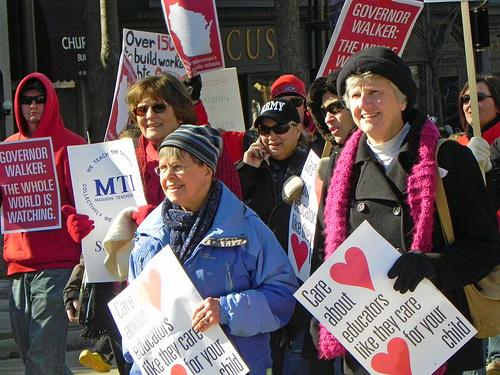
This is what I remember from the protest. Unlike anti-war protests I’d been to in the past, so many of the protestors two years ago were older than me, middle class, looking for all the world like the mild-mannered sort of folk who’d never consider leaving home to protest. When I look at them now all I can think is “heroes.”

The good work goes on. Teachers are still teaching, and even though “Each Other’s Anodyne” is the title poem from my chapbook, it is not the end of the story. This is: “No One Can Stop Us.”

And even though we lost the recall, and the vast majority of the protesting is done, there are still voices out there that inspire me. Recently, Margaret Rozga accepted a Martin Luther King Jr. Award on behalf of her late husband, James Groppi. Her speech was terrific, and the video is inspiring to watch. Her poetry is terrific, and I’m so pleased for her at the attention it’s getting. But you know what else inspires me about Peggy? The years and years and years and years she taught.
_____
[Photo from flickr, Creative Commons. Taken by Richard Hurd on February 19, 2011.]

“I see it . . . I see you”

In the yinny-yangy world of work, my last post, “Welcome to UW-Bitchland,” was a protest against a criticism I responded badly to–someone suggested that full-time faculty should be on campus five days a week. Since I’m not, I took it personally. I absolutely don’t agree. I’m VERY available to students in person when I’m on campus (four days a week), and on email when I’m not (I check email six days a week). Also this: “Relax! You’ll Be More Productive!” (I took their energy audit and I am officially only 20% energized. Sheesh. More on that another time.)

But today, I’m really, truly feeling the love. A colleague who’s probably 15 years younger than me checked in through email–someone had criticized me in a way she thought was simply not true, and she just wanted to check in.

Driving to work I was thinking how lucky I am to have worked in a place with people ahead of me and behind me (chronologically) who supported me.

It’s more than support. I truly feel that I have a solid cohort of folks who see me, who get me, who appreciate me.

So of course, I was reminded of Bradley Cooper.

In multiple interviews, he relates this story, how he had “taped an audition scene with his mother, hoping to land a role as De Niro’s son in 2009’s ‘Everybody’s Fine.’ A hotel meeting ensued, Cooper remembers, that was typically short and pointed.’He looked at me,’ Cooper says, ‘and he said, “Yeah, you’re not gonna get it [Sam Rockwell did], but I see it . . . I see you . . . I see you . . . oh, uh, who was reading the other role, your mother? Yeah, I thought that.'”

What you see when you watch a lot of Bradley Cooper interviews is how over-the-moon he has been and still is about Robert DeNiro. It’s unabashed. And apparently, it’s mutual–Mr. DeNiro also gushed on Katie Couric’s show.

So here’s me gushing: I’m celebrating love of colleagues this Valentine’s Day. I’m not saying I love every single one of my colleagues (what are the odds of that even being possible?), but I am saying thank-you to people who have said to me in so many ways over the years, “I see it…I see you.”

I want to try harder than ever to say it back, to seek out those people and those moments and say it loud and proud: “I see it…I see you.” I love you.

_____

Valentines in the window of the British Heart Foundation Charity Shop - Uxbridge

Valentines in the window of the British Heart Foundation Charity Shop – Uxbridge


_____
(photo from flickr creative commons by Spixey)

Welcome to UW-Bitchland

timeclock
On further reflection we have removed the timeclocks
We asked you to use to punch in and out every day.
We were never pleased with the level of compliance
among certain faculty members who shall be unnamed,
and we recently learned student workers were employed
to clock in and out, being notified by email and text.
And even after the reasonable minimum had been set,
there were those who insisted 40 hours qualified
as full-time. Oh really? Since when? Well, nevermind.
The purchase of GPS ankle bracelets has been authorized
and yours will arrive sometime this week. As you can see,
they are unobtrusive. They match everything.
anklebracelet

We’ll now know every minute you’re on campus.
Actual productivity means much less to us.
_____
(timeclock pic from flickr, creative commons, posted by Philo Nordlund. Ankle bracelet from Wikipedia, Wikipedia commons.)

_____
This post should probably always be paired with the next one, “I see it…I see you.”

Pretty Bleak

UPDATE! ENG 203 students helped me revise.  We put in “bleeding” instead of “blue-gray” in line five, AND we’re contemplating using a verb/gerund in the last line, something along the lines of dancing/prancing like a gas (based on the heaving and skipping preceding it).

_____

for Alayne

PRETTY BLEAK

Unremittingly gray and beige and white,

The forecast should have called for headache weather.

This must be what arthritis looks like

From inside the land of pain. Frozen virus showers.

Bleeding  pewter, slate, graphite, gray.

Dirty snow. Even pine trees look more black than green.

Oh, February. Oh, Wisconsin. Oh.

I would flush this bleakness like shit if I could.

Another month at least of scraping the windshield.

Of all plans depending on what the weather pretties say.

I almost don’t believe in hot and humid,

In a day when there is zero percent chance of snow.

And yet, just that fast, the snow’s subliming,

Heaving from solid, skipping liquid, free as a gas.

______

Snow in Italy (NASA Goddard Photo and Video NASA Goddard Space Flight Center)

Snow in Italy (NASA Goddard Photo and Video NASA Goddard Space Flight Center)

We know it snows in Italy.  Here’s proof.

But that’s not what we think of when we think of Italy. Here’s to a sunny day, sitting on a stone veranda, drinking a chewy wine out of one of those little water glasses.  Cheers!

_____

(photo from Flickr, Creative Commons)

Being Strategic About Lent

Convergence of the universe, February 10, 2013 example:

We’re heading into a week with Mardi Gras and Lent, and then Valentine’s Day, which will feature a visit to my campus from the UW Colleges Chancellor and Provost.

Really feels like the universe got its dates mixed up. Shouldn’t it be Mardi Gras, Valentine’s, and THEN Lent? I would say, in general, prolonged contact with administrators makes me feel Lenten. (I mean that in the sweetest possible way, of course.)

So take that week of big dates and mash it up with a book I’m reading, The Generals, by Thomas Ricks (“One of Ricks’s strengths is that his judgments are nuanced” says one reviewer. I’ll say. I bought two copies of the book as a “family book club” selection–my parents and my husband and I are making our way through it.)

So then take that book and those dates and layer them on top of my recent attempts to make good use of Things and a Sunday meeting, and here’s what we get:

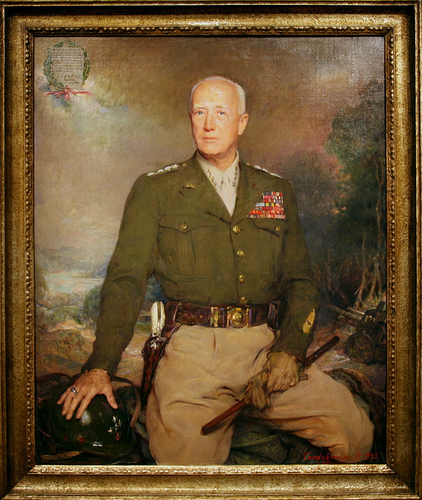
I’m feeling the need to be my own General Patton, my own Ike, my own General George C. Marshall, and be strategic about how I’m spending my time, supremely allying my short-term goals with my long-term goals and the available hours.

Here are the quotes I’m finding stunning this morning:

According to Ricks, “Marshall understood that Eisenhower had a talent for implementing strategy. And that job, Marshall believed, was more difficult than designing it. ‘There’s nothing so profound in the logic of the thing….But the execution of it, that’s another matter.'”

Interestingly, until I typed it, I was misreading this as “nothing so profound AS the logic of the thing,” which is telling, since I LOVE, love, love designing plans, so of course I’d be biased in their favor.

When Marshall met with Eisenhower right after Pearl Harbor , he gave him a test, saying, “Look, there are two things we have got to do. We have to to do our best in the Pacific and we’ve got to win this whole war. Now, how are we going to do it? Now, that is going to be your problem.” Ricks presents the next part in an understated way that emphasizes the drama:

“‘Give me a few hours,’ Eisenhower requested.”

Can you imagine? Mind-blowing.

Ricks quotes Eisenhower repeatedly from Ike’s memoirs (which I now very much want to read), here matching a quote from Ike to the incredible test above, “I loved to do that kind of work” Ike wrote. “Practical problems have always been my equivalent of crossword puzzles.”

According to Ricks, the thing Ike was amazingly good at was prioritizing.

Which is something I’m amazingly bad at sometimes. So I want to learn from this:

“Prioritizing tends to be a forgotten aspect of strategy. The art of strategy is foremost not about how to do something but about what to do. In other words, the first problem is to determine what the real problem is. There are many aspects to any given problem, the strategist must sort through them and determine its essence, for there lies the key to its solution. Eisenhower clearly understood the need to separate the essential from the merely important.”

Wowie, zowie. That’s my task: separating the essential from the merely important. To some extent, this echoes other works I’ve read, such as Steven Covey’s Seven Habits of Highly Effective People, which I read as a birthday present TO my father one year. I was broke since his birthday is in September (and academics don’t get their first paycheck until October–it took me a lot of years to figure out how NOT to be broke in September), so I pledged to read books he’d been recommending.  I was pleasantly surprised by Covey’s book.

But somehow reading about these things in the context of WWII seems really compelling to me right now, and wow–I had no idea how HUGE George Marshall was in effecting our success.

I enjoyed the chapter on Patton, about whom Ricks says, “The blustery Patton behaved in ways that would have gotten other officers relieved, but he was kept on because he was seen, accurately, as a man of unusual flaws and exceptional strengths.”  And I’m now on the chapter about Mark Clark, who, according to Ricks, “was perhaps, never quite bad enough to relieve but not quite good enough to admire.” That’s damning.

So I’m summoning my inner General Marshall to appoint my inner Ike to implement my plan and keep my inner Patton under control.

General Patton, from Flickr Creative Commons, attr. to clif1066

General Patton, from Flickr Creative Commons, attr. to clif1066

Forward, march!

Party on Mardi Gras.  Express love on Valentine’s Day. Give nothing up for Lent; instead add IN supreme focus on prioritizing.

Left-right-left-right-left-right (doo wah diddy diddy dum diddy doo).

Pedagogy Stew in Voice of the River Valley

In the category of New Year/New Adventure, this is my favorite so far. I’m very happy to have a column in the very cool regional publication, Voice of the River Valley. The tagline on the masthead says it pretty well: “A guide to people and events that inspire, educate, and enrich life in the River Valley area.”

That covers a lot because there IS a lot here–I’ve been here for more than twenty years, and I’m still amazed. There really does seem to be some kind of vortex that draws in interesting stuff, and I’ve never lived in a prettier place. (Sure, Missoula was gorgeous, but in a way that alarmed me the whole time I was there–I’d be driving and see MOUNTAIN in my rearview mirror and my Midwestern brain kept telling me “MASSIVE THUNDERHEAD.”)

The current publisher, Sara, is picking up nicely from the founder, Mary, and I’m happy to be a part. I’ll be posting monthly some “stewing” on pedagogy–what we teach, how we teach it, why, whether it works…. This column will typically be focused on the two ends of a spectrum I’m involved in, teaching at the college level and then volunteering at the River Valley Elementary Studio School where Wendell attends. Also, parenting involves a fair bit of educating….

The February issue is available in more than 100 locations around southwest Wisconsin, and also online. The January issue contained this piece, which I’m happy to reprint here (I’ll always wait to post one until the next issue is out–and I’m making almost no changes here, except to add links or correct minor things I meant to say differently.)

ALSO NOTE: I’m happy to take requests. What should I write about as I’m stewing over pedagogy that applies to both college and our public schools?

_____

Howard Gardner’s groundbreaking book, Frames of Mind: The Theory of Multiple Intelligences, came out in 1983, the year I graduated from high school. I saw no evidence of its existence in my college or graduate school courses—as an English major, I was supposed to demonstrate what I knew through exams and essays, and I did a pretty good job of it. In creative writing classes, I was supposed to experiment, but on the page, with regular ink. I did occasionally ask professors to assess my learning in ways they hadn’t announced in the syllabus. I once wrote a poem in response to John Betjeman’s “The Conversion of St. Paul” (better than anything I was writing in creative writing) and asked if the professor would grade it instead of the essay he’d assigned, which wasn’t going well. He was a sweet man and said yes, “But try harder to write an essay next time.”

It wasn’t until I’d been teaching full time for several years that I began to hear about multiple intelligences (or their close cousin, learning styles) from two directions: my university colleagues, typically with much derision; and students, some of whom were very aware of what they were good at and how they learned best. In fact, I’ve had several students over the years tell me they were kinesthetic learners and thus not good essay-writers, and could they have an alternate assignment? (For irony, see previous paragraph.)

I’m interested in how students learn, though, so I do not meet multiple intelligences and learning styles (and I know they’re not the same thing) with the same skepticism as many of my colleagues. Asking about this recently, one common response from my colleagues ran along the lines of, “Wasn’t that all debunked?”

In a 2009 article called “Matching Teaching Style to Learning Style May Not Help Students,” author David Glenn reported on research that shows that although students may have a preferred learning style, the crucial thing, in terms of learning, is whether the teacher has designed the class to best teach whatever concept or skill is currently on the docket. To me, this is the best match-up of theory and practice.

I volunteer a couple of hours a week in my son’s second-grade classroom at River Valley Elementary Studio School, usually during literacy time. His teacher, Nicole Steigenberger, has done a terrific job of setting up a variety of activities for students to choose from, and she nudges them, gently, over the course of a week, to read to themselves, to a partner, draw in response to written descriptions, write in response to pictures with prompts, write their own stories, etc. They also take online assessments periodically, and they get a few minutes just before lunch to do literacy apps on the iPad. These students are not only learning to read and write. They’re learning to learn and demonstrate their knowledge in a variety of ways, which, given the amount of learning they have ahead of them, is almost as important as learning to read and write.

Grateful for my Crazy Life

Just this once, right now, and I wouldn’t say
It will happen again, I’m glad I have too much to do.
My crazy job is almost never boring.
I have the kind of brain that makes big plans
Involving levels and layers and long-term fun
With multiple players and organizations, and—well,
I tell you what—it makes me feel alive.
And tending to the people that I love
Takes time, but look at who I love—a full
Roster of family and friends and coworkers, a whole town
Of creative, funny people. And I LOVE Things,
More than a To Do list, more than software.
My house is messy, yes, because we choose
To read and play instead of clean. What a way
To be allowed to live. I’m grateful. At least today.

C-word, N-word, R-word: Forward!

Seriously considering putting a warning in my syllabi for spring semester:

CAUTION! Profanity Uttered Here.

By me, by other students, by Louis C.K. in our pop culture unit in my composition classes….

Probably thinking, "man, I don't want to be in a composition class."

Probably thinking, “man, I don’t want to be in a composition class.”

When I was tenure-track, I was getting some negative comments from students about my profanity in the classroom, (probably based on The Five-Paragraph Fuck) and my student evaluation numbers weren’t as high as they needed to be to make satisfactory progress on what I used to call “the march to tenure,” so I made swearing less one of my goals. At the time, I asked myself “how important is swearing to me vs. making sure I get tenure?” Seemed like an easy choice.

Since then, I had the honor of working with a male professor who swore like crazy in class, and got terrifically high student eval numbers (mostly because he was an amazing teacher). One of the conclusions I drew from that, rightly or wrongly, was that it’s o.k. for boys to swear. Girls, not so much.

Well, fuck that shit.

It isn’t as though I swear a whole lot, actually, in life or in class. More as a writer probably than any other time. But the freedom to do so feels important, and gosh, sometimes it’s just fun.

But I suppose I’m wanting to give my students fair warning, in case they’re likely to take too much offense. Of course, we’re a small campus, so there aren’t very many sections of any given class, so it isn’t as though students have a lot of choice in course scheduling. So maybe I just want them to steel themselves….

I guess showing Louis C.K. in class gives me automatic membership in the “It’s Our Job to Complicate Students’ Worldview” Club.” Note: I have also shown Slapshot in class. But it isn’t as simple as that.

I have two goals as a teacher that often come into conflict with each other:
1. I want to create a learning environment where students feel safe to learn and grow.
2. I want part of that learning and growing to come through experimentation and boundary-expansion.

So, for example, #2 is being satisfied when students have to grapple with the episode of Louie called “Heckler/Cop Movie,” when Louie goes absolutely nuclear on a female heckler. He calls her a c*&t and calls her mother a c*&t. He says, at one point, “You’re the worst thing that ever happened to America.” I ask students to analyze it (and some episodes of Roseanne) in terms of humor, and it didn’t take very long this past fall semester for students to notice that Louie doesn’t fare so well in that episode, that every offensive thing he does gets punished one way or the other. Then they did research, and many of them found this article: “The Filthy Moralist: How the comedian Louis C.K. became America’s unlikely conscience” from the Atlantic. So there you go, worldview complicated.

Well, worldview complicated for a lot of students. Complicated in one way for students who were appalled by his humor and needed to see how freaking brilliant he is. Complicated, too, for students (primarily male and white) who already thought Louie was hilarious, but couldn’t imagine he might, possibly, be making fun of THEM for laughing and not thinking.

You’ll notice I couldn’t quite bring myself to spell out the c-word. The DVD I had bleeped it, and we had some relatively hilarious, inadvertently hilarious class moments when we discovered that not everyone knew what “c-word” stood for, or what the word meant, or why it struck some people as different than saying “dick” instead of “penis.” #whyIloveteaching

And this takes me back to point #1 above: in our culture, the c-word has a lot of baggage, much of it painful for women. As a teacher, I now feel it is my duty, to be even-handed, to find something that some male students might feel not-just-offended-but-wounded by in the same way some way some female students felt in response to Louie’s rant. Open to suggestions here. (Seriously. Post suggestions.)

My big concern, in other words, is that I don’t guide students in pursuing #2 at the expense of the same people over and over–people who are often picked on in our society.

Just in the realm of vocabulary alone, it’s hard for me to think of a _-word that slams a heterosexual white man without any obvious disabilities. But if we were brainstorming, insults for women, those in the LGBTQ community, people of color, people who are differently-abled…those insults would just spring trippingly and quickly off our tongues.

I’m completely comfortable deleting a post on my own Facebook thread when someone casually uses language I am offended by (or worry a friend might be offended by). In the classroom, the rules of propriety and etiquette don’t seem as clear to me.
_____

As part of my ongoing creativity research, and in preparation for spring semester, I’m continuing to read Dispatches from the Classroom: Graduate Students on Creative Writing Pedagogy, a terrific book I got excited about FIRST because there are precious few articles, let alone whole BOOKS on creative writing pedagogy. This book, edited by Christ Drew, Joseph Rein, and David Yost, came out last year and I find it consistently thought-provoking.

Just this week, I finished M. Thomas Gammarino’s “Invoking the Muzzle: Censorship and the Creative Writing Classroom” and found much to applaud and agree with, but a few places I found sticky.

It’s pretty obviously connected to my concerns above.

He positions himself as a libertarian sort of professor for the most part (for which I feel some kinship, cf: assigning Louis CK, above).

“Can fiction create a hostile learning environment?” he asks as he discusses one of his own experiences as a student writer, when he turned a story into a workshop about a pedophile keeping “pets” in the basement. The teacher reacted strongly, reasoning that other students would essentially have been forced to read it, that they weren’t as free to put it down as they would have been if it had been in a magazine, etc. Gammarino dropped that class, but as he points out, the problem remains.

He summarizes another incident (that he was not involved in) in which a teacher was disturbed by the violence in a student story and sought help outside the classroom–this ended with the student getting expelled and the instructor losing her job. Gammarino blames this on the institution’s overreaction and the attempt at censorship, calling it “prophylactic hysteria” (the phrasing of which I covet).

I like how he distinguishes the basic philosophical positions: “Libertarians may find themselves in the anguished position of having to defend the free speech of people whose viewpoints they find repulsive, but those who favor enacting controls on hate speech appoint themselves to the essentially undemocratic position of prescribing a morality for the masses.”

(I would say in this case it’s not the masses so much as it is the enrollment in any given course, but the point still holds.)

I also appreciate that he asked for feedback from other creative writing teachers, and there’s one response I’d like to highlight, the one from Wilton Barnhardt: “It is, of course, always a judgment call whether this kind of incident is pure aggression, a sociopathic acting out, a smart-ass way to get attention or indulge in hate-speech, or a clumsy attempt by an untrained writer to deal with difficult topics. I think we all know good and well when it’s the former, and I am prepared to sit there and listen and help and edit when it’s the latter.”

Therein lies the sticky place for me. I don’t always know good and well how to distinguish between the former and the latter. Sometimes it’s obvious, sure, but we’ve all seen studies about the higher incidence of mental illness in the field of creative writing, so it wouldn’t be surprising at all to find problems with mental illness in the creative writing classroom.

[Would it automatically be different, I realize I need to ask myself, seeing violent imagery from a student I knew to have mental illness issues, vs. a student who seemed emotionally stable? Hm.]

Violent imagery + mental illness doesn’t automatically add up to “will act on what is described.” Still, when a student I was working with informally began submitting pieces about stalking and harming a female teacher, I wrote him and said I wasn’t comfortable working with him. He cried censorship, and maybe he was right, but one of my absolute life goals is to trust my gut more, and my gut was telling me “RUN!”

I had the choice though–he’d been my student in the past, but wasn’t enrolled in anything at the time.

Gammarino did not give much space to discussing his original teacher’s point about student choice in terms of reading and responding, but I think it’s an important question. He was also very dismissive of another teacher he knows of who asks students to fill out a cover sheet for the pieces they’re going to workshop, describing the potential offensiveness (among other things, I assume). Gammarino says “I want to challenge the warrant behind all of this: namely, that it is part of the writing teacher’s job to protect the comfort level of his students—that is, to keep them from being offended.”

But it isn’t just “being offended” that I’m concerned about. It’s trauma. If a young woman has been raped, a rape scene will be traumatic. The more graphic, the more traumatic (I assume). And even if a young woman hasn’t been raped, do I really want to contribute to the rape culture we live in by asking a whole class to read a graphically violent rape scene?

I’m remembering a particular violent story, a series of revenge fantasies by a student who had writing skills and “issues” in approximately equal measure. It just so happened that the women victims came to more gruesome ends than the men.

I worked with this particular student all semester, and tried to get him to move beyond what I called his “shock and awe” imagery. But there were female students who were deeply uncomfortable working with him, and I don’t feel as though I helped them navigate their discomfort because I wasn’t sure how much of it was sort of an intellectual “ooh. ick.” and how much was simply an appropriate reaction of horror.

Gammarino says “Clearly teachers must do everything they can to protect their students’ safety,” but in this case he means safety in the sense of not actually being the ones killed and hacked up as described in this particular story.

Nothing bad happened in that way with this student; I wasn’t really worried that it would. My “gut,” in other words, was telling me this wasn’t going to make the news.

Gammarino adds that teachers must also “maintain a level of discussion appropriate to higher education,” and that’s where I’m getting stuck. What is appropriate here?

I absolutely agree with him when he says “…insofar as we choose to protect our students from ideas we ourselves may find odious, we also protect them from developing complex minds capable of deciding such matters for themselves.”

So my goal IS helping them navigate their discomfort and their horror. I am wondering if some kind of cover sheet would help–not simply to let students opt-out of reading something they’re alarmed at before reading it, but to also help us keep track of who is pushing what boundaries.

Gammarino describes his own pedophile-with-pets story as “a chance to stretch my imagination,” and that, ultimately, is what I find most troublesome about censorship–it boxes everything up so tightly there is precious little stretching possible.

If we grant that creative writing has to be about more than the craft of writing (the “writing” half of “creative writing”), but also has to be about creativity, then the stretching is crucial, and worth a great deal of student discomfort.

But what if the student writing the scary imagery has been doing that for years? And wants to do only that for the class? How creative is that? What about the student who wants to turn in only masturbation-paced erotica? They’re pushing other people’s boundaries, sure, but not their own.

So here’s my plan for my beginning creative writing class for Spring 2013: students are going to have access to a cover sheet for workshops. Half of it will be what they want to tell other students about the piece they’re submitting, and half of it will be like this (note–VERY ROUGH DRAFT), a way to keep track of how much experimenting people are doing. So if, for example, someone is writing in traditional meter and spouting mainstream ideas all semester, we can all note that and suggest the person push in some other directions. But by the same measure, we can suggest that someone who is consistently writing pieces that “might give your grandmother a stroke” could branch out a little.

I’m also going to Xerox Gammarino’s piece for my creative writing class before the first workshop. I anticipate a good discussion.

(This is also something I’m realizing I need to research more.)

Still haven’t decided about the “CAUTION: Profanity uttered here” warning.

Where All the Slackers Did Go

I was thinking when the Boomers all retired,
Gen X would make the world more fun. Oh well.
My timeline, my assumptions–shot to hell.
I wish I’d known all this when I was hired.

There’s just so much I am so wrong about.

But I’m sure of this: however much the Gnostics
redeem the fall of Eve (and bless them for it),
the curséd part of work will not wash out.

Thorn and thistle, labor, sweaty brow–
an ever-expanding to do list (not quite cancer)–
let’s do our very best, let’s make it count–

I’m remembering how lazy I was when I was a child….

Work might be how I pay my fucking bills.
Work isn’t why I’m on the fucking planet.

New Policy on Tasks

Just as we no longer find it appropriate
to tempt our weak-willed colleagues with sweets
(or risk killing those with peanut allergies)
and thus last year banned everything but fruit
from the break room (and really–carbs–hello?),

we can no longer tolerate undone tasks.
Please volunteer whenever someone asks.

If you feel too busy (and only you would know),
you might consider sleeping slightly less
or drinking more caffeine. Or barring those
perfectly adequate solutions, you might
get a sitter and have a fun date night
with colleagues. If you don’t pitch in, someone
who’s really overworked will be forced to get it done.

for Dana

Don't compartmentalize! Work from home!

Don’t compartmentalize! Work from home!