Category Archives: Writing

The Noble Gases (continued)

1
No wonder I can never remember all eight—
there are only six. I have a place mat
with the periodic table of the elements on it—
I guess it’s time to get it out again.
The ones I never forget are neon
and radon—bar signs and killers in the basement.
I usually remember Superman’s Achille’s heel,
thus krypton, and if I think of Jason, I might
think of Argonauts and thus argon, but
usually I don’t. Almost never will
I think of helium, the most famous one,
the silly voice, the birthday balloon,
the one that can overfill your lungs
and kill you, leeching all your oxygen.

2
There are so many things I can’t remember
all at once. Did I lock the door or not?
Trying to cover up for a name I forgot,
I always introduced myself to my friend’s mother.
I wanted her to say her name back to me.
She never did, but one time said through her teeth,
“I know who you are, god damn it.”
I know her name now, but she’s dead. I don’t need it.
I forget whole poems I’ve written. And other names,
of course, of people I ought to know, and students,
within weeks (or days) of turning in final grades.
I forgot how to start the Lord’s Prayer more than once.
My father’s early Alzheimer’s makes this shit
fraught so I try to console myself with lists.

3
The boys sat in the back, playing chess in their heads.
My friend Beckie and I decided we had too many plots
of Gilligan’s Island in our bright enough heads
to do what they did, several turns in before someone forgot
where some piece was and they argued and then they were done.
I rear-ended a Jeep that same trip, having forgotten
to keep far enough back, forgetting to count
one thousand one, one thousand—ouch.

The noble gases are noble because they’re inert,
unchanging, unlike those brains with the tangles and plaques.
And which noble gas is it inside a laser can fix your eyesight?
Which one makes the IMAX movies so bright?
It’s xenon, which, until a friend pointed it out,
I’d forgotten. I can never remember what all I lack.

With thanks to Max Garland,

and Beckie Hendrick,

and John Heasley (who did remember xenon)

photo (1)

Image

The Noble Gases

for Max Garland

No wonder I can never remember all eight—
there are only six. I have a placemat
with the periodic table of the elements on it—
I guess it’s time to get it out again.
The ones I never forget are neon
and radon—bar signs and killers in the basement.
I usually remember Superman’s Achille’s heel,
thus krypton, and if I think of Jason, I might
think of Argonauts and thus argon, but
usually I don’t. Almost never will
I think of helium, the most famous one,
the silly voice, the birthday balloon,
the one that can overfill your lungs
and kill you, leeching all your oxygen.

____
Working on part 2 and 3 of this poem–will post more soon.

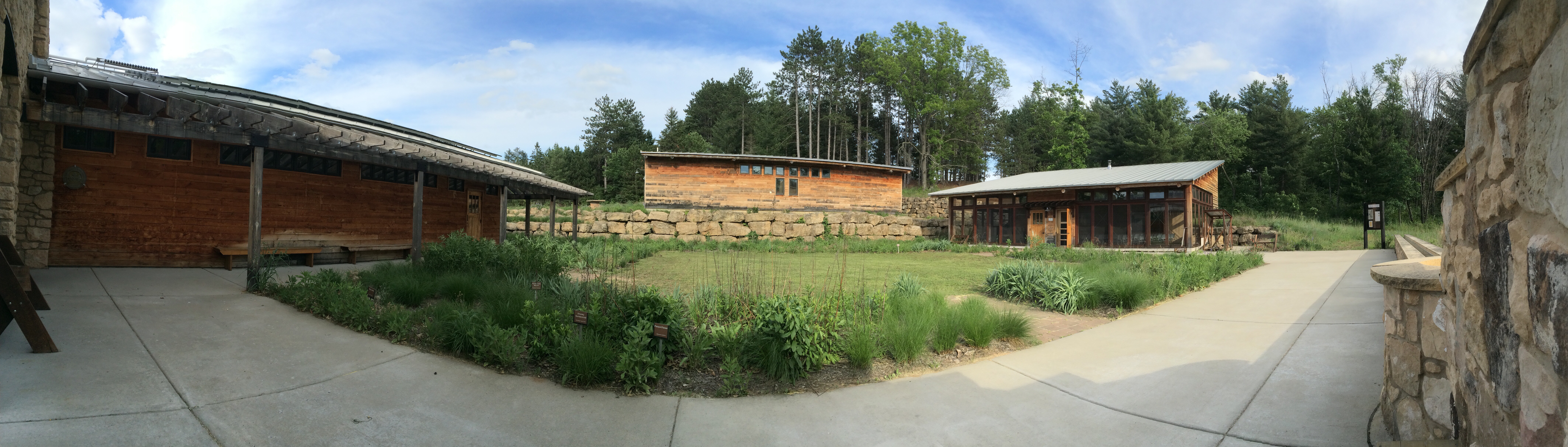
What a pleasure it was to hear Max Garland read at the Aldo Leopold Center on an absolutely perfect Wisconsin summer night. I always enjoy his poems and he spoke so earnestly and well about the importance of art, of making it and supporting it, I found I had tears in my eyes a bunch of times.

Here’s a photo I took as I resisted the mingling part of the evening–I couldn’t bear to be inside on such a gorgeous night.

The Aldo Leopold Center outside Baraboo.

The Aldo Leopold Center outside Baraboo.

This poem came in response to his poem “Hydrogen,” which is available through the Western Kentucky University English Department website.

_____

I have fond memories of WKU, where I once participated in a marathon poetry reading. We read forever there. We might still be reading there.

2103_539916388268_7792_n

Spiraling: Writing the Unthinkable

20131005-192623.jpg

Lynda Barry had us draw spirals today.

I got to do a workshop with her in her Image Lab at the Wisconsin Institutes for Discovery, where she is a (jolly good) fellow. It was a writing workshop, but we drew a little. We spiraled.

20131005-192636.jpg

When we were getting ready to write, or when we were listening to someone else read, we drew spirals.


20131005-192643.jpg

We were supposed to draw it as tight and close as we could without having the lines touch. I got too big on this one and it turned into a labyrinth.


20131005-192651.jpg

Sometimes I closed my eyes and drew.


20131005-192658.jpg

Here’s more of the labyrinth.


20131005-192707.jpg

Eyes closed for a bit.

I like how these pics look a little spooky. I went to scary places today, and I even wrote a ghost story.


Creative People Say Yes (Sometimes)

I once came upon my cousin Reid practicing different ways to say “no.” He was 3 or 4 at the time. “No, I couldn’t possibly,” he said. “Absolutely not.”

He was onto something, that little ‘un. At least in my family, saying no takes practice.

Saying no? I’m big on it. Sometimes I’m even good at it. I certainly like the IDEA of saying no.

I’ve written about a fair number of times:
“How do I do that? How do I become the sort of person who says no to things?”

Clitter-Clatter Clutter Time , which references two terrific posts by my favorite tattooed Lutheran blogger, Nadia Bolz Weber, “The Spiritual Practice of Saying No,” and its companion piece, “The Spiritual Practice of Saying Yes!”

The Sarcastic Lutheran says, “The people who are inclined to say yes to everything do all the work and then burn out and become resentful about the people who are inclined to say no to everything. It’s as though the world is divided into martyrs and slackers.”

I don’t make a very good martyr or slacker, either one, not for very long.

I worked enough 50+ hours this spring semester, I worry my slacker credentials are in danger of not being renewed.

Busy as I’ve been, I’m nowhere close to martyrdom. I have some regrets, but I don’t regret all of the times I said yes. (Or came up with something to do that no one even asked me to do.)

Recent things that added to my to do list that I am particularly happy to locate in the land of “yes!”:

  • In addition to volunteering in my son’s classroom at the River Valley Elementary Studio School a couple hours a week, presenting a lesson on storytelling, with a way of talking about narrative arc that was a big hit.
  • Leading the Westby Co-Op Credit Union Board of Directors and branch managers in creativity exercises.
  • Serving as a (paid) reader for writing sample/placement tests for incoming UW-R students, and as a local developmental writing coordinator (unpaid).

In general, I am unrealistic about how the number of things I try to get done will fit into the number of available hours, and I don’t necessarily do things in the right order (which sometimes does and sometimes does not qualify as procrastination).

Thus, some of my commitments (such as returning student work promptly) suffered this spring, and probably, saying “yes” to new stuff impacted the ongoing stuff.

In general, I need to parse, pare, and prune my To Do list.

So, in one way, I totally get Kevin Ashton’s “Creative People Say No.”

He is right that “We do not have enough time as it is. There are groceries to buy, gas tanks to fill, families to love and day jobs to do.”

And he is right that “Time is the raw material of creation.”

Time is a precious resource. It must be guarded. I get it.

But wow did that blog post bug me.

(more on page 2!)

Driving in a David Cates Novel

“O beautiful, for spacious skies
But now those skies are threatening”
“The End of the Innocence”

Taking the secret detour, the one the natives use,
I fly down Highway T to Z,
past the Cates family farm but really,
it’s the dips and swales and curves
and hills and valleys and long slopes up
and ridge roads that feel impossibly high
for Wisconsin that let me know I’m in a zone
where fiction could happen and also perhaps
some magic but for me, partly panic–

I get agoraphobic on some of these rises
where all you can see past the crest
is the sky. It reminds me of Eastern Montana
a little (except for more trees on both sides),
where I once drove up a long brown hill for so long,
for an hour, forever, I stopped believing in Canada.
I couldn’t imagine anything north of where I was.
Nothing but a sheer drop-off to Hell, maybe,
over the top, nothingness, a crevasse, the crimp-
edge of the known world, no ditch, just–

The trip up, the torture, doesn’t last that long here.
Just when I’m wanting to pull over,
figure out how to turn around or back up,
which is impossible–the road’s too narrow,
the curve’s too sharp, the hill’s too steep–
well, there we are, around the bend
finally, a stretch of open road, another red barn.

Another falling-down house tucked in behind
a mess of blooming lilacs, under which,
if this really is a David Cates novel, someone’s having sex
RIGHT THIS MOMENT, and probably with someone they shouldn’t.

And later the woman, or maybe she’s a girl,
would take a dandelion and say “make a wish”
as she blew the white seeds everywhere at which point
the man, or maybe he’s still a boy,
would think “tampopo” but not say it, not wanting
the girl to feel bad for not knowing Japanese,
and he might also think, but not say,
some racy, clever thing using the word “blow.”
What he probably would say would be “Great.
Now there are more weeds everywhere,”
but then regret having said anything at all.

Because you have to remember, the moment you think
“Anything can happen,” that something bad could.

Just because it’s almost June and everything’s green,
every shade of green, just because the blue sky
is paint-chip sky-blue right overhead, even when
you’ve got Don Henley cranked on the radio,
you can glance in your rear view mirror and see
how the bright blue turns to pale blue and then haze
and then gray along the horizon.

You can see farms you can’t get to on Highway Z.
The people who live there are happy or sad.
But you’ll never get there. You’ll never know.

Coming home, you’ll stop at the T of Highway T and 23
and you’ll see Frank Lloyd Wright’s wind mill
and it won’t impress you this time. Not at all.
_____

I left Southern Illinois to go to graduate school in Missoula, Montana, and there met David Cates, who’d come from Spring Green, Wisconsin, where I live now.

Freaky.

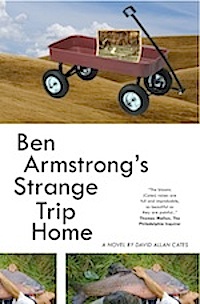
His latest book is odd and beautiful and haunting and two trips to Dodgeville recently I really have felt as though I entered some sort of parallel universe. If you read the book now, there’s probably a silver station wagon taking a curve a little too fast. I’ll be waving.

The latest novel by David Cates (wonderful to read, odd to drive in)

The latest novel by David Cates (wonderful to read, odd to drive in)

When a Marriage Makes

When a marriage makes a baby,
no one is surprised.
When a marriage makes a mess,
well, likewise.

When a marriage makes a record,
it is some kind of sign.
When a marriage makes a book,
that book, that marriage–they’re mine.

____

nath doing the hand-sewing

nath doing the hand-sewing

old school

old school

This. Feels. Amazing.

This. Feels. Amazing.

_____
40 years ago, I put together a collection of some of my own poems along with outright thefty poems cobbled from Beatles lyrics & birthday cards. It was made of typing paper, bound with construction paper and yarn. This was in order to get out of trouble in 3rd grade (having been squirrelly in math class).

I still hope, eventually, to publish a collection of poems through conventional channels, but how lovely it is to have a husband who can take a manuscript of my poems related to teaching, and make of it…a book.

Lazy, Lazy Thinking in the Noon Day Sun

I always used to talk about racism when I talked about logical flaws in my composition classes–that stereotypes came from generalizing badly. Sample size too small, oversimplifying, etc. (I don’t spend much time on logical flaws now, and I miss them–such fun names! Such color and metaphor–one day, the Straw Man smelled a Red Herring and Ergo, Propter Hoc!)

It never occurred to me until I read “Study: Racial stereotyping linked to creative stagnation” on Salon.com that racism was connected (in inverse proportion) to creativity. It makes sense, though.

I’ve written once before in this blog on the notion of lowering associative borders, in a post called “I Can’t Get No Satisficing.”  Having high associative borders is similar to what this study (described in more detail in in this article, “Racial Essentialism Reduces Creative Thinking, Makes People More Closed-Minded” in Science Daily) calls categorical thinking.

The lead researcher, Carmit Tadmor, and her co-authors say that although creative stagnation and racism “concern very different outcomes, they both occur when people fixate on existing category information and conventional mindsets.”

The study is hopeful that people can change their thinking. I am too–part of the reason I want to begin doing workshops on creativity is that studies show people can become more creative thinkers. We’re not stuck with what we were born with.

What I would call a “creativity workshop” is typically called “enhancement training” or “creativity training” in cognitive research. Hsen-Hsing Ma published an article in 2006 with overall terrific news about the possibility that we can become more creative.

Ma cites an early researcher, Paul Torrance,  who found that “programs teaching children to think creatively were at least 50% successful.” Another study from those rockin’ 1970s by Mansfield, et. al., showed “most evaluation studies of creativity training programs seem to support the view that creativity can be trained.”

SO WE’VE KNOWN THIS FOR A LONG TIME.

For the 2006 article, jazzily titled, “A Synthetic Analysis of the Effectivieness of Single Components and Packages in Creativity Training Programs,” Ma did what is called meta-analysis of studies (reading LOTS of studies on an issue and summarizing and analyzing their results), showing the following:

Good news item #1: “Overall, the finding of this study confirms the result of Torrance’s (1972) investigation; namely, that children can be taught to think creatively.”

But oh, gracious, the news is better than that:

“This study also found that creativity training programs tended to be more successful with older participants than younger ones.”

So–watch out old racists and stagnant thinkers everywhere. The times they are a changin’ (NOTE: if you’re old enough to recognize that song, you’re just the right age to benefit from creativity training.)

We can become more creative.

We can become more creative.

___

(Image from Creative Commons on flickr, “Coloured Rooms Doorways-Brian Eno Speaker Floers Sound Installation at Marlborough House” by Dominic Alves.)

“How do I do that? How do I become a person who says no to things?”

(If you’re keeping score at home, this is also “How to Get the Pay Raise You Deserve, Part V”)

Here’s one of my favorite drums to pound:

You can raise your hourly wage by working fewer hours.

(You have to be on salary for the math to work.)

How? Here’s how to do less:

10. Take people at their word. Take them up on their offers. For example, when I get an email from someone who says, “Would you like to do X, or do you need me to do it?” I mostly say, “That would be great if you would do it! Thanks!” Because what are the possibilities there?

a. It was a passive-aggressive way of asking me to do it.

b. It was a genuine offer to do X.

c. It was a way to try to shame me into doing it, hoping I wouldn’t admit to “needing” anything.

So, for a. my response is that I might sometimes accede to passive-aggressive bullshit without realizing what I’m doing, but when I see it, I like to mess with it, and play dumb, and pretend like I’m dealing with someone who says what they mean. (Because they totally should say what they mean, or at least stop talking to me.)

For b., my response is THANKS! Then I try to make the offer back  when I can. (I’m not a selfish jerk. I’m just trying to stay relatively sane.)

For c., I would, if I were forced to name names, say call 1-800-Shame Resilience and ask to talk to Brené Brown. She’ll give you the what-for. And I have many, many needs about which I have so little shame that I’m happy to let someone else feel needed.

My need to admit I have needs and someone else’s need to feel needed = pie and ice cream.

This is how great it feels to be needed.

This is how great it feels to be needed.

9. Ask for help. Don’t even wait for someone drive their passive-aggressive sedan by you so slowly that it’s easy-peasy for you to grab the bumper and ride your skateboard along in their fumes for a while. Just ask for help.  You’re a good person. You’re helpful. When someone who isn’t ALWAYS asking for  help asks you for help, do you think that person is horrible?  (Don’t tell me if you do.)
8. Pretend you’re someone you’re not. Would the Mansplainer say yes to everything asked of him? He would not. If you were a rock star, would your personal assistant field this request to you? He would not.
7. Wait to say yes. Lots of people have talked about this, so I won’t say much. But it’s pure gold in terms of effectiveness. It’s hard to say no in the moment of social pressure ACK ACK ONE OF THOSE BAD DREAMS WHERE I CAN’T SPEAK, but it’s way easier half a day later to email and say, “I’m sorry. I just looked at my to do list and my calendar and I just can’t.”

6. Don’t LIE and say you looked at your to do list and your calendar. Actually do it. And try to make it a really accurate to do list and a calendar on which you’ve sketched out when you’re going to do what’s on the list. (Please allow me once again to recommend Things and “Sunday Meeting” by Kerry Rock-My-World.)

5.Stop thinking up new things to do that no one even asked you to come up with.

4. Don’t wait until your wicked-burnout ways land you in a health or relationship crisis (they will, eventually). Get that calendar back out and imagine you’ve been warned that approximately two weeks from now, there will be a one to two-day crisis that you absolutely have to deal with.

Or, if that feels icky, imagine that the grandmother of a former student wants to give your campus a check for $100,000 dollars and because that student spoke so fondly of you, you have to accept the check in person. Two weeks from now. It will take two days.

What would you do? Cancel some stuff? Ask people to cover for you? Reschedule some stuff? Imagine blocking out two whole days. Make a plan.

Then follow through.  Or, if that feels too indulgent, do it for one day. Or an hour.

If you really can’t do it just for yourself, to get caught up, or catch a movie, or take a nap, or work on your favorite part of your job that you never get to work on, or go on a date, or WHATEVER, then schedule an appointment with a healthcare professional and use sick leave. That is what sick leave is for. It is for when you have a health problem. If you can’t make time for what is important, you have a problem.

3. Find that one thing on your to do list that you haven’t done yet, that you don’t want to do, that you keep putting off, for whatever reason. Cross it off your list. If someone else needs to know you’re done with it, email them and say, “I’m so sorry, but I said yes to too many things this semester/month/week/year/time on the planet. I am not going to do this. I am very, very sorry.”

This is not the BEST way to be a people pleaser, but you know what? Ms. People wasn’t pleased at how long it was taking you to do whatever. At least now Ms. People can make other plans.

And even though it wasn’t taking up your time because you weren’t doing it, it was taking up a lot of psychological energy hanging around on your to do list. Kind of like that creepy guy that kept asking you what kind of batteries he should buy with his special massage implement when you worked at Spencer’s Gifts.

2. Check in with people who know you & will tell you the truth (their truth, anyway) who can fulfill these roles (these might or might not be people you actually work with, and these may be the only useful roles the fun house mirrors play in your life):

MIRROR: person who sees things pretty much as you see them in terms of philosophy, values, work-life balance, who respects you and cares for you. Ask the MIRROR person: am I working too much? am I working enough? Jussssssssst right? Make adjustments as needed, in consultation with that person.

FUN HOUSE MIRROR SKINNY WORKAHOLIC VERSION: ask someone who lives to work and works to live the same questions. If that person EVER, EVER, EVER says something along the lines of “You’re working an awful lot lately,” you know it’s crisis time (see #4 above).

(Don’t wait for that person to say “You’re working too much.” They don’t believe that is possible.)

FUN HOUSE MIRROR LOVE-HANDLED BELUSHI-BOY: if you say to this terrific guy, who’s probably wearing a Hawaiian shirt & shorts with 700 pockets, “hey, am I working enough?” and he says, “No, you’ve been super mellow and ready to play pool a lot lately” go back and double-check with your MIRROR and then make a plan if you need to. Could be you’re making time for a precious friend or it could be you got TOO GOOD at setting boundaries. Don’t worry if that happened, because

Here’s what there will always be plenty of: people asking you to do stuff. You will never lack for opportunities to do a little back-fill if you realize you were slacking. Which you probably weren’t.

1. Do whatever you can to be the kind of person who operates from a base of worth and plenty rather than inadequacy and scarcity.

I still struggle with this, but I’m trying to listen less to the voice in me that wants everyone to like me all the time, especially the people I don’t like. I’m trying to listen more to the voice that says I am enough, and that I get to be picky about who rides on the bus with me. People who bring me down can’t get on my bus. Or they at least can’t sit in the back where we’re singing “One Tin Soldier.”

This isn’t possible for all of us, I know, at least maybe not now, not this year, not this week, not with this boss, not in this job, not in this economy–I get it. I feel it. I feel gobsmacked by it sometimes. But when and where it’s possible, we need to listen to Nancy Reagan’s quavery, moneyed, seat-of-power voice:

JUST SAY NO.

Getting the Pay Raise You Deserve, Part IV

Part of healing from burnout is learning to set boundaries. Making time for what’s important (yourself. family. friends. fun. community. yourself again) other than your work.

Easier said than done. Really easily said. “Set boundaries.” Unless you have a cute little hint of a lisp the way John F. Kennedy, Jr. had. Then it’s a little harder to say.

Pretty hard to do.

But those of us who’ve emerged from the Pretty Good Depression still employed find ourselves picking up the slack left behind when people were laid off, or  not replaced, or carrying a heavier load in terms of student enrollment, juggling new initiatives, etc. etc.

It is just so easy to do too much for too long and end up having your soul scrape up against your to do list like bone-on-bone-bad arthritis.

In the long run, as I mentioned to my boss’s boss’s boss last Valentine’s Day (ahem), a system that is structured to rely on people burning themselves out LIKE OURS is not sustainable. (It also doesn’t get the best work out of people, even in the relative short-run–but that’s the subject of yet another blog yet to be written. Stay tuned.)

For me, the urge  to work too much (and the actuality of working too much and the guilt of perhaps not working enough) mixes with my long-term tendencies toward depression and anxiety into a toxic burnout brew that makes me less of everything I want to be (loving, enthusiastic, effective) and more of everything I’d rather not be (chronically irritated, cynical, spastically ineffective).

I’m still learning, but I’m making progress.

If you click on “burnout” in my blog categories, you’ll see it’s something I write about a lot. (cf: fixate upon.)

In Getting the Pay Raise You Deserve, Parts I, II, and III,

I acknowledge:

It is all too easy to come across as whining, and something like “I had to spend an hour on the phone getting my insurance coverage worked out today” can come across as ingratitude, a classic First World Problem….it is a luxury to consider what changes we could make to improve our lot. But you know what? A lot of us in academia do have that luxury, especially those of us with tenure.

I assert:

You can raise your hourly wage by working fewer hours.

I celebrate myself, I sing myself:

I don’t work too hard. I work hard enough.

Here’s how good I am at setting boundaries.  I got folks pounding on one of the walls I built hollering at me  like they’re possessed by the spirit of Chico Marx: “You no work enough.”

Here’s the contested boundary of the month:

In response to Scott Walker’s 2011 budget bombs (which resulted in less take home pay for my family), I looked around to find ways to save money. We love Culver’s just as much as we always did, but we don’t go as much as we used to. INSERT LOTS AND LOTS OF OTHER EXAMPLES OF BUDGET TRIMMING HERE. And then, to save money on gas, I started working from Spring Green some Tuesdays (my teaching schedule is MWF). That enabled me to volunteer in my son’s classroom now and then. That turned into a regular gig. That turned into a commitment. Which turned into a column in the Voice of the River Valley.

I do a lot of work on Tuesdays, and I check email a lot during the day. I’m considering setting up virtual office hours to make sure students and advisees remember that I am available on Tuesdays, just not in person in my office on my campus. And as I mentioned in one of the three prior posts in this series, I average more than 40 hours a week during the 9-month contract. Since I try to take a week off between semesters, and two days off at Thanksgiving, and two or three days off during spring break, and maybe Labor Day if I’ve got my course syllabi ready, that means I typically average 45 hours during an actual teaching week.  (I don’t count how many hours I work in the summer, but it probably averages to about 20. )

I don’t see why it’s anyone’s beeswax, if I’m accessible to students, if I’m doing my job well (I have official recognition of that), and if I’m doing my share for service (and I do), WHY it matters how many of those hours are in my office or on campus or in my kitchen or at a coffee shop or wherever.

But there are people for whom dedication to campus life is measured in hours worked (more hours = more dedication) and hours on campus (more = more). I don’t agree. I hope the issue goes away. If it doesn’t–well, gracious. You won’t like me when I’m angry.

Take this one boundary skirmish as a warning, all ye who dare to dream of  work life balance. Sometimes when you set a boundary, you have to defend it. But a lot of times, people don’t even notice.

If you’re brave enough, if you’re tired enough, if you’re burned out enough, tune in next time when I share my Top List of Ways to Work Less. (Remember: if you’re on salary, you can raise your hourly wage by working fewer hours.  The hilarious irony is that the quality of your work will actually go up, and in some cases, the quantity too–because you have more energy to focus on the things you’re still doing. Shh. Don’t tell.)

Meanwhile, Joshua blew the trumpet at Jericho and the walls came a-tumblin down.

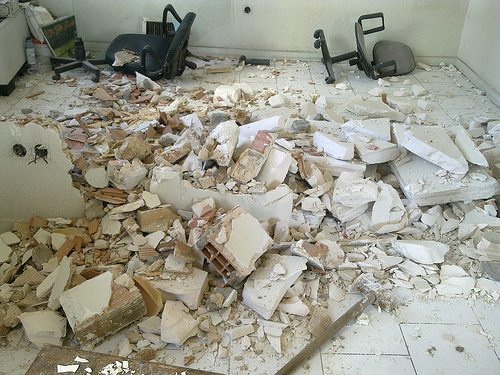
This is what a system structured on burnout looks like. Eventually.

This is what a system structured on burnout looks like. Eventually.

_____

(photo from flickr, Creative Commons, by Babak Farrokhi, entitled “Office Under Construction.” So it’s not really about sustainable systems OR Jericho.)

Grateful for my Crazy Life

Just this once, right now, and I wouldn’t say
It will happen again, I’m glad I have too much to do.
My crazy job is almost never boring.
I have the kind of brain that makes big plans
Involving levels and layers and long-term fun
With multiple players and organizations, and—well,
I tell you what—it makes me feel alive.
And tending to the people that I love
Takes time, but look at who I love—a full
Roster of family and friends and coworkers, a whole town
Of creative, funny people. And I LOVE Things,
More than a To Do list, more than software.
My house is messy, yes, because we choose
To read and play instead of clean. What a way
To be allowed to live. I’m grateful. At least today.