2013 Wisconsin Professor Mindset List

On August 20, Beloit College will do what it’s been doing since 1998 and release the Mindset List for incoming college freshman. These lists are fun, especially if you don’t look every single year. So, for example, last year’s #20 “Exposed bra straps have always been a fashion statement, not a wardrobe malfunction to be corrected quietly by well-meaning friends,” amused me. I think about bras straps now and then. Other deep things I think about include trying to figure out when we’ll all decide shirts need to be shorter than the jackets they are worn under, or at least tucked in. I hope someone tells me when this happens. It took me a while to notice it was o.k. to have a shirt hanging out below a jacket.

This list is written in the spirit of “young folks live in a different world,” and to the extent that professors are old folks who are out of it, and a little more out of it each year, I think the list is helpful.

But honestly, if you’re the sort of professor who hasn’t noticed that students get their music in digital format now, a glance at this list won’t help much. And going overboard with the impression that “they often listen to it on their laptops or replace it with music downloaded onto their MP3s and iPods” (last year’s #15) might make  us miss out on an awesome opportunity to talk about the deep pleasure of listening to music on vinyl, a pretty big trend among youngsters at the moment (maybe that will be on this year’s list).

Dana Falconberry, who looks almost old enough to drink legally, had an awesome show at the Sh*tty Barn last night. She sells her song in CD, MP3 and LP format.

It turns out that spending time with young people is a really good way to learn about their mindset.

I was terribly impressed with Dana Falconberry, for example. Not only was the music awesome, her gratitude was really shiny and sweet to see. She said repeatedly how honored she was to play music in a venue where people were listening. Sitting in their chairs and listening. And totally engaged. She thanked Chris and Martha, the owners of the Sh*tty Barn, repeatedly, and followed up one of her compliments with “especially considering the state of the music industry right now.”

So, yes, I have to have it in my heart to reach out to students this fall who truly, truly, love Justin Bieber. But they don’t all love Justin Bieber (mentioned in last year’s #1).

I will check out the list when it comes out next week, remembering that it is written by guys who are older than me, who seem to be nostalgic about a world that was already gone when I started college in 1983.

Meanwhile, although I am utterly unqualified to write a list about anyone’s mindset but my own, I thought it might be fun to try to list some things that are true of me and at least one other professor (how’s that for a high standard in statistics and the logic of generalization?) I’m not the first professor to have done this–professors doing their own mindset lists may become as much of an August tradition as people passing around the Beloit list, which contains 75 items.

I don’t have the attention span or time for that many. I’m sure the fact that Sesame Street came on the air when I was four (and I thought for a while it was JUST FOR ME and was upset when I found out other kids had it in their houses, too) has something to do with my relatively recently diagnosed ADHD, the existence of which I’m sure was bemoaned in an earlier list.

1. If you’re a traditional age student, I have been teaching since before you were born.

2. If you’re a non-traditional student, first of all, you are my favorite kind of student. Seriously. Second, I am assuming you’ve been doing a lot of interesting things other than getting a college degree, and I’m looking forward to hearing about them.

3. Even though I did less of what I call “work-work” this summer than I usually do, I didn’t “have the summer off.” I did some work I got paid for (evaluating student writing samples for composition class placement) and some writing and research and class prep (which I consider “pro bono,” since I didn’t get paid for those).

4. You should know I am open to questions and complaints. This will become clear as the semester proceeds. (Or you’ll find out that I like to see myself as open but am really a bitch–I don’t think that’s true, but it’s within the realm of what’s possible. I ask for student feedback A LOT, in a variety of ways, including anonymous surveys, so I feel certain someone would have told me by now if I were pretending to be open but not really open.)

5. Even though I’m open to questions and complaints, I don’t get all happy hearing the “I paid for this class so I should be able to do what I want” argument, also known as the “student as consumer” model.

Let me assure all students and parents contributing to my students’ education (tuition now covers almost half of what it costs to run my institution–it used to be a third), and the good taxpayers of Wisconsin (state support for higher education is dwindling, but it’s still there), and taxpayers all over the country (federal financial aid, etc.) that I am determined to give good bang for the buck in and out of my classroom.

I am a well-published, award-winning, full professor in my 26th year of teaching at the college level. Moreover, I am working to improve. All the time. Every year. Every semester, actually.

But students aren’t really consumers. Even if a student of mine is paying 100% of her or his own tuition (which is rare), that isn’t half of what it costs to educate that one student. (And in a classroom of 24, it’s 1/2 of 1/24th.)

So if we stick with the consumer model, then the consumers are the ones who pay the most, and in that case, the student is a product.

Fortunately for all of us, I don’t like the consumer model much at all.

I’m getting paid a good salary to do an important job, and I’m on it. I got this.

6. However, you should also know that I don’t respond well to the “You should be available to me 24 hours a day since you make $80,000 a year” argument. Like a lot of professors my age (I’m 48), I am in the sandwich generation.  I have a son who’s eight and a half, and parents whose doctor appointments I track on Google calendar–not because I have to take them to the doctor every time, but because that’s just what they do a lot of during the week, and I’m close to my parents. I’m also married to a pretty terrific guy.

Thus, because of all my important and socially acceptable obligations, I simply cannot be available 24/7.  But honestly?  I’m not even trying.

I spend a fair bit of time on things that are only important in the sense that it’s important to enjoy life.

I just don’t think my (relatively) good salary means I should be available to students 24/7.  This applies to my colleagues as well, btw.

I don’t know how much you’d have to pay me to be that available, but it’s way more than I will ever make as a professor.

But I’m VERY available. Students praise me for it year after year in the end of term ANONYMOUS surveys the UW Colleges distribute. I’m in my office a lot and on email a lot and even available for online chats.

Also, I don’t make $80,000 a year, which leads us to the next point:

7. It’s kind of an icky time to work in the public sector in Wisconsin. It’s probably better if we don’t talk about it much.

8. I am a lifelong underachiever. My talents and my potential have almost never led to the kind of success other people anticipate for me. So I totally get skipping class, procrastinating, doing sub-par work, and generally all manner of slacking. Keep in mind, since I was born in 1965, I’m not a Baby Boomer. I’m Generation X, known across the universe for slacking.

Here’s what I don’t get:  the student who doesn’t do the work and somehow expects a grade other than what is indicated by the work that was done.

I get it if you don’t want to bring your A Game to my class. I won’t take it personally. Or I’ll try not to. But if you don’t bring your A Game, don’t be all fussy at me when your grade isn’t an A.

(And you probably ought to bring your B Game to class if you want a C, because it turns out college is often more challenging than high school. Not always. But often.)

9. If I can figure out where to get a bunch of them for free, I’m going to have a big bowl of condoms and dental dams in my office. Come by and grab a handful. (I’d buy them for y’all, but can’t really afford that, cf. #7.)  I heard on the radio last spring the rate of AIDS infection is going down except for traditional-age college students. Geez, people. Watch Philadelphia, would you? Seriously. Most of you aren’t going to get jobs with good benefits, so you won’t be able to afford all the awesome AIDS drugs we have now. And hello–what you do or do not do now can give you or keep you from getting things like cervical, anal, or mouth or throat cancer. So really, could you just try to not get any STDs? And wait just A LITTLE LONGER to get pregnant? Sheesh.

10. When I first started teaching, my group of graduate assistants was  told that part of our job was to help “thin the herd,” that SIU had admitted more freshmen than it could accommodate in sophomore classes. I can’t remember the exact percentage, but we were supposed to make sure there were at least a few Fs on our final grades, and if there weren’t, we were in danger of not being re-hired.

A snootier way to talk about this would be to say that first-year courses and instructors are “gatekeepers,” and in charge of getting rid of students who aren’t really “college material.”

It’s ridiculously easy to teach in such a way that a certain number of students are guaranteed to fail.

It’s much, much harder to try and teach in such a way that students are sufficiently supported on their way to  meeting appropriately high standards.

But that’s what I’m trying to do. If you’re in my classroom, I want you to succeed.

_____

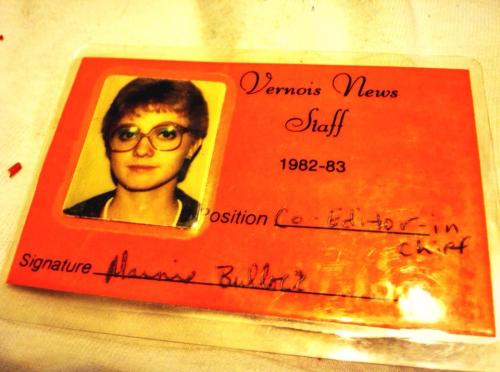
So there you go. My 2013 Mindset List. What was on my mind when I started college? Eye shadow, apparently:
I don't know yet as much as I thought I knew then.

I don’t know yet as much as I thought I knew then.

Shark Week poem entry

They say you have to keep moving or else you die.
So I haul my cartilage from surfer to seal,
wall-eyed and hungry, fighting stereotypes.
Call it “feeding frenzy,” but what I feel
Is exuberance, or joy, to say it plainer.
For me, it’s blood in the water. For someone else,
A luggage sale at Boston Store. (But hell–
When is there not a luggage sale there?)
I’m like the rooster who won’t pay child support,
The tom whose kittens are not safe from him,
Can’t stick around. Safer outside the fort.
It doesn’t pay to stop until I cash it in.
But in the ocean, even when you’re dead,
You don’t stop moving. Waves rock your bed.

The Word Made Flesh is Sylvia

And tremblingly, we’ve all partook.
The only question’s whether
we’re cannibals or communicants.
Either way, we eat her

grave cave crisp papery skin,
we suck her red homunculus
right off our own chapped lips.
We do it again and again.

The only way to know
if, instead of gruesome, all is holy,
(but all is both), is when we’re done,
we can’t be, she can’t be,
not one single living word can be
diminished. None.

_____
So, once again, I agree with Chuck Rybak. We do suck Sylvia. 🙂

APT’s Hamlet is Awesome. Go See It.

Q: How’s Hamlet?

rgbackdrop

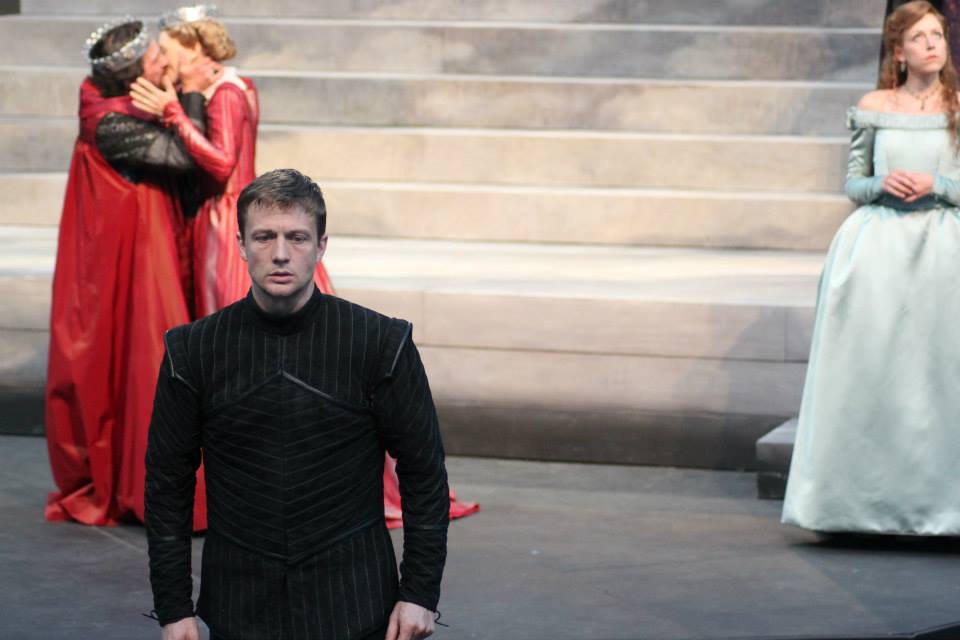
The short answer, for American Players Theatre’s 2013 production is that it’s terrific and I’m still processing how terrific it is.

It took me to my APT happy place numerous times on Sunday night (a very muggy-buggy night), by which I mean I forgot I was watching a play, forgot I knew the actor playing the part, forgot I was anywhere but in the moment on the stage.

Part of me wants to stop there–to say, simply, it was great. Everyone who can get here should get here and see it.

Except this Hamlet was so freakingly brilliant–I thought about it for hours after I got home, and I’ve thought about it all day.

So at the risk of revealing my theatrical and Shakespearean ignorance (the vastness of which undiscovered country has not been mapped), here are some of those thoughts.
____

I really think John Langs, the director, is brilliant. I know a theater production is a collaborative process, so my appreciation of the unnerving, stark, gorgeous, imposing, spare set goes to Takeshi Kata and Andrew Boyce. And the way the lighting shows two Hamlets–his posture saying one thing, his face saying another?  Credit for that goes to Michael A. Peterson.

The shadow seems much surer of itself here.

The shadow seems much surer of itself here.

But over and over, each component worked with every other component. The costumes worked with the set. And the set worked with the lighting. And the lighting emphasized the performances. And the performances were awesome. That’s to the director’s credit.

And having James Pickering–a really well-known Milwaukee actor who’s never appeared on the APT stage before–play the ghost and the player who plays the king parts and the gravedigger–that’s not just a casting idea. That’s an interpretive idea.

It made it seem like the ghost was showing up ALL THE TIME.

The child longing for the nuclear family that no longer exists.

The child longing for the nuclear family that no longer exists.

I know directors pluck from other performances (and there are a lot of Shakespeare casting traditions that would be utterly lost on me–I mean, I know about Cordelia/the fool, but that’s about it), and I know Langs directed Darragh Kennan in Hamlet in Seattle pretty recently, so I don’t know if this is the FIRST Hamlet to do that with the ghost/player/gravedigger, and I don’t know if the ghost has shown up other times when he doesn’t have lines, as he does in this performance (I won’t say where-all, because at least one of them seemed like a big risk with a big payoff), but it all went beyond “interpretive idea,” actually. It felt like vision. Genuine artistic vision.

What a counterpoint to Bassanio and Antonio from Merchant of Venice.

What a counterpoint to Bassanio and Antonio from Merchant of Venice.

Casting at APT is a complicated thing–eight plays done in repertory, core company and guest artist needs and contributions considered (who had a huge part last year, who had only supporting roles, who has one huge role this year and needs other supporting roles, who has reliable chemistry with who else)–so I can’t attribute the genius casting of this production of Hamlet to John Langs alone. Whoever had a hand in it, though–bravo.

If I’d been asked, prior to seeing this performance, to list Shakespeare’s really nasty kings, I’d have said Richard and Richard and then changed the subject, since I don’t know the histories as well as I ought. I might not have thought of Claudius at all. It’s not what I would typically think of as a meaty part.

But in Jim DeVita’s hands? Well, I hear Jim’s a fine cook, so I could say it’s like carving a chicken and understanding there’s good meat to be found places other than the drumstick and breast. Anyway, he found the meat. And chewed it up.

I mean, wow. When he says, of Fortinbras, “Holding a weak supposal of our worth,/ Or thinking by our late dear brother’s death / Our state to be disjoint and out of frame,” the delivery was so powerful I found myself wondering if Langs had somehow let Claudius deliver one of Hamlet’s speeches. (He didn’t. At least that one’s not Hamlet’s.)

“I like him not,” he says of Hamlet. And you think, “uh oh.”

I don’t mean Jim was upstaging or scene-stealing or anything bad. He just made it so clear how powerful Claudius was. How mean.

And unlike some productions, which maybe emphasize the Oedipal-incestuous-icky embraces between Hamlet and his Mom because no one can possibly imagine her really being turned on by whatever Claudius they’ve cast (the pompous guy in the Slings and Arrows production comes to mind, Season Two, Episode One, not the first season’s Claudius), De Vita and Staples have awesome onstage chemistry. One review found it “puzzling” why they were “hanging all over each other.” It didn’t puzzle me at all. Wouldn’t you, on him, were you she? And wouldn’t you, her, were you he? I, me, we would, methinks.

Gert and Claud

Gert and Claud

And then of course there’s Hamlet his own self.

Bravo, Matt Schwader. Bravo.

Mike Fischer’s review gets it right, that Matt’s “intensity adds bite and even menace to Hamlet’s encounters.” He calls him “white-hot,” and says he “handles Shakespeare’s verse as well as anyone at APT.” Yes, and yes, and yes.

I am enjoying reading and re-reading about Matt’s Hamlet process in his blog, “Bounded in a Nutshell.”

(He’s not just pretty. He’s also thinky.)

Matt’s explanation of his process helps explain one of the things that amazed me last night: the BIG ASS SPEECHES melded into the play so smoothly. They weren’t under-played, and not muted, but at no point did the production feel like this:

Druuuuuuuuummmmmmmroll: SOLILOQUY. (more stuff, more stuff, more stuff) and then
Druuuuuuummmmmroll: SOLILOQUY.

For example, leading up to the most famous of the BIG ASS SPEECHES, the “to be or not to be” one, because David Daniel’s Polonius is so strong, and Jim De Vita’s Claudius is so strong, and Christina Panfilio’s Ophelia is so strong, I found myself focused on what THEY were doing. Especially Ophelia. (I’ve never felt so pissed at Shakespeare for killing someone off as this Ophelia. She had spunk, damn it.)

Lou Grant to Mary Richards: "You've got spunk. I hate spunk."

Lou Grant to Mary Richards: “You’ve got spunk. I hate spunk.”

So when Matt came onstage and began speaking, to the audience, it took me a beat or two to realize that what he was saying was one of those speeches, even though I’d known what was coming.

In terms of speaking to the audience, as he was, part of the time, in this speech, Matt has this to say, “I’ve found that it is simply much more dramatic and engaging to watch an actor speak with another person (or group of persons, as is the case with direct address), than to be muttering to his or herself. Tremendous drama lives in the unexpected. What unexpected thing can happen to a person talking to his or her self? Not much. On the other hand, talking with an audience opens a flood of possibilities as to what might happen.”

The unexpected here is that Ophelia is listening, and she startles Hamlet, which was startling. In a good way. Because then the “get thee to a nunnery” lines seem startling, even though I knew they were coming.

Hamlet and Ophelia.

Hamlet and Ophelia.

_____

Matt did a fantastic job, which wasn’t startling. Anyone who’s watched him the last few years knew this was coming, that he’d earned it & that he could do it.

But what was startling overall was how his performance seemed utterly in service of the play.

I don’t mean I expected Matt to be selfish or show boaty. I’m just used to thinking of Hamlet as a vehicle for Hamlet (the character and the actor who plays him). This didn’t feel vehicular at all.

What a great play.

Another fantastic shot from Carissa Dixon

Another fantastic shot from Carissa Dixon

_____
(All these awesome images of the production are used with permission from the awesome Carissa Dixon.)

My Last Transition Metal for a While

The end of this month, I’ll turn 48. Inspired by Oliver Sacks, I looked up 48 on my Periodic Table of Elements place mat and found that Cadmium is element 48. It is a Transition Metal, the last I’ll experience for a while. Next up is Indium, which is grouped under “Other Metals,” (so no telling what that’ll be like), and then a couple of Nonmetals, and then, at age 54, a noble gas! Xenon. That’s something to look forward to.

More about Cadmium, from a lovely blog called GrrlScientist, which has an “element of the week” feature:

  • It’s highly toxic.
  • Used in nuclear reactors.

Cadmium also “adds fatigue resistance to many solders,” which I mis-read first as “adds fatigue resistance to many soldiers.” In any case, fatigue-resistance sounds lovely. Just what I need.

It can make strong batteries and then pollute the environment.

It makes pretty colors.

This post on cadmium yellow says that “Claude Monet (1840-1926) liked to use cadmium yellow for outdoor settings in paintings such as Autumn at Argenteuil, as he believed it would better guarantee the survival of his art. For this reason he abandoned chrome yellow pigments (with the exception of zinc chromate yellow) in the latter part of his career.”

Cadmium green, meanwhile, shows up online as all the shades of green I’ve been obsessed with lately. I may have to go to an art store soon just to get a tube of Winsor & Newton:

cadmiumgreen

So, other than being toxic and all, 48 should be an interesting year.

If you haven’t yet, you should read “The Joy of Old Age. (No Kidding.)” in which Oliver Sacks points out that his upcoming birthday, 80, is Mercury on the Periodic Table (I don’t know if he has the table on a place mat or not). It’s a lovely piece, with several notable moments. My favorite is this:

“At nearly 80, with a scattering of medical and surgical problems, none disabling, I feel glad to be alive — ‘I’m glad I’m not dead!’ sometimes bursts out of me when the weather is perfect. (This is in contrast to a story I heard from a friend who, walking with Samuel Beckett in Paris on a perfect spring morning, said to him, ‘Doesn’t a day like this make you glad to be alive?’ to which Beckett answered, ‘I wouldn’t go as far as that.’)”

I have elements of both those sentiments. Sometimes I do feel “every day is a gift,” but some days, I admit, the gift feels like a total white elephant.

Here’s hoping 48 is more Sacks than Beckett. In most ways.

The Thinger for the Clutter Contained

Having declared repeatedly in public that my home was “half a matchbook collection away from being an episode of Hoarders” (saying this I am exaggerating, but not by as much as I would prefer), I have been plunging this summer, over and over, into our accumulated everything.

This is not easy.

One becomes a pack rat through a combo pack of habits, issues, and inept strategies.

For me, nearly every bit of sorting, cleaning, pitching, packing, reorganizing, moving, shifting, recycling, re-gifting, tagging for yard sales, and donating involves a commensurate inner activity.

Ideally, the inner activity means reflecting on and evaluating all the habits and strategies mentioned previously, and also gently, gently nudging apart the layers of issues involved that led me to the place in the first place.

Sometimes the inner activity is limited to “Ack!” or “oh my god” or “sheesh.”

But I keep at it.

I can be very persistent.

Some of this is deeply satisfying, the emptying of a container of stuff I no longer want, thus making it available to contain other stuff I do want.

And fairly often when I say or even think the word “container,” I think of James Thurber, and “Here Lies Miss Groby” (the first paragraph of which is available even to non-subscribers of the New Yorker, which fortunately contains the quote I was remembering).

“He remembers staying awake nights saying over and over ‘The thinger for the thing contained’ or thinking of an example of the Thing Contained for the Container. If a woman were to grab a bottle of Grade A and say to her husband, ‘Get away from me, or I’ll hit you with the milk’, that would be a Thing Contained for the Container.”

This is a way of talking about metonymy. I wonder if the act of blogging about metonymy will help me remember its definition in contrast to synecdoche. Probably not. But I would like to stake a claim here: I began saying “Schenectady” in place of “synecdoche” years and years before Charlie Kaufman made a movie called Synecdoche, New York, which I still haven’t seen.

All this is a way of procrastinating, by the way.

One last bit of reverie, before I head once more unto the breach, my friends:

I called my blog “marniere” because I’m fascinated by sinkholes. Fascinated and horrified by the idea of a chasm opening up where there previously was none. A chasm with ample space.

If you pitched your clutter in a sinkhole, you wouldn’t be able to access any of it easily. But you would be able to pitch and keep pitching for the longest time.

(I need to write part 2 for this a reminiscence of my childhhood entitled, “The Ravine Where We Threw Trash.” But for now, it’s once more unto the breach I’ve made in the wall of accumulated everything.)

Much Ado (Very, Very Much)

My anxious thoughts do woo me like Don John,
with wild tales of catastrophe, with shame,
and I play stupid Claudio each and every time.
I fall for lies. I forget everything I’ve known.
Up next the betrayed Hero inside me dies.
Not really dead, but a bad-ass swoon, or worse–
the split-second wish that everything would end
if this building, choking, chewing panic can’t.
Only Beatrice says it can. I always lose
when I argue with myself. I am a mess.
Only Benedick, in pill form, thus,
can hush me, with his little medicated kiss.

_____
That Joss Whedon. I tell you what. I loved, loved, loved his Much Ado About Nothing.

Having been swamped a bit with anxiety lately, I’ve been thinking on it, and am concluding that anxiety is a big, fat liar. But sneaky, and seductive.

Today’s wisdom, thus: if the sneaky liar is as cute as Sean Maher playing Don John, no wonder I keep falling for it.

Sean Maher  taken by Gage Skidmore

Sean Maher
taken by Gage Skidmore

And, fortunately, all’s well that ends well, right? (Because in this case, Beatrice is right–the panic never lasts. Also note: I’m so sorry to repeat the structure of Shakespeare here in my sonnet, giving Benedick the last word. I just tell myself he must be an awesome kisser in that last scene, if she stops talking entirely.)

But wouldn’t it be lovely, if my inner Claudio developed his shit-detector a wee bit more?

And if my inner Hero freaking stood up for herself instead of swooning?

Well. One does what one can to line one’s psychological ducks up*, and then one hopes the duck poop doesn’t give everyone swimmer’s itch.

_____

*including the appropriate and authorized use of anti-anxiety meds, thank you very much

(Image of Sean Maher available through Creative Commons license on Flickr.)

I Do Stew.

I’m so grateful to have a column in the Voice of the River Valley.

1. Even though it has a website, it functions largely as a print publication. You can see it all over southwest Wisconsin, lovely cream pages in stacks here and there.
2. It’s free!
3. The cover has fantastic photography, sometimes from my favorite photographer (hint: he has the same last name as I do).
4. It’s an audience I wouldn’t ordinarily reach. People come up to me in Richland Center, in Spring Green–they don’t read my blog. They don’t have a Twitter feed. But they read the Voice of the River Valley.
5. Regular deadlines help me. Speaking of which, today’s the 15th, isn’t it. Hm.
6. Word count maximums challenge me. I can write a sonnet pretty easily, or I can go on and on in prose–1,000 words, 1,500…. But 500 is HARD.
7. The editor/publisher Sara and I worked pretty hard to figure out what the focus of my column should be & when we landed on writing about the world of teaching from my perspective–long-time professor at UW-Richland and recent volunteer at the River Valley Elementary Studio School, we both knew there was a rich vein of material to mine.
8. I continue to be pleased with the name we settled on for the column. I wanted something to go with “pedagogy” in a way that was provocative or at least startling, and “stew” ended up being the one we kept going back to. It fits, you know? Because I do stew.
9. And so does Sara. The publication already has a pretty big audience and circulation, but she’s interesting in pushing the boundaries and experimenting, and I applaud that, in principle and in actuality.

Back to work on my 7th “Pedagogy Stew” column! The June column is available online; I’ll post it here when the July issue comes out.

Pedagogy Stew: May 2013

When I teach plot in a literature or creative writing class, Freytag’s triangle is usually part of the lesson. (Picture a scalene triangle, with a long slope upward
on the left, and a shorter slope coming down on the right.) Good old Gustav came up with his triangle in the 19th century as a way of describing the structure of Shakespeare and Greek tragedies, and as it’s taught now, it’s typically labeled with terms like “rising action,” “climax” and “denouement.” (The last always gives me pause, since, as a Southern Illinois native, I grew up hearing Beaucoup Creek pronounced “buck up.”)

Asked to teach a unit on storytelling to each of the four classes at the River Valley Elementary
Studio School, I wanted a way to translate this triangle for younger students. Here’s what I came up with:

Hello.
Uh-oh.
Oh no!
Now we know.

I’m pleased to say the teachers at the Studio School have found this useful as they’ve continued to work on storytelling. Students will be writing and performing plays to demonstrate what they’ve
learned about the Oregon Trail.

When I told some of my UW-Richland students about my translation, a couple of them said, “Hey! How come you never explained it to us like that?” I will, henceforth.

We do need students to be able to tell stories well. Not just to demonstrate what they’ve learned. Not just to sharpen their analytical skills. Not just to make sure they transfer smoothly into upper-level creative writing courses and move one step closer to publication. All those things are important, of course, but what seems most important to me is that we want them to be able to tell their own stories, to themselves.

We want them, as Brené Brown says, to own their own stories. “If you own the story you get to write the ending,” she says in Daring Greatly. As UW-Richland’s psych professor, Dennis Carpenter, explained to me, the technical term for this is “cognitive appraisal.” Our reaction to what happens depends a great deal on the story we tell ourselves about the event. When students own their stories, they’ll be able to decide whether a week of insults was the uh-oh leading to full-scale bullying, or the oh no! in which they put a stop to the insults. Students will be able to decide if a few weeks of falling behind in assignments meant they needed to buckle down and finish strong, or admit that the story of a particular class ended with dropping.

I go back again and again to the end of Robert Penn Warren’s book-length poem Audubon:

“In this century, and moment,
of mania, / Tell me a story.”

We all need to do that, right? We have a lot of different stories (and, gasp! that triangle doesn’t always work for the telling), but I know what kind of story I need the most right now. It’s the very last line of Audubon:

“Tell me a story of deep delight.”

Pedagogy Stew: April 2013

Objects in Motion

I’m so glad dance is part of my son’s education.
Sometimes, sure, an object at rest remains at rest,
But tonight an object in motion continued in motion—

A whole school of molecules kept dancing,
From slow solid to wavy liquid to hyper gas.
I’m so glad dance is part of my son’s education,

unlike mine. When I dance I’m like a squirrel on the ocean.
My grade school almost never danced—toomany Baptists.
Just like the law that keeps all those objects in motion,

he’ll continue to feel what he’s learned, not just emotion—
it’s embodied learning at its cellular best.
I’m so glad dance is part of my son’s education,

not just text and audio, not just construction
paper, more than dioramas, more than tests.
The law says an object in motion continues in motion,

and here’s proof. Still dancing, past bedtime, way past.
Those filthy feet look like a month of dirt amassed.
I’m so glad dance is part of my son’s education.
An object in motion continues in motion.

At least every quarter, the River Valley Elementary Studio Schoolin Spring Green has what is called a “culminating event,” where students display what they’ve learned in the previous unit. We’ve seen art galleries, tableaux, singing and now dance. Students worked with local professional dancers, along with their regular teachers, to choreograph the states of matter and the laws of motion, and at the end of February, we got to see them dance to “Solid Liquid Gas” by the band They Might Be Giants (as well as more classical works).It’s not just what you learn—it’s how you learn it, where you learn it, and how you demonstrate it. All of it matters.

Or, as one of my former students said recently, “You don’t break with your arms. You break with your butt.” He had just executed the most authoritative break I have ever seen. The pool table in the UW-Richland student center always has a mix of some of our most and least diligent students. This particular student has not had the most straightforward path through our traditionally-takes-two-years Associates Degree, but he has some solid momentum going now. It has been interesting, and encouraging, to watch him at rest, in motion, and exerting force—not necessarily in that order.

There are so many ways, and so many places, to learn the laws of motion.