I Do Stew.

I’m so grateful to have a column in the Voice of the River Valley.

1. Even though it has a website, it functions largely as a print publication. You can see it all over southwest Wisconsin, lovely cream pages in stacks here and there.
2. It’s free!
3. The cover has fantastic photography, sometimes from my favorite photographer (hint: he has the same last name as I do).
4. It’s an audience I wouldn’t ordinarily reach. People come up to me in Richland Center, in Spring Green–they don’t read my blog. They don’t have a Twitter feed. But they read the Voice of the River Valley.
5. Regular deadlines help me. Speaking of which, today’s the 15th, isn’t it. Hm.
6. Word count maximums challenge me. I can write a sonnet pretty easily, or I can go on and on in prose–1,000 words, 1,500…. But 500 is HARD.
7. The editor/publisher Sara and I worked pretty hard to figure out what the focus of my column should be & when we landed on writing about the world of teaching from my perspective–long-time professor at UW-Richland and recent volunteer at the River Valley Elementary Studio School, we both knew there was a rich vein of material to mine.
8. I continue to be pleased with the name we settled on for the column. I wanted something to go with “pedagogy” in a way that was provocative or at least startling, and “stew” ended up being the one we kept going back to. It fits, you know? Because I do stew.
9. And so does Sara. The publication already has a pretty big audience and circulation, but she’s interesting in pushing the boundaries and experimenting, and I applaud that, in principle and in actuality.

Back to work on my 7th “Pedagogy Stew” column! The June column is available online; I’ll post it here when the July issue comes out.

Pedagogy Stew: May 2013

When I teach plot in a literature or creative writing class, Freytag’s triangle is usually part of the lesson. (Picture a scalene triangle, with a long slope upward
on the left, and a shorter slope coming down on the right.) Good old Gustav came up with his triangle in the 19th century as a way of describing the structure of Shakespeare and Greek tragedies, and as it’s taught now, it’s typically labeled with terms like “rising action,” “climax” and “denouement.” (The last always gives me pause, since, as a Southern Illinois native, I grew up hearing Beaucoup Creek pronounced “buck up.”)

Asked to teach a unit on storytelling to each of the four classes at the River Valley Elementary
Studio School, I wanted a way to translate this triangle for younger students. Here’s what I came up with:

Hello.
Uh-oh.
Oh no!
Now we know.

I’m pleased to say the teachers at the Studio School have found this useful as they’ve continued to work on storytelling. Students will be writing and performing plays to demonstrate what they’ve
learned about the Oregon Trail.

When I told some of my UW-Richland students about my translation, a couple of them said, “Hey! How come you never explained it to us like that?” I will, henceforth.

We do need students to be able to tell stories well. Not just to demonstrate what they’ve learned. Not just to sharpen their analytical skills. Not just to make sure they transfer smoothly into upper-level creative writing courses and move one step closer to publication. All those things are important, of course, but what seems most important to me is that we want them to be able to tell their own stories, to themselves.

We want them, as Brené Brown says, to own their own stories. “If you own the story you get to write the ending,” she says in Daring Greatly. As UW-Richland’s psych professor, Dennis Carpenter, explained to me, the technical term for this is “cognitive appraisal.” Our reaction to what happens depends a great deal on the story we tell ourselves about the event. When students own their stories, they’ll be able to decide whether a week of insults was the uh-oh leading to full-scale bullying, or the oh no! in which they put a stop to the insults. Students will be able to decide if a few weeks of falling behind in assignments meant they needed to buckle down and finish strong, or admit that the story of a particular class ended with dropping.

I go back again and again to the end of Robert Penn Warren’s book-length poem Audubon:

“In this century, and moment,
of mania, / Tell me a story.”

We all need to do that, right? We have a lot of different stories (and, gasp! that triangle doesn’t always work for the telling), but I know what kind of story I need the most right now. It’s the very last line of Audubon:

“Tell me a story of deep delight.”

Pedagogy Stew: April 2013

Objects in Motion

I’m so glad dance is part of my son’s education.
Sometimes, sure, an object at rest remains at rest,
But tonight an object in motion continued in motion—

A whole school of molecules kept dancing,
From slow solid to wavy liquid to hyper gas.
I’m so glad dance is part of my son’s education,

unlike mine. When I dance I’m like a squirrel on the ocean.
My grade school almost never danced—toomany Baptists.
Just like the law that keeps all those objects in motion,

he’ll continue to feel what he’s learned, not just emotion—
it’s embodied learning at its cellular best.
I’m so glad dance is part of my son’s education,

not just text and audio, not just construction
paper, more than dioramas, more than tests.
The law says an object in motion continues in motion,

and here’s proof. Still dancing, past bedtime, way past.
Those filthy feet look like a month of dirt amassed.
I’m so glad dance is part of my son’s education.
An object in motion continues in motion.

At least every quarter, the River Valley Elementary Studio Schoolin Spring Green has what is called a “culminating event,” where students display what they’ve learned in the previous unit. We’ve seen art galleries, tableaux, singing and now dance. Students worked with local professional dancers, along with their regular teachers, to choreograph the states of matter and the laws of motion, and at the end of February, we got to see them dance to “Solid Liquid Gas” by the band They Might Be Giants (as well as more classical works).It’s not just what you learn—it’s how you learn it, where you learn it, and how you demonstrate it. All of it matters.

Or, as one of my former students said recently, “You don’t break with your arms. You break with your butt.” He had just executed the most authoritative break I have ever seen. The pool table in the UW-Richland student center always has a mix of some of our most and least diligent students. This particular student has not had the most straightforward path through our traditionally-takes-two-years Associates Degree, but he has some solid momentum going now. It has been interesting, and encouraging, to watch him at rest, in motion, and exerting force—not necessarily in that order.

There are so many ways, and so many places, to learn the laws of motion.

Pedagogy Stew: March 2013

I’ve invented the most amazing computer game for my
composition students.

When I comment on their essays, which they’ve turned in online, I use “insert comment” to give feedback. There are pros and cons to this, of course, but one major PRO is that I’m now confident students can read my feedback. (I have handwriting issues. Lowest grade I ever got in my life? Penmanship. Fourth grade. At the time, I was sure Mrs. Cox had it in for me, but on reflection, I
think, no, that “C” was generous.)

Here’s the game: After I’ve finished grading the essays, their next assignment is a short exercise in which they should copy/paste one of the comments I’ve made, and then describe what
resource they looked to for help (online grammar site? our textbook? class notes?) and what
they plan to do to improve before the next essay.

All right, so…not so hot as a game.

It is, however, a fairly good test of their ability to navigate the online environment of digital essays and professorial feedback. Fairly often I have a non-traditional student who struggles online. (Drop-down list? Double-click? What’s that?) It’s not just non-traditional students. We think of Millennials (those born between 1980 and 2000) as being 100 percent wired, but I don’t
find them to be 100 percent proficient in computer usage that helps in the classroom. They can text,but word processing? Maybe not. They all use Google, but they may struggle when online research involves a database that uses Boolean logic or traditional Library of Congress Subject headings.

This round of essays, in each final draft, I am burying a link to an article in Nature
on the subject of “distributed thinking.” In “People Power: Networks of Human Minds Are Taking Citizen Science to a New Level,” Eric Hand describes how a group of scientists came up with Foldit, an online game in which “players compete, collaborate, develop strategies, accumulate game points and move to different playing levels, all while folding proteins.”
Computer models were thorough but slow—when gamers got involved, things went faster because, as Hand points out, “humans[are] blessed with a highly evolved talent for spatial manipulation, [and] can often see the solution intuitively.”

Beyond gamification (which means structuring learning, or anything else, like a game, with rewards—like giving chocolate for correct answers), what distributed thinking makes possible is
turning those skills our students use in gaming (and, um, some of us might possibly, occasionally, use in something girly and ridiculous like “Candy Crush,” a game that reports results on Facebook) into skills that could help solve real-world problems.

It isn’t just that I would like students to bring some of that persistence to their academic tasks. I would. But I would also love to figure out how to translate challenges (inside and outside academia) into the LANGUAGE and CULTURE of gaming, ina deep and serious way. Maybe then, when my son grows up, all his app-addled gaming hours will be a real asset.
______
6/15/13 NOTE: I ended up putting the link to the Nature article inside some Extra Credit directions–three students were very excited to find it. Next semester, I’ll think of more ways to make their hunting & clicking more rewarding.

I was talking about this to a student as we were searching EbscoHost (and online service with multiple databases to find articles) for sources for one of his papers, and told him I wished someone could structure searches like this as a game. He got it instantly: “Well, sure, like EbscoHost is a hallway, and….”

I can’t wait for the iOS version!

Creative People Say Yes (Sometimes)

I once came upon my cousin Reid practicing different ways to say “no.” He was 3 or 4 at the time. “No, I couldn’t possibly,” he said. “Absolutely not.”

He was onto something, that little ‘un. At least in my family, saying no takes practice.

Saying no? I’m big on it. Sometimes I’m even good at it. I certainly like the IDEA of saying no.

I’ve written about a fair number of times:
“How do I do that? How do I become the sort of person who says no to things?”

Clitter-Clatter Clutter Time , which references two terrific posts by my favorite tattooed Lutheran blogger, Nadia Bolz Weber, “The Spiritual Practice of Saying No,” and its companion piece, “The Spiritual Practice of Saying Yes!”

The Sarcastic Lutheran says, “The people who are inclined to say yes to everything do all the work and then burn out and become resentful about the people who are inclined to say no to everything. It’s as though the world is divided into martyrs and slackers.”

I don’t make a very good martyr or slacker, either one, not for very long.

I worked enough 50+ hours this spring semester, I worry my slacker credentials are in danger of not being renewed.

Busy as I’ve been, I’m nowhere close to martyrdom. I have some regrets, but I don’t regret all of the times I said yes. (Or came up with something to do that no one even asked me to do.)

Recent things that added to my to do list that I am particularly happy to locate in the land of “yes!”:

  • In addition to volunteering in my son’s classroom at the River Valley Elementary Studio School a couple hours a week, presenting a lesson on storytelling, with a way of talking about narrative arc that was a big hit.
  • Leading the Westby Co-Op Credit Union Board of Directors and branch managers in creativity exercises.
  • Serving as a (paid) reader for writing sample/placement tests for incoming UW-R students, and as a local developmental writing coordinator (unpaid).

In general, I am unrealistic about how the number of things I try to get done will fit into the number of available hours, and I don’t necessarily do things in the right order (which sometimes does and sometimes does not qualify as procrastination).

Thus, some of my commitments (such as returning student work promptly) suffered this spring, and probably, saying “yes” to new stuff impacted the ongoing stuff.

In general, I need to parse, pare, and prune my To Do list.

So, in one way, I totally get Kevin Ashton’s “Creative People Say No.”

He is right that “We do not have enough time as it is. There are groceries to buy, gas tanks to fill, families to love and day jobs to do.”

And he is right that “Time is the raw material of creation.”

Time is a precious resource. It must be guarded. I get it.

But wow did that blog post bug me.

(more on page 2!)

Something Beyond Cynicism

On the other side of burnout
there is rest, there is a place
where even my incompetence
has a bucket it fits into.

As I compost all my bitterness,
my misplaced hopefulness,
my misspent hours,
I watch the steam

rise up from what’s rotten.

A wisp of a moist gray ghost,
a sign of moving on,
a sweet portent

there and gone.

What’s done
is done.

Marnie’s Idea Mill–churning out great ideas since…NOW.

I am pleased, excited, terrified and astonished to be announcing the launch of Marnie’s Idea Mill, a crowdfunding campaign on Indiegogo.

I’m raising money to replace myself in the classroom, so that I will have time to design and implement workshops on creativity.

Thanks in advance for checking out the site and considering making a contribution!

You can help other ways–posting the link on your own Facebook page or blog, retweeting, or forwarding to people who might make a contribution will help, too.

I also welcome feedback on any and all parts of this project.

Also accepting good wishes and blessings!

Metaphor 1.1

Metaphor 1.1


_____
The perks I’m offering include a shout-out on this blog, a copy of Each Other’s Anodyne (a hand-sewn chapbook, a collection of my poems about teaching), feedback on your own creative writing, customized sonnets, and personalized creativity coaching sessions.

As of today, I’ve raised $10,000 in contributions and pledges toward the $24,000 total I need ($6,000 per course x four courses). My fundraising goal on Indiegogo is $4,000, and the deadline for the online campaign is June 17.

My ultimate deadline is July 1.

When I say I love impossible things, I am not kidding.

But I’m trusting Marnie’s Idea Mill can make some magic and attract some magic and make creativity workshops possible (which will then generate even more magic).
_____

Because I am married to a man who is 1/4 Finn, who has read the Kalevala multiple times and also cheers for Finnish drivers in World Rally racing, I know that the Sampo is a mill that generated an infinite supply of flour, salt, and gold.

It was made by Ilmarinen (using a forge, that, as my husband likes to point out, the Kalevala never mentions being destroyed–so maybe it’s still out there…) for the Mistress of the North, who turned out to be a nasty sort, and after a complicated series of events I couldn’t quite follow as my husband described it, the People of the South decided to steal the Sampo. The boat it was in sank, but pieces of the Sampo washed ashore and prosperity accompanied even those pieces.

There used to be a store in Madison called the Magic Mill, which I loved, but it closed. The Sampo, though–that’s a really potent metaphor.

The Sampo one of the images I had in mind when I decided to call my Indiegogo crowdfunding campaign “Marnie’s Idea Mill.”

Idea generation is a huge part of how we measure creativity, so I wanted a metaphor of something that generates. Mill seemed kindlier than factory somehow….

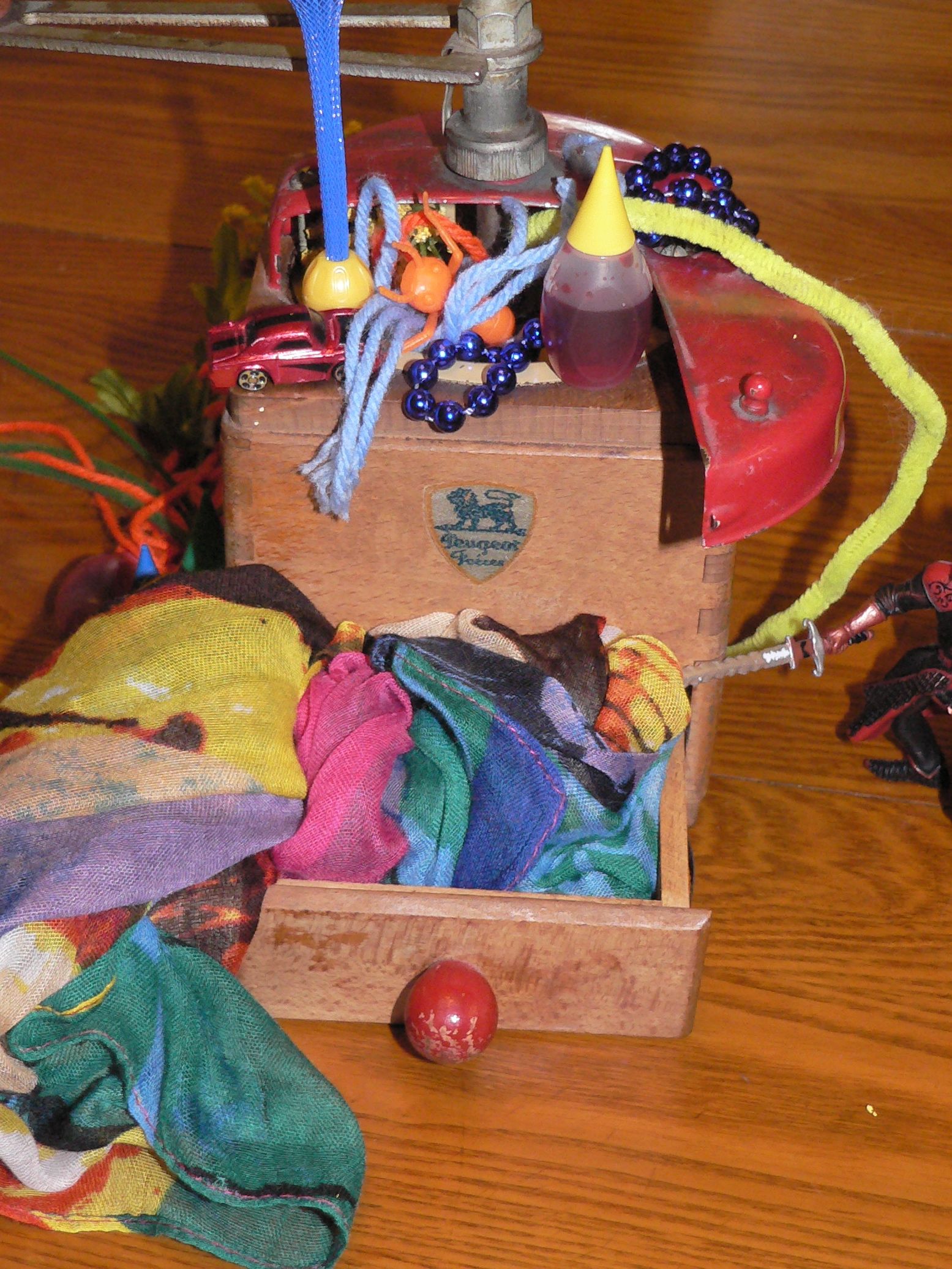
Plus, we have a wide assortment of Peugeot hand grinders (my husband is also 1/4 French).

Another old, old story I had in mind is from 1 Kings 17. In it, Elijah curses the land of Israel, “there shall not be dew nor rain these years, but according to my word.” The Lord sends him to a brook where ravens care for him, and then to a widow, who, when asked for a wee bit of bread by Elijah says, “As the Lord God liveth,” (which I think would now translate to “holy crap, man”). She says she barely has enough to keep herself and her son alive one more day. But Elijah blesses her barrel and says it will not be empty until God sends rain. (I always thought that should be until a few months after the rain showed up, but I’m sure it worked out fine.)

For me, this is a story about living from a place of “enough” rather than a place of “not enough.”

I am trusting there is enough good will and money in the world to help me meet my goal of designing workshops to help people become more creative–more people who can forge amazing mills, more prophets who can see plenty when the rest of us see scarcity….

More where there is currently less.
_____
(You can read more about my creativity research, my fundraising, and my ideas for workshops on various pages here on my blog.)

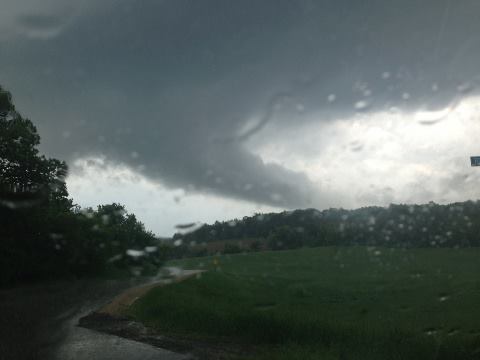
If God’s going to all the trouble of sending a tornado after you….

When I was little, I wasn’t scared of tornadoes.

My Dad always said, “If God’s going to go to all the trouble of sending a tornado after you…” and I actually don’t remember the exact words of what came after that, but the idea was, just give up. If God wants you to die in a tornado and you survive that tornado, he’ll send another tornado. Or a car wreck. Or a brown recluse spider.

I found that profoundly comforting when I was a child and beyond, but I’m sure my Dad’s calm helped, too. (Note to self: try not to freak out ENTIRELY as you’re fleeing your own home, your child in tow, to your parents’ basement across town. When I said, “Get in the car right now!” I’m pretty sure I had the same intonation & volume as “You can’t handle the truth!”)

Back in the 70s, there were watches and warnings pretty much all the time, it seemed, from March through September. We ignored watches entirely, and only grew concerned about warnings if the sky turned green.

Dad and I used to stand in our garage and watch sheets of rain come across the open field northeast of our house. He was probably smoking a pipe. I was probably petting Wooly and Daisy (the best dogs ever in the history of the world).

Regardless.

I now note several problems with Dad’s tornado wisdom.

1. Even if my belief in God had not changed, OH MY GOD. Really? I’m a good Baptist girl and God might just, out of pretty much fucking nowhere, send a tornado to kill me? And I can’t get away no matter what?

2. My belief in God has changed. I have a kind of wacked-out sort of X-Files Mulder/Scully hybrid of beliefs. As in:
a. I want to believe.
b. Maybe God could steer tornadoes in a pinch, but tends not to.

3. The basically impossibly huge question of how a loving God could allow horrible things to happen. (I’m not going to solve that here. Sorry if you’re disappointed.)

When I lived in the second of a series of three trailers I called home as a graduate student at Southern Illinois University, I began to have a recurring nightmare about tornadoes. In it, I would wake up in the middle of a horrible storm, feel the trailer begin to shake, watch the walls suck inward, watch the roof blow away, and then try to hold onto my bed to keep from getting sucked into the sky. Then I would wake up.

I suspect this had to do with being in miscellaneous precarious emotional situations in those years. And also living in a trailer. “God’s bowling alleys,” my brother always called trailer parks.

(So, o.k. What is it with men in my family and tornadoes?)

But during one actual tornado warning, I stayed in Trailer #1 and announced to God, “I’ll just die here with my cats, thank you.” Very green sky. Large branches flying by the window. Trailer rocking in real life, not the dream world. (Oh, that girl. I could just smack my 21-year-old self!)

I think, over the years, I’ve just grown less and less fatalistic. Certainly less suicidal! It is also possible my frontal lobe has developed some.

And then having a husband I love and I son I am OVER THE MOON ABOUT makes storms really stressful.

We’ve had a wacky weather week in Wisconsin. More storms coming.

Is it possible, in what I now called the land of “Zen Baptist” on my faith journey, to take wise precautions and yet be at peace about whatever comes?

Sure hope so.

Because what comforted me as a child, comforts me not at all right now.

_____
Here’s what fun about social media. Someone named Kevin posted this on Channel 3000’s Facebook page. The comments are hilarious. Including: “it’s sunny in beloit” and a whole thread of “don’t take pictures while you’re driving” and “it’s not a tornado.”

So. Probably not a tornado. (No one actually said it was.) And also not my picture. But gracious. I wouldn’t mind some boring weather.

Not a tornado.

Not a tornado.

Driving in a David Cates Novel

“O beautiful, for spacious skies
But now those skies are threatening”
“The End of the Innocence”

Taking the secret detour, the one the natives use,
I fly down Highway T to Z,
past the Cates family farm but really,
it’s the dips and swales and curves
and hills and valleys and long slopes up
and ridge roads that feel impossibly high
for Wisconsin that let me know I’m in a zone
where fiction could happen and also perhaps
some magic but for me, partly panic–

I get agoraphobic on some of these rises
where all you can see past the crest
is the sky. It reminds me of Eastern Montana
a little (except for more trees on both sides),
where I once drove up a long brown hill for so long,
for an hour, forever, I stopped believing in Canada.
I couldn’t imagine anything north of where I was.
Nothing but a sheer drop-off to Hell, maybe,
over the top, nothingness, a crevasse, the crimp-
edge of the known world, no ditch, just–

The trip up, the torture, doesn’t last that long here.
Just when I’m wanting to pull over,
figure out how to turn around or back up,
which is impossible–the road’s too narrow,
the curve’s too sharp, the hill’s too steep–
well, there we are, around the bend
finally, a stretch of open road, another red barn.

Another falling-down house tucked in behind
a mess of blooming lilacs, under which,
if this really is a David Cates novel, someone’s having sex
RIGHT THIS MOMENT, and probably with someone they shouldn’t.

And later the woman, or maybe she’s a girl,
would take a dandelion and say “make a wish”
as she blew the white seeds everywhere at which point
the man, or maybe he’s still a boy,
would think “tampopo” but not say it, not wanting
the girl to feel bad for not knowing Japanese,
and he might also think, but not say,
some racy, clever thing using the word “blow.”
What he probably would say would be “Great.
Now there are more weeds everywhere,”
but then regret having said anything at all.

Because you have to remember, the moment you think
“Anything can happen,” that something bad could.

Just because it’s almost June and everything’s green,
every shade of green, just because the blue sky
is paint-chip sky-blue right overhead, even when
you’ve got Don Henley cranked on the radio,
you can glance in your rear view mirror and see
how the bright blue turns to pale blue and then haze
and then gray along the horizon.

You can see farms you can’t get to on Highway Z.
The people who live there are happy or sad.
But you’ll never get there. You’ll never know.

Coming home, you’ll stop at the T of Highway T and 23
and you’ll see Frank Lloyd Wright’s wind mill
and it won’t impress you this time. Not at all.
_____

I left Southern Illinois to go to graduate school in Missoula, Montana, and there met David Cates, who’d come from Spring Green, Wisconsin, where I live now.

Freaky.

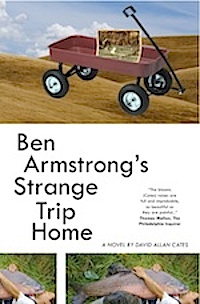
His latest book is odd and beautiful and haunting and two trips to Dodgeville recently I really have felt as though I entered some sort of parallel universe. If you read the book now, there’s probably a silver station wagon taking a curve a little too fast. I’ll be waving.

The latest novel by David Cates (wonderful to read, odd to drive in)

The latest novel by David Cates (wonderful to read, odd to drive in)

Teacher Lady! a new magazine for lady teachers!

I get my best ideas during finals week.

I get my best ideas during finals week.