C-word, N-word, R-word: Forward!

Seriously considering putting a warning in my syllabi for spring semester:

CAUTION! Profanity Uttered Here.

By me, by other students, by Louis C.K. in our pop culture unit in my composition classes….

Probably thinking, "man, I don't want to be in a composition class."

Probably thinking, “man, I don’t want to be in a composition class.”

When I was tenure-track, I was getting some negative comments from students about my profanity in the classroom, (probably based on The Five-Paragraph Fuck) and my student evaluation numbers weren’t as high as they needed to be to make satisfactory progress on what I used to call “the march to tenure,” so I made swearing less one of my goals. At the time, I asked myself “how important is swearing to me vs. making sure I get tenure?” Seemed like an easy choice.

Since then, I had the honor of working with a male professor who swore like crazy in class, and got terrifically high student eval numbers (mostly because he was an amazing teacher). One of the conclusions I drew from that, rightly or wrongly, was that it’s o.k. for boys to swear. Girls, not so much.

Well, fuck that shit.

It isn’t as though I swear a whole lot, actually, in life or in class. More as a writer probably than any other time. But the freedom to do so feels important, and gosh, sometimes it’s just fun.

But I suppose I’m wanting to give my students fair warning, in case they’re likely to take too much offense. Of course, we’re a small campus, so there aren’t very many sections of any given class, so it isn’t as though students have a lot of choice in course scheduling. So maybe I just want them to steel themselves….

I guess showing Louis C.K. in class gives me automatic membership in the “It’s Our Job to Complicate Students’ Worldview” Club.” Note: I have also shown Slapshot in class. But it isn’t as simple as that.

I have two goals as a teacher that often come into conflict with each other:
1. I want to create a learning environment where students feel safe to learn and grow.
2. I want part of that learning and growing to come through experimentation and boundary-expansion.

So, for example, #2 is being satisfied when students have to grapple with the episode of Louie called “Heckler/Cop Movie,” when Louie goes absolutely nuclear on a female heckler. He calls her a c*&t and calls her mother a c*&t. He says, at one point, “You’re the worst thing that ever happened to America.” I ask students to analyze it (and some episodes of Roseanne) in terms of humor, and it didn’t take very long this past fall semester for students to notice that Louie doesn’t fare so well in that episode, that every offensive thing he does gets punished one way or the other. Then they did research, and many of them found this article: “The Filthy Moralist: How the comedian Louis C.K. became America’s unlikely conscience” from the Atlantic. So there you go, worldview complicated.

Well, worldview complicated for a lot of students. Complicated in one way for students who were appalled by his humor and needed to see how freaking brilliant he is. Complicated, too, for students (primarily male and white) who already thought Louie was hilarious, but couldn’t imagine he might, possibly, be making fun of THEM for laughing and not thinking.

You’ll notice I couldn’t quite bring myself to spell out the c-word. The DVD I had bleeped it, and we had some relatively hilarious, inadvertently hilarious class moments when we discovered that not everyone knew what “c-word” stood for, or what the word meant, or why it struck some people as different than saying “dick” instead of “penis.” #whyIloveteaching

And this takes me back to point #1 above: in our culture, the c-word has a lot of baggage, much of it painful for women. As a teacher, I now feel it is my duty, to be even-handed, to find something that some male students might feel not-just-offended-but-wounded by in the same way some way some female students felt in response to Louie’s rant. Open to suggestions here. (Seriously. Post suggestions.)

My big concern, in other words, is that I don’t guide students in pursuing #2 at the expense of the same people over and over–people who are often picked on in our society.

Just in the realm of vocabulary alone, it’s hard for me to think of a _-word that slams a heterosexual white man without any obvious disabilities. But if we were brainstorming, insults for women, those in the LGBTQ community, people of color, people who are differently-abled…those insults would just spring trippingly and quickly off our tongues.

I’m completely comfortable deleting a post on my own Facebook thread when someone casually uses language I am offended by (or worry a friend might be offended by). In the classroom, the rules of propriety and etiquette don’t seem as clear to me.
_____

As part of my ongoing creativity research, and in preparation for spring semester, I’m continuing to read Dispatches from the Classroom: Graduate Students on Creative Writing Pedagogy, a terrific book I got excited about FIRST because there are precious few articles, let alone whole BOOKS on creative writing pedagogy. This book, edited by Christ Drew, Joseph Rein, and David Yost, came out last year and I find it consistently thought-provoking.

Just this week, I finished M. Thomas Gammarino’s “Invoking the Muzzle: Censorship and the Creative Writing Classroom” and found much to applaud and agree with, but a few places I found sticky.

It’s pretty obviously connected to my concerns above.

He positions himself as a libertarian sort of professor for the most part (for which I feel some kinship, cf: assigning Louis CK, above).

“Can fiction create a hostile learning environment?” he asks as he discusses one of his own experiences as a student writer, when he turned a story into a workshop about a pedophile keeping “pets” in the basement. The teacher reacted strongly, reasoning that other students would essentially have been forced to read it, that they weren’t as free to put it down as they would have been if it had been in a magazine, etc. Gammarino dropped that class, but as he points out, the problem remains.

He summarizes another incident (that he was not involved in) in which a teacher was disturbed by the violence in a student story and sought help outside the classroom–this ended with the student getting expelled and the instructor losing her job. Gammarino blames this on the institution’s overreaction and the attempt at censorship, calling it “prophylactic hysteria” (the phrasing of which I covet).

I like how he distinguishes the basic philosophical positions: “Libertarians may find themselves in the anguished position of having to defend the free speech of people whose viewpoints they find repulsive, but those who favor enacting controls on hate speech appoint themselves to the essentially undemocratic position of prescribing a morality for the masses.”

(I would say in this case it’s not the masses so much as it is the enrollment in any given course, but the point still holds.)

I also appreciate that he asked for feedback from other creative writing teachers, and there’s one response I’d like to highlight, the one from Wilton Barnhardt: “It is, of course, always a judgment call whether this kind of incident is pure aggression, a sociopathic acting out, a smart-ass way to get attention or indulge in hate-speech, or a clumsy attempt by an untrained writer to deal with difficult topics. I think we all know good and well when it’s the former, and I am prepared to sit there and listen and help and edit when it’s the latter.”

Therein lies the sticky place for me. I don’t always know good and well how to distinguish between the former and the latter. Sometimes it’s obvious, sure, but we’ve all seen studies about the higher incidence of mental illness in the field of creative writing, so it wouldn’t be surprising at all to find problems with mental illness in the creative writing classroom.

[Would it automatically be different, I realize I need to ask myself, seeing violent imagery from a student I knew to have mental illness issues, vs. a student who seemed emotionally stable? Hm.]

Violent imagery + mental illness doesn’t automatically add up to “will act on what is described.” Still, when a student I was working with informally began submitting pieces about stalking and harming a female teacher, I wrote him and said I wasn’t comfortable working with him. He cried censorship, and maybe he was right, but one of my absolute life goals is to trust my gut more, and my gut was telling me “RUN!”

I had the choice though–he’d been my student in the past, but wasn’t enrolled in anything at the time.

Gammarino did not give much space to discussing his original teacher’s point about student choice in terms of reading and responding, but I think it’s an important question. He was also very dismissive of another teacher he knows of who asks students to fill out a cover sheet for the pieces they’re going to workshop, describing the potential offensiveness (among other things, I assume). Gammarino says “I want to challenge the warrant behind all of this: namely, that it is part of the writing teacher’s job to protect the comfort level of his students—that is, to keep them from being offended.”

But it isn’t just “being offended” that I’m concerned about. It’s trauma. If a young woman has been raped, a rape scene will be traumatic. The more graphic, the more traumatic (I assume). And even if a young woman hasn’t been raped, do I really want to contribute to the rape culture we live in by asking a whole class to read a graphically violent rape scene?

I’m remembering a particular violent story, a series of revenge fantasies by a student who had writing skills and “issues” in approximately equal measure. It just so happened that the women victims came to more gruesome ends than the men.

I worked with this particular student all semester, and tried to get him to move beyond what I called his “shock and awe” imagery. But there were female students who were deeply uncomfortable working with him, and I don’t feel as though I helped them navigate their discomfort because I wasn’t sure how much of it was sort of an intellectual “ooh. ick.” and how much was simply an appropriate reaction of horror.

Gammarino says “Clearly teachers must do everything they can to protect their students’ safety,” but in this case he means safety in the sense of not actually being the ones killed and hacked up as described in this particular story.

Nothing bad happened in that way with this student; I wasn’t really worried that it would. My “gut,” in other words, was telling me this wasn’t going to make the news.

Gammarino adds that teachers must also “maintain a level of discussion appropriate to higher education,” and that’s where I’m getting stuck. What is appropriate here?

I absolutely agree with him when he says “…insofar as we choose to protect our students from ideas we ourselves may find odious, we also protect them from developing complex minds capable of deciding such matters for themselves.”

So my goal IS helping them navigate their discomfort and their horror. I am wondering if some kind of cover sheet would help–not simply to let students opt-out of reading something they’re alarmed at before reading it, but to also help us keep track of who is pushing what boundaries.

Gammarino describes his own pedophile-with-pets story as “a chance to stretch my imagination,” and that, ultimately, is what I find most troublesome about censorship–it boxes everything up so tightly there is precious little stretching possible.

If we grant that creative writing has to be about more than the craft of writing (the “writing” half of “creative writing”), but also has to be about creativity, then the stretching is crucial, and worth a great deal of student discomfort.

But what if the student writing the scary imagery has been doing that for years? And wants to do only that for the class? How creative is that? What about the student who wants to turn in only masturbation-paced erotica? They’re pushing other people’s boundaries, sure, but not their own.

So here’s my plan for my beginning creative writing class for Spring 2013: students are going to have access to a cover sheet for workshops. Half of it will be what they want to tell other students about the piece they’re submitting, and half of it will be like this (note–VERY ROUGH DRAFT), a way to keep track of how much experimenting people are doing. So if, for example, someone is writing in traditional meter and spouting mainstream ideas all semester, we can all note that and suggest the person push in some other directions. But by the same measure, we can suggest that someone who is consistently writing pieces that “might give your grandmother a stroke” could branch out a little.

I’m also going to Xerox Gammarino’s piece for my creative writing class before the first workshop. I anticipate a good discussion.

(This is also something I’m realizing I need to research more.)

Still haven’t decided about the “CAUTION: Profanity uttered here” warning.

If My Teaching Career Were Keats, It Would Be Dead

T minus 10 days and Spring Semester 2013 officially begins for me (I know many people have started already, and no, I don’t know why our classes begin on a Friday this year).  When I turned in grades for Fall 2012, I officially completed my 25th year of teaching at the college level.  When I started in 1987 at age 22, I was not particularly good at my job, but I was enthusiastic. My skills are solider now, and my enthusiasm…well, it’s pretty solid for the part of my job that takes place in the classroom.

As I approach the beginning of my 26th year of teaching, I find myself wondering about metaphors for semesters.

Of course, it might be better not to have a metaphor for a semester at all. It might be more productive to be the Kings and Queens of Denotation (say what?) and simply proceed, understanding that a semester is a unit of time. But that’s not how I roll.

The rooms we teach in affect how we teach: Nancy Van Note Chism notes “social constructivists point out that the social setting greatly influences learning. Picture the limitations of the standard classroom or study carrel in terms of these ideas. The decor is sterile and unstimulating; the seating arrangements rarely allow for peer-to-peer exchange; and the technology does not allow individual access to information as needed. Rather, the room supports a transmission theory whose built pedagogy says that one person will ‘transfer’ information to others who will ‘take it in’ at the same rate by focusing on the person at the front of the room.”

I think metaphors affect us in much the same way. If our metaphors don’t match our pedagogy, we will find ourselves asking students to balance buckets of water on their heads whilst also spinning on a merry-go-round (one of those old-school ones that are really dangerous and hard to find) without even realizing the impossibility of what we’re asking.

(But wow—wouldn’t that be hilarious? Everyone would just be soaked and dizzy and puking and miserable and laughing like crazy.)

Here are some metaphors I’ve been mulling:

  • Train trip
  • Garden
  • Party
  • Game
  • Business meeting
  • Battle
  • Swimming pool
photo by stingberd on Flickr (available through Creative Commons license)

photo by stingberd on Flickr (available through Creative Commons license)

Pros and cons:

  • Train trip

+ Destination clear. Class schedule much like itinerary. Professor as engineer and conductor.

– Rigidity. Students are simply passengers (passive unless they take over the train, which feels like a bad western).

  • Garden

+Aesthetically pleasing. Students as gardeners. Learning outcomes as harvest

-SLOW. I always plant more than I can manage. Weeds.

  • Party

+Fun

-Learning not always fun

  • Game

+Clear objectives. Fun.

-Competition is stressful.

  • Business meeting

+Businesslike.

-Businesslike.

  • Battle

+Goals, outcome and timeline clear (if Colin Powell is in charge).

-Someone has to lose (die).

  • Swimming pool

+Professor as swimming instructor, coach, and lifeguard.  Fun. Immersion implied (the Baptist in me loves that part). Stakes are high.

-Some people show up with rocks in their pockets and WILL NOT FLOAT.

Think metaphors don’t matter? What about this:  One of my grad school professors said once, while erasing the board from a previous class, “Not erasing a board when you leave a class is as bad as not flushing the toilet when you leave the bathroom.”  It’s hard to get that out of your head, and it’s made me awfully sensitive to this particular sort of professor-etiquette (or lack of it).  But, yuck, for the image, and YUCK to saying what we write on the board is POOP in need of flushing.

As I’m working on syllabi for the spring (notice how I imply the work has already begun), I’m mulling the garden and game metaphors most.

Perhaps croquet the way we used to play at Gran’mommy and Gran’daddy’s… We must have used several sets, because I remember way more than six or eight players. And there was no standard set-up. We put the wickets in the trickiest places–one favorite was on the edge of a steep slope from the yard down to the road. If you missed that one, you were in the road, trying to hit your way back up. And I remember my Dad and my Uncle Ferrell just WHACKING (pardon me, I mean ROQUETING) each other all the way across the road, into the corn fields…

Or maybe not.  Would we actually get to the appropriate learning outcomes in a game like that?

See? That’s why I struggle, every goddam semester I’ve ever taught, with making it all the way through the semester using the week-to-week schedule I pass out on the first day. I have the best intentions of hitting each train station on the appointed day and time, but I’m just not very good at it.

I want to explore what it means to balance train-like, business-assed precision with game-like, adventuring fun.

Meanwhile, what’s your favorite metaphor for a semester? For any other unit of time? For any other job?

Dear Jodie Foster: I got it (and it wouldn’t matter if I didn’t)

It’s been a long time since I watched an award show, but my husband was getting our son to bed last night, so I got to turn on the Golden Globes, which has long been my favorite awards show because it never seems to take itself too seriously, and just enough big stars always show up to make it fun.

I missed the beginning, so I missed some good Fey-Poehler moments, but thank-you universe, I got to see George Clooney canoodling Amy Poehler during the best actress in a comedy category moment.

And I got to watch all of Jodie Foster’s speech. Live.

And it made me cry. In a good way. Because it’s 2013, I said something on Facebook almost immediately, and then read a comment and HOLY CRAP–that speech was an instant controversy in a way something can be instant controversy only now, with all our immediate access and RESPOND RESPOND RESPOND modes.  I’m glad I wasn’t looking at f.b. or Twitter when she was speaking, because the people complaining might have colored the speech for me.

It’s a pretty Rorschachy cultural moment, apparently. People who watched the same speech I did thought it was incoherent, fragmented, confusing, and inappropriate. On Twitter and Facebook, people have said she was drunk. On drugs. Unhinged. Or sad. Perhaps in need of professional help.

So far, the only article I’ve read that gets it right (from my perspective) is this one from Salon, “Jodie Foster Comes Out, Gritting Her Teeth,” and even there–I thought she was having more fun than that.

In an attempt to figure out why people are responding so differently, I’ve watched the speech several times and analyzed the transcript. Here’s what I think–it was the tone and the pace and the lack of transitions that made people holler “incoherent!” If you watch the speech again, knowing what’s coming, or look at the transcript, it doesn’t seem so wacky. Or even very disorganized or fragmented.

Some caveats for my analysis: I love Jodie Foster. She could pretty much do or say whatever and I would be fine.

Caveat #2: the speech did feel zoomy to me, sort of flight-of-fancy-paced, but HELLO. I like that kind of zooming, that kind of doesn’t-feel-structured-but-it-is feeling.

What did we expect her to do? I suppose we would have expected a brief “thank you, this town has been very good to me, etc.” speech. Something like her Oscar speech, when she won for The Accused in 1988, a 141-word snippet in which she also thanks her mother. She said, “There are very few things: there’s love and work and family. And this movie is so special to us because it was all three of those things. And I’d like to thank all of my families, the tribes that I come from.”

In contrast, last night’s speech was more than 1,100 words. Nearly ten times as long. Lots of time to do lots more.

And I do know from incoherence. I’ve been teaching first and second-year college students for 25 years now. There’s incoherence (no main point, supporting points that don’t match main point, supporting points that don’t connect to each other), and then there’s subtlety.  I also teach creative writing, including creative nonfiction. There are ways to express ourselves that meander, that don’t add up to incoherence. I think Jodie Foster is more akin to Mary Paumier Jone’s “Meander” than a first-year disorganized essay, or a “bizarre” or “incoherent rant,” as many people are labeling the speech.

What she did, as I outline it, is the following:

  • Start with an insider joke (“Well, for all of you ‘SNL’ fans, I’m 50! I’m 50!”)
  • Thank the person who introduced her (“I want to thank you for everything: for your bat-crazed, rapid-fire brain, the sweet intro. I love you and Susan and I am so grateful that you continually talk me off the ledge when I go on and foam at the mouth and say, ‘I’m done with acting, I’m done with acting, I’m really done, I’m done, I’m done.’” MORE ON THIS LATER. IT IS KEY.)
  • Comment on winning a Lifetime Achievement Award (““Trust me, 47 years in the film business is a long time….”)
  • Announce that she is going to pull a rabbit out of a hat (“So while I’m here being all confessional, I guess I have a sudden urge to say something that I’ve never really been able to air in public.”)
  • Thwart our expectations (“I’m single!”)
  • Explain why she’s thwarting our expectations (After a weird moment without audio–I thought it was my TV, but the ABC transcript says “audio went out,” she picks up with “…be a big coming-out speech tonight because I already did my coming out about a thousand years ago back in the Stone Age….”)
  • Comment on culture in a joking way (“But now I’m told, apparently, that every celebrity is expected to honor the details of their private life with a press conference, a fragrance and a prime-time reality show. You know, you guys might be surprised, but I am not Honey Boo Boo Child. No, I’m sorry, that’s just not me….)
  • Comment on culture in a serious way (““But seriously, if you had been a public figure from the time that you were a toddler, if you’d had to fight for a life that felt real and honest and normal against all odds, then maybe you too might value privacy above all else. Privacy.”  That BUT SERIOUSLY does count as a transition, btw.)
  • Impart some wisdom (“There are a few secrets to keeping your psyche intact over such a long career. The first, love people and stay beside them.”)
  • Thank people who have helped her (“That table over there, 222, way out in Idaho, Paris, Stockholm, that one, next to the bathroom with all the unfamous faces, the very same faces for all these years.”)
  • Conclude (“I will continue to tell stories, to move people by being moved, the greatest job in the world. It’s just that from now on, I may be holding a different talking stick. And maybe it won’t be as sparkly, maybe it won’t open on 3,000 screens, maybe it will be so quiet and delicate that only dogs can hear it whistle. But it will be my writing on the wall. Jodie Foster was here, I still am, and I want to be seen, to be understood deeply and to be not so very lonely. Thank you, all of you, for the company. Here’s to the next 50 years.”)

What’s so fragmented about that? Just because she didn’t say, “Next, I would like to comment on culture in a joking way.”  Really? We needed that? “And finally I would like to conclude.”

I always tell students that transitions are for readers. They’re kind. They’re considerate. Jodie Foster wasn’t being so terribly kind and considerate, I suppose–maybe that’s why people actually seem offended by the PERCEIVED lack of coherence. We thought she was nice! We thought she loved us and wanted us along!

One reason I think this seemed incoherent is not because she was incoherent; I think it’s because she is so freaking smart. Who the hell tries to comment on culture and impart wisdom at the Golden Globes? Jode.

I don’t know that we’ll ever know if this was ad-libbed or totally planned or partly ad-libbed and partly planned or how sober she was. We just heard her thoughts on privacy, after all.  But it stands up pretty well to analysis.

And it’s hilarious in some ways, even though people were mostly NOT laughing at the right places (not at the Golden Globes and judging from Twitter, not in a lot of homes).  If we go with the notion that the biggest component of humor is surprise, we can see she was going for it again and again–starting with “I’m 50!” and tossing out the almost Schecky Green style of “my fellow actors out there, we’ve giggled through love scenes, we’ve punched and cried and spit and vomited and blown snot all over one another — and those are just the costars I liked.” (Someone should have done a rim-shot. Maybe if she’d slowed down and said, “bah dum bum” we’d have gotten it, but no, she was ZOOMING.)

Then she moved on  “I’m single” and then with “I’m not Honey Boo Boo,” which, if she’d allowed us to linger, could have taken us to layers upon layers of serious hilarity. Jodie Foster, beautiful, in a shiny dress that matched her great blue eyes, fit, strong, brilliant, no she is not Honey Boo Boo. But wow. If she did have a reality show….But we didn’t get time to picture it and giggle to ourselves because she went zooming on to “I’d have to spank Daniel Craig’s bottom just to stay on the air” (which he did laugh at–another reason to love him).

Then there’s all the deep irony of 1)coming out by thanking your longtime lover when HEY!  You just told us you weren’t coming out!  WAIT A MINUTE!  and 2)sending a message to your mother who apparently has dementia and is close to death, which is a pretty goddam intimate thing to do when you were just lecturing us on PRIVACY, 3)and also, there were your sons, which paparazzi are pretty crappy at grabbing snaps of, beautiful boys, right there at your table when you were just lecturing us on PRIVACY….

[And this actually wasn’t the first time she “came out” in public. I’m looking for the link, but she thanked Cydney publicly at least once before and called her her wife–and if her being a lesbian were a secret at all, it was a pretty open secret. I know some people have been angry at her for years for not “coming out” in a big way, but obviously, she wanted to do it her way.]

Caveat #3: I love Robert Downey Jr’s performance in Home for the Holidays, and Foster’s commentary on the DVD of that movie makes it sound like he ad-libbed almost constantly, and that she loved it.

So maybe I wasn’t as startled at the pace and lack of transitions in the speech because Robert Downey Jr. introduced her. He set the tone, and he set the pace. He was ironic almost all the way through, and silly, and almost no one laughed, it seemed, when he praised her for her philanthropy and the Jodie Foster Aquatic Pavilion, which he followed up quickly with a picture of her face photo-shopped onto Bo Derek’s famous “10” shot, with the caption, “Let’s Get Wet!”

He didn’t pause to let any of his jokes sink in. He just plowed on through.

And when she thanked him, she specifically mentioned his “bat-crazed, rapid-fire brain,” and “the sweet intro.”  You know what? The intro wasn’t sweet. It was, I trust, sweetly intended, since they’re friends, but it was mostly for her I think, an individualized, Robert Downey Jr.-ized chunk of what she would find funny.

She just picked up that baton and ran with it, and if we couldn’t keep up, well–we don’t get to hang out with them, do we? We’re not in their league.

Mel Gibson did look a little lost. I’d rather not be in his category of lost-ness.

But it says something, doesn’t it, that the two actors she chose to have at her table are not known for their clear-headedness and decorum? I take from this that she is loyal as the day is long and she has a fondness for the crazy. Both traits I happen to share.

I did feel dizzy at the end of her speech, no doubt, and the “I may never be on stage again” was a very weird moment, but we got a lot of Jodie Foster last night, more than I ever thought we’d get. Just looking at who was at her table–that was a lot, by itself.

She’s been in the public so publicly, so long, I’m not going to say “we got the real Jodie Foster!” There are layers upon layers upon layers there.

But in a room where she feels at home, where she can take whatever tone she wants and zoom however fast she wants, she ended with good news, “I will continue to tell stories, to move people by being moved,” and what I took to be the storyteller’s basic credo: “Jodie Foster was here, I still am, and I want to be seen, to be understood deeply and to be not so very lonely.”

She finished with “Thank you, all of you, for the company. Here’s to the next 50 years.”

That’s why it matters, right, why it was bothering me for people to react to the speech so differently than I did? Because I was, very distantly, keeping her company. I’m 47. Beginning with her picture on the Coppertone bottle (and I could write a whole blog about Coppertone, the very name working as a transporter, and if I ever smell it–wow, I’m gone), she has been a part of my life.

She was never not there.

I wish her well and I loved, loved, loved that speech.

Zoom zoom!

_____

UPDATE: Here’s a story from 2007 when Jodie Foster thanked Cydney Bernard. She isn’t quoted as having said “wife,” so I’m either remembering a different story, or remembering this one wrong, but this is from five years ago.

Where All the Slackers Did Go

I was thinking when the Boomers all retired,
Gen X would make the world more fun. Oh well.
My timeline, my assumptions–shot to hell.
I wish I’d known all this when I was hired.

There’s just so much I am so wrong about.

But I’m sure of this: however much the Gnostics
redeem the fall of Eve (and bless them for it),
the curséd part of work will not wash out.

Thorn and thistle, labor, sweaty brow–
an ever-expanding to do list (not quite cancer)–
let’s do our very best, let’s make it count–

I’m remembering how lazy I was when I was a child….

Work might be how I pay my fucking bills.
Work isn’t why I’m on the fucking planet.

New Policy on Tasks

Just as we no longer find it appropriate
to tempt our weak-willed colleagues with sweets
(or risk killing those with peanut allergies)
and thus last year banned everything but fruit
from the break room (and really–carbs–hello?),

we can no longer tolerate undone tasks.
Please volunteer whenever someone asks.

If you feel too busy (and only you would know),
you might consider sleeping slightly less
or drinking more caffeine. Or barring those
perfectly adequate solutions, you might
get a sitter and have a fun date night
with colleagues. If you don’t pitch in, someone
who’s really overworked will be forced to get it done.

for Dana

Don't compartmentalize! Work from home!

Don’t compartmentalize! Work from home!

Just Walking the Dead with Bowie (thank you, thank you, thank you)

(Hello there, multiple folks from multiple countries who’ve landed on this blog by Googling “walking the dead” and “meaning” or some such. Let me see if I can answer that question–I took it to be two things: one, a play on words, similar to “walking the dog,” and two, a sense of remembering, being nostalgic, longing for people and places and times that have passed. There may be other things going on as well–for all I know, it’s a translation of some clever saying in German. Thanks for checking out my blog! Please read on, if you would….)

_____

Well, that’s it. David Bowie’s 66.
He’s old. I’m old. We’re old. How much do I care?
I’m happy to report he is still deeply weird.
The video “Where are we now” is sick
(sick meaning not normal, not boring), lovely in
a creepy way–Berlin, mute woman, disembodied heads–
I was born in the birthplace of the Brothers Grimm–
explains a lot–Bowie sings “just out walking the dead”

How close was I to suicide in college?
In high school? Too close. I’m glad I danced away.

And Bowie helped. His weirdness, the vast collage
of his career, still here to help me navigate
the perils of middle age–oh here it comes–
the dancing and the danger and the weirdness–just in time

_____

Why does 47 feel so much like 17?

And why is the self-destructive behavior of my middle-age so banal? I haven’t been suicidal for decades. My risky behavior has nothing to do with drunk driving or needles or strangers. (Not that it ever did. Ahem.)

I just eat too much. And weigh too much. And move too little. And here’s how I tend to handle stress–self-medicate with food, with alcohol (but not enough to actually be interesting about it).

I shuffle things around in my compartmentalized brain, but gracious the clutter’s accumulated.

So. I hadn’t even realized how much I needed a new Bowie album until I saw the video. But I did need it. I do. So thank-you.

(Now I need to hunt for a picture of myself when I used to make my hair look like his.)

It wasn’t real. It was absolutely wonderful.

A snow globe, a Hallmark special, our own sitcom,
A Christmas card by Norman Rockwell–well,
It’s true. We had perfect holidays back home.
Our schedules, our stockings, our hearts—full, full, full.
We always had to eat before we opened presents,
We ate too much, and THEN distributed the loot.
We took our turns opening, youngest to oldest, we oohed
And ahhed and made jokes. Gran’mommy’s perennials:
“Boxes can fool you,” and “Pretty paper,” (which she saved).
Everyone played nice. It was nice. And it stayed that way
Because the grownups held their breath. I am grateful
For the effort I didn’t see when I was a child. I do grieve
It wasn’t sustainable. We didn’t sustain it. I won’t say
It wasn’t real. It was absolutely wonderful.

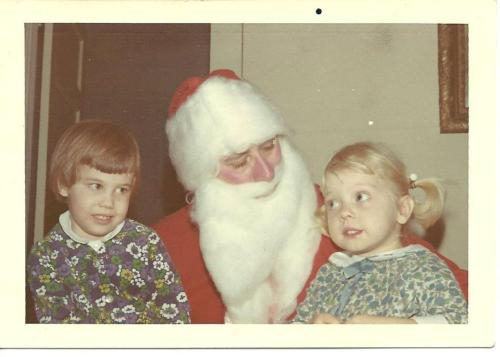
Jodie and me talking to Santa. Jode's not too sure about this guy....I'm probably being really specific about what I want.

Jodie and me talking to Santa. Jode’s not too sure about this guy….I’m probably being really specific about what I want.

_____

We were so lucky. It wasn’t perfect–of course not. Not one person involved was perfect, so the gathering couldn’t have been. But it sure seems perfect in my memory.

Santa visited a lot of years when there were youngsters. This appears to be a Les Hutchison year, and I’m somewhere around three, so it predates my cousin Rob. I was the youngest, so I’d have opened my presents first. Poor Jodie–she had one year to go first, but as long as she remembered, someone else went sooner. (She probably didn’t mind too much.) Then Rob was the youngest for a very long time, 10 or 12 years, anyway. (My mom and her next youngest sister had their children very young; my Mom’s baby sister had her babies much later, right when my brother’s daughter was born, in the early 80s–so the late 60s and all the 70s, Jodie and Rob and I were the kids. My brother is six years older than me, so I’m sure he wouldn’t mind not being listed in this particular lucky cluster, though he’d have opened his presents right after Jodie.)

I remember the food(Aunt Wessie’s cinnamon bread), I remember the decorations (a creepy Santa like this one, I think)il_170x135.388388796_hm64

I remember the bad, bad jokes, and I remember the laughter. We laughed A LOT.

I remarked to a friend once that I never, ever laughed harder than when I was with my family (by which I mean this branch of the family, my Mom’s branch, the Roane/Marlow branch).

This friend had an insightful response, “Well, yeah, laughter breaks up tension pretty well.” Or something along those lines. And that’s partly true. As I got older, I had a stronger and stronger sense of everyone holding their breath, which I’m not nearly as good at (though I’m better at it than I want to be).

Keeping secrets and keeping up appearances. Pretty standard family stuff.

So, sure, there was tension. There still is.

But the truth is, I come from funny people. I just do. Some of it’s corny, some of it’s mean, but it is a constant, and it’s varied, and it’s smart, and it’s just a huge part of who we were. And are.

So whatever else there was, there was humor, and there was love, and there was phenomenally good luck.

We had an extraordinary run of people staying pretty healthy and grownups being mostly employed and marriages working relatively well. No one drank at these family gatherings (that I knew of), and no one fought (that I noticed), and everyone seemed to have a great time, and typically left to go home (we almost all lived in a one-mile radius) only when we’d planned our next gathering (which was never very far away).

On Christmas, that meant making plans for Gran’daddy’s birthday on December 26. If he were still with us, he’d be celebrating his 97th today. By the late 70s, we’d gotten in the tradition of someone giving him fancy collections of sausage and cheese for Christmas, and we’d gather for his birthday the next day and eat them. The numbers and varieties of cheese and sausage grew over the years, and we’d pass them around and around, shouting back and forth about which ones were best, spiciest, etc.

And in those pre-Google years, we nearly always had these two conversations: What is Boxing Day? And does “second cousin” mean the same as “first cousin, once removed?” I actually don’t ever want to look those things up–it was always too fun confusing each other with our answers.

There is no more one-mile radius. We have health problems in all manner of stripes and stages. We’re no longer exempt to national averages on marriage and employment.

Gran’daddy has been gone a year and a half and Gran’mommy seven more years than that.

So much is gone. Over. Done.

But what we had was real. And it was absolutely wonderful.

Keep the Protest in Protestant and/or Get Over It

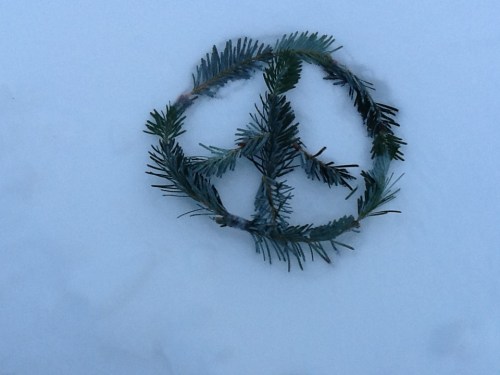
Peace on Earth

Peace on Earth

First, a re-run: I published an op-ed called “Keep the Protest in Protestant” four years ago in Madison’s Capital Times. You can’t find it in madison.com’s online archive–apparently the Cap Times pieces don’t stick around that long. (Weirdly, an even older 2007 op-ed of mine from the Wisconsin State Journal is still available, in which I talk about merit pay, dilatory legislators, and skid-loaders, which, at the time, my son called “baby scoops.”)

Fortunately (I think), “Keep the Protest in Protestant” is still available online, but at a tea party-ish site that apparently keeps tabs on the Cap Times. You could Google it, but if you did, you’d see the comments, and I don’t want to link it here, because I don’t want to connect to them even by pinging. The comments were pretty tame, though, all in all. At the time I was attending Plymouth Congregational Church in Dodgeville & I did, and still do, appreciate the United Church of Christ as a denomination. Whatever it was I said, there were enough markers for several in the comment thread to assume I was going to hell and to hold me responsible for abortion.

Here are my favorite moments in the piece:

I’ve no doubt there is passion and sincerity on the part of some of those who choose, for example, to shop at a store where the decorations say “Merry Christmas” and not “Happy Holidays.” I’m related to some of these people…..

Never mind that “holiday” traces its roots to “holy,” whereas we all know that Christmas is a pagan cake with Jesus icing on top. If you’re hunting for your Lord’s birthday, hunt for the date astronomers estimate there was a great star in the sky or when the census would have been taken or when the shepherds would have been out tending their flocks by night. You can run the numbers six ways from the Sabbath (Saturday or Sunday) and you won’t hit Dec. 25. The Puritans knew this. They didn’t like the maypole in spring, and they didn’t like the pine pole in winter. (But they did like beer. Go figure.)

Four years ago, I wasn’t seeing other people make this argument. Someone’s made it way better, now: “The Puritan War on Christmas” was just published in the New York Times. Lots of people have picked up the “Keep the _____ in ______” idea. My favorite on Facebook is “Keep the Han in Hanukkah,” with a young Harrison Ford brandishing a menorah.

And lots of people are, of late, pointing out that the X in Xmas stands for Christ–even this fellow, R.C. Sproul, in a post from a couple weeks ago, says “There’s a long and sacred history of the use of X to symbolize the name of Christ, and from its origin, it has meant no disrespect.” That’s R.C. Sproul, a CALVINIST, (whose name I recognized from my evangelical roots) who publishes with Tyndale (a noted Christian publishing house, well respected in the land of evangelicals, even THOUGH, we talked a lot in my church, in the 70s, about how that the guy who did The Living Bible, which Tyndale published, was struck silent for seven years because the Living Bible was a PARAPHRASE, not a translation.)

So some people are offended by being wished Happy Holidays. I’m offended by their taking offense.

And, if they knew, they’d likely be offended by my being offended at their having taken offense.

Round and round and round, like a train under a Christmas tree.

Would it help if I were Labiche, and blew up the tracks?

Of course not. This isn’t a real war. It’s a peaceful protest against the warriors who see themselves as defending Christmas.

I wish I thought none of this mattered. But when someone blames Jon Stewart for a massacre, it begins to matter, right?

My favorite response to the crazy talk that began almost immediately after the shootings in Newtown is by Rachel Held Evans, ANOTHER EVANGELICAL, called “God can’t be kept out.”

I know I was remembering Rachel’s words as I was snuggling with my son this morning, looking at our Christmas tree, telling him how happy I was he knew the Christmas story, how in a very dark time, God decided to make herself known on earth, starting out as a baby.

She gave Jesus to poor parents, and made him a Jew, which was a very scary thing to be in the Roman Empire. “The Romans were just jerks,” I told him.

And when we’re feeling at our lowest, at our most vulnerable, when things seem the darkest, we can remember that’s what Christmas is about–that God is with us.

However important I think it is for people to be historically accurate in what they complain about, however much I wish we all cared more about substance than surface, however big a gap there is between the right-wing and left-wing members of my family on this and other matters, I do know what’s more important.

So I’m trying, at least trying, to save my biggest protest-mojo for what really matters.

We are in a world of hurt. Whatever love we have access to, we need to share it. Now.

Merry Xmas.

(Sorry. Couldn’t resist.)

Sustainable Chaos (Two Week Sonnet, Day 14)

Riding the line between abundance and chaos,
My stupid focus is on lack, lack, lack.
I try gratitude, but follow the switchback
Back toward loud whiny-assedness–
Too much. Too much! There really ought to be less
Except of course when there needs to be much more.

A good friend named my mountain bike “Pathfinder”–
However much I blazed my way off trail,
I only once rode my bike off the dock into the lake,
and only once or twice required stitches,
Got poison ivy only in the tiniest patches–
I somehow always got somewhere close to on track.

Somehow always somewhere close, like now.
My amen’s so hard, so real, it feels profound.

_____

Sunday, 12/16/12
Ah, the best-laid schemes o’ mice an ‘Marnie gang aft agley (and definitely bleak December’s winds ensuin).

Wednesday the 13th should have been Day/Line 12, and then one post a day with today as the last. The week before finals proved ungainly, however, and I found myself–as we all did–profoundly disturbed and dislocated by the shooting on Friday–so far beyond my normal distraction….

In turn, I will try to process and then write about the heartbreak, the grief, the fury, the impotent rage, the pragmatic actions that this particular shooting moves me to. Today, as a finish to this poem particularly, I can only attest that at the moment my focus in not at all on what I lack.

Two Week Sonnet, Day 11

Riding the line between abundance and chaos,
My stupid focus is on lack, lack, lack.
I try gratitude, but follow the switchback
Back toward loud whiny-assedness:
Too much. Too much! There really ought to be less
Except of course when there needs to be much more.
A good friend named my mountain bike “Pathfinder”–
However much I blazed my way off trail,
I only once rode my bike off the dock into the lake,
and only once or twice required stitches,
And poison ivy only in small patches,