
Category Archives: Uncategorized

Muncie Jones and the “Lawn Sprinkler of Hope”

It’s so easy for me to take an uncharitable view of the last 21 years and zoom in on the goals I haven’t met.

Tongue-in-crater-where-there-used-to-be-a-tooth.

A sort of obsessing that can be genuinely damaging.

If I do it long enough, I feel like George Bailey, surveying Potterville, with the full horror of it beginning to dawn on me:
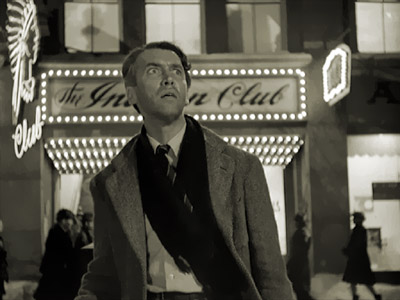
(That’s actually a pretty good depiction of how I felt at AWP in Chicago, last spring, and Unmetgoalville was pretty much why, although I also get awfully used to my little town and don’t necessarily function well in towns larger than 17,000 or so, at least not without some self-coaching. Pitiful, really, given that 17,000 is how big Mt. Vernon is, where I went to high school–if you’d told 17-year-old Marnie that 47-year-old Marnie would have a hard time feeling comfortable in Chicago, the teenager would’ve laughed, since she regularly drove in the Windy City whilst visiting her brother.)

And here I am, coming across the teaching job that doesn’t even seem to recognize me.

“But I’m a full professor,” I yell, chasing the poor ad hoc position into the bar where she faints.

“My life’s not like that,” I says to myself. “Really it’s not,” I assure myself on a cold, rainy, November afternoon. “I’m not Muncie Jones.”

Whereas, of course, I am in some ways. Indiana Jones’s sister Muncie wasn’t intentionally a play on Virginia Woolf’s Judith (Shakespeare’s sis), but that had to be lurking in my mind somewhere.

However. Now that I’ve seen Shakespeare’s Will, I can’t think of any woman in Shakespeare’s life without thinking of Tracy Michelle Arnold.

Which is where things take a turn for the better. Tracy portrayed Anne Hathaway with a phenomenal range of vulnerability and fierceness. (Now that I’m reading Brene Brown’s Daring Greatly, everything has something to do with vulnerability.)

There is fierceness in this family of women–the Jones family, the Shakespeare family, my own family.

A lot of my life, that fierceness has come out in less-than-productive ways. It may be why I liked playing with fire.

In my middle age, I am finally, finally learning to channel that fierceness into focus and grit.

One of my role models is Jenny Shank, who first caught my eye in Poets & Writers (Jan/Feb 2011), when she wrote about being a “Ham-and-Egger,” a phrase she got from Don DeLillo, which she defines in this way:

“I love that phrase, ham-and-egger. It’s how I think of myself as a writer. I’m not going to dazzle anybody with lyricism or structural ingenuity. But I put my head down and work and sometimes a story comes of it. I ham-and-egg my way through. It took me a long time to figure out that not every writer has to be brilliant.”

She also writes about sobbing during a Fellini movie because it reminded her “of my childhood dream of becoming a writer, one that I haven’t shaken for three decades, a dream that I almost gave up on a number of times, even though I still continued to write.”

And if the subject matter itself weren’t inspiring enough, she referred back to Fellini and said “Okay, so I’m not an orphaned Italian hooker in a ratty fur. But inside, aren’t we all orphaned Italian hookers in ratty furs?”

I know I am.

And I sobbed and sobbed later that spring in 2011, two different times (I don’t sob much, so I remember them). One time was taking a detour on my way to work, to go sit in the gorgeous St. Luke’s in Plain, Wisconsin and pray–this was in the midst of Wisconsin’s Arabesque Spring, when we were protesting in the snow. I felt as though the job I’d worked so hard at for 20 years was just being spit on and ground into the mud by the heel of a governor’s anti-union, anti-education Act 10.

The other sobbing happened when I got my rejection from Wisconsin Wrights. I’d submitted a revised version of Gashouse Love, a full-length play I started writing in February of 2003. I got a full typed page of comments that told me pretty thoroughly the play didn’t work. That was the bad news. But there was plenty of good news in that page–the anonymous commenter took the play very seriously, was clearly hooked by it in several ways, and very much seemed to want it to work. The sobbing came from having put in a lot of hours revising, all those hours COMING TO NAUGHT (that’s how it felt at that moment), but mostly a sense of exhaustion (see previous paragraph’s sobbing) and utter bafflement–I had almost no idea at all how to make the play better, but any little hint of how to revise carried with it a tag of THIS WILL TAKE HOURS, WEEKS, MONTHS, POSSIBLY YEARS OF WORK.

But I didn’t give up. I didn’t. I almost can’t believe it, but I didn’t.

I am sure I had the phrase “ham-and-egger” in mind.

I’d spent most of the summer of 2010 working on the poems of Speakeasy Love Hard. Gashouse Love has three generations of a family dealing with what they call “the flapper girl poems,” and I knew those poems needed to exist in full, regardless of how much showed up in the play.

The anonymous commenter for Wisconsin Wrights said the poems needed to be in the play more, and I didn’t know how to do that. I know a little more, now.

The poems from 2010, whose origin was a play begun in 2003, finally went public in the fall of 2012. It was a wonderful evening. One of the outcomes of getting to hear Sarah Day, Ashleigh LaThrop, and Nate Burger read those poems was that I felt as though a nuclear reaction had gone off in the middle of Gashouse Love.

Is the path to revision any clearer? No–but I’m excited to work on my writing plan for the rest of this semester/academic year, and will include in it “Listen to recording of Speakeasy Love Hard multiple times, with friends, taking notes and getting feedback on revising Gashouse Love.” I’m giddy with the thought of it because that play needs those poems. All of them.

Forever is how long I’ve heard you have to focus less on publication and more on enjoying revision. Could it be I’m finally there?

Not that I’m giving up on publishing. I’m not. But I am compartmentalizing and strategizing. Here again, Jenny Shank’s article was helpful: she says she invented “Johnny Business” as a way to compartmentalize the publication goals. It seems to me he lives in the same neighborhood as Michael Perry’s muse–Perry says his muse is the guy at the bank who’ll repossess his house if he doesn’t write more and get paid for it.

All of this is validated in creativity studies. In a textbook on creativity (would love to teach or take a class using this as a textbook!), Mark Runco summarizes several sources on persistence and calls it “a prerequisite for creative accomplishment,” saying that “important insights often demand a large investment of time.”

“A decade may be necessary for the person to master the knowledge necessary to understand the gaps and nuances of a field.”

[Or in my special, special case, a decade OR TWO.]

Runco quotes Arthur Cropley (one of his books charmingly has a picture of a chicken and an egg on it) who says, “In addition to possessing certain personal traits, creative individuals are characterized by their willingness to expend effort.”

Runco follows that up with a nice reiteration: “That is a good definition of persistence: The willingness to expend effort.”

Jenny Shank’s efforts are paying off–her most recent book, The Ringer, won a High Plains Literary Award. I’m so happy for her!

And Muncie Jones? Maybe she hasn’t spent as much time dodging poison darts as her hotshot brother. But she’s hanging in there. She’s been teaching four sections a year for 21 years, and sure, in one way, you could say that job has has ground her soul down to nubbins.

But you could also say it’s been really helpful ballast, and that her hot air balloon, her ship, her (whatever transportation mode requires ballast), is about to dock somewhere truly exciting.

It’s like what Jenny Shank calls “a lawn sprinkler of hope that just sprays randomly around without any direct target.” That’s not cold, gray rain on my window. That’s hope.

Yes. No–wait. Sorry. (Two Sonnets)

I work 50-60 hours a week.

No–wait. Sorry. I don’t. Next question.

I think everyone should work as hard as I

Oh, 40-45. On average. Whatever.

Work. We have to pull together like a family

Have I ever told you about my father’s father?

Where everyone pulls their share. It’s only right.

He sold family land and drank the profits down.

The world is such a mess. So much to do.

Compared to that, I’m like the Queen of All

Community doesn’t just happen out of the blue.

That’s right and good. I believe in good enough.

You have to make it, have to have been the one

Yea, verily, I sure do reap all kinds of stuff

To have built it before you can say you’re living in

Wherein I did not sow. I’m really horrible,

Community. I mean at home, at work,

I know. I’m doing the best I can. Or–no–

And locally. Where you shop and what

It’s like my Dad says, “I do good work when I do it.”

You eat and whether you go door to door

I’d almost always rather just stay at home.

For the community-based candidate

But there are some groups and people I support.

Of your choice. Oh sure, I have a lot of fun.

When I can get up off my fat white ass

I just joined a handbell choir, for one.

It’s like a Christmas miracle has come to pass.

My Desperate Love for Baseball

“It breaks your heart. It is designed to break your heart. The game begins in the spring, when everything else begins again, and it blossoms in the summer, filling the afternoons and evenings, and then as soon as the chill rains come, it stops and leaves you to face the fall all alone. You count on it, rely on it to buffer the passage of time, to keep the memory of sunshine and high skies alive, and then just when the days are all twilight, when you need it most, it stops.”

A. Bartlett Giamatti

Despite the stink of steroids over all

professional sports, my desperate love for baseball,

it goes on. Goes on even with the Cardinals finished.

I still watch the games, I love the names. Prince Fielder,

Angel Pagan, Buster Posey, Hunter Pence–

a jump rope chant, a spell for a long October.

A. Bartlett Giamatti’s right. Forlorn

for summer just exactly when we need

it most. I miss the hundred sliding beads

of sweat, all racing down the gin & tonic glass.

Let me confess another sin. “Best ass

in the National League,” a friend said of Tommy Herr.

That’s why I started watching in 1982.

The game blessed my lust. My love. Continues to.

Genius Loci: the Sh*tty Barn

Some time-traveling incarnation of Ma Rainey possessed by Brian Eno,
serving the cooked and the raw, together, straight up—
that’s the guiding spirit of the Sh*tty Barn.

Here’s what we got going in Spring Green, Wisconsin right now: the nights are colder, the leaves are changing, a lot of the architects are heading to Arizona next week, but there are 10 days left of up-the-hill shows at APT, three and half more weeks at the Touchstone, and a full month of Sh*tty Barn sessions left to go. I can still pretend it’s summer, at least for a while.

Bessie Smith sang, “I hate to see that evening sun go down” in “St. Louis Blues.” I would sing, “I hate to see the Autumn Equinox.” Dark and getting darker, that’s where we are, so I rely on these local portkeys to take me somewhere else–somewhere midterms and winter aren’t on the way.

I can’t tell you how special the Sh*tty Barn is to me. Nowhere else did it make sense to perform something that I didn’t even know what to call. Not a poetry reading. Not a verse play. So what was it, in the end?

A special night, or, as one of my students told me today, “It was dope.” One terrific director, David Daniel, took a big schmear of narrative poems and shaped them into a narrative that worked on stage.

David working with Nate.

Three terrific actors–how lucky am I? Terrific venue, grants from the Spring Green Area Arts Coalition and the Sauk County Good Idea Grants program, all benefits of this wonderful place. The poet Honor Moore said Spring Green seemed to have some kind of special vortex going on–or maybe I said that and she agreed–in any case, this is a special place, with special people here for a good long while, or just a brief passing through. (You can see David, Sarah, and Nate a few more times yet this season at APT.)

Here’s Sarah Day, as Elizabeth, a character I wrote with her in mind–she’s reading from a book of poems called Speakeasy Love Hard:

Sarah reacting to Nate singing.

Here’s Ashleigh LaThrop as May, who is certainly the guiding spirit of Speakeasy Love Hard, but I think May’s also secretly the poet of it all:

Ashleigh’s sweet smile.

Here’s Nate Burger, just absolutely nailing a poem after the intermission. It’s called “Mobius Strip of a Man.” Did I mention he nailed it? He just nailed it.

Nate reading “Mobius Strip of a Man.”

Also on the list of my luckiness–being married to a man who can take such fantastic pictures.

After they’d finished Speakeasy Love Hard, Sarah asked if it was all right. “You’re scowling,” she said. I hope I conveyed sufficiently how wonderful it was (IT WAS WONDERFUL), that the look on my face is how I look when my mind is blown. Do playwrights ever get used to hearing their words come out of the mouths of amazing actors?

I feel as though a nuclear reaction has gone off in Gashouse Love, the play that needed Speakeasy Love Hard. No wonder the look on my face was intense, and not just blissed out (though I was feeling the bliss just as much). I have a lot of processing to do.

Will I be lucky enough to work more with these people in this place?

So grateful to the universe that it happened this one time. It was dope.

Speakeasy Love Hard: The Interview

I recently sat down with myself to ask myself some questions about the September 24th performance of Speakeasy Love Hard @ the Shitty Barn in Spring Green. We enjoyed some mocha latte in the busy dining room of our Spring Green home, as little Lego men tried to corral Jurassic Park dinosaurs and our crazy cat chased pipe cleaners.

Tell us about Speakeasy Love Hard .

Sexy. Funny. Poetry.

That’s what I’ve been saying, and that just about covers it, but in more specific terms, I’ve worked with David Daniel to come up with a lightly-, slightly-staged version of some of my narrative poetry.

The main feature is based around a set of poems called Speakeasy Love Hard, which take place in the 1920s. A young woman leaves home, makes a friend, meets a veteran of WWI, falls in love—experiences all the wildness of Prohibition St. Louis. There’s a little baseball, too—I have a poem called “Urban Shocker.”

Sarah Day and Nate Burger and possibly another mystery woman will be the performers for Speakeasy Love Hard.

After half-time, Nate Burger will be reading some other poems, also sexy, also shocking. David Daniel might even get in on the fun.

Shocking? Could you give us an example?

Well, sure—some general warnings—there’s profanity here and there, and what the ratings board would call sexual situations. No actual nudity though. That I know of. But definitely for mature audiences only.

This one’s called “Ballad of the Bad Man.” It’s sort of mildly shocking.

You take me down to the wrong side of town
At night you do, you know it.
For you, baby, I’d swallow the moon.
All that dark, and us glowing.

My whole life I’ve hated morning.
A sunny day can slay you.
The only thing between me and you
Is hours. I’m pretty good at waiting.

Report for duty at midnight, sir.
We get one shift of happiness.
Every joke and drink is work
To get us started. Make it last.

We both wake up from bad dreams at 3:00.
You hit me once without seeing
Who it was you hit.
I was crying before I felt it.

You take me down to the bad side of town.
At night you do, you know it.
I go down without a fight.
Wherever you want me, I’m going.

So, other than the appeal of a life of illicit lust, what would you say the message of the piece is?

Well, as I told Mr. Daniel, I don’t actually think too much about the message. I figure if I’m doing my job focusing on the music of the language and the flesh-and-bloodness of the characters, the message will just come out on its own.

But once he asked me that, I started thinking about it, and I think my work centers on these four things:

You have to laugh.
You could always have sex.
You rail at God.
You make it through.
(Repeat as needed.)

The poster is pretty hot. Could you talk a little about that?

I’m so lucky to be married to a multi-talented man! Nath Dresser is a singer songwriter—he performed recently at the Shitty Barn at a celebration of Townes Van Zandt. But he’s also a talented photographer, and he designed the poster. When he showed me the image, I just about swooned.

Have you worked with David Daniel or Sarah Day or Nate Burger before?

David was the director last year for my 10-minute play for 24-7 here in Spring Green. On the first read-through he said, “You’re insane,” but I assumed he meant that in the nicest possible way. I’d written a verse play overnight, with three sonnets and two sea-chanteys that had to be cut back for the performance. He did an admirable job shepherding my terrific actors through my insanity, so I thought he’d be good to work with again.

Sarah Day inspires me, generally and consistently and greatly, but she’s also done me the honor of reading my play drafts, and she’s done several dinner-table readings of them, and she participated in a reading/workshop at UW-Richland, of a play which is now called Second Blessing.

I think Sarah and David are phenomenal—I can’t really say enough about how thrilled I am to work with them again.

I haven’t worked with Nate before, but I’ve seen his work at APT, and I know he loves poetry, so I’m excited to get to work with him.

What’s your Bacon Number?

I think four, if writers count (and they might not). Because Randall Duk Kim’s number is two, so Sarah Day’s number is three (or hers might be higher—I’ll have to ask), so if writers count (and, again, they probably don’t), mine is four.

Everybody’s too busy and everybody’s broke. Why should anyone fork out $7 and three hours for Speakeasy Love Hard?

Great question. First of all, the actors are terrific. You know how people say they’d pay to hear certain actors read from the phone book? Well, these poems are at least as good as a phone book. Second, the Shitty Barn. I’ve never not had a good time at the Shitty Barn.

And finally, how many golf balls can you fit in a 747?

I have no idea. But 7:47 was when I was supposed to leave for school when I was grade school. I was a latch-key kid, so I was in charge of getting myself to school on time. Knowing me, 7:47 is not when I left. It’s probably just when I thought, “I’m supposed to leave now.”

All righty then. Anything else you want people to know?

Nope—just hope to see everyone on Monday, September 24, at 7:30 at the Shitty Barn! Buy your tickets in advance if you don’t want to wait in line!

Updates and information are available at
https://marniere.wordpress.com/speakeasy-love-hard-the-shitty-barn/

Tickets can be purchased at the door or in advance at
http://www.brownpapertickets.com/event/275278

The Heart of the Farm

for Joy

The woman, the wife, of course, could be the heart,

The husband could, or the children, doing their part

To keep machinery humming—the chore machine,

The pet machine, the house-barn-garden machine.

They grow up fast on farms, those children do.

Maybe the heart of the farm is the land. It’s true

Each generation adds their hard-earned sweat

To the soil, but it’s the land sustaining it.

I think the heart of the farm is made of wood,

Or maybe metal and enamel, handed down

When someone in the family could buy new

Or someone died. The kitchen table holds

Conversations, accounts payable, and food–

It’s so alive it almost makes a sound.

Professor is “Person of Interest” in Crime Against Civility

My contract starts up again on Monday, and one of the things I’ll be working on before classes start is Xeroxing my yellow and red warning cards–if anyone’s late to class one time, it’s an automatic yellow card, no matter the reason. Late a second time? Red card.

Once you get a red card, you have two options: go talk to our Student Services Director, so he can either kick some serious ass, or do some problem solving. Option #2 means you go to our Roadrunner Café Lunch Ladies and you do

WHATEVER THEY TELL YOU TO.

You don’t get to come back to class until you have the signature from one of those folks.

The policy applies to me as much as my students, and it’s kept me on time, as much as it has my students. (Before motherhood, I swear I was NEVER late to class. But the last 7.5 years, I’ve felt so scrambled for time that I’m always thinking I can get just one more thing done before I walk over to class….)

Sure, it’s a little juvenile, which one of my consistently-tardy students complained, immediately, loudly, last fall when I introduced the cards. But, as another student said to him, “So get to class on time.”

What I like about this policy is that #1, it worked. #2, it was silly enough to bring some lightness to the subject. #3, it was so clear-cut that there wasn’t much fussing about it when someone was late. I think the idea began germinating when one of my colleagues said he has a cardboard box at the front of the room and anyone who was late had to bring a donation for the food pantry the next class period. I liked that, but then there’s a box to deal with, and worrying about students stealing ramen when I wasn’t looking. Warning cards seemed easier, and sillier. (And as we always used to say at Lake Benton Baptist Camp, soccer players have the best legs.)

All the best advice about handling classroom incivility involves making expectations clear and enforcing rules consistently.

The red card/yellow card (in addition to now implying that I perhaps watched more than three minutes of the Summer Olympics) allows me to be clear and consistent.

Do I wish, as a college professor, that I didn’t have to do anything like this, ever?

Sure. But if wishes were horses, I’d find them alarming and probably be allergic to them.

Part of what helps me love my job is that I try to teach the students I have, not the students I wish I had. And honestly? If I had the students I wish I had, I’d probably miss the ones I have now.

If I get out of teaching anytime soon, it won’t be because of my students.

We’ve seemed to have waves of tardiness at UW-Richland in the 20 years I’ve been there. Some semesters it’s an issue, most semesters not.

But I try not to blame students for this, not after I’ve made my expectations clear. I teach at a two-year campus, so I’m getting a lot of 18- and 19-year-old hooligan-wannabes, and my thinking is that they are JUST NOW absolutely responsible for themselves.

I’ve explored the issue of civility in the classroom a number of times in workshops that I facilitated, and that workshop is now available online, at the UW Colleges Virtual Teaching and Learning Center. It’s a narrated power point, and you can watch/listen any time you want, should you want to.

I try to emphasize the notion that if things are going badly in the classroom, it is, first and foremost, the professor’s job to figure out why. It behooves us, frankly, to look at ourselves as a “person of interest” in the case of crimes against civility.

These workshops have worked best in groups where faculty, staff, and students were present—otherwise, it’s too easy for one group to complain about the others. In groups with a cross-section, too, it becomes clear that there isn’t one right way to handle any of this. I would never say, for example, that everyone, or even anyone other than me, should use red warning cards as a way to curb tardiness. It works for me; it’s up to us to find what works for us.

I’m genuinely fond of students, and that comes across pretty consistently, but I’m still guilty of what they’d list as “bad professor behavior” sometimes–being too disorganized. It’s a relative thing, of course. I’m way more organized than some of my peers, and I’m not joking at all when I say I think there’s a lot of undiagnosed ADHD in academia.

But I’m more organized all the time, and one of the BIG crimes against civility I’ve been guilty of over the years–taking too long to return student work–is REMARKABLY improved (which is why I keep remarking on it–a fair number of the posts in my blog on procrastination have to do with this issue).

In fact, the fact that you can access a perfectly lovely version of the narrated power point on the VTLC site is proof I’m more organized. I offered to narrate it last spring so Jennifer Heinert, the current director of the VTLC, could make it part of an online workshop. I didn’t know at the time, but if you use a Mac to narrate a power point, the narration is likely to just cut out. Randomly. I didn’t have time to fix it last spring, but since Jennifer was getting good feedback on “The Good, the Bad, and the Ugly: Civility and Responsibility in the Classroom,” I wanted to make it right, and I told her I’d fix it over the summer.

It took several tries of narrating test power points on the Mac before I finally Googled the issue and found out it was mostly the Mac. Then I had to line up a mic for my office PC. Then I had to copy/paste each slide into a new document, because the mix of ppt/pptx in the old one was making the whole thing freeze up in places.

So it wasn’t perfect last spring, in terms of content, and it’s still not. I wish it were even more of a scholarly project—hope someone else can move it in a more rigorous SoTL/Scholarship of Teaching and Learning direction. It was absolutely FLAWED last spring in terms of execution. Still, it did some good, and now it’s fired up and ready to go for the fall semester.

Thus, even though I do not technically, typically score high in conscientiousness self-assessments, I am capable of doggedly finishing a project.

In this case, it’s because I have immense respect for Jennifer Heinert, and the original UWC VTLC Director, Nancy Chick, and I’m thrilled to be a part of what is a really valuable resource for us in the UW Colleges (and elsewhere—it’s online! It’s free! It’s pretty-much open access! It might be a MOOC!)

But I was also determined to make it work better because civility in the classroom is so important, and if I can do anything to spark conversations that make civility more common, I’m on it.

[The original title of this blog was “Kids These Days,” but I changed it. Even ironically, I didn’t like adding to that chorus. It’s not that I think my students always behave in lovely ways. They don’t, and I call them on it. But “kids these days” not only makes me sound old and crabby even when I insist I’m trying to make a joke about it, it’s not “these days.” I was very squirrelly as a first-year college student, and that was nearly 35 years ago. I was so squirrelly that my son would probably rate it as “Volume A.”]

On Conscientiousness

It smells like cider, my ongoing, lifelong lack
Of industry. We’ve lived here twelve years now,
this summer becoming for us a massive wreck
of good intentions rotting on the ground.

I was so happy when we bought this house,
With its fulsome, near-truck-garden and fruit trees.
But year by year I’ve scaled back. It turns out
I can’t work full-time and be a mom and weed.

Or maybe I just can’t keep up with everything
I wish I could. Unnecessary further proof
I am not Robert Frost: apple-picking
Exhausts me before I ever start. The ruin

of this apple harvest shames me, and yet—
a mess like this taught ancient humans to ferment.

I am now caught up with apple-mucking (cleaning up the rotten apples on the ground under our apple tree), and we did harvest enough to make some apple sauce. But there’s still a faint smell of cider in our backyard, and I’m sure the yellow jackets are still on the prowl. Now they can focus more on the rotten apples hanging high up in the tree, which I can no longer reach, because the apple-picking tool for high branches broke last year. It was modeled on one my Granma Roane used for her cherry tree–a broom handle with an empty tin can attached to the end.

I’m campaigning for a massive pruning of this tree this fall. It’s tall enough it could conceivably be a problem for the phone lines that run through it. Also, it’s too big for an orchard tree, and although we don’t have an orchard, we do have a plum tree and an asparagus bed, and some years I have an actual vegetable garden, so I need this tree to be manageable. Here’s what I’d like—a much smaller tree that I feel good about taking good, organic-gardener care of. I’d like to learn more about apple maggots and whatnot, so that our next harvest will yield fewer BUT MUCH NICER apples. The ones we get now are not the kind you can just pluck off the tree, polish up, and take a big bite out of. Almost every one has a worm in it, so you have to wash them & cut them & use only the parts not bruised by worm travel.

Pruning back the apple tree feels metaphorical to me right now.

This time last year, I came across an article in the New York Times on Grit. I loved the article a lot, and shared it with my students in my composition classes. Many of them seemed to benefit from it. Angela Duckworth is featured in the article; her research coined the term “grit,” and she has questionnaires available where you can see how “gritty” you are, and also how ambitious you are.

I would be VERY gritty if it weren’t for needing to admit that statements like “new ideas and projects sometimes distract me from previous ones” are indeed “very much like me.” (If there were an option on the Likert scale that said, “Are you kidding? This is me, 1,000,000%,” I would have to choose that one.)

I am VERY ambitious. No qualifiers.

This article and Duckworth’s grit research helped me realize last fall that chief among the many things keeping me from realizing my ambitions, is my tendency to start new projects (without every actually letting go of previous projects). I decided to list, off the top of my head, the projects I had in mind to work on and complete in the next three years or so. Without even straining my memory at all, I came up with 17 projects. 17. Each of which I estimated would take six months to a year to complete, assuming that I still have to teach to pay the bills. Crazy. So I set up a survey asking people to help me decide where to focus my efforts. Not surprisingly, the votes were pretty evenly spread out, because I tried to choose people who knew me from a variety of contexts.

One thing that got proportionally more votes, which surprised me, was having actors perform some of my narrative poetry at The Sh*tty Barn (an amazing venue in Spring Green). So I churned out some grant applications, and am now in the process of working on that performance with David Daniel as my director. (More on that project soon, as we get the cast set and rehearsals in full gear—but mark your calendars: it’s happening on Monday, September 24, 2012!)

One thing that got fewer votes, proportionally, was raising funds for a sabbatical project—developing creativity workshops. I’m plowing ahead with that. It occurred to me as I was reading the survey results that I had not talked to many people about the project—so why would they vote for it?

(Blogging got a lot of votes. So here I am.)

My friend Kim’s response to the survey was recommending that I read an article on Atul Gawande (which I wrote about a little in a previous post, “On the Lighting of Farts and the Reduction of Bile”).

I identified with Gawande’s push for excellence, but I suspect I do not work as many hours as he does. I also suspect he is someone who needs less sleep than I do. (I often suspect this of successful people, which may not be logical.)

Regardless, I was already learning that I can only realistically work on one or two professional projects at a time even before I came across this quote:

“Highly productive academics focus on one thing at a time….Switching back and forth between ideas breaks up concentration and eats up valuable time. By contrast, people who meditate and focus on breathing are better able to concentrate and focus on their immediate tasks,” which comes from an article that brought Angela Duckworth back to the forefront of my brain recently.

(She’s also on my mind because I’m working on my syllabi for the fall semester, even though I’m not on contract again until 8/27.)

The article is called “Traits of the ‘Get It Done’ Personality: Laser Focus, Resilience, and True Grit” recently appeared in The Chronicle of Higher Ed.

NOW, in addition to Duckworth’s Grit and Ambition scales, I could also take Brent Roberts’ Conscientiousness quiz!

It turns out I score above average in virtue and responsibility (I will always be at least partially the GOOD BAPTIST GIRL I strove to be whilst growing up), and then ALMOST up to average on industriousness, and then far below average on self-control, order, and traditionalism. (Of those, I’d like to improve in self-control most. I’m not sure how much order I actually want or need, though more than I currently have, probably. Don’t care at all about traditionalism.)

The Chronicle article does a nice job of pointing out that it takes a balance of traits to publish successfully in academia—that you also need to be creative, and if you score high in traditionalism, for example, you’re not going to score high in creativity.

The article quotes Roberts: “If you look at the profile for someone who’s realized creative success, they can’t be conventional….Whether you’re an engineer or an artist or an English professor, your job is to create new knowledge.”

Which brings us back to those apples.

Yes, I wish I’d kept up with them as the summer wore on. Yes, I wish I’d pruned the tree years ago. Yes, I wish I’d hung up all manner of pie tins and jingle bells to scare away the birds and squirrels who started enjoying the apples long before they were ripe. Not having done any of those things, I am currently satisfied with having mucked up most of the cider makings.

I anticipate pruning the tree back because the huge harvest of minimally useful apples is not something I’m capable of (willing to be? interested in?) staying on top of. A significantly smaller harvest of more usable apples—I’ll Robert Frost myself all over that.

Metaphorically, then, I’m also learning how to prune back my short-term, how-much-can-I-actually-get-done-in-a-year ambitions. If I keep coming up with new ideas all the time, without following very many projects through to completion, I’ll end up with a multitude of rotten projects at my feet. (And that attracts yellow jackets, which, in my case, since I’ve already been promoted to full professor, can’t be a dossier committee—could be, instead, a hiring or grants committee that turns me down, OR, more likely, my own self-loathing thoughts.)

Let me emphasize–over the years, I have followed a number of projects through to completion, to respectable levels of success. Just not as many projects, and not the level of success I’d prefer. Other years I put up more apple sauce, in other words.

Two final thoughts on those apples–I suspect there’s a yellow jacket symbol for “kind-hearted woman” etched on every building and etchable plant in our yard, which, unfortunately, won’t keep them from stinging me.

And then this–if everyone on the planet had always been diligent about harvesting everything right when it was ripe and not letting anything rot, we would never, as a people, have discovered beer.

The End of the Drought


“nobody,not even the rain,has such small hands”
                        e.e. cummings


That’s where you’re wrong, e.e. (can I call you e.?)

Because when you’ve been in a drought and it finally rains,

Rains hard, sky green, trees whip-dancing like Salome,

Each drop reaches in like the tiniest hand, a clean

Well-meaning touch of good intent and love,

And suddenly I approach believing in a God

Who has a plan that we’ll eventually be fond of,

Once we learn the particulars she had in mind.

And even when we find ourselves still caught

In hell, in misery, injustice not

Yet made right, the pouring rain is pushing pause,

Is washing fresh, is resurrection, is applause.

I can’t remember ever being more

In love with the rain, or anyone, not ever.

Summer Theologica, Part I

In an earlier version of the following poem, which I, ahem, can’t seem to find, there was a line that said, “Television, being neither action nor contemplation, must be sin.” I’ve been contemplating the notions of action and contemplation this week (not so much acting on either notion), so I thought of that now-homeless line.

There is a burning ban in Wisconsin now (I’m scared to use the barbecue grill even), and we haven’t had enough rain for a very long time (and not much rain in the forecast), so even if we still lived out in the country, which we don’t, we wouldn’t be burning trash. The images of cold and wet are comforting to me at the moment:

SUMMER THEOLOGICA

Burning trash is better on the other Solstice,

December, the colder the better,
And even wind is fine
With enough snow cover.
Deep dark. We pile in
Two months of cat food bags
And Pop Tart boxes, low APR deals
And wadded up rough drafts.

One big blue kitchen match or two
Scraped fast against the barrel,
Which once was painted bright blue,
And the flame touches,
Tickles, dances, overwhelms
The trash. The chemical residue
In the barrels sends up thick smoke, sky blue.

Transformed! Detritus of the modern life
Consumed by fire, condensed to steam
And ash. Another chance to start again,
Another slate scorched clean.

The fire keeps you warm.
On Christmas Eve once, I sang
“Away in a Manger” while burning trash,
cows actually lowing nearby.

Bits of paper rise in the night,
Against the starry sky it’s hard
To keep saying paper, fire, ash—
Orange lace makes more sense,
Flickering warm constellations
In a coldly growing universe.
Our dwindling friend, the past, is receding.
One gust and there’s a gray hole
Where the tiny fireworks had been.

But we keep up with trash better
Spring, fall, summer, letting it pile up
Only if there’s a burning ban, and this summer,
There’s way too much rain for that.

Loading the barrel raises a cloud
Of mosquitoes from the puddle inside.
Die, demons, die, I say,
Lighting it fast. But they’re so thick.
I want to wear a smudge pot
Round my neck, dip my clothes in Deet
And citronella oil, set myself on fire.
At least immolation wouldn’t itch.
At least not at first.

There is something holy about fire,
I think to myself, dancing on the squishy
Ground to dodge all the whiny
Little proboscises aimed at me.
All that was is less.
The volume visibly reduced.
Blue incense rising slowly toward heaven.
Here it is, God, what was, what we no longer want.

_________________

This poem is about so many things, and it used to be about so many more. (In that version I can’t find. I don’t think I burned it–I’m just not sure where it is.) There used to be a line in there from a friend who burned trash with me once and said, “I’m the worst person you know.”

There is redemption in burning trash. In getting caught up.

A couple of weeks ago there were three posts that people were sharing on Facebook, all related, I think, to burning trash—at least metaphorically.

First, there was this one, on the potential benefits of procrastination, called “Procrastination Rules.” The only point at which I disagreed was in the penultimate paragraph (most of which I did agree with), in which Frank Partnoy said, “If we aren’t working at all, we are being slothful. If we are working on something unimportant, we are showing bad judgment. But if we are working on something important, then does it really make sense to judge us negatively for not working on something less important? If we put off errands because we are trying to cure cancer, are we really procrastinating? And if that is the meaning of procrastination, why is it so bad?”

Terrific questions, but two other posts were flying around the same day that made it clear it’s not true that we’re being slothful “if we aren’t working at all.”

One was this one, “Why Killing Time Isn’t a Sin,” in which Leo Babauta says “Killing time isn’t a sin — it’s a misnomer. We’ve framed the question entirely wrong. It’s not a matter of “killing” time, but of enjoying it….Now we might spend this moment working if that work brings us joy. But we might also spend it relaxing, doing nothing, feeling the breeze on the nape of our neck, losing ourselves in conversation with a cherished friend, snuggling under the covers with a lover. This is life. A life of joy, of wonderfulness.”

What’s interesting to me is that this seems like neither action nor contemplation to me (I see contemplation as somewhat synonymous to meditation—something requiring focus and effort). This just seems like fun.

And fun, as an anti-dote, can be very powerful, as Tim Kreider points out in “The ‘Busy’ Trap.” I loved how forthrightly he said, “I am not busy. I am the laziest ambitious person I know.” But beyond his terrific voice (I’m really enjoying his book, We Learn Nothing), he has some really important points.

“Idleness is not just a vacation, an indulgence or a vice; it is as indispensable to the brain as vitamin D is to the body, and deprived of it we suffer a mental affliction as disfiguring as rickets. The space and quiet that idleness provides is a necessary condition for standing back from life and seeing it whole, for making unexpected connections and waiting for the wild summer lightning strikes of inspiration — it is, paradoxically, necessary to getting any work done.”

This is connected to what a lot of creativity researchers talk about in the steps, or stages of creativity (which I covered in my first blog, “Creativity: A Pumpkin Saga”):

“People who describe the stages or steps of creativity use some variation of the following list (much of which comes from an early researcher named Wallas, though he is rarely cited):
• Immersion (where you consider all the possibilities)
• Incubation (where you set your work aside and let your subconscious stew)
• Inspiration (when, like Archimedes, you have your “eureka!” moment—and bathrooms rank high statistically as places where we report getting inspired*, btw. But I shouldn’t say “we” because I would never report that, even if it were true, which of course it’s not)
• Verification (where someone whose judgment matters, for whatever reason, says, “Yes! Tastes great!” or “I’ll publish that!”).”

Procrastination gets you in trouble sometimes in relation to this list, because if you’re working with a deadline, and you spend too much time on the immersion stage, you might not have much time to leave for the incubation stage, and that might cut down on the likelihood of inspiration.

There’s a balance there–as in most things, as in the story of Mary and Martha (tune in tomorrow for that one), as in burning trash–you don’t want to put it off too long, because then you’ll have bags and bags of things to burn and it’ll take forever to get it done. But you don’t want to do it every day, because then you’ll have a tiny little boring fire that will be out before you have time to appreciate how wonderful the moment is, how beautiful the flames, how delicate the ashes are as they lift up and float away.