
Category Archives: Uncategorized

Derailing the Train of the Perfect Semester

Welcome aboard, students and friends, yes welcome to
The Train of the Perfect Semester. I’m your Engineer,
Conductor, Coal Shoveler, and the Happy Waving Guy
In the bright red caboose.  See the circus animals?
I clean up after them and feed them.  (And unlike
SOME professors, no, I don’t think my students
Are animals. Or vice versa.) See the tracks
Below us, flying past? Learning outcomes
Set by the department.  Or wait, no,
The learning outcomes are our destination.
Yes, that’s right. So those rails, well, they must be
The syllabus. (I thought the train might be the syllabus,
One car per week, but that doesn’t work.
Why would you move through a moving train like that?
And I need the lounge car more than just one week.)
I’m in constant contact with other trains,
Most are far ahead of us, a few behind,
And we are all converging on the station,
The depot with its train-font, “Finals Week,”
Where you will disembark and I’ll post grades
And tend to the train for a month or so until
We load her up again in Spring and head for May.

Except, oh Christ, it doesn’t work that way for me.
It never has. And even there, in that happy stanza,
I fucked it up—the destination was “Learning  Outcomes,”
Not “Finals Week.” The hardest thing for me
In everything is how to keep things straight.
So yes, it would be lovely if you’d climbed
The folding step and taken your seat and toured
Each depot along the way in an orderly fashion
Set up by me, “Here is the town of Paraphrase,”
Imagine my having said, “Next stop, Quotation Sandwich.”
Only those stops required, in order,
With me as your energetic tour guide.
(Oh great—engineer, conductor, shoveler, happy guy
animal wrangler and tour guide. I needed more work.)
And I guess your ticket for each stop would be a quiz
Or an essay. Your luggage is all your prior learning….
How much grit did you pack? You’ll need a fair bit.

Let’s talk about those circus animals.
They’re well treated, of course. They’re escapees
From other circuses, if you really want to know.
I thought you might enjoy them. I thought you might
Even learn a little from them, but no,
They aren’t exactly on the syllabus.

So here’s the thing. I lied when I gave you the schedule
For the semester. I should have told you then
“Here’s where we’re starting out, the first few weeks,
and then here’s a list of everywhere else we’ll go,
but no, I’m not committing to exactly when.
I promise we will get to the destination. On time.
And we will stop at all the absolutely necessary stops.”

Beyond that, I should have told you, who knows?
Will I ever be brave enough to say that?

Will I ever be brave enough to say that
If I see a pond I’ve never noticed before
And it occurs to me we could go fishing there
For topic ideas or movie reviews that bring up
What we’re reading from the 19th century,
We’re stopping. We’re always going to stop.
We might even abandon the train. Don’t freak—
I promise we’ll get where we’re going. We always do.
But I will not promise by what conveyance.

If you’re the sort of student who needs the train
To run on time above all else, my class will make you nuts.
But if you’re focused on the destination,
(I will give repeated updates about how close we are),
and able to be a traveler, not a tourist,
and able to enjoy the scenery and the side trips,
I can promise you  a punched ticket in 16 weeks.
You might even get the opportunity to shovel coal!
Or animal shit! I’ll even let you wave from the caboose.

Also there might be small robots or sushi or kazoos.

______
Here at the Sunday morning gathering of Zen Baptists at my house (Today’s Attendance…1), the reading was from St. Anne (Lamott) about the prayer of “Help.”

I came away thinking–why do I persist in seeing my semester as a mess when the weekly schedule I set up becomes something fictional? Why not work on making sure we hit the necessary stops but otherwise just say to students, why not say TO MYSELF, “Sure it’s a mess. But it’s a GLORIOUS mess.”

Because that’s what life is. At least that’s what my life is.

(And yes, I was thinking of those leaders who were praised with “at least the trains ran on time.” It isn’t logical, of course, to equate an on-time train with evil, but it’s also not logical to equate a meandering journey with educational malpractice, which is what those EXEMPLARY PROFESSOR CRITICS in my head say to me. I’m telling them hush. I’m telling them, enjoy the freaking ride, and here’s some herbal insect repellant. “For what?” say the EXEMPLARY PROFESSOR CRITICS. “For the bugs up your collective butt,” I say.)

Guest Blog from my Dad! “Unseen Shadows and Unheard Echoes”

Hello, everyone! One of my big goals as I begin my second year of blogging is to host more guest bloggers. My first guest is my Dad, Everett Bullock.

Born in 1939 in Southern Illinois, he has to his credit full retirement from the U.S. Army, including time in Viet Nam during the Tet Offensive. Also to his credit: the ability to dance the Charleston on roller skates when he was a teenager (I have no video proof, but I do trust him on this).

He and my Mom will celebrate their 54th wedding anniversary on November 29th. That’s to their credit–good job, guys!

Also, he’s a terrific Dad–loving and present. I know I learned a lot of what I know as a writer and thinker from him–you’ll see why, below.

(And, just so you know, if you’re concerned after reading the poem & commentary, he’ll be surrounded by family and love on Thanksgiving AND after–it’s a huge reason I lured my parents up to Spring Green, so I can bother them ALL THE TIME at their house.)

Happy Thanksgiving everyone, and without further ado, here’s my Dad’s post:

_______

Amateur writers of prose or poetry often hesitate to put words on paper or in their computer. At times it is because of a lack of confidence in their ability, and other times we literally cannot think of anything to write. For better or worse, there are also occasions when our emotions, dreams, or nightmares reduce our ability to think clearly and write sensibly. Several years ago, members of my family departed after a Holiday visit, and I experienced a period such as this. I could not think of any cause for my feeling or any means for moving out of it. After suffering for a few hours, I started trying to write, planning to draft a poem or a paragraph or two that might clarify my problem. The attached poem was the result, finished several hours and days later. It was a relief to finish it, and I buried it with my other treasures for some time.

I must have done a poor job of burial, as the poem would come to mind every time a family member or friend would depart after a visit. I finally excavated the poem and tried to improve it. I had no success. I found that every time I read the poem, it caused me to miss those who were gone and caused me to think of how I might let them know how much I cared for them the next time they visited. While I have improved greatly, I am still less open about my caring than I should be, and I still seek out the poem to consider the empty house, empty of life, love, caring, or passion. May those who read this poem reach out to their loved ones before they depart and be sure to let them know of your love before their departure. There is no guarantee you will be able to do this at the next visit.

Everett Bullock
November 18, 2012

Unseen Shadows and Unheard Echoes

Now the house sits quietly, with feeling.
The chairs are in their places, empty.
The floors are bare and clean.
Tables are loaded with empty space.

In the dim corners, latent shadows stir,
stretch, and observe without blinking,
present, but not present,
old dust undisturbed.

The walls push faint noises from
one room to the next, pausing,
while silence catches up and passes,
leaving faint echoes.

Outside, the flowers nod with approval
as the grass straightens.
Trees hold their own conversation
with large, slow gestures.

The wind seeks familiarity,
Examining with gentle fingers,
passing with kind rejection,
continuing its search.

The fence sturdily fences out,
and fences in,
providing a beginning
and an end.

The house is still,
And waits patiently
for decay or use,
secure but empty.

Also Not Sinatra, Except I’m Not Retiring

Philip Roth says he’s retired from writing:


‘“I didn’t say anything about it because I wanted to be sure it was true,’ he said. ‘I thought, “Wait a minute, don’t announce your retirement and then come out of it.” I’m not Frank Sinatra. So I didn’t say anything to anyone, just to see if it was so.’”


According to the author of the New York Times article, “Mr. Roth stopped because he feels he has said what he has to say.”  Later, though, he quotes Roth as saying


“’I know I’m not going to write as well as I used to. I no longer have the stamina to endure the frustration. Writing is frustration — it’s daily frustration, not to mention humiliation. It’s just like baseball: you fail two-thirds of the time.’ He went on: ‘I can’t face any more days when I write five pages and throw them away. I can’t do that anymore.’” 


Which seems different to me than not having anything more to say.


In any case, although I am also not Frank Sinatra, I am not retiring.


I’m still up for all the frustrations, more up for them than ever, really. I’m trying to be very intentional about which projects I work on and what actions I’m taking to build my audience.  We’ll see what the payoff is soon enough, but what’s nice about where I am right now is that if I’m not satisfied with the payoff, I’ll change what I’m doing.


Interviewing a friend last week about creativity—more on that in an upcoming post—he commented on all the work I’m doing, not just the writing, but the work of getting the writing out there in front of people (Shitty Barn, blogging, etc.) and said sort of casually that I was someone who actually had something to say (as opposed to people who seem to get in front of an audience regularly but don’t have much important to say).


Pretty huge compliment from someone I respect hugely.


And I don’t feel as though I’ve come anywhere close to saying it all.  Maybe in 33 years, when I’m nearing 80 as Philip Roth is, I’ll be done.  If I’m lucky enough to live that long, a whole Jesus-on-earth-lifetime, with my faculties intact, maybe then.


But not yet.


My first blog post was November 20, 2011. Although I had used Facebook’s “Notes” as a kind of blog  previously, and had published the occasional op-ed in the Cap Times or Wisconsin State Journal, blogging is the first time I’ve genuinely felt as though I was writing “my letter to the world,” in any kind of format that might allow the world to actually receive the letter, let alone read it, in any kind of consistent fashion.


So here’s where we are so far:

With this post,

  • 52 posts published.
  • 3,828 views all time.
  • 278 views on my busiest day (thank-you Aeron Haynie!)
  • 1,179 views in my busiest month (thank-you  Aeron Haynie!)
  • Hits from all over the world—many of which are spam, or people Googling something and landing on my blog by error or curiosity. And yet, it’s a pretty picture:

Image

(And there are more one-hit wonders below Ukraine (with its blue sky/wheat field flag), including Germany, Japan, Hungary, and Tunisia. But hey!  I have former students in Japan.  Why aren’t they reading my blog for real?  HarrrUMPH.)

These stats don’t say how many people actually read the blog, or GOT IT, or enjoyed it, but they’re interesting, nonetheless. More telling, perhaps, are my

  • 204 comments,
  • 38 “followers,” and
  • 64 “likes.”


I had no expectations going into this but still have been pleasantly surprised by the response (so I must have expected less somehow). I want to do some research to get a sense of what an appropriate goal might be for expanding my readership, but the blog has led to another writing opportunity already (more on that soon!) and more importantly, it’s given me a way to share what I’ve always done a lot of—writing.


Goals I’ve settled on for my second year of blogging:

  • try to post at least once a week (I aimed for 52 because that means I averaged one a week, but they came in very spurty spurts).
  • host guest blogs!

In fact, I want my next blog to be a guest blog from one of my favorite writers, my Dad.

In this week of giving thanks, I am thankful for everyone who’s tuned in and given my little radio show a listen. I’ll be back soon spinning the discs and dancing in the privacy of my padded room.  (Did I ever mention I started out in radio?  It’s true.  Why, one time I interviewed Big Jim Thompson when he was governor down in Illinois…..)


Off Balance in Blaze Orange

“The morning air is all awash with angels… …keeping their difficult balance.”

Richard Wilbur, “Love Calls Us to the Things of This World”

The morning air is awash with orange in Wisconsin,
gun deer season almost here, all the manly men
and women hanging their gear on the line so the doe urine
don’t stink up the house so much. All righty then:

we all must choose who we are: our inner Zen Fransciscan
who is APPALLED at the blood and gore being
touted as a family ritual over Thanksgiving,

OR our car-insurance-paying selves who thank
every roadkill we’re not responsible for hitting,
every hunter who lowers the population,

OR all our cells currently, valiantly fighting
off all the diseases that are tick-borne
with names more beautiful than Lyme or Rocky Mountain–

babesiosis, and tularemia (which sounds like a dance),
OR we must admit those doe eyes, so longingly brown,
do nothing reliably but throw us off balance.


_____

Of course, another choice is participating in the hunt, enjoying the family tradition and ritual. I’m not a vegetarian, and I’m not anti-hunting, so I actually do see that as a perfectly fine option (it just didn’t occur to me as I was writing the poem, and I was trying to list the choices as I see them for myself as a non-hunter).


I was also interested in Dave Zweifel’s column, “If only hikers spent as much as hunters,” in terms of one of the basic things that keeps the hunt the way it is in Wisconsin–money-bucks and not boy-deer-bucks. He points out that “those folks who stroll in the woods don’t buy ammo and guns, down six packs of beer and devour big, juicy steaks after the sun goes down.”


Well. If we’re not shooting, there’s no need to buy ammo and guns.  And I’m not so big on the steak-eating.   But by golly, I’m going to try and buy lots and lots of beer, which I’m sure will do nothing but add clarity to the issue.


I Almost Forgot

To make my son’s lunch this morning. Just in time
I remembered, but it’s a pitiful meal on account of
I forgot to get more beef sticks and he’s denied
Oreos (mean of me, he has serious Oreo love)

Because yesterday that was all he ate
And the turkey and spinach I sent today
May travel home uneaten. He can’t do hot lunch
At school—too many allergies to trust

The menu there. Also I almost forgot,
But often in the morning dark I think of it,
That peeling carrots, tucking in a juice box,
Checking to see if the banana is ripe

Enough but not too ripe…. Oh, pickiness!
Diurnally this task is a blessing in my life.

NaNoWriMo (no-whoa) NoCanDo

I’m happy for and jealous of friends and colleagues who plunge annually into National Novel Writing Month.  They post their daily word counts and I pout a little to myself.  I tried, two years ago, and felt swamped by the semester toward the end of the month, and gave up.

Now I have friends who are posting about DigiWriMo, and I was tempted, since I’m blogging, to sign up for this, but I resisted.

I’ve had to be brave and sing to myself, “no can do.”

See, my problem has never been finding time to write. My problem has never been lack of output.  I’m prolific as all get out.

Profligate, in fact. All those hours, all those drafts, all those poems, warehouses full really. Going to waste in isolation.

What I need is NaFiOnGoProBeYoMoOnMo:  National Finish One Goddam Project Before You Move On Month.

So that’s my November–continue working on “Guided Trespass,” a draft of a scholarly chapter for a book on creativity.

But I don’t want to feel utterly deprived, and I won’t. I’m still blogging, and writing poems in the car on the way to work, and here’s my big treat:  for every hour I spend researching and writing on “Guided Trespass,” I get to spend an hour working on expanding one of my approximately six billion ten-minute plays into a full-length play.

Because what I need is long-term success, not a good month. Kerry Rockquemore has not only a terrifically cool name, she has terrific advice. In her 2010 piece, “30 Days Until Finals,” she has the following as items on a list–

“Prioritizing your research and writing,” “Developing a consistent daily writing habit,” “Creating support and accountability for your writing.”

It’s that third one that I most need to work on.  Later in the list, we also get “understand what is holding you back,” which will maybe make December into UndWhaIsHoYoBacMo.

She finishes with “Releasing yourselves from the need to be Super Professor” and “Developing a spirit of compassion towards yourself as a writer.”

I don’t want to spend a month on either of those goals. I want to spend the rest of my career on the first, and the rest of my life on the latter.

Muncie Jones and the “Lawn Sprinkler of Hope”

It’s so easy for me to take an uncharitable view of the last 21 years and zoom in on the goals I haven’t met.

Tongue-in-crater-where-there-used-to-be-a-tooth.

A sort of obsessing that can be genuinely damaging.

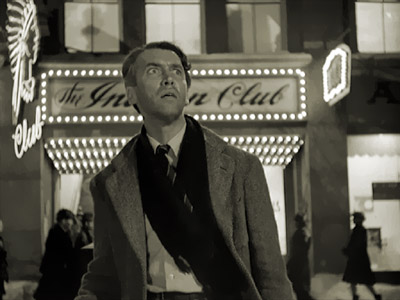
If I do it long enough, I feel like George Bailey, surveying Potterville, with the full horror of it beginning to dawn on me:

(That’s actually a pretty good depiction of how I felt at AWP in Chicago, last spring, and Unmetgoalville was pretty much why, although I also get awfully used to my little town and don’t necessarily function well in towns larger than 17,000 or so, at least not without some self-coaching. Pitiful, really, given that 17,000 is how big Mt. Vernon is, where I went to high school–if you’d told 17-year-old Marnie that 47-year-old Marnie would have a hard time feeling comfortable in Chicago, the teenager would’ve laughed, since she regularly drove in the Windy City whilst visiting her brother.)

And here I am, coming across the teaching job that doesn’t even seem to recognize me.

“But I’m a full professor,” I yell, chasing the poor ad hoc position into the bar where she faints.

“My life’s not like that,” I says to myself. “Really it’s not,” I assure myself on a cold, rainy, November afternoon. “I’m not Muncie Jones.”

Whereas, of course, I am in some ways. Indiana Jones’s sister Muncie wasn’t intentionally a play on Virginia Woolf’s Judith (Shakespeare’s sis), but that had to be lurking in my mind somewhere.

However. Now that I’ve seen Shakespeare’s Will, I can’t think of any woman in Shakespeare’s life without thinking of Tracy Michelle Arnold.

Which is where things take a turn for the better. Tracy portrayed Anne Hathaway with a phenomenal range of vulnerability and fierceness. (Now that I’m reading Brene Brown’s Daring Greatly, everything has something to do with vulnerability.)

There is fierceness in this family of women–the Jones family, the Shakespeare family, my own family.

A lot of my life, that fierceness has come out in less-than-productive ways. It may be why I liked playing with fire.

In my middle age, I am finally, finally learning to channel that fierceness into focus and grit.

One of my role models is Jenny Shank, who first caught my eye in Poets & Writers (Jan/Feb 2011), when she wrote about being a “Ham-and-Egger,” a phrase she got from Don DeLillo, which she defines in this way:

“I love that phrase, ham-and-egger. It’s how I think of myself as a writer. I’m not going to dazzle anybody with lyricism or structural ingenuity. But I put my head down and work and sometimes a story comes of it. I ham-and-egg my way through. It took me a long time to figure out that not every writer has to be brilliant.”

She also writes about sobbing during a Fellini movie because it reminded her “of my childhood dream of becoming a writer, one that I haven’t shaken for three decades, a dream that I almost gave up on a number of times, even though I still continued to write.”

And if the subject matter itself weren’t inspiring enough, she referred back to Fellini and said “Okay, so I’m not an orphaned Italian hooker in a ratty fur. But inside, aren’t we all orphaned Italian hookers in ratty furs?”

I know I am.

And I sobbed and sobbed later that spring in 2011, two different times (I don’t sob much, so I remember them). One time was taking a detour on my way to work, to go sit in the gorgeous St. Luke’s in Plain, Wisconsin and pray–this was in the midst of Wisconsin’s Arabesque Spring, when we were protesting in the snow. I felt as though the job I’d worked so hard at for 20 years was just being spit on and ground into the mud by the heel of a governor’s anti-union, anti-education Act 10.

The other sobbing happened when I got my rejection from Wisconsin Wrights. I’d submitted a revised version of Gashouse Love, a full-length play I started writing in February of 2003. I got a full typed page of comments that told me pretty thoroughly the play didn’t work. That was the bad news. But there was plenty of good news in that page–the anonymous commenter took the play very seriously, was clearly hooked by it in several ways, and very much seemed to want it to work. The sobbing came from having put in a lot of hours revising, all those hours COMING TO NAUGHT (that’s how it felt at that moment), but mostly a sense of exhaustion (see previous paragraph’s sobbing) and utter bafflement–I had almost no idea at all how to make the play better, but any little hint of how to revise carried with it a tag of THIS WILL TAKE HOURS, WEEKS, MONTHS, POSSIBLY YEARS OF WORK.

But I didn’t give up. I didn’t. I almost can’t believe it, but I didn’t.

I am sure I had the phrase “ham-and-egger” in mind.

I’d spent most of the summer of 2010 working on the poems of Speakeasy Love Hard. Gashouse Love has three generations of a family dealing with what they call “the flapper girl poems,” and I knew those poems needed to exist in full, regardless of how much showed up in the play.

The anonymous commenter for Wisconsin Wrights said the poems needed to be in the play more, and I didn’t know how to do that. I know a little more, now.

The poems from 2010, whose origin was a play begun in 2003, finally went public in the fall of 2012. It was a wonderful evening. One of the outcomes of getting to hear Sarah Day, Ashleigh LaThrop, and Nate Burger read those poems was that I felt as though a nuclear reaction had gone off in the middle of Gashouse Love.

Is the path to revision any clearer? No–but I’m excited to work on my writing plan for the rest of this semester/academic year, and will include in it “Listen to recording of Speakeasy Love Hard multiple times, with friends, taking notes and getting feedback on revising Gashouse Love.” I’m giddy with the thought of it because that play needs those poems. All of them.

Forever is how long I’ve heard you have to focus less on publication and more on enjoying revision. Could it be I’m finally there?

Not that I’m giving up on publishing. I’m not. But I am compartmentalizing and strategizing. Here again, Jenny Shank’s article was helpful: she says she invented “Johnny Business” as a way to compartmentalize the publication goals. It seems to me he lives in the same neighborhood as Michael Perry’s muse–Perry says his muse is the guy at the bank who’ll repossess his house if he doesn’t write more and get paid for it.

All of this is validated in creativity studies. In a textbook on creativity (would love to teach or take a class using this as a textbook!), Mark Runco summarizes several sources on persistence and calls it “a prerequisite for creative accomplishment,” saying that “important insights often demand a large investment of time.”

“A decade may be necessary for the person to master the knowledge necessary to understand the gaps and nuances of a field.”

[Or in my special, special case, a decade OR TWO.]

Runco quotes Arthur Cropley (one of his books charmingly has a picture of a chicken and an egg on it) who says, “In addition to possessing certain personal traits, creative individuals are characterized by their willingness to expend effort.”

Runco follows that up with a nice reiteration: “That is a good definition of persistence: The willingness to expend effort.”

Jenny Shank’s efforts are paying off–her most recent book, The Ringer, won a High Plains Literary Award. I’m so happy for her!

And Muncie Jones? Maybe she hasn’t spent as much time dodging poison darts as her hotshot brother. But she’s hanging in there. She’s been teaching four sections a year for 21 years, and sure, in one way, you could say that job has has ground her soul down to nubbins.

But you could also say it’s been really helpful ballast, and that her hot air balloon, her ship, her (whatever transportation mode requires ballast), is about to dock somewhere truly exciting.

It’s like what Jenny Shank calls “a lawn sprinkler of hope that just sprays randomly around without any direct target.” That’s not cold, gray rain on my window. That’s hope.

Yes. No–wait. Sorry. (Two Sonnets)

I work 50-60 hours a week.

No–wait. Sorry. I don’t. Next question.

I think everyone should work as hard as I

Oh, 40-45. On average. Whatever.

Work. We have to pull together like a family

Have I ever told you about my father’s father?

Where everyone pulls their share. It’s only right.

He sold family land and drank the profits down.

The world is such a mess. So much to do.

Compared to that, I’m like the Queen of All

Community doesn’t just happen out of the blue.

That’s right and good. I believe in good enough.

You have to make it, have to have been the one

Yea, verily, I sure do reap all kinds of stuff

To have built it before you can say you’re living in

Wherein I did not sow. I’m really horrible,

Community. I mean at home, at work,

I know. I’m doing the best I can. Or–no–

And locally. Where you shop and what

It’s like my Dad says, “I do good work when I do it.”

You eat and whether you go door to door

I’d almost always rather just stay at home.

For the community-based candidate

But there are some groups and people I support.

Of your choice. Oh sure, I have a lot of fun.

When I can get up off my fat white ass

I just joined a handbell choir, for one.

It’s like a Christmas miracle has come to pass.

My Desperate Love for Baseball

“It breaks your heart. It is designed to break your heart. The game begins in the spring, when everything else begins again, and it blossoms in the summer, filling the afternoons and evenings, and then as soon as the chill rains come, it stops and leaves you to face the fall all alone. You count on it, rely on it to buffer the passage of time, to keep the memory of sunshine and high skies alive, and then just when the days are all twilight, when you need it most, it stops.”

A. Bartlett Giamatti

Despite the stink of steroids over all

professional sports, my desperate love for baseball,

it goes on. Goes on even with the Cardinals finished.

I still watch the games, I love the names. Prince Fielder,

Angel Pagan, Buster Posey, Hunter Pence–

a jump rope chant, a spell for a long October.

A. Bartlett Giamatti’s right. Forlorn

for summer just exactly when we need

it most. I miss the hundred sliding beads

of sweat, all racing down the gin & tonic glass.

Let me confess another sin. “Best ass

in the National League,” a friend said of Tommy Herr.

That’s why I started watching in 1982.

The game blessed my lust. My love. Continues to.

Genius Loci: the Sh*tty Barn

Some time-traveling incarnation of Ma Rainey possessed by Brian Eno,
serving the cooked and the raw, together, straight up—
that’s the guiding spirit of the Sh*tty Barn.

Here’s what we got going in Spring Green, Wisconsin right now: the nights are colder, the leaves are changing, a lot of the architects are heading to Arizona next week, but there are 10 days left of up-the-hill shows at APT, three and half more weeks at the Touchstone, and a full month of Sh*tty Barn sessions left to go. I can still pretend it’s summer, at least for a while.

Bessie Smith sang, “I hate to see that evening sun go down” in “St. Louis Blues.” I would sing, “I hate to see the Autumn Equinox.” Dark and getting darker, that’s where we are, so I rely on these local portkeys to take me somewhere else–somewhere midterms and winter aren’t on the way.

I can’t tell you how special the Sh*tty Barn is to me. Nowhere else did it make sense to perform something that I didn’t even know what to call. Not a poetry reading. Not a verse play. So what was it, in the end?

A special night, or, as one of my students told me today, “It was dope.” One terrific director, David Daniel, took a big schmear of narrative poems and shaped them into a narrative that worked on stage.

David working with Nate.

Three terrific actors–how lucky am I? Terrific venue, grants from the Spring Green Area Arts Coalition and the Sauk County Good Idea Grants program, all benefits of this wonderful place. The poet Honor Moore said Spring Green seemed to have some kind of special vortex going on–or maybe I said that and she agreed–in any case, this is a special place, with special people here for a good long while, or just a brief passing through. (You can see David, Sarah, and Nate a few more times yet this season at APT.)

Here’s Sarah Day, as Elizabeth, a character I wrote with her in mind–she’s reading from a book of poems called Speakeasy Love Hard:

Sarah reacting to Nate singing.

Here’s Ashleigh LaThrop as May, who is certainly the guiding spirit of Speakeasy Love Hard, but I think May’s also secretly the poet of it all:

Ashleigh’s sweet smile.

Here’s Nate Burger, just absolutely nailing a poem after the intermission. It’s called “Mobius Strip of a Man.” Did I mention he nailed it? He just nailed it.

Nate reading “Mobius Strip of a Man.”

Also on the list of my luckiness–being married to a man who can take such fantastic pictures.

After they’d finished Speakeasy Love Hard, Sarah asked if it was all right. “You’re scowling,” she said. I hope I conveyed sufficiently how wonderful it was (IT WAS WONDERFUL), that the look on my face is how I look when my mind is blown. Do playwrights ever get used to hearing their words come out of the mouths of amazing actors?

I feel as though a nuclear reaction has gone off in Gashouse Love, the play that needed Speakeasy Love Hard. No wonder the look on my face was intense, and not just blissed out (though I was feeling the bliss just as much). I have a lot of processing to do.

Will I be lucky enough to work more with these people in this place?

So grateful to the universe that it happened this one time. It was dope.